Author: Alexis

  • How to Create Great Goals: Using OKRs to Focus on Impact

    How to Create Great Goals: Using OKRs to Focus on Impact

    Setting goals is easy. Creating goals that actually help teams focus, align, and make progress is much harder.

    Over the past weeks, I have been asked the same question several times:

    How do you create great goals?

    In this episode of Le Podcast on Emerging Leadership, I explore this question through a very practical lens, using the OKRs approach (Objectives and Key Results).

    Beyond goal setting as a formality

    OKRs are often introduced as a framework or a process to comply with. When that happens, goals quickly become disconnected from real work.

    In this episode, I take a different approach: starting from impact, not from metrics or activities.

    Rather than asking โ€œwhat should we measure?โ€, the real question becomes:

    • what impact do we want to create?
    • for whom?
    • and how will we know if we are making progress?

    Using Impact Mapping to create meaningful OKRs

    To make this concrete, I use a simple example and the Impact Mapping approach to walk through the process of creating OKRs step by step.

    We look at:

    • how objectives express intent and direction
    • how key results help teams learn, not just report
    • how to connect daily work to meaningful outcomes

    The goal is not to get the wording โ€œrightโ€, but to create goals that support better conversations and better decisions.

    OKRs as a leadership practice

    Used well, OKRs are not a management tool. They are a leadership practice.

    They help teams:

    • clarify what matters now
    • align without over-controlling
    • take responsibility for results rather than tasks

    If you are struggling with vague goals, misalignment, or goal fatigue, this episode will give you a practical starting point to rethink how you create goals.

    Where to listen:

    Anchor Breaker Google Podcast Radio Public Spotify Apple Podcast RSS


    Using Narakeet, a product created by Gojko Adzic, the author of Impact Mapping. I created a less than two-minute video to explain the whole process.

    Le Podcast – Season Two

    Le Podcast – Season One

  • Making Change from the Inside: Leadership Beyond Management Roles

    Making Change from the Inside: Leadership Beyond Management Roles

    Making change in a team is often associated with authority, hierarchy, or formal leadership roles. But in practice, some of the most meaningful change starts from the inside, through everyday actions and choices.

    In this episode of Le Podcast on Emerging Leadership, I sat down with Michael Reid, the narrator of the audiobook edition of Changing Your Team From The Inside, to celebrate its release and reflect on the ideas behind the book.

    From audiobook to leadership practice

    Beyond the audiobook itself, our conversation explored what it really means to act as a practitioner of change inside a team or an organization.

    We discussed the importance of:

    • making the work visible, so teams can see what is really happening and improve together
    • investing time to learn through play, using simple games and practices to experiment safely
    • building lasting relationships, as a foundation for trust and collaboration
    • clarifying the goals of the team, to align efforts and reduce unnecessary friction

    These are not abstract leadership concepts. They are concrete levers that anyone can use, regardless of role or title.

    Leadership beyond management roles

    One of the key points we come back to in this episode is that Changing Your Team From The Inside is not a book for managers only.

    It is written for practitioners.
    People who want to:

    • take responsibility for their environment
    • influence how work is done
    • and create positive change where they are

    The book, and this conversation, are grounded in the idea that leadership is not a position. It is a practice.

    A final note

    If you are looking for ways to improve collaboration, alignment, and satisfaction at work without waiting for permission or a reorganization, this episode will resonate with you.

    It is an invitation to look at what is already within your reach and to start changing your team, from the inside.

    Where to listen:

    Anchor Breaker Google Podcast Radio Public Spotify Apple Podcast RSS


    Le Podcast – Season Two

    Le Podcast – Season One

  • The Audiobook is available!

    The Audiobook is available!

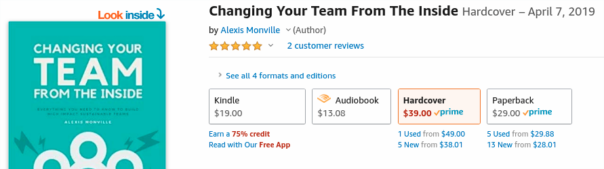
    In addition to electronic, paperback, hardcover, and team edition, Changing Your Team From The Inside is now available as an audiobook!

    Michael Ried did an excellent job in narrating the book. I was even caught listening to him forgetting that I was on a review mission ๐Ÿ™‚

    The book is available on the platform you usually use to find your books like Amazon, Audible, or iTunes.

    Please let people know about it!

    And let me know what you think!

  • How to Form a Cross-Functional Team That Actually Works

    How to Form a Cross-Functional Team That Actually Works

    Forming a team is often treated as a logistical task: bring people together, give them a goal, and get started.

    In reality, forming a team is a leadership act. And when people come from different functions, backgrounds, or organizations, it quickly becomes a real challenge.

    In this episode of Le Podcast on Emerging Leadership, I sat down with Valentin Yonchev and Matt Takane from Red Hat Open Innovation Labs to explore a deceptively simple question:

    How do you actually form a team?

    From a group of people to a real team

    Valentin and Matt have extensive experience building cross-functional teams in a wide range of contexts. Teams assembled:

    • for a single meeting
    • for short, focused engagements
    • or for longer-term initiatives

    Rather than sharing abstract principles, they describe practical ways to move from a group of people to a team that can actually work together.

    What you will take away from this episode

    In this conversation, we discuss:

    • what really matters when forming a team
    • how to adapt your approach depending on the duration and purpose of the engagement
    • how to notice early signals that something is not working
    • what leaders can do when collaboration stalls or friction appears

    Whether you are assembling a temporary working group or launching a longer initiative, you will find concrete ideas you can apply immediately in your own context.

    Practices and references

    During the discussion, Matt mentions the Open Practice Library, a valuable resource for discovering concrete practices that support collaboration, learning, and experimentation:

    👉 https://openpracticelibrary.com

    We also refer to the idea of pulling the Andon cord. Originally coming from Lean manufacturing, this practice is about making problems visible early, so teams can stop, reflect, and improve together rather than pushing through dysfunction.

    A final thought

    If forming teams is part of your role, this episode is a reminder that teams donโ€™t just happen. They are shaped deliberately, through attention, intention, and small but meaningful leadership choices.


    Where to listen:

    Anchor Breaker Google Podcast Radio Public Spotify Apple Podcast RSS


    Le Podcast – Season Two

    Le Podcast – Season One

  • The Breakfast Huddle on Innovation Fatigue

    The Breakfast Huddle on Innovation Fatigue

    While I was travelling to Singapore, I have been invited to discuss innovation with Eliott Danker on MoneyFM.

    Thanks to Eliott interviewing talent, we touched on a lot of different aspects:

    • Innovation fatigue
    • Sustainability
    • Burnout
    • Innovation and customer experience
    • Team organization preventing people to innovate
    • Inclusivity of different perspectives
    • Management of talented individual
    • Manager role and manager discomfort
    • Creating the conditions for great work
    • Hiring, onboarding, training, mentoring
    • Empathy and personas
    • Understandgin the Flow of work
    • Bottleneck and constraints
    • More effort is not the solution
    • Measure the impact of the work from a customer perspective, not the work itself

  • Theory X and Theory Y

    Theory X and Theory Y

    I had the great pleasure to deliver the closing keynote of Voxxed Days Singapore. During the talk, Going Open, I introduced Douglas McGregor theories on human motivation and management that he developed at the MIT Sloan School of Managementย  in 1957.

    The assumption in Theory X is that workers are lazy; they dislike and don’t want to work and do all they can to avoid it. As a consequence, if you agree with that assumption, your way of managing people, who have no intrinsic motivation and no ambition, the system needs to be “command and control.”

    The assumption in Theory Y is that work could be as natural as play and rest; people seek responsibility and are able to direct themselves to deliver on their commitments. As a consequence, if you agree with that assumption, your management style is radically different, and the system could tend toward self-organization.

    Theory X and Theory Y are self-fulfilling prophecies. Acting accordingly to the theory causes it to come true.

    Reconsidering the way we are managing people in an organization is an essential ongoing exercise.

    As an example, our actual reward system might perfectly fit the Theory X assumption, while we would prefer our whole team to live under Theory Y.

    What about you?

    What type is your organization?

    What type are you?

    Could I behave like X, because my organization is X?

    Do you think my organization could change if I change my behavior?

    It could be really interesting because X organizations suffer from a centralization flaw. And like spiders, if you cut the head, the organization dies.

    By contrast, Y organizations are resilient like starfishes, if you cut an arm, the starfish will regrow it, and even more interesting the arm will regrow a whole new starfish, as all the knowledge needed is available to do exactly that.

    Y organization are really like Open Organization.

    Open Organization is the term coined by Jim Whitehurst, CEO of Red Hat for his eponym book published in ย 2015. The book written primarily for organizational leaders, demonstrates how open source principles are changing the nature of working and managing in the 21st century.

    There are five characteristics of Open Organization:

    • Transparency. Transparency by default as a foundation.
    • Inclusivity. Inclusivity of all perspectives.
    • Adaptability. Feedback mechanism to continuously learn.
    • Collaboration. Collaboration to produce better outcomes.
    • Community. Shared values and purpose.

    How can we adopt those characteristics in our organizations?

    I then proposed some of the approaches that you can find in the book, Changing Your Team From The Inside, to foster the change in your team and organization.

  • Going Open – Closing Keynote

    Going Open – Closing Keynote

    On May 31, 2019, I had the pleasure to deliver the closing keynote of Voxxed Days Singapore: Going Open!

    Thank you to all the participants and organizers for a fantastic event!

    I had the opportunity to sign my book, Changing Your Team From The Inside on the Red Hat booth, and to meet great people!

    The title of the talk is Going Open to Support Your Digital Transformation, the slides are available here and I will update the post as soon as the recording is available.


    The pitch of the talk: “Do you feel your organization, your team, and yourself are focusing on the right things or are you overwhelmed by the thousands of tasks that you need to do? What do you need to get your organization, your team, and yourself to continuously improve to get to the point of doing the things right? Going open is the best way to support your organizationโ€™s digital transformation. Going open is applying the principles of the open organization. Open is the antidote of the lack of focus and the lack of continuous learnings that is ailing organizations today. What are the differences between a centralized organization and an open organization? Learning about these differences can help you advance your objectives in your digital transformation. The open source development model is the root of the Open Organization. The diversity the open source model brings is an endless source of inspiration to transform your organization–and this is what this session will expose.”


  • Ratings and Reviews

    Ratings and Reviews

    Ratings and reviews contribute significantly to the success of a book โ€” not a rocket science fact. When we go to platforms like Goodreads, we choose our next book based on the category, the title, the cover, the abstract, AND the ratings and reviews!

    It seems that ratings and reviews account for a lot in our choices.

    And because of all that, I need your help!

    Could you please help the book Changing Your Team From The Inside to reach a wider audience?

    It is straightforward:

    • Leave a rating on Goodreads
    • Leave a rating and a review on Goodreads
    • Leave a rating and a review on Amazon (If you already did Goodreads, you are one copy/paste away!)
      • Maybe you will be allowed to do the review only in your localized version of Amazon, please go for it!

    I am asking that now because I am really proud of the second version of the book published at the beginning of April! I worked on the second version during the previous months with a fantastic team! John Poelstra and Michael Doyle did a tremendous job to help me improve the book! Thank you!

    To celebrate, the second edition, the book is now available in Hardcover version on Lulu!


    I chose to end all the chapters of the book, Changing Your Team From The Inside, with a section titled โ€œSummary and Actionโ€. The goal of those sections is to give you keys to act immediately on your environment. I heard great feedback about one of the practice. The practice is a way to guide one-on-ones when meeting new people. Another one is The Matrix of Principles that you could also test with the principles of the agile manifesto.

    I also answered in a post to a question on how to create Team Agreements efficiently.


    At the beginning of the month, I had the pleasure to participate in a fantastic event: Agile Games 2019. Here are three posts about the adventure: The worst presentation ever, OKRs! OK What?,ย Agile Games New England 2019!


    A friend forwarded you the message? You can subscribe to the mailing list here!


  • Agile Games New England 2019

    Agile Games New England 2019

    In two previous posts, OKRs! OK What?, and The worst presentation ever, I covered sessions proposed during the Open Space on the third day of Agile Games 2019.

    In this post, I would like to highlight the other sessions in which I found interesting “nuggets”, to use a term that my friend and colleague, Matt Takane often uses.

    Opening Keynote

    Jason Tice opened the event with a keynote about games for high performing teams. The games are built on the learning from Patrick Lencioni’s book The Advantage. In a nutshell, trust is the foundation of high performing teams. The ten ways collaboration builds trust are:

    1. Active listening
    2. Ask questions
    3. Leave breadcrumbs / Enable transparency
    4. Provide humble feedback
    5. Mentor (and learn, yes, mentoring is a social learning experience)
    6. Be whole and authentic
    7. Use metaphors and tell stories
    8. Periodic reflections (What’s going well and what could be improved)
    9. Visual framing
    10. Share appreciation

    Jason had us played at each table.

    The first player rolls two regular 6-sided dices and adds the total rolled to determine the storytelling topic:

    2. A time you have made a mistake or failed
    3. A time that you have received recognition
    4. A time that you have helped a team member/coworker
    5. A time when your manager or a coworker made you angry
    6. A time that you had a great day at work
    7. A time when you let someone down
    8. A time when you were singled out or excluded
    9. Something outside of work that brings you joy
    10. A time when you were inspired
    11. A time when you contributed to team success
    12. A time when you recognized or appreciated someone else

    The player then rolls the story cubes to establish common visual metaphors upon which stories for the topic will be based.

    Each participant at the table tells a short story based on the cubes that were rolled. Everyone listen (recording the story by taking note is an option).

    When the story is complete, the participants respond by providing ONLY appreciations.

    Conclude with a round table in which participant share how they felt during the exercise and what they learned about themselves.

    The last nugget. When you receive an appreciation, take a picture, if you use a service like google photo, the photo will show up in your feed in one year!

    Building Network and Bridges

    Erica Maguire proposed two activities.

    The first one was the classic low-tech social network with a speed dating twist to run quickly the introduction and create the connection. For more details on how to run the activity, consider this post by Dave Gray.

    The second one was about building bridges.

    The goal is for two teams to each create half of a complete bridge. The acceptance criteria are:

    • a matchbox car should be able to drive over the bridge
    • the length of the bridge should accommodate eight matchbox cars
    • the width of the bridge should accommodate the width of 4 matchbox cars
    • you should be able to drive a matchbox car underneath the bridge

    You have 2 minutes to plan.

    You have then 8 minutes to build the bridge.

    You are not allowed to look at what the other team is doing.

    You are not allowed to communicate with them.

    After the build phase, each team brings his half of the bridge on the integration table for a review.

    You then have 2 minutes for a retrospective with the other team.

    You can propose another iteration with the adaptation proposed during the retrospective.

    Lego Labs Mini-Residency

    Matt Takane and Tim Beattie proposed an interactive session that simulates what they do at Red Hat Open Innovation Labs‘ 6-12 week Residencies.

    A lot of activities covered in a short amount of time. The activities are described in the Open Practice Library (in which you can contribute your own practices by the way).

    We built a city with Lego and while doing that we experimented activities like:

    • The Social Contract
    • Identified the main aspect of building a city using “How might we…”
    • After some affinity mapping
    • We defined the relative priorities with the Priority Sliders
    • Use a Story Mapping approach to define what we wanted to build first
    • Position the items we wanted to work on an estimation ladder
    • Place the items on a kanban board, used by the multiple teams to coordinate their delivery on the integration table
    • Improved our way of working during a short retrospective
    • Enjoyed the simple introduction of the test framework
    • Appreciated the loud encouragement of our Product Owner

    A lot of fun, and a lot of learnings!

    Pandemic

    Chris Diller, from the Target Dojo, proposed to play the cooperative board game Pandemic. What do you think playing a cooperative board game could teach us? They use the game as a starter in retrospective asking questions about similarities and differences with the work of a real team. We then discussed the roles in the game, and in real life, which was a rich discussion. After that, we discussed our behaviors, were we playing like an agile team during the game? Were we more or less agile than at work? Were we focused on an MVP (minimal viable product) or were we trying to do everything, and finally achieve nothing? (the latter, unfortunately…)

    The debriefing phase was simple and powerful. Very well done!

    Tips and tricks for meetings

    Scott Showalter proposed a session to share tips and tricks for effective meetings.

    Some are designed for when people start trickling down the room:

    • An easel pad titled “I am optimistic that…” with an invitation to complete with what you have in mind
    • Another easel pad titled “The meeting will be successful if…” with an invitation to complete with what you have in mind
    • And a last one asking for “co-facilitation volunteers” like note-takers, time-keeper

    Some are designed for the meeting itself:

    • The collaborative note taking: using post-it notes, one note per things you want to capture, draw or write in caps, and place the notes on a dedicated easel pad
    • The back of the room agenda: large post-it notes have the topics we want to cover sequenced in order
    • The pie-chart agenda: draw a circle on a piece of paper, and then cut in slices representing the time we should invest for each topic
    • The classic talking stick was here a speaking object that the participants put on their heads ๐Ÿ™‚
    • Scott replaces the classic “hand signal” in which the facilitator raises his hand, and all the people do the same and stop speaking as soon as they see people doing that, with a powerful whisper. He was just saying quietly: “if you can hear me clap once”, “if you can hear me clap twice”… those bring the silence in the room very effectively!

    And lastly, some to close the meeting:

    • Success Story: The success stories are your action items, one per post-it note that you paste on an easel pad
    • Undo button: One post-it note is your undo button. In the rounded-square that you draw on the note, write something you want to undo.

    Another great session!

    The power of conflicts

    Shahin Sheidaei proposed a session to harness the power of conflict to improve our organization.

    He started with a simple question: “pick a color that represents conflict from the color cards on the table”.

    Four of us picked red, one picked black, and one orange.

    We then explained what the color represented for us: Anger, fear, absence of hope, and… creativity for the person who picked orange!

    An interesting difference of perspectives at our table.

    From another table, we heard a person picked green, and then explain that it represents an opportunity.

    The exercise is simple enough to be introduced quickly to any team. A great opportunity to have a conversation about what represents conflict for the team, and what to do the next time we will have, or maybe we should have one.

    Shahin then introduced Thomas Kliman model and invited us to identify what was our default mode:

    • Avoiding
    • Accommodating
    • Compromising
    • Competing
    • Collaborating

    We then played with a partner with fake scenarios trying to use the different mode.

    In the end, we studied one real story brought by one of the people of a group of three.

    Another excellent session!

    Making it pop

    Jenny Tarwater closed the last day before the open space with a session highlighting the importance of a structured debrief.

    She introduced Thiagi Six Phases of Debriefing.

    As Thiagi said: “People don’t learn from experience; they learn from reflecting on their experience.”

    The six phases are meant to balance the structure and the need for the free flow of the debriefing.

    Phase 1: How Do You Feel?

    Phase 2: What Happened?

    Phase 3: What Did You Learn?

    Phase 4: How Does This Relate To The Real World?

    Phase 5: What If?

    Phase 6: What Next?

    And, of course, we had the opportunity to test the debriefing after short games at each table:

    • Clock: Raise your arm and point at an imaginary clock fixed on the ceiling, point at 12, 3, 6, 9.
      • In what direction your finger is moving?
        • Clockwise
      • Lower the finger, until it is lower than your head, in what direction your finger is moving
        • Counterclockwise
    • Compute: Sum of 1 2 3 4 5 6 7 8 9 10.
      • How did you compute? Left to right, right to left, by 10s, by 11s, others…
      • We debriefed using prompts
        • I felt …
        • I learned …
        • I can use …
        • I plan to …
    • Who knows what are the choices on that menu: Soup or Salad and Bread

    A great session!

    Terraforming Mars

    Scott Showalter and David Bujard proposed an open space session using the board game Terraforming Mars.

    The idea of the session was to study the gameplay of the existing game, to then, adapt it for an enterprise transformation.

    • What would be the metrics that will replace the score track, the temperature, the number of oceans, and the atmosphere?
      • Maybe: budget, position in analyst quadrant, team satisfaction, customer satisfaction?
    • What would be the cards?
      • The experiment that we could make: self-learning, training, dojo, open space with a team…
    • How to measure the appetite for change?
    • How to know where to act with the cards?
    • How the design of the board should evolve to be adjusted to the organization?

    Interesting session. A lot of work to be done to be able to get to a result for a specific organization. And, yes, I added that in my Someday / Maybe column ๐Ÿ™‚

    Kanjis

    Lastly, we played Kanjis with Isabel Monville, and it was a great session.

    Tell me if you would like to play the game!

  • OKRs! OK What?

    OKRs! OK What?

    OKRs! OK, What? Joseph Contreras, Scrum Master at Fidelity, proposed this Open Space session on the third day of Agile Games 2019.

    Joseph invited the participants to contribute to a short presentation of what Objectives and Key Results (OKRs) are.

    In a nutshell, Objectives are where we want to go, and Key Results tell us when we get there. Key Results are aspirational and not reaching 100% is not a problem.

    I really liked the first example he used, and the invitation he made to the participant to challenge the formulation.

    The example was:

    • Objective: I want to be healthy
      • Key Result: I eat less sugar

    We challenged the Objective by pushing to have it stated the destination. Something like: I am healthy.

    We challenged the Key Result by saying that eating less sugar is an activity. Yes, it is a healthy one because as human beings we store the excess sugar as fat. So maybe the Key Results should be a measure of the proportion of fat in our body.

    Joseph then shared is own personal OKRs, and invited us the same way to challenge them. He told us that the previous version of his OKRs where really bad, and that we can expect to fail the first time, and improve the next one. I think it gave freedom to people in the room to challenge that second version.

    The result was a great social learning experience. It was the perfect way to have all the participants think about measuring the impact of activities, and not the activities themselves.

    The participants were able to build upon what the others just said and proposed better objectives and better key results in just a few minutes.

    Does this inspire you to invite your peers to challenge your OKRs?


    More about OKRs in the Chapter 12 of Changing Your Team From The Inside!


    Featured image is by

  • The worst presentation ever

    The worst presentation ever

    Last week, I attended Agile Games New England. The last day of the conference uses Open Space Technology which is the best way to organize and run a conference.

    With an Open Space, all attendees are active participants. They define the program and choose which sessions to contribute. They also have the freedom to leave a session when they think they are not learning or contributing. This is known as “The law of 2 feet” or “The law of mobility.”

    I chose to propose two sessions for the Open Space:

    One with Isabel Monville, to play a game with the participants: Kanjis. This one went great and I will come back to that session in a future post.

    One by myself to discuss my book: Changing Your Team From The Inside. This one was the worst presentation I ever made.

    What happened?

    I picked the first time available, and so it was one of the first sessions of the day. When you attend an open space, and especially for the first time, you are confronted to a last minute choice of your first session. At the same time, you just heard about the law of two feet, and the roles of bees and butterfly.

    • A bee is a person that goes from breakout session to breakout session, maybe collaborating with some groups and cross-fertilizing ideas that come from another group.
    • A butterfly is a person that does not take part in any breakout at the moment to fulfill her own needs. Sometimes butterflies cluster in impromptu sessions and make groundbreaking insights.

    You can choose not to attend any session and be a bee or a butterfly whenever you want. The freedom of choice brings some people to select late and to switch room frenetically hoping to find the best possible spot. All people also need to discover the space. After one session, it seems that everybody adjusts, and the last minute’s changes at the beginning of the next sessions are less disruptive.

    I chose a small room with a triangle-shaped table so we could have a good conversation.

    I started 2 or 3 minutes after 10. And just after I started people entered the room, and left the room for the next 5 minutes. Each time they tried to open the door they were pulling the handle instead of pushing. A bad design choice, if the door needs to be pushed, it should be a plate, not a vertical handle that suggests the door should be pulled.

    Do you see what is going on there? I blame the circumstances. I try to justify what happens. If I continue down that path, I will learn nothing. A quick look at the Responsibility Process can help in that situation. It works this way:

    • Responsibility Owning your ability and power to create, choose, and attract
    • Quit Giving up to avoid the pain of Shame and Obligation
    • Obligation Doing what you have to instead of what you want to
    • Shame Laying blame onto oneself (often felt as guilt)
    • Justify Using excuses for things being the way they are
    • Lay Blame Holding others at fault for causing something
    • Denial Ignoring the existence of something

    What really happened?

    I started my presentation, and two sentences after the start, I was confused and changed my initial plan, tried to mumble through all the chapters without giving any airtime to the participants.

    I knew it was not going well. During the previous days, I had the opportunity to sit next to a person who was taking beautiful notes in her notebook. Before the beginning of the session, I nudge her to be our notetaker for the session. During the session, I had her notes in front of me reflecting the growing confusion in which all people in the room were probably.

    Someone tried to save the session. She found her way to interrupt me and the notetaker, asked questions, and put the session on a better track. Thank you!

    What did I want to say initially?

    This book equips you to make a positive change in your organization starting from the one place you can guarantee success – you.

    The book is structured in three parts: The Individual, The Team, and The Organization.

    Each chapter turns insight into actions that you can use straight away to build momentum and create lasting change from yourself to your team, from your team to other teams, and from other teams to the entire organization.

    If youโ€™re looking to make a change in your organization but donโ€™t know where to begin, worried that nobody will listen to you, or fear youโ€™ll burn bridges along the way then Changing Your Team From The Inside will give you a plan, increase your influence, and help you build high impact, sustainable relationships in the process.

    This book has everything you need to build high impact, sustainable teams.

    Jim Kwik said:

    If an egg is broken by outside force, life ends. If broken by inside force, life begins. Great things always begin from inside.

    I shared this belief that great things always begin from inside.

    After that introduction, my goal was to open the floor to questions and facilitate the conversation from there, bringing more details of what you can find in each part of the book.

    It seems that I was not ready to say just that. And as I was not prepared enough to deliver the message. I failed to deliver it.

    Interestingly, even if I knew that it was not going well, I was not able to stop myself and ask to start over.

    Something that I want to be sure to work on.

  • Version 2 of the book is available

    Version 2 of the book is available

    It took a few month to get to the second version of the book, Changing Your Team From The Inside.

    The paperback version is available on Lulu and the electronic version is on Leanpub. The new version of the book will be available on Amazon in a few days, keep in mind that Amazon takes a 70% cut on books over $9.99 ๐Ÿ™‚

    A big thank you to all the readers who provided feedback during the last months. It helped me to make that second version much better!

    I want also to address a very special thank you to John Poelstra and Michael Doyle, two amazing coaches who helped me in the revision process. Learn more about them and how a coaching session works by listening to this episode of the podcast.