“This is an excellent publication if you are ready to rewire your brain to take charge of your development rather than enduring your work.”
— Julien Danjou, Staff Engineer.
“While targeted for Software Engineering, a lot of (if not all) concepts described in the book can be applied in nearly any job. It’s inspiring, and honestly, I wish I had this book when I started my career!”
— Emilien Macchi, Senior Principal Software Engineer.
“This book completely changed how I viewed my work and how I work with other people.”
— You. (Well, this could be you, once you’ve read the book of course.)
OKRs are often presented as a goal-setting framework. Something to roll out, track, and review.
Used well, OKRs are something else entirely: a learning practice that helps individuals, teams, and organizations focus on what really matters.
In this episode of Le Podcast on Emerging Leadership, I had the pleasure of welcoming Bart den Haak to explore OKRs from a very practical perspective.
From startup practice to long-term learning
Bart is a software engineer who first encountered OKRs more than ten years ago in a startup context. Since then, he has continued to use OKRs across different environments and now advises companies on how to adopt them meaningfully.
This long-term perspective makes the conversation especially grounded. We talk less about theory and more about what actually works.
Revisiting the foundations of OKRs
Building on a previous episode where I shared an approach to creating great goals using OKRs and Impact Mapping, this conversation goes deeper into the fundamentals:
what OKRs really are
how they differ from other goal-setting approaches such as MBOs, Balanced Scorecard, Hoshin Kanri, or 4DX
who can use OKRs: individuals, teams, or entire organizations
where to start when introducing OKRs
Rather than treating OKRs as a one-size-fits-all solution, we explore how context matters.
Learning zones and common pitfalls
A key part of the discussion focuses on learning.
Bart explains how OKRs can help teams:
step out of their comfort zone
enter a learning zone
while avoiding the danger zone where pressure and fear take over
We also discuss common pitfalls:
turning OKRs into performance evaluation tools
confusing activity with impact
setting goals that are either too safe or too vague
Resonance with practitioner leadership
Bart’s approach resonates strongly with me and aligns closely with the ideas I explore in Changing Your Team From The Inside and I am a Software Engineer and I am in Charge.
In all cases, the underlying idea is the same: leadership is a practice, and tools only work when they support responsibility and learning.
Julien Danjou is a Staff Engineer at Datadog, where he’s in charge of building a production profiler for Python. Their goal is to provide performance analysis of their customers’ applications by understanding how their production systems behave and then optimize them.
His other hat is Mergify, building a workflow automation system for GitHub. You define rules, e.g., “merge this pull request when the CI passes and the code has been reviewed” and their bot does the merge for you. Simple.
Julien was sketching out his next Python article for his personal site when he received my email request to be an early reviewer of I am a Software Engineer and I am in Charge. I thought of him because he was always interested in reading professional development books that we talked about as much as he enjoyed continuing to develop his own technical chops.
Of course, Julien and I had worked together at eNovance and Red Hat so I’m sure he was keen to see what Michael and I had written in I am a Software Engineer and I am in Charge just out of curiosity, but he was also keen to understand if this book could genuinely push his leadership skills further.
Despite his unsureness, and his own priorities, the book looked like a quick enough read and his curiosity to learn what was in it tipped him over the edge.
Immediately the book challenged the way he thought about how he interacted with other people, but the book was written in a way that reminded him of The Phoenix Project, which he really enjoyed reading, and gave him the confidence to keep going. Reading Sandrine’s story pointed out many situations he witnessed or encountered directly in the past. He became inquisitive about how she would handle the situation.
At the end of each chapter is a summary of what we learn from the story and Julien found this section particularly helpful to pull out and internalize the key points he was learning. The real test, where the rubber meets the road so to speak, was being able to choose an experiment to validate his findings for himself. It was only then that he knew this book could help develop his skills because he’d actually be able to prove it to himself by doing the experiments.
Julien told me that he did have one regret about the book though.
Julien would be happy to connect with you if you share common interests and are entrepreneurial minded. Right now, that would cover working on Python performance, building a SaaS startup, or cooking. 🙂
You can reach him through email at julien@danjou.info or on Twitter @juldanjou.
The idea of the “10x engineer” has been around for decades. It suggests that some engineers are inherently more productive, more impactful, or more valuable than others.
But is that really the right way to think about excellence in software development?
In this episode of Le Podcast on Emerging Leadership, I had the pleasure of welcoming Julien Danjou, an open source software hacker with more than 20 years of experience and the author of several books on Python.
Questioning the 10x engineer myth
I invited Julien to discuss the myth of 10x engineers and to share his perspective on how engineers actually grow their skills and impact over time.
Very quickly, the conversation moved beyond code.
According to Julien, while technical skills are important, two other dimensions are essential:
understanding the business, and
understanding the social component of work.
Beyond technical excellence
Great engineers do more than write efficient code.
They:
understand the context in which their work creates value
communicate effectively with others
collaborate across roles and disciplines
and take responsibility for outcomes, not just tasks
These capabilities multiply impact far more reliably than individual technical speed.
Examples you can apply immediately
One of the strengths of this conversation is how concrete it is. Julien shares examples drawn from real experience, all of which can be applied immediately by engineers who want to grow.
The discussion resonated strongly with me and aligns closely with the ideas Michael and I share in our book I am a Software Engineer and I am in Charge.
If you are an engineer looking to grow, or a leader wondering how to support excellence without relying on hero myths, this episode offers a grounded and practical perspective.
The real multiplier is not being 10x faster, but being 10x more connected to people, context, and purpose.
Editor’s note: This article is written from the perspective of a fictional character, Sandrine, the protagonist of I am a Software Engineer and I am in Charge. You can learn more about the book at https://iamincharge.club
Sandrine sighs as she starts her third week in confinement. The ability to work from home was one of the things she always wanted to have. But, all of a sudden, the invaluable perk has become a burden to carry every day. Isolation starts to take its toll.
Sandrine feels that she is stressed because of the crisis. Knowing it is normal to feel this way doesn’t seem to help much as some of her friends already lost their jobs at the beginning of the crisis.
Sandrine is glad that her company made the pledge to keep all the workers with full pay. The pledge is one of the reasons she wants to stay productive and keep the company in business.
Contradictory information is coming in from everywhere. It is hard not to feel overwhelmed in all that polarized noise. Sandrine would like to shield herself from negative distraction yet at the same time, in a strange way, scrolling through the infinite social feeds gives her a sense that she is still connected with the world.
*Bing*
Sandrine receives a DM notification on her instant messaging.
It’s her friend, Mary.
Sandrine responds and the two have a short conversation.
Sandrine sips from her glass of water.
A calendar notification pops up on Sandrine’s computer. It’s a reminder that her manager, Gaspar, has invited her to an afternoon virtual hot chocolate with her team.
Sandrine thinks for a moment before replying.
Are you feeling like Sandrine right now?
Mary seems to have found some momentum by becoming more active on social media and checking in on people. She’s even managed to pick up a great idea on virtual mocktails from Sandrine because of it.
And maybe she’s right. Maybe Sandrine could view her meeting from a different perspective. Maybe by thinking about how she could support her colleagues, she will see some actions she can take that don’t exist when she views the situation from the perspective of how she feels.
How about you? Where could you change your perspective to find some momentum in your world right now?
Many change efforts focus on behavior: what people should do differently, what processes should change, what practices should be adopted.
The Anatomy of Peace invites a deeper shift.
In this episode of Le Podcast on Emerging Leadership, John Poelstra and I explore the book The Anatomy of Peace by the Arbinger Institute and what it teaches about leadership, responsibility, and inner stance.
From behavior to being
John first recommended The Anatomy of Peace in our previous conversation on how (not) to provide feedback. I read it twice and fell in love with it.
In Changing Your Team From The Inside, I write that change starts with you.
The Anatomy of Peace pushes this idea further:
Change starts with who you are.
Not with techniques. Not with intentions. With the way you relate to others, and to yourself.
A heart at peace or a heart at war
One of the core ideas of the book is the distinction between:
a heart at peace, and
a heart at war.
When our heart is at war, we tend to see others as:
obstacles
objects
or threats
When our heart is at peace, we see others as people, as human beings with their own needs, struggles, and intentions.
This inner stance profoundly shapes how we lead, collaborate, and respond to conflict.
Boxes, judgment, and responsibility
We discuss the idea of being “in the box”: stories we tell ourselves such as I deserve, I’m better than, I need to be seen as, or I’m worse than.
These boxes justify our behavior and keep us stuck. We also explore how this maps well with Christopher Avery’s Responsibility Process, where responsibility increases as we move away from blame and justification.
The book reminds us that we always have a choice:
to honor or betray our senses and desires
to judge others or to become curious
to judge ourselves or to show compassion
Signals from the body and inner practices
Another powerful idea we discuss is how our body gives us signals when our heart is at war. Tension, discomfort, and reactivity can become cues to pause and reflect.
We also touch on practices that support this inner work, such as:
Hoʻoponopono
meditation
These practices help create space between stimulus and response, allowing more intentional leadership.
Further resources
You can find more information and resources about The Anatomy of Peace on the Arbinger Institute website.
A final thought
Leadership is often described as something we do to or for others.
This episode is an invitation to see leadership as something that starts within: with how we see others, how we relate, and who we choose to be in each interaction.
Some people told us that it was not the perfect timing as people surely have other things on their minds. Others told us it was the right timing because people will want something to read. As a result, I think I don’t really know if it is good or bad. I only hope that the book will find its audience and have the impact we wished for when we wrote it.
For April’s fool, we thought about what kind of joke we could make. We opted for a merch store with announces on Twitter using quotes from movies. We thought everybody would guess the joke and laugh with us.
I don’t think it worked. The products were named, the first, the of, and the month. Maybe people did not even get to the page and saw that?
Let’s not all of them, because someone ask it was for real, and if it was possible to order something 🙂 Yes, it is for real and we updated the page with real product names!
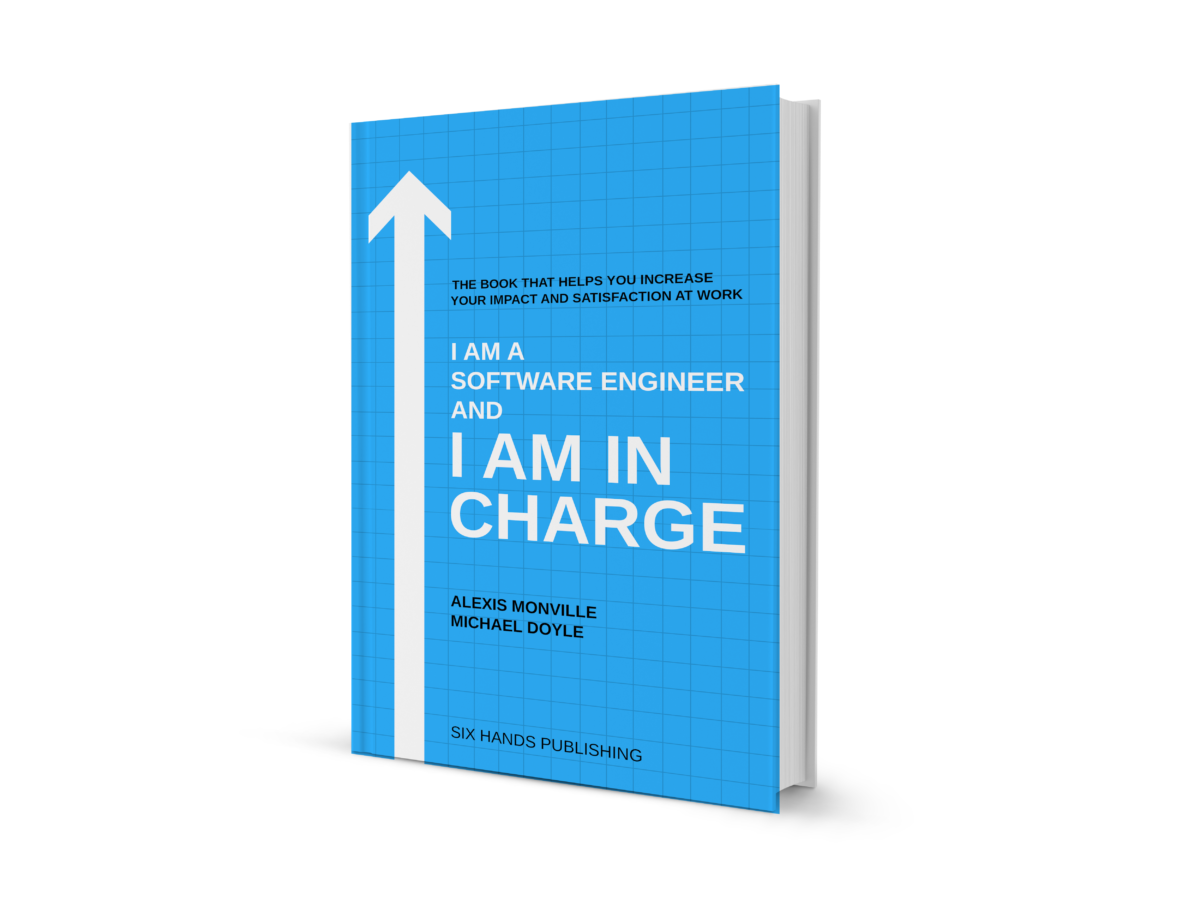
It’s a book to help Software Engineers increase their impact and satisfaction at work. You can learn more about the book and sign up to be the first to know when it launches in May here: iamincharge.club
In the meantime, we asked each other three questions about why we wrote this book and what we hope it achieves for you, the reader.
Interview summary:
Michael interviews Alexis
1. Alexis, I remember you showing me a mockup cover for I am in Charge, what gave you the idea for this book?
The idea came at the end of the review process of Changing Your Team From The Inside. The work we were doing, and the regular meetings we had with John Poelstra and you were so exciting and so profound that I wanted to find a reason to continue that relationship.
The fact that we were spread over the world, John in Portland, Oregon, you in Brisbane, Australia, and me in Boston, Massachusetts, and still able to collaborate as if we were in the same room was for me the sign that we were a great team.
Once you have a great team, you know you can do great things with the team. I wanted to take the opportunity to make our conversations available to people so they could benefit from them.
2. You mentioned your other book, Changing Your Team from the Inside, how do these two books complement each other?
I learned a lot from Changing Your Team From The Inside. I learned from writing it. I learned from the feedback I received from people reading it. I learned from the review process with John and you.
One thing I realized is that I wanted to make the message of Changing Your Team From The Inside universal. I did not want to choose an audience for the book. My thinking was, it can apply to anyone in any sector whatever their role. I still think this is true. But, it is a mistake, without a defined audience, people are never sure they can recommend it to someone. Some people think it is for software engineers, some for coaches or change agents, some for managers. I want to say yes to all of those, but it is not the way it works.
With I am a Software Engineer and I am in Charge, we made the choice, thanks to you, to focus on a specific audience in a specific sector. Narrowing the audience forced us to make the recommendations more specific and more actionable.
In the end, I still think people could apply the recommendations even if they don’t have that specific role and even if they are not in that specific sector. This is a little bit like the Manifesto for Agile Software Development. The first sentence is: “We are uncovering better ways of developing software by doing it and helping others do it.” If you replace software development in that sentence with singing, cooking, teaching… it could work, and I believe that the values and principles would be interesting for you to look at to introspect on your practices.
3. What is your greatest hope for someone who reads I am a Software Engineer and I am in Charge?
The subtitle of the book is: “The book that helps increase your impact and satisfaction at work”. My greatest hope is that readers will do exactly that: increase their impact and increase their satisfaction. I hope that they will be empowered to do that and to spread the message around them. I hope that by doing so they will contribute to making a better world.
Software will play a big role in the future or humanity. I hope that Software Engineers will realize the power they have in shaping that future.
Alexis interviews Michael
1. Michael, what came to mind first when I showed you the mock-up of the cover of a book with your name on it?
Wow. I need to read this book!
Unfortunately before I could read it, we had to write it.
I know the saying is “Don’t judge a book by it’s cover.” but I felt an immediate, positive reaction when I saw it. I knew, without any hesitation, that I wanted to work with you to write this book.
2. I know you invested a lot of energy in defining how your personal contribution will have the biggest impact on the world. How do you see the book supporting your goals?
The book was a combination of a few things happening for me at the time.
Having an ongoing reason to work with you Alexis was one thing, improving my writing skill was another, but beyond that, I liked the idea of creating an artifact that would persist beyond me. Something that would help those who read it gain insight about how they see their current situation and what they can do about it when they shift their thinking.
3. What is your greatest hope for someone who reads I am a Software Engineer and I am in Charge?
Two things.
One. To realise that in any situation you can, at the very least, control your thoughts and your actions—which will ultimately change your result.
Two. To recognise that doing the first thing is an ongoing process that only improves with practice over time.
#mc_embed_signup{background:#fff; clear:left; font:14px Helvetica,Arial,sans-serif; }
/* Add your own Mailchimp form style overrides in your site stylesheet or in this style block.
We recommend moving this block and the preceding CSS link to the HEAD of your HTML file. */
#mc-embedded-subscribe-form input[type=checkbox]{display: inline; width: auto;margin-right: 10px;}
#mergeRow-gdpr {margin-top: 20px;}
#mergeRow-gdpr fieldset label {font-weight: normal;}
#mc-embedded-subscribe-form .mc_fieldset{border:none;min-height: 0px;padding-bottom:0px;}
Be the first to know when the book launches
* indicates required
Please select all the ways you would like to hear from I am in Charge:
You can unsubscribe at any time by clicking the link in the footer of our emails. For information about our privacy practices, please visit our website.
We use Mailchimp as our marketing platform. By clicking below to subscribe, you acknowledge that your information will be transferred to Mailchimp for processing. Learn more about Mailchimp’s privacy practices here.
In this article, I would like to provide information and pointers to information on the Chief of Staff’s role in the tech industry. As a member of the Engineering Leadership Team at Red Hat, I have been in that kind of role for almost three years for the SVP of Engineering.
People instantly connect the role to the one that John R. Steelman was the first to hold in 1946: White House Chief of Staff. The definition of the role varies immensely between every presidency. Even more, as Chris Whipple states in the subtitle of his book The Gatekeepers, “The White House Chiefs of Staff Define Every Presidency.”
As for the White House, the job depends on the company and executive the Chiefs of Staff serve. The general acceleration of the pace of business is the main reason mentioned for the emergence of the role in tech companies. CEO and Executive tend to shift their focus from inside their organization to outside. They need someone trusted to cover for them. Mark Organ, the CEO of Influitive, describes the Chief of Staff job as making him a superhero.
The first orientation focuses on the executive the CoS reports. How do we make the executive operate at the highest level of performance?
The second orientation includes, in addition, the executive’s leadership team. I love that aspect of the job, transforming a group of people reporting to an executive into a true team leading the company or the business unit. Being part of a team, each member levels up his game and benefits from the diversity of the group.
The third orientation is the organization itself aiming at answering the question: How do we best set the organization to accomplish its objectives. One aspect of that is why I love using Objectives and Key Results (OKRs) to establish a continuous two-way street dialog between the people in the organization and their leadership team. The dialogue helps to clarify the strategy and to evaluate what are the right things to do to implement it.
As Ben Casnocha, who was the Chief of Staff for Reid Hoffman, surfaces very well, the more connected the Chief of Staff is with the executive he or she served, enable better decision making and better tradeoffs.
What are the attributes you will want as or for a Chief of Staff:
Expert Facilitator: you manage conversations, synthesize multiple points of view, align on strategic orientation, either in-person or remotely,
Trusted Organizer: you bring order to things, you get things done, and you manage sensitive information in confidence and discretion.
Strategic Thinker: you can see the big picture, evaluate importance and urgency, and provide context for decisions.
I often wondered how Elon Musk was managing his time between his three main companies: SpaceX, Tesla, and The Boring Company. Surprisingly, Sam Teller was the Director of the Office of the CEO for the three companies.
Can it mean almost anything? Yes. So it means that you can define a role so that your contribution has the most significant impact on your organization.
To find out more about the Chief of Staff role in tech, follow the CoS Tech Forum.
Edit on April 20: Here is another article to add to the references. This is from the Harvard Business Review: The Case for a Chief of Staff. The three-level model makes a lot of sense to refine the role.
Psychological safety is a term coined by Amy Edmondson, author of The Fearless Organization.
At its core, psychological safety describes an environment where people feel safe to speak up, ask for help, take risks, and admit mistakes without fear of being blamed or rejected.
In this episode of Le Podcast on Emerging Leadership, I explore why psychological safety is such a foundational condition for effective teamwork.
Psychological safety as a conversation starter
I first discussed psychological safety with my team when sharing Google’s work on Project Aristotle, which identified psychological safety as the most important factor in high-performing teams.
What made it powerful was not the conclusion itself, but the conversations it enabled. Psychological safety gave us a shared language to talk about:
fear and risk
mistakes and learning
inclusion and respect
Assessing psychological safety in a team
In the episode, I share a simple set of questions that can be used to assess psychological safety within a team. Each question can be answered on a scale from “Strongly disagree” to “Strongly agree”.
When someone makes a mistake on my team, it is often held against them
In my team, it is easy to discuss difficult issues and problems
In my team, people are sometimes rejected for being different
It is completely safe to take a risk on my team
It is difficult to ask other members of my team for help
Members of my team value and respect each other’s contributions
These questions are not a diagnostic tool. They are an invitation to reflect and to start meaningful conversations.
Beyond safety as comfort
Psychological safety is sometimes misunderstood as being “nice” or avoiding challenge.
In reality, it enables:
honest feedback
learning from mistakes
healthy disagreement
shared responsibility
Without psychological safety, teams tend to hide problems, avoid risks, and limit their contribution.
Further reading
In the episode, I also mention several books that explore related themes:
The Fearless Organization by Amy Edmondson
The Coddling of the American Mind
In Great Company
Each of these books, in different ways, examines how environments shape behavior and learning.
A final invitation
Psychological safety is not something you install. It is something you practice, through everyday interactions and leadership choices.
If this topic resonates with you, I would love to hear your feedback and experiences.
In May 2011, Isabel and I had the pleasure of organizing the first edition of TEDxBordeaux. The theme we chose was Together. The underlying idea was, as I said in my introduction to the event, We can rediscover our power to change things.Together.
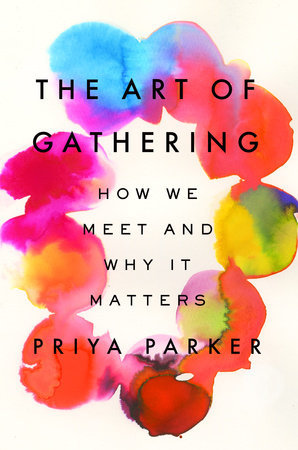
When I read about 15 Toasts in Priya Parker’s book, The Art of Gathering, it reminded me of the dinner we organized with the speakers and organizers the night before the event.
The 15 Toasts dinners aim at creating safe spaces that give the “15 guests the permission to be vulnerable, engage as human beings in an open and genuine conversation, and surprise one another and themselves.”
I hadn’t thought of that this way, but when I read that sentence, I thought: “Yes, exactly that!”
Side conversations are not necessarily the ones you plan for…
Our goal was that the speakers connect, learn more about each other so that they support each other on the big day on which they will give the best talk of their lives. We thought that the audience would feel the connection between the speakers, the organizers, and that will contribute to the overall perception of the event, and help make the connection between the theme, and each of the topics the speakers will cover: Education, Healthcare, Technology, Art, Universal Basic Income, Open Source…
We were lucky enough to find the best possible location to do that: a big round table in a private room at the back of a good and reasonably priced restaurant. Unfortunately, that space does not exist anymore, the restaurant moved to another location, and the people who took over chose to remove the big round table and replaced with too many small tables of four.
As Isabel coached all the speakers, she was the connection point between all of them. We worked on assigning the seats so that the people can be comfortable to engage in side conversations. But we wanted more. The dinner participants all knew that they would have to introduce themselves, answering three questions that Isabel had shared in advance. We don’t remember the questions but it was something to push them out of delivering their usual pitch.
And it worked! It worked during the dinner. It also worked during the rehearsals the morning of the event. It worked during the event itself on that Saturday afternoon. The speakers and the organizers all behaved kindly, supporting each other, overcoming the obvious growing pressure, and contributing to the magic of the event.
The next time you organize an event, you can start to think of using the necessity of food to accomplish something more. I don’t believe large dinners in conference centers can accomplish that, and this is the reason I love so much the Dinner with a Stranger idea.
I will cover that next time.
What are your best ideas to foster that sense of connectedness that definitely gets things done? Please share through the usual means: comments, Linkedin, Twitter, or direct email. Thank you!
I have been asked thousands of times to facilitate small or large gatherings. When I worked on Changing Your Team From The Inside, I wanted to make clear that self-organization is the most powerful way for people to organize, but that based on their history, you will need to help them get there. You will need to create the conditions for self-organization to happen.
Chapter nine of the book is titled Organize because self-organization requires organization. I focused the chapter on meetings because it is something easier to change, to adjust, to experiment on, than to change the whole organization. And I believe it is much more impactful to change the way we meet than to change the reporting structure.
The Art of Gathering, by Priya Parker, is a perfect book. The structure brings you gently to think about all the aspects that matter about your gathering.
It starts with the purpose of the gathering. Why do we really gather? And, of course, the answer is not because it is Monday.
Then you cover the uncomfortable question of who should join. And, no, inviting everybody is not an inclusive option. It is even the opposite. Why would someone who attends a meeting on which he or she will bring no value should feel included?
In the role of the host, you have power, and you have to use that power to serve the purpose of the gathering and your guests.
The time of the gathering is a temporary alternative world in which the traditional rules are not necessarily valid. You can, and in fact, you have to create rules that once again will serve the purpose and the guests. The author gives a ton of inspiring examples.
I know that, and even knowing it, I understood reading the chapter that I was not investing smartly enough on the openings of my gatherings.
In conferences or other gatherings, my frustration level grows each minute that passes. Why that? Because people are not true and authentic. Okay, I am over-generalizing. Not all people are manipulative and insincere. And not all people behave all the time the same way. The big idea is that it takes intentional efforts to create conditions for people to be true and authentic.
In meetings, when we stay on the surface of things, we can be very polite and respectful, avoid any potential conflicts and keep the status quo forever. If keeping the status quo is what you need, you probably don’t have to push hard to get to that. If not, then it is on you to organize the controversy so we can really discuss what matters and initiate a change.
We are approaching the end of the post, and you have to know that ends matter a lot. I would like to, once again, thank the author for having created that perfect book. I would like to thank you for reading and sharing this post. I would like to encourage you to read the book, and to share what you learned and how it affects your next gatherings. Working on ending the meeting properly is probably one thing I would change in Chapter 9 of Changing Your Team From The Inside.
And finally, what I would love is to have Priya Parker on Le Podcast to discuss how to apply her expertise and experience to online gatherings. But I guess you will all have to ask for it to happen!