Category: General

  • The 67 days of the leadership challenge

    The 67 days of the leadership challenge

    The compilation of all the LinkedIn posts published over the summer of 2022 with the hashtag #67daysofleadership.

    Thank you for your support during the challenge.

    My initial idea was to list the names of all people who shared, reacted, and commented on the posts. I realized it was a pretty challenging task – as it continues to move daily, even on old posts – and that it will not bring much value to the reader. You know who you are. Thank you.

    At the end of the challenge, Jérôme Bourgeon was the first one to ask if I had reached my goal. The goal I set for myself on Day 1 is to share and learn about leadership daily.

    The answer is nuanced.

    Yes, I want to continue to learn about leadership every day. The situations I face daily are good opportunities for that. Writing about those is helpful to thinking and consolidating the learnings.

    No, I don’t want to have the pressure to share daily.

    Furthermore, I had no expectations about the metrics: the number of views, shares, reactions, and comments.

    But, it is very addictive.

    I learned through the comments a lot. It sparked some fantastic conversations with people I was not expecting to have. So, I wanted more comments so that I could have more of those conversations.

    I looked for the validation and support of the reactions. I discovered there were more choices than likes during the challenge (I know, it was probably there in front of me the whole time, and I had ignored it.)

    I learned that shares could extend the reach of your message to an entirely different network sparkling new connections.

    I was disappointed with the LinkedIn algorithm. Some posts were viewed more than 30,000 times, while others collected just a bit more than 100 views. The algorithm picks winners and losers every minute based on criteria that are still unknown to me. Even my wife, Isabel Monville, who is an executive coach, and could have been interested in them, and would have certainly supported me, was not seeing them. She knows better ways to support me daily than through LinkedIn. Maybe that’s why the algorithm chose not to put my posts on her feed. 

    Early engagement on a post, the reaction from the people mentioned, the content itself, keywords, emoticons, pictures, videos, and links are probably factors, and I still don’t understand them.

    Even if I try to remind myself that metrics were not the point, sharing and learning were. It still frustrates me a bit.

    Overall, it was a great experience, and I feel blessed and grateful for all it brought me. Thank you!

    What I intend to do:

    • I continue to write. Writing to think and consolidate learnings.
    • I connect with people. People I already know, people I don’t, so that we discuss and learn together.
    • I share from time to time on my blog or LinkedIn. Sharing to create conversation opportunities.

    Let’s talk!

    Enjoy your journey!

    [edit on Sept 8, 2022]
    I woke up this morning with a notification of a new post on LinkedIn from Michael Doyle. He created a cover for the pdf I assembled with all the posts. Thank you, Michael!

    Michael also shared the whole process of creating your ebook. Check it out here.

  • Peer-to-Peer Feedback Survey

    Peer-to-Peer Feedback Survey

    During my #67daysofleadership challenge, on Day 47, I shared about Three Trillion Dollar Coach. I mentioned that I want to use with my team a peer-to-peer feedback survey inspired by one used at Google and described in the book.

    To give some context, my team is the one leading all engineering at Red Hat.

    🤔 What are your thoughts about the adaptation?

    For the past 3 months, using a 0 to 10 scale, to what extent do you disagree (0) / agree (10) that each person :

    – Displayed extraordinary in-role performance.

    – Exemplified world-class leadership.

    – Achieved outcomes that were in the best interest of both Red Hat as a whole and his/her organization.

    – Expanded the boundaries of what is possible for Red Hat through innovation and/or application of best practices.

    – Collaborated effectively with peers (for example, worked well together, resolved barriers/issues with others) and championed the same in his/her team.

    – Contributed effectively during team meetings (for example, was prepared, participated actively, listened well, was open and respectful to others, disagreed constructively).

    Please, provide your best feedback using the text areas for the last two questions:

    – What differentiates each team member and makes him/her effective today?

    – What advice would you give each team member to be more effective and/or have a greater impact?

    Last question for you, the reader of the post, would you favor an anonymous survey?

  • What to Nurture in Sustainable and High-Impact Organizations?

    What to Nurture in Sustainable and High-Impact Organizations?

    by Alexis Monville and Jérôme Bourgeon.

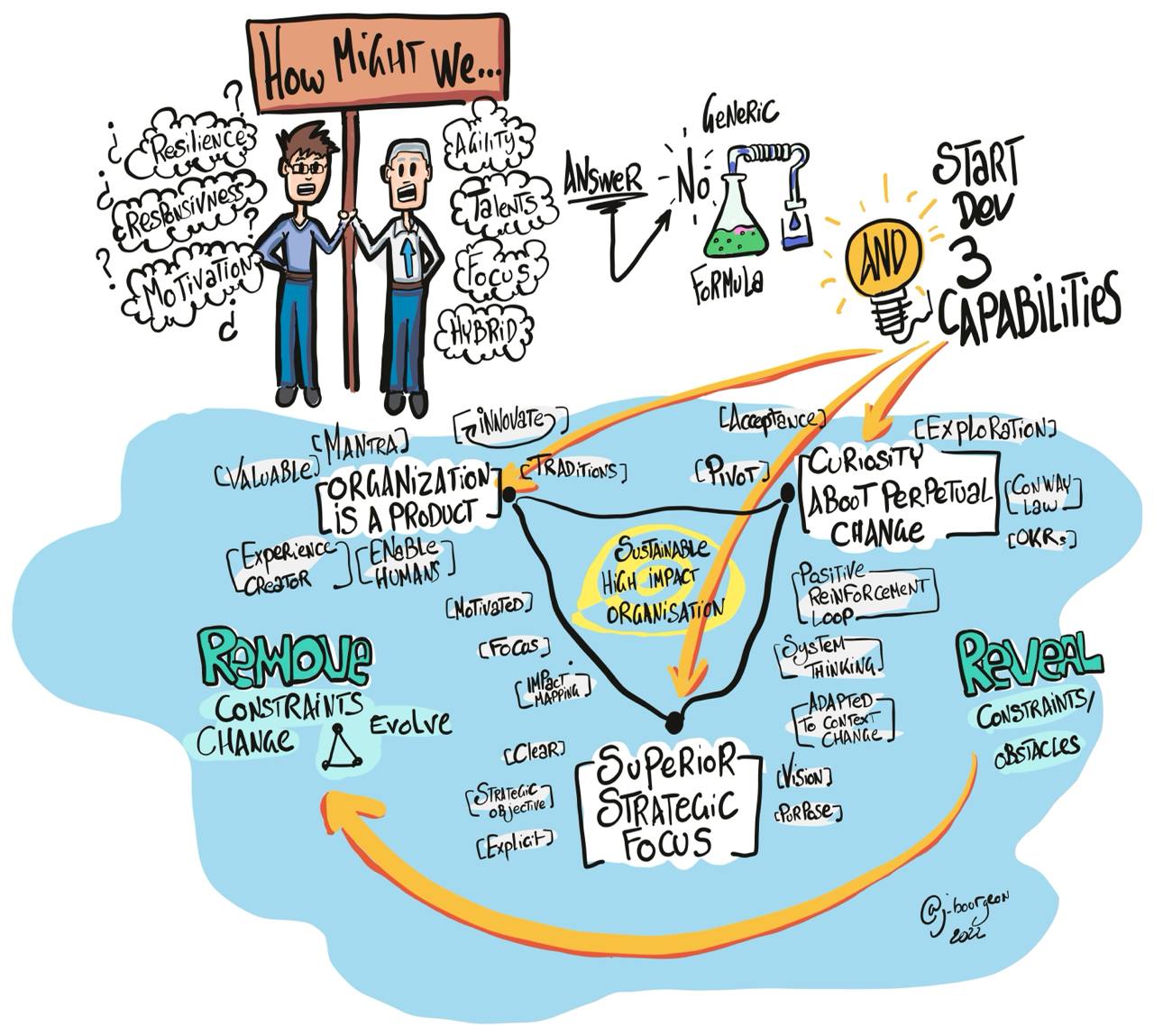
    When old innovations depreciate quickly, and new ones become a standard in a short time, how to facilitate your organization’s resiliency, agility, and responsiveness to an ever-changing ecosystem? How to attract and retain talents? How to keep them focused, motivated, and engaged in our ever more challenging new hybrid world?

    Some companies seemed to evolve organically to fit their economic and sociologic context, no matter their sizes. How are they accomplishing that wonder?

    No magic formulas are available on the market. You would have already applied it to your organization.

    Igniting the change in your organization requires the development of three capabilities. In developing those capabilities, you will uncover the magic formula for your organization and shift its culture.

    This article provides you with the questions to assess where you stand in developing the three capabilities and suggest tools you can use to push the development further.

    Superior Strategic Focus

    An organization can achieve extraordinary results when all people row in the same direction. We love to start here because everyone smoothly agrees that a clear purpose, vision, and strategic objectives are fundamental to success.

    One approach to facilitate the shared understanding is engaging the organization, starting with the leadership team, in drawing an impact map. The impact map represents a shared understanding of the assumptions about the future and pushes all people in the same direction.

    Questions to reflect on:

    • Why do we exist, and what do we do? How would people in your organization answer those questions? Are they in agreement?
    • How does your organization define performance?
    • Which of your business assumptions is at risk of being invalidated?

    The Organization is a Product

    Building the organization like a product is our mantra. An organization that provides an incredible experience to employees in a hybrid world. An organization that enables them to do their best work, providing a fantastic experience to partners and customers.

    The “way we do things here” has some time to be protected. Some traditions and rituals are essential pieces of the culture. Sometimes they have to go or evolve to let the organization move to higher levels of development.

    Applying the Impact Map to the organization is a way to do that. Explore how to create working agreements. Explore how new rituals fit the new hybrid world: company roulette and culture on a plate (ask us if you want to know more about those).

    Questions to reflect on:

    • What is the last story you heard in your organization that moved you?
    • What is the next feature your organization needs to provide to generate more value?

    Curiosity about Perpetual Change

    As humans, we crave stability. It does not exist. Ourselves and our environment change constantly. Being curious about change and accepting the reality of perpetual change is dawting individuals and organizations. Building positive reinforcement loops facilitates acceptance.

    Observe the organization in place and compare it to the original design. Observe the connection between the organization and the product and services of the organization (Conway). Explore how to develop Objectives and Key Results (OKRs) to foster positive reinforcement loops.

    Questions to reflect on:

    • What could be the next capability your organization needs to create?
    • What have you changed your mind about recently?
    • Which of your beliefs have you let go lastly?

    Starting the three capabilities development journey shifts the culture, and brings meaning and purpose to your organization. The first steps reveal obstacles and constraints to remove to achieve more sustainability and higher impact. Motivation and engagement grow with a higher focus, a better organization, and a freshness of curiosity.

    In the long run, the development of the three capabilities creates the condition for your organization to evolve organically, enabling your business to develop and pivot when needed.

    Illustration by Jérôme Bourgeon

  • A New Habit for the New Year

    A New Habit for the New Year

    Changing Your Team From The Inside chapters end with an activity for the readers to try. The exercise suggested at the end of the first chapter, titled Be The Change, is the Best Possible Self. When you follow the last link, you can learn how to do the activity and why you should absolutely try it.

    Thanks to the newsletter from the Greater Good Science Center of the University of Berkeley, I was reminded of the activity. A newsletter you may want to subscribe to. You may even want to follow their flagship course on The Science of Happiness.

    When you have a more optimistic vision of the future, you are more likely to take the necessary steps to get there, which means installing new habits in your days.

    Last year, in the new year post for this blog, I talked a little about willpower, bringing back the previous new year post, mentioning Kelly McGonigal’s book The Willpower Instinct. Let me do it once again. Being harsh when you miss a day or a commitment, especially when you want to take on a good habit or quit a bad one, triggers guilt, which pushes you to seek comfort. Comfort you may want to find in the very thing you are trying to stop doing. In short: be kind with others and with yourself.

    Speaking of habits, maybe you want to make a new habit of listening to exciting podcast episodes? What about you start listening to Creatures of Habit, another great episode of Hidden Brain, a podcast by Shankar Vedantam.

    Whatever you pick as a new habit, I wish it will serve you well, and that you will achieve your best possible self in 2022.

    All the best!

    PS: I would love to take some time to have a chat with you. Ping me on LinkedIn to make it happen 🙂

    Le Podcast – Season Two

    Le Podcast – Season One

  • A tale of a leadership team workshop

    A tale of a leadership team workshop

    Day One: Coming Together

    For some leaders from different organizations that will merge into one in the upcoming weeks, the face-to-face meeting is the first opportunity to meet in person with each other and their new manager. Even if the three facilitators made sure to greet everyone as they entered the room, the tension was palpable over the friendly chit-chat.

    The organizational structure has been announced over the last week, but not all leaders have been appointed yet. The departure of some leaders has already been communicated, and the others intuitively feel we are not done yet with those kinds of announcements.

    The oversized room feels comfortable. The tables are in a U-shape facing two giant screens on which we can already see the faces of the four people who were not able or willing to travel. Participants are used to the social distancing rules and leave one empty seat between them, spreading across the room.

    We are together for two and a half days to establish, define, and align the mission and the organization’s strategic objectives.

    One of the facilitators kicks off the meeting with some housekeeping words and gives the freshly appointed senior vice president the floor for opening remarks. She speaks about the opportunity for the organization and the chance to start together. She thanks the participants for their hard work and acknowledges their deep experience and vast expertise.

    She is able to show some vulnerability mentioning she feels tired and nervous. Easy to understand that she could feel that way, as she was appointed six weeks before to tackle the critical challenge for the organization.

    She asks people to be honest, speak up, be ready to let go of the past, and consider everything as fixable. She brilliantly closes by mentioning how if we are successful, employees, partners, and customers will look at us differently.

    Now we can really start, and the facilitator is back at the center of the room to establish the ground rules and make the participants express what they need. A good time for the facilitators to share their roles. One stays in the background, takes notes, monitors the chat, and shares the documents. The two others alternate being in and outside the circle. The one outside warns that she will take the liberty to reformulate straightforwardly what she heard expressed indirectly.

    Alternating at the center of the circle, she asked: “Think of a person you have not good thoughts about.” It was quite amusing looking at people looking around in the room, while an image popped into my mind instantly. Are those views really personal, or are they organizational views? Do you think what you think because people are part of another org? Then, she asked to put those past thoughts in the past files and give people a chance in the present moment.

    Now is the time for something big hairy, scary, stinky… Do you guess what is coming? Elephants, of course! Being open is being known, expressing what is only known by you so that others can know it. Participants are asked to express what they need and make it about themselves. The round table allows each participant to say something, building on what the others already shared. It is a nice combination of hopes and fears. Only one participant declined to say anything, revealing frustration from one facilitator who dropped: “You have three days, man.”

    In her closing comments, the organization leader mentions how she feels pressured to solve all the problems mentioned. She highlights the opportunity for the leadership team to select what problems to solve first and solve them together.

    If you feel it is time for that team to get to work, you are going way too fast, a leadership team needs maturity, and one cannot rush maturity. The facilitator is back in the center speaking of “pre-resilience”: the resilience you built in the past, and that is now in your “bank”.

    The organization leader is now in the center to share a story of resilience that will make the whole audience shiver, close to shedding a tear. Asking people to share their stories of resilience in a large group would be too much for many of them. The participants split into groups of four and spend the next 45 minutes sharing their stories. Interesting exercise of sharing vulnerabilities, that group of Senior Directors and Vice Presidents are all human, in the end, facing their own life challenges.

    Now that we have gone through the first phase of team formation let’s get to a shared understanding of what the employees in the organization and the rest of the company, the customers, and the partners think, feel, and do.

    Once again the group is split into small subgroups to reflect and propose their understanding. The readout is shared after the session with the whole group. The discussion is positive and fluid. The group of remote people demonstrated excellent engagement and collaboration, providing the rest of the group with a great readout.

    The last session of that first day is dedicated to defining who we want to be as a leadership team. What would we be ready to commit to? Similar things are brought in all formation discussions of teams. 

    Two things I found worth sharing here:

    • Someone proposed to add “assume positive intent,” which drove a lively conversation around the proposal. People approved, but it is not an excuse to be a jerk; you have to give people good reasons to assume positive intent!
    • Someone proposed to add “calling out” people on their bad behaviors not respecting the shared commitment. The proposal sparked another lively discussion. I loved the resulting proposal that instead of calling people out, we should maybe consider calling them in, as they belong to the group, or calling them up to their potential.

    All agreed that we would all have to invest some time in building relationships and that the face-to-face meeting was only a first step toward that goal.

    It is time for a nice dinner together to close the day.

    Day Two: Working Together

    “Can you count to 15 as a team?” asked the facilitator as the second day started. The facilitator immediately starts saying: “one,” one participant says “two,” and three participants talk over each other, saying “three.”

    We failed the first attempt, as each participant had to say one number without ever talking over another person. We are not allowed to “strategize” as the facilitator starts again immediately with “one.” We improved. We “only” failed at “five” this time.

    The facilitator reminds us that we have to include the people online. Another attempt, another failure. Frustrating. I am sure that we could do it if we had the time to agree on a strategy. But it is not allowed.

    Instead, the facilitator asks us to take a few deep breaths, close our eyes, and focus on our breath returning to normal. She uses a lovely “meditation” voice, and we continue to get back to the breath. We slowly emerge from that short meditation session by opening our eyes again.

    We then made another attempt. A successful one! Interestingly, I was absolutely sure it was my turn to speak when I said “ten.” How did I know? I don’t know. It seemed we felt more confident and more focused after that short meditation session.

    I am convinced that first success helped us for the rest of the day. We started bringing some other elephants into the room just after that. An excellent way to start the day!

    In her opening remarks of the day, the organization leader starts with an outside-in view, goes through the company goals, and how critical today is in defining the purpose and objectives of the team, and not only what we will do, but how we will do it.

    The framework used to work on the mission and purpose is simple and efficient. We just have to fill in the blanks.

    This organization exists to…

    We will do this by…

    So that…

    We decide as a group to focus only on the first and last “blanks”: This organization exists to […] so that […]. Building on the team formation work that was accomplished the first day, that quite a large group of people emerges after 45 minutes with a sentence. A sentence that we are all ready to consider as the sentence representing the purpose of the organization.

    Now is the time to fill in the middle blank with 3 to 5 strategic objectives, and for that, we are back in small groups, that the facilitators designed to be slightly different from the previous ones.

    We are back in the large room, and I am a bit anxious that the other groups will not align at all with each other. The readout starts, and I am happily surprised that the first group has strategic objectives that are nearly 100% aligned with what we have. The wording is different, by this is quite close.

    We discussed the rationale behind the wording of each proposal as a team. It progressively becomes clear that we can converge the four groups into one proposal.

    The facilitators will close the day saying that they will craft a converged proposal.

    We then applied the same framework to craft the leadership team mission providing clarity and driving consistency.

    And we call it a day! Another dinner is ready for us, and people start to get closer to each other.

    Day Three: Coming out with one Leadership Voice

    The last day will be a half-day, and I feel it is enough! The idea is to be able to express all that we discuss with one voice—being able to deliver the message to the different audiences we will address.

    We have 20 minutes to prepare a 2-3 minutes pitch to the audience of our choice.

    Before getting each of us to deliver our pitch, the facilitators propose to warm us up with a Leadership Karaoke. What are the rules of the game? Simple: each of us will go on the stage in turn, and say: “What you always want to know about…” which will prompt the facilitators to go to the next slide. Then, we will have to speak for 2 minutes… Of course, the slides are kind of random, from a picture of a hot dog, Hannibal Lecter from the Silence of the Lambs, an electrical telegraph device, or a slide mentioning “company values”… We had a lot of fun and debriefed as a team on the best way to engage the audience.

    After the next break, we all went back on stage to deliver our 2-3 minute pitch. After each pitch, the facilitators encouraged us to send a direct message to the person who just presented mentioning one thing we liked, one thing to consider to upgrade the pitch.

    A very energizing session in which we confirmed our alignment. We also learned a few things to refine our understanding or increase our impact.

    Of course, the last person to go on stage is the organization leader. The address also serves as closing remarks and farewell as some are already traveling back home while the others will stay a bit more to prepare the next day Townhall.

    The Next Day

    I am sitting at the airport lounge when I join the virtual Townhall gathering all the people who will be part of the new organization. I witnessed an impressive leadership team delivering a clear and consistent message. Furthermore, the way they complemented each other when answering the question was very impressive.

    This is just the beginning for that newly formed Leadership Team, but this is a very promising one!


  • Invest a few hours to excel at public speaking

    Invest a few hours to excel at public speaking

    A few months back, I was doing some research on public speaking, and I stumbled on this short video of one of the world’s experts in public speaking Conor Neil. What I learned in the video changed forever the way I envision starting and finishing a talk.

    Yes, there is a grownup way to say: Once upon a time…

    Funny enough, I found a reference to Conor in a post from Michael Thompson which gave me the courage to send emails to people I don’t know to thank them for their great work. Something you may want to try!

    Michael, the co-author of I am a Software Engineer and I am in Charge, told me that even when you are not keen on public speaking, you can always use the improvement to make an impact when the moments arise, like saying something poignant at a birthday party, or maybe setting the best tone possible when meeting someone new.

    Speaking about meeting someone new, I recommend using the One-on-one Discovery technique and/or prepare The Story of Your Life in 5 words as recommend in the episode of the podcast Hidden Brain.

    I think there are many ways to use public speaking skills beyond the fear laden speaking in front of 300 people that most people think about (well at least I do) when we utter the words “public speaking”.

    Michael Doyle

    You may need more to be convinced that you can excel at public speaking. What about you try the MIT Course in which Patrick Winston teaches How to Speak.

    Then you can get to work on how your talk sound with Julian Treasure. His TED talk, How to speak so that people want to listen, has more than 45M views! In his talk, you will learn about: register, timbre, prosody, pace, pitch, and volume.

    Once you learn from those world experts, you have to seize all the opportunities to practice. In the next meeting, the next internal lunch and learn, the next internal conference, maybe a meetup about something you are passionate about, or even submit your first talk? You can also join a local Toastmaster?

    I experimented with the teaching from those world experts in the last talk I gave at the Tech Leadership Conference. Happy to hear your thoughts about what I should improve!

  • Emile wants to solve consistency the open source way

    Emile wants to solve consistency the open source way

    Do you remember Igraine from the Primary Team story? Igraine leads the EMEA region of a global company. Bob, Igraine’s manager, told the Field Leadership Team that he wanted to get more consistency from the three main regions and that Igraine, leading EMEA, Yun, leading APAC, and Aileen, leading Americas, should come up with proposals. Bob wants to drive more consistency to scale the business and avoid duplicating efforts in the three regions.

    At this point of the story, Igraine invited Emile, the consultant passionate about Leadership and Organizational Development, to discuss how to solve the challenge. Emile built a rapport with Igraine when he dared to discuss the Tribal Leadership stages with her. Find more about that in Are you at the right table?

    Emile is super excited about the opportunity. He heard noises from the grapevines that the pendulum was about to swing from decentralization to centralization. Some even say that there will be complete top-down control from the global organization over the regions.

    Emile has another idea in mind to solve the consistency and duplication of efforts issues. He reached out to Veronica, the head of the Sales Operations team in EMEA, to get a sense of the concrete problems and evaluate his idea.

    As the three regions grew independently, they put processes and tools to support their sales team. The global team at that time has no interest in standardization and was ready to invest in more people to solve the reporting issues caused by the inconsistency between the regions.

    How to solve that?

    Emile wants to solve consistency and duplication of efforts in the open source way.

    The open-source model is a decentralized software development model that encourages open collaboration, meaning “any system of innovation or production that relies on goal-oriented yet loosely coordinated participants who interact to create a product (or service) of economic value, which they make available to contributors and noncontributors alike.”

    Levine, Sheen S.; Prietula, M. J. (2013). “Open Collaboration for Innovation: Principles and Performance” Organization Science.

    Emile proposes to identify the top 3 processes that are the most time-consuming for the teams. And then, Emile offers to engage the three regions in staffing cross-functional teams with people from the three regions to make the processes consistent and select the tooling. Veronica is onboard with the idea! She is ready to join forces with Emile to convince others that the open source way will be better than centralization like for software development.

    Emile imagines that with three successes, they will select the next three and even have a more open approach to get people to volunteer to contribute to the selection and the resolution of the next challenges.

    When Veronica and Emile go to Heiden, who leads the finances team for EMEA, he took a good 30 minutes to poke the holes in the approach.

    After that, he pauses and laughs. Veronica and Emile are puzzled.

    Heiden, just says: “okay, you are really serious about it, and I agree that we should try.” He then continues waving the book Humanocracy in front of the webcam: “Like Gary Hamel and Michele Zanini said in the book, central planning, and central control is the model of the old USSR, not the model an innovative company should embrace, right?”

    Let’s propose the open source way!

  • Start with Music

    Start with Music

    A few weeks back, I joined yet another online meeting, and something felt instantly different. Smooth music was playing in the background while the host welcomed me to the meeting.

    The host was Michael Doyle, and that was the first time I was exposed to that approach of welcoming people in online meetings. I tried to think about what felt different, and it is tough for me to describe—something like a cool down, calm and relaxed atmosphere. The meeting then went very well, and I was delighted with the outcome.

    Was it only chance? Was it only about the people involved? I needed to test that in other settings.

    I picked a team and a meeting that would be much more challenging, and I played smooth, positive jazz music to open the meeting.

    People were surprised. They made a few comments about the music and what it reminded them. If we were not in the middle of a pandemic, the meeting would have probably been in-person, and we would have been in a hotel, so I guess that is why the first thing they mentioned was the elevator, the hotel lobby, and the breakfast lounge. The chit-chat went very smoothly and relaxed. I felt the meeting went very well.

    As a result, I decided to play the music again during the breaks. I will do that again!

    What about you try that too?

    Do you know any research on the topic? I would love to read some!

  • Are you at the right table?

    Are you at the right table?

    In Delivering Happiness: A Path to Profits, Passion, and Purpose, Tony Hsieh, the former CEO of Zappos, shared how he learned to play poker out of boredom. Poker is not like the other gambling games played in casinos with odds stacked against you. With Poker, you don’t play against the casino. You play against the other players. So, if you know the rules and you understand the statistics, then you can win. The question then is to pick the right table to play.

    “Act weak when strong, act strong when weak. Know when to bluff.”

    ― Tony Hsieh, Delivering Happiness: A Path to Profits, Passion, and Purpose

    Do you want to compete with excellent players with no money on the table? Or do you want to play with not so strong players with a lot of money on the table? It depends on your motivation behind playing.

    Two big learnings from that experience in Poker:

    • Know the rules of the game you play,
    • Pick the right table.

    All that brings a question: Are you at the right table?

    Let’s bring back Igraine from the Primary Team story. As you may recall, Igraine is a fictional character who leads the global company’s EMEA Field Organization.

    Emile is one of the consultants in that organization. Emile is passionate about Leadership and Organizational Development. He joined the company mainly because of its higher-purpose communication.

    He thought he had found one of the rare “Stage 5” organizations to use the denomination of the book Tribal Leadership: Leveraging Natural Groups to Build a Thriving Organization.

    Organization stages from Tribal Leadership

    STAGE ONE
    These are tribes whose members are despairingly hostile—they may create scandals, steal from the company, or even threaten violence.

    STAGE TWO
    The dominant culture for 25% of workplace tribes, this stage includes members who are passively antagonistic, sarcastic, and resistant to new management initiatives.

    STAGE THREE
    49% of workplace tribes are in this stage, filled with knowledge hoarders who want to outwork and outthink their competitors on an individual basis. Each employee is a lone warrior.

    STAGE FOUR
    The transition from “I’m great” to “we’re great” comes in this stage where the tribe members are excited to work together for the benefit of the entire company.

    STAGE FIVE
    Less than 2% of workplace tribal culture is in this stage—where members who have made substantial innovations seek to use their potential to make a global impact.

    https://www.triballeadership.net/

    Emile is frustrated with some aspects of the current organization. He sees the stages as:

    1. Gang: Life sucks. Life is constantly threatened. You have to join a gang to survive.
    2. Dictatorship: Your life sucks. You are under the pressure of an authoritarian boss.
    3. Individual Greatness: People say: “I am great.” They hoard information in one-on-ones to outthink their competition. They made jokes at the expense of others to demonstrate their greatness.
    4. Organization Greatness: People say: “We are great.” They collaborate to outpass the competitors.
    5. Life is Great Culture: People say: “Life is great.” They collaborate and cooperate inside and outside the organization to create a positive impact on the world.

    Emile believes that the individual incentives, the individual awards, not speaking of the crazy number of one-on-ones, prove that the organization is at stage 3 at best, far from the promise of stage 5.

    Furthermore, when he shared to one of his mentors about his willingness to develop leadership in the organization, the response came as a shock:

    “I understand that you want to develop leadership in the organization, but is it the kind of leadership the organization wants?”

    Emile’s anonymous mentor

    Do you believe Emile has to leave the table to find another one?

    The first thing to realize is that similarly as human development stages present simultaneously in all of us:

    • baby: me,
    • child: us,
    • teen: all of us.

    The same applies to organizations. Part of the organization, or even people in the organization, could be operating at one stage while others operate at another stage. So, what can be observed in one part of the organization is probably not true somewhere else.

    “A great question for coaches to ask is this: “What triads, if built, will fix this problem?” The “black belt” version of the question (most useful in stable Stage Four cultures) is “What triads will help us spot and fix problems so big we can’t even think of them?”

    ― Dave Logan, John King, Halee Fischer-Wright, Tribal Leadership

    The second thing to realize is that your influence level in driving behavioral changes is more important than you think. If you adopt new behaviors, like having one-on-ones only for getting to know people or for development purposes, and stop having one-on-ones for “problem-solving” or “influencing” (the classic “information-hoarding” of stage 3). Then, you can start a movement because other people witness the efficiency of the approach.

    The third thing to realize is that it could be the right table to play at if you play according to the rules of the stage. You cannot play “stage 5” with people at “stage 2”. But you may start to play “stage 4” with people at “stage 3” who realize that something has to change in their organization.

    With all that in mind, what proposal Emile can make to Igraine?

    Assume Igraine is at stage 3; based on the previous story; it is probably not changing everything in her way of working.

    Emile wants to identify one thing that a triad could fix (to use the terminology of Tribal Leadership). Shifting from one-on-ones to a group of three people who can, by connecting, build momentum and bring lasting change.

    Because people at stage 3 complain about the lack of time, Emile has to pick one thing that gives back Igraine time.

    And because people at stage 3 complain of the lack of drive of people reporting to them to solve problems, Emile has to pick a crucial problem for Igraine and the organization. Something that improves the balance on the BEPS Axes of a Leader.

    Emile has to bring the idea in a typical “stage 3” way: many one-on-ones to make sure the idea has chances to get through. Emile has to pick the right table, in which he plays the rules of the game even when the goal is to change the rules.

  • Hand Signals for Virtual Meeting

    Hand Signals for Virtual Meeting

    One person asks a question, not even a rhetorical one, followed by an awkward silence. Did it ever happen to you? It happened to me a lot, especially now that my days are filled with online or virtual meetings.

    Of course, the facilitator of the meeting, or the person who asks the question, could formally go around the table to ask each participant to express their opinions. It is time-consuming, does not really help with the dynamic of the conversation, and in most cases, does not really help surface the potential disagreements.

    The simplest way is to assess the opinion of the room is to introduce hand signals. Here is how it works with the team I interact with. The approach is loosely inspired by the Decider (from The Core Protocols).

    The proposer clearly states is one and only one proposal and asks the participants to show their hands. The best results are obtained when everybody votes at the same time that to avoid the temptation of following the crowd (and regretting it after 🙂 ).

    Participants can:

    Thumbs Up to show their approbation.

    Thumbs Down to show their disagreement.

    Flat Hand to show they are ready to support the decision of the team.

    Let’s review what is coming next when all participants have expressed their opinion.

    When everybody thumbs up, or you have a majority of thumbs up and some flat hands. Nothing to really worry about and you can move on.

    When you have a thumb down, or you don’t have a majority of thumbs up, it signals the need for inquiring about the reasons of the participants. The way you formulate your question is important. “What will it take to get you to thumbs up?” is a better question than “What do you think?” as it focuses the person on finding a way to move forward, and not to express all the reasons to stop the progress.

    You can adjust the proposal and get another vote.

    The teams usually adjust very quickly to the approach and find improvements in their way of expressing their opinions. Progressively, team members will be more comfortable to express when they are “absolute NO” on a proposal, which will minimize the time spent attempting to resolve things that cannot be resolved.

    The last signal we introduced in one team is: Arms Crossed to signify when is it time to move on to another topic. The equivalent of the ELMO facilitation technique. ELMO stands for Enough Let’s Move On. You can use the real Elmo or a picture of him, just a piece of paper, or Lisette Sutherland’s Collaboration Superpowers Cards.

    I also worked with teams that introduced a variant of the flat hand signal. With the Palm up, it then means that the participant will follow the team but would prefer not to, but does not have strong objections.

    A good addition to the classic: I want to speak!

  • Primary Team

    Primary Team

    In The Five Dysfunctions of a Team, Patrick Lencioni tells the story of an executive team. To avoid having the functional leaders be only interested in their own department, the CEO asks them to consider the Leadership Team as their primary team.

    The idea of a primary team that takes precedence over all the others is key to overcome silo-thinking in the interest of the higher-level company goals.

    How can the primary team approach be used when we go deeper into the organization?

    Let’s take the example of Bob, a Global Sales and Marketing leader who reports to the CEO. His primary team is then the Corporate Leadership Team.

    Let’s assume that Bob’s reports are a Marketing Leader, Rahman, and three Sales Region Leaders: Yun, Igraine, and Aileen. Those four leaders form the Field Leadership Team.

    Have you noticed what I just said?

    Bob’s primary team is not the Field Leadership Team, even if he is the manager of the people in the team.

    Bob’s mission is to assist his reports to form a team so that they can lead Sales and Marketing for the company in all the regions. In addition to his reports, Bob invites in the Field Leadership Team leaders of supporting functions to share the same goals.

    Let’s cascade that at the regional level. Igraine leads EMEA. She has direct reports covering sales in sub-regions, marketing, and dotted-line reports from the region’s supporting functions: People, Legal, Finances, Operations.

    Bob wants Igraine to consider the FLT as her primary team. But, Igraine does not see that this way. She has successfully grown the business from a small subsidiary in one country to a significant business rivaling in size and growth rate with Aileen’s Americas region.

    Igraine is deeply involved with the business in the region. And every day brings confirmation that she needs to be deeply involved in the details to make sure that decisions are made in the right way.

    Igraine would like to form a leadership team with her direct and dotted-line. But where to start when you need to be calling all the shots, and you know that you need to be involved in the details.

    Igraine cannot let the business fail. She seems to be the only one who really understands the business’s details and the only one to really care or act at the right time.

    Furthermore, people are asking for change even quoting Einstein on insanity, but we have been very successful in doing what we are doing, do we really believe something has to change?

    The short answer is Yes!

    Let’s go through some of the aspects of the changes.

    Perception

    What about if what you see as a confirmation of the need to be deeply involved was in reality due to a self-fulfilling prophecy.

    When Douglas McGregor introduced the Theory X and Theory Y on human motivation and management he developed at the MIT Sloan School of Management in the 50s, he explained that they were only assumptions.

    But, I would say here. Unfortunately, if you agree with the assumptions, they will be realized.

    So what Igraine observes as a confirmation, could be in reality, just a consequence of what she is doing in managing herself and her team.

    Interest

    In The Motive: Why so many leaders abdicate their most important responsibilities, Patrick Lencioni covers the question of interest that comes with what is observed above. Maybe, the motivation of the leader does not match his or her current role.

    In our fictitious example, Igraine was very successful and was promoted to take “bigger” jobs. Still, in reality, her interest, motivation, and energy come from what she was doing before.

    Either she makes the decision and finds interest in the “bigger job,” or she will not make a shift. Not only her progression will stop there, but her whole region is at risk if she does not.

    I believe this is what led Laurence J. Peter to formulate his famous principle.

    Balance on the BEPS Axes

    You may have read about the BEPS Axes of a Leader before. BEPS stands for Business, Execution, People, and System and helps people realize when they don’t invest in one or more axes.

    The Business part of the equation is the most important. It’s about understanding the business and the ecosystem your organization evolves in, understanding why you provide solutions, products, features, and services, and formulating a clear vision. We should always start here

    Most people make the mistake of focusing on Execution, but this is not usually the main problem. It tends to be an issue for managers when they are deep in execution or defining the precise tasks each person should work on. By going too deep, they forgot the other axes.

    People can be more of a problem. Hiring, growing, managing performance, and self-improvement is often passively delegated to HR or managers. However, this is not always a beneficial practice.

    System is a big one, and usually, one suffering from underinvestment. As American engineer W.E. Deming said, “a bad system will beat a good person every time.” Understanding the system formed by the people, the organization, the processes, and tools is of paramount importance and will help you remove the obstacles to great work. It’s all too common to see layers of complexity piling up on top of each other. Simplicity is key.

    How to help Igraine?

    Back to Igraine. What happens is that Igraine is deeply involved in Execution to make sure the business is successful. Igraine knows the System very well and knows how to navigate the System very well.

    The chances are that the System grew around Igraine without her realizing the complexity of it. Multiple people took the lead of specific aspects forming teams that grew “natural” boundaries around them.

    The silo-effect emerges because of these boundaries, but Igraine can navigate the system without even feeling the boundaries. The problem is only visible to the other people in the organization who will experience the difficulties linked to these boundaries: slow process, busy work, inaccurate and/or inaccessible data.

    Now that the system is in place, it can take a lot of energy to change it. The teams would love some change, but usually, they identify that changes are needed in other teams. Not many people have a complete understanding of the whole system and the ones who have usually don’t experience the complexity the same way as others. So they don’t have a big incentive to change it.

    This is where Igraine’s deep knowledge of the System can make a difference. By focusing her attention and energy on changing the system to make it simple and efficient for its regular users, she can greatly impact the organization’s performance.

    The whole system connects to her, putting her on the critical path of all decisions.

    Delegation

    Telling Igraine, she should delegate will not help. She knows that. She wants that. It is just not happening. Telling her, she has to intentionally not make a decision but grow the people to make them is not enough.

    To help her, people in her organization can influence the change by taking the lead on specific decisions.

    Let’s take a concrete example: the definition of the commission plans. Do you want Igraine to decide on every one of them? Let the process runs the way it ran in the past, and this is exactly what you will get.

    You have to insert yourself into the system. Start with the Why. Write down the motivation behind the commission plans, the behaviors to influence, and how the plans’ components are meant to influence them.

    Now put your thoughts into your proposal. What do you want to achieve and how it will affect the plans: add/remove a component, add/remove a plan, align the plans of different roles.

    With that in hand, you can meet with Igraine and involve her in the high-level decision. Once you reach an agreement, you can now propose to review all the plans for your perimeter.

    In doing so, you drove a change in the system, you got Igraine to delegate something that was falling on her plate for historical reasons, and you made her decision at the level she should be involved in.

    You are not asking for more delegation, or even worse, waiting for delegation to happen. You are driving it.

    To do that with confidence, you need to balance your investment on the four axes and involve multiple stakeholders in preparing your proposal. You have to leverage the organization’s knowledge and the knowledge of Igraine to make the change happen.

    When the leaders in Igraine’s leadership team can drive those kinds of changes, Igraine will have proof that she can delegate more to her leadership team.

    You don’t need to wait for the change to come from the top.

    You can make it emerge and help Igraine make the right choice for her primary team.

  • Resolution for the Exhausted

    Resolution for the Exhausted

    What seemed to be a long time ago, I started my first post of the year by telling you that I opened a Gym Club in January and told you what happened to that club in February.

    More important, you will find in the post mentioned above suggestion to keep up with your resolutions.

    The last mentoring conversations I had inspired me for that post. In several of them, I believe nearly all of them, people mentioned how tired they were.

    In one of the conversations, we went deeper to understand the root causes, and the strategies to put in place to install a sustainable pace for the teams.

    I am a big fan of speedy meetings. It is an option to schedule 25 minutes meeting instead of 30 minutes, or 50 minutes instead of 1 hour. I intended never to schedule back-to-back meetings so that I can have a break in between them.

    My plan was to use the break either as a real break from the day with a short meditation for example.

    Sometimes I felt it was better to use the break to immediately capture and share the action items so that other people will not be blocked waiting for me.

    Unfortunately, it does not completely work. I am even tempted to say: “It failed miserably.” The break time is too often used by the previous meeting that runs over, making it challenging to arrive on time for the next meeting. Reading this, you can observe that I am not flexible with time. Read more about that in The Culture Map post.

    The consequence of running over is endless back-to-back meetings. More context switching. More pending small tasks accumulating (the ones that I sometimes forget at the end of the day to remember them in the middle of the night). No physical and mental breaks. This impairs the ability even to be oneself, to behave, think, live properly.

    In addition to that, as nobody works in an office, there is no water cooler break anymore, no social conversation, no simple ideas sharing or bouncing outside of the context of a formal meeting.

    Sounds damning, right?

    One of my mentees found what I think is a perfect tactic during an open space retreat with his team. They want to focus their meeting on one topic. They schedule one hour for the topic on their calendar. But their team agreement or social contract is:

    • The first five meetings are for social conversation,
    • The next twenty minutes are for collaborating on the topic,
    • The next twenty minutes are for focused time on the followups of that conversation,
    • The last fifteen minutes are for a break.

    Attentive readers could point out that nothing prevents the twenty-minute discussion from running over and consuming the whole time. It is obviously true. Nothing but the team member themselves. They defined the solution, updated their team agreements, and are now in charge of the implementation.

    When I adopted speedy meetings, I wished people would adjust to the unusual timing and follow my lead.

    When as a team:

    • people agree on how to create, review and improve their OKRs,
    • people agree on how to structure the time of their meeting,
    • people agree to limit their work in progress so that they limit context switching,
    • people agree to ask for a clear purpose, clear agenda, and get to a clear understanding of what their contribution is expected to be, before accepting a meeting invite,
    • people agree to call out each other when they break the social contract or team agreement,
    • and other aspects they will identify as key to install a sustainable pace.

    They can have a big impact.

    So maybe a good resolution could be to create or update your team agreement or social contract and have one of your OKRs focused on getting to a sustainable pace even in the challenging conditions we currently face.

    With all my best wishes.