Author: Alexis

  • On Consultants

    The MIT Sloan School of Management recently published a talk that Steve Jobs delivered at MIT in 1992. During the speech, he discussed how consultants, are missing a big part of learning that you can only get when you own “something over an extended period of time.”

    As a consultant, you will drop by, make some recommendations, and swing to the next company without really seen the results of your ideas.

    I have been a consultant for quite some time, and when I was not a consultant, I have seen how consultants were engaging with their client. I have to agree with what Jobs said. Without having skin in the game, the ones who pay the price of the recommendation are the customers, not the consultants.

    Don’t get me wrong. I am not advocating for consultants staying for a long time in the same place, as it doesn’t change the issue. When a consultant stays for an extended period, he or she will become part of the system, and so part of the problem.

    When I was working with teams, I always tried to explain using a quote from Nanny McPhee: “When you need me, but do not want me, then I must stay. When you want me, but no longer need me, then I have to go.” I am not sure I remember who gave me the idea to use that quote… I would guess it is Olaf Lewitz.

    With Laurent, we tried to use an approach in which we will have more skin in the game. We proposed to customers two different prices: one was at the high end of the consulting rates, the second was half the rate with a mention that we will invoice 5% of the benefits provided by the mission. We never found a customer who chooses the second option. I understand that the approach could have dramatic side effects of aiming to get the benefit in the short-term without having to care for the long-term consequences.

    When I changed back to an internal position, I always insisted on being part of the team, and share not only “change,” “transformation,” or “improvement” goals, but real business goals. In doing so, I need to care at the same time for both the short-term and the long-term, and my natural tendency to welcome change avoids that the complacency of accepting the status quo.

    Either you are consultants, or you hire or work with consultants, what do you think?

  • November in France!

    Thanks to Aurélien Morvant (Kokan) I will be back in France for two weeks at the end of November. I will present a session around the book Changing Your Team From The Inside during AgileTour Rennes (November 23-24, 2018).

    I already planned a few other visits to companies and organization to present the book, but as we have five months to prepare, my calendar has still a lot of openings.

    I am open to present during other events, for companies or organizations.

    The session could be:
    – A 30-minute talk followed by Q&A,
    – A 50-minute talk followed by Q&A,
    – A 90-minute interactive session (for a group of 30 people max),
    – Or something we could define together to fit your needs.

    Please contact me if you are interested in organizing a session!

  • The Story Behind The Book

    The Story Behind The Book

    Earlier this week, I announced the availability of the first edition of Changing Your Team From The Inside. I said in that post that I would tell you the story behind the book.

    Back in 2013, I started to think about writing a book about the connection between agile and open source values, principles, practices, and tools. I thought that it would be an inspiration for large IT teams to transform their organization considering the different services they are running as open source projects in a community of distributed developers. As There are still quite a lot of projects that are maintained by one or two individuals, I thought that it would be an excellent opportunity to bring in open source communities practices that will value the work of a team, more than the heroic behavior of individuals. I delivered presentations on that topic, like in 2014, at the OpenStack Summit, in Atlanta, with Frederic Lepied, or in 2015, at the Open Stack Summit, in Vancouver, with Nick Barcet.

    During the work on this project, I was struggling with different audiences, and I concluded that it was not the right angle. I aborted the project to work on a more individual-based approach.

    A discussion of their values and principles with one of the companies I was working with at that time brought another insight. One of the founders said: “the most important thing is, we want employees to be happy, and with that, we will have happy customers.” This simple sentence drove a lot of research on happiness, so much research, that at some point I even thought that I would write something on that topic. Thanks to Julien Dubois, I keynoted the Drupal Developer Days in 2015 with “Happiness is Coming,” and that well received!

    I continued to work around that idea during the next two years, bringing some of the content in several conferences and using it in my day to day work. Working with a company heavily invested in leading OpenStack to success, to provide enterprises with cloud capabilities for their on-premises infrastructure was an excellent source of learning. With Mark McLoughlin, we delivered a presentation in 2016, at the OpenStack Summit in Austin, to cover the idea of the flow of work going from the upstream company to the customers of the product based on the different projects coming from different communities. We wanted to send the message that whatever company you are working with, you don’t wear two different hats, a company hat, and a community hat, you integrate both responsibilities in your day to day work.

    The OpenStack community was also a great source of learning with great people like Colette Alexander who founded the Stewardship Working Group to support the technical leaders in the community in the development of their leadership skills. We enjoyed a leadership training provided by ZingTrain in Ann Arbour. (What? A deli delivers training on leadership?)

    The travel to Ann Arbour gives the opportunity to Emilien Macchi and me to visit Menlo, the company founded by Richard Sheridan, the author of Joy Inc. I am telling that to highlight that the quest for happiness was significant in that journey of building high impact sustainable organization.

    I became progressively convinced that companies needed Transformation Manager because the transformation is not a small improvement. Transformation supposed that you will entirely reconsider the way you work. I started to work on the book. I also began to work on defining the role of a person like this in my company. It slowly became clear that it was not working, we were falling back on the “change agent” role, or the “agile coach” role, or the “improvement person.”
    If you are familiar with the 14 management principles of Deming, you know the sole idea of having a person in a transformation manager role is breaking the last one of them:

    “Put everybody in the company to work to accomplish the
    transformation. The transformation is everybody’s job.”

    Like quality should be built in the product and not assess after the fact, the transformation should start from within.

    People are the source of change.

    The beliefs of people define the value of the organization they are working with. People can change their organization from the inside. And so, I think I found the right angle, providing ideas of approach people could use to foster the change in their organization.

    The rest is in the book: Changing Your Team From The Inside.

    I am eager to hear from you about what’s working (or not) for you!


    I heard back today from Claude Aubry the author of the great book on Scrum in French:

    The approximate translation is: I finished the book Changing Your Team From The Inside and I highly recommend it. Very inspiring.

    Thank you Claude!


  • The First Edition Is Available

    The first edition of Changing Your Team From The Inside is available! Check-out which version is the right one for you!

    Thank you very much for your support along the way.

    What I feel today is quite complex. At the same time, I am happy with a sense of accomplishment, AND, I am worried that it could be not good enough to be out in the world.

    You will tell me!

    I have to say that a very long feedback loop is not ideal. I am even discussing the importance of short feedback loop in the book. I will tell the story behind the book in a longer post during the week.

    I need you to tell me what you would need to give to the book a five-star review. You know that people base their choices on reviews and recommendations, right? I need you to be honest even if you think it is brutal. Maybe I will cry a bit. I need you to tell me what you really think because I will use your feedback to update the book.

    Of course, all customers will have access to all the updates of the electronic versions! So you will not only get access to it, you will help all the other readers and me! A big thank you for that!

    If you are subscribers to the mailing list, you can ask for a 25% discount. For the electronic version, you have to lower the price down to the minimum. For the paperback version, drop me a note, and I will send you the coupon.

    Thank you!

  • Great! You asked for more “versions” than expected!

    Great! You asked for more “versions” than expected!

    Thank you to the subscribers to the mailing-list! I appreciate your support!
    All the subscribers to the mailing list, before the launch, will receive a 25 % discount on all versions of the book. So please, continue to share with your friends and colleagues!

    I am making good progress in finishing the book. The reviewers are doing a great job! Thank you folks! You are all amazing! I feel I am lagging behind, but we are getting there 🙂

    Last month, I asked you what versions should be available. I received more answers than expected which is great! Among the responses, a fair number are asking for electronic only, paperback only, or both.

    I also discussed with my friend and colleague, Julien Danjou, the author of  The Hacker’s Guide To Python and Scaling Python, on that topic of versions. His two books are available in different versions. The distribution of sales among the versions shows a real interest from readers for this variety.

    The conclusion is straightforward, let’s satisfy all the needs with an electronic only, and a paperback and electronic versions.

    Julien also told me that many people wanted to have the time to discuss with him about the book, and so he created a version to do precisely that. In your responses, there were several asks we could satisfy with a “team offer” that includes a discussion with the team.

    And, there’s more! My friend Laurent Salsé from Fitnet Manager, the ERP for those who don’t like ERP, told me: what about a tool that transforms the recommendations of the book into concrete actions for the team! Definitely interesting!

    You have more ideas about the book versions!  If it’s the case, please, send me a note right now and tell me! If nothing comes to mind, just say hello. I like getting to know the people who are interested in reading the book.

  • Mailing List Subscribers to receive a 25 % discount on all versions of the book!

    Mailing List Subscribers to receive a 25 % discount on all versions of the book!

    First of all, I would like to thank the subscriber to the mailing-list! I really appreciate your support! I am happy to announce that all the subscribers to the mailing list, before the launch, will receive a 25 % discount on all versions of the book.

    I know that this offer leads to two questions.

    1- Where is the book?

    2- And, what do you mean by “versions” of the book?

    To the first question, I need to ask for a little more patience. I am working on finishing the book. Which means more reviewing, more professional proofreading, and more rewriting on my side. I guess that I will need to stop that cycle at some point 🙂

    To the second question, I discussed the idea to make the book available in different versions to satisfy the various needs of readers. The obvious first version is the book available in electronic formats. The second version is the paperback version of the book. But there’s more! Some reviewers already asked for the ability to engage their teams in a live discussion about the book and the challenges they face. So, I guess that this should define the third version.

    Maybe you have ideas about what should be the versions of the book. If it’s the case, please, send me a note and tell me!

    And if nothing comes to mind, just say hello. I like getting to know the people who are interested in reading the book.

  • Kanjis at Agile Games France

    Kanjis at Agile Games France

    The 2018 edition of Agile Games France just ended a few days ago. What is extraordinary about this unconference? The non-organization principle is pushed to the extreme, and reminded from the start to the participants: “If you want something to happen, do it” as it’s originator, Alexandre Boutin, repeats each year during the less than 2 minutes introduction.

    The events gather less than 100 people in a new town each year since 2012. This maximum number of people was agreed upon by the participants themselves during the retrospective of one of the first events.

    A lot of people wants to attend, and the less than 100-euros tickets sell in a few minutes. The participants are a mix of people who are coming for the first time, and people that are returning each year. Alexandre is making that visible during his introduction by gathering people around the number representing their number of participation. The visible representation is helping people that are coming for the first time to see that they are not alone in that situation, and also encourages people that are returning to support the newcomers.

    How does it work?

    A hotel fully booked by the participant is the best configuration we found so far. One of the locals, who chose the place, presents the available spaces for gathering subgroups. Then people who want to facilitate a game put the proposal on a sheet of paper on the wall with a few information about it, duration, number of players, and the learning outcomes.

    People who want to play a game, write their first names on the papers to signal the facilitator that they are interested. And after some time, one of the facilitators takes one paper from the wall and signal to the crowd: “we will play that game in that space, we are looking for 6 to 12 people maximum”. The facilitator is followed by the ones who want to participate. And the process will repeat itself for two days.

    As all the games have different duration, from short 5 to 10 minutes games, to 2-hours simulations, it could be dazing to try to create a formal agenda. So, no grid and no timing, always on time and never late. When people are available, they are coming back to the main room. In front of the wall, participants are sharing their review of the game. People are sometimes asking one facilitator to play a game again to give them another opportunity to play. People are switching from being a facilitator to being a player during the day.

    For the first edition, in Nantes, in 2012, I proposed the Beer Distribution Game created at the MIT Sloane School of Management in the 1960s. The simulation game illustrates the bullwhip effect that could happen in a supply chain, when people have a limited understanding of the whole system, and limited communication. A really fun eye-opener that the participants enjoyed at that time, voting for that game as the best experience they had during the event.

    Creating a safe space to play a game is helping people to experience a new approach freely. During the debriefing, they will connect the dots with their environment. And, at that moment, they will know that they need to change, and they will know that they can do it. They experienced the different kind of behavior people could show during a transformation, on a short time frame.

    For the 2018 edition, I brought with me a new barely tested game: Kanjis.

    The game is an icebreaker to warm-up the team for a long meeting.

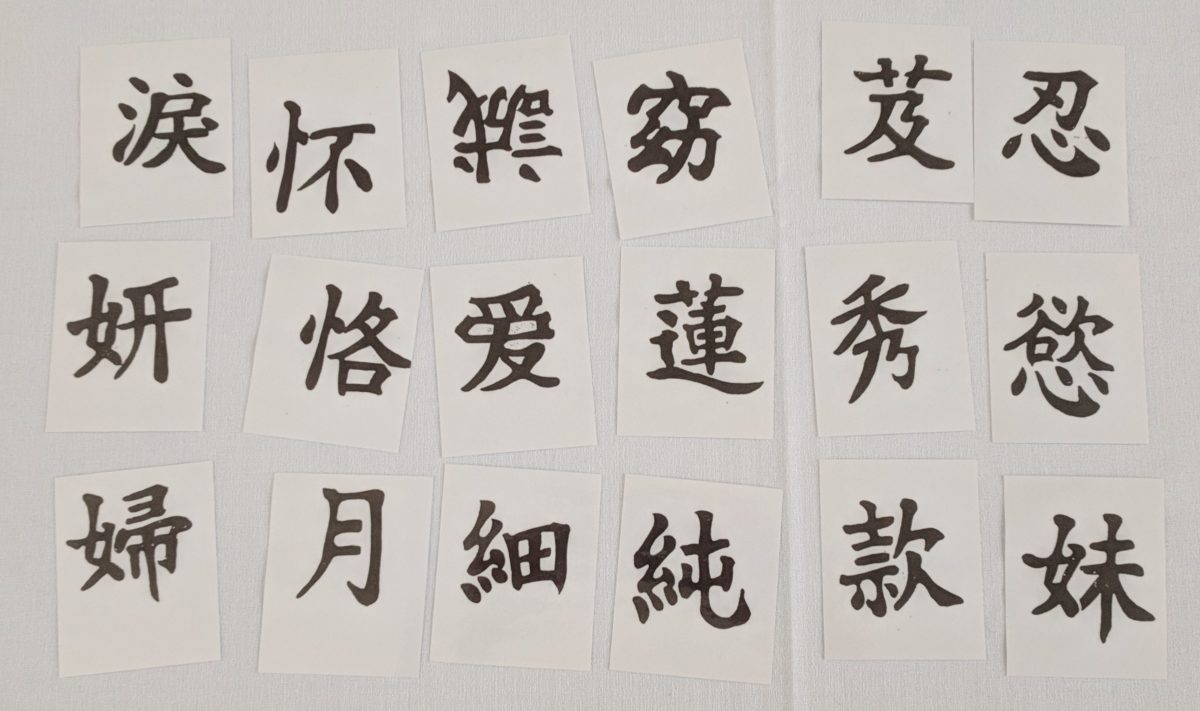
    A group of more than eight people is asked to watch a set of cards figuring Kanjis for 1 minute. The facilitator splits the group in half.

    The first group is sent outside of the room for roughly 5 minutes, and the members are asked to introduce themselves.

    The second group stays in the room and is asked to quickly introduce themselves in 3 tags while the facilitator is preparing the next step of the game. The second group is presented with a new set of cards, and ask to tell, as a group, which are the ones that are coming from the previous set. The facilitator marks the selected cards on the back, and prepares the set of cards for the first group.

    When the first group is coming back in the room, the facilitator invites them to tell which are the cards they like.

    What is happening?

    The first group usually found very difficult to identify the cards that were part of the first selection. They could found some of them in their small pick, habitually because one of the participants made an association with something meaningful.

    The second group, when asked the cards they like, is identifying the cards that were part of the previous set. They often pick all of them, and when they don’t, their wrong picks are similar to the one they should have picked.

    When we are asked the first rationale question, we use only the logical part of our brain, and tend to activate limiting beliefs. People will say things like: I don’t have a good memory, the cards don’t make any sense. Also, the group is asked to answer “as a group” which will activate fears of being wrong and being judged by the others. The peer pressure will shut down some of them that will prefer to remain silent instead of making proposals.

    When we are asked the second emotional question, we have access this time to all our brain. Of course, during the first phase, our brain recorded all the cards, and when asked which one we like, the brain is simply matching with what is already known. We tend to like what we know.

    The words that we will choose as the facilitator or as participants will have a strong impact on the ability of the participants to engage fully and to access all their resources.

    I had the idea of the game while listening to John Cleese speaking during a Talk at Google:

    There was a very interesting experiment. A psychologist showed a group of people some Chinese ideograms characters. They came back next week, and they said to the people: “now we’re going to show you some more, some of the ones you saw last week, some new, will you tell us which ones you saw last week.” They were absolutely hopeless. Nobody could do it at all. It was exactly chance. Then they repeated the experiment the second time, they said on the second showing: “we’re going to show you some more ideograms, will you tell us which ones you like.” And the ones they liked were the ones they’d seen the week before. So, the information was in there in the unconscious, but it couldn’t be accessed in a straightforward way.

    John Cleese, during a talk at Google in 2015

    The initial version of the game is published today after several runs and improvements during Agile Games France 2018. I would like to thank all the participants for their immensely valuable feedback.

    The game is published under a creative commons license, and the contributors will be credited in the revision log.


  • Changing Your Team From The Inside @DevConf.CZ

    Changing Your Team From The Inside @DevConf.CZ

    I gave a talk today at DevConf in Brno about Changing Your Team From The Inside.

    The recording is below, and you can follow that link to the slides.

    Thank you for all the great feedback.


  • Care Personally

    Care Personally

    Care personally and challenge directly. That is how Kim Scott defines Radical Candor. At the end of November, I decided that I will offer her book to some of my colleagues.

    A book is an opportunity for learning through discussions with others. I already discussed the advantage of a book discussion club, and by offering a book, I wish to have those conversations, with each person. And yes, I am also planning a book discussion club.

    When you give a book, some conversation could start surprisingly fast, like last year when I gave “Joy” to colleagues, and one of them told me immediately: “Is there a message? Do you think I make my employees unhappy?”. This conversation took me by surprise and I probably just mumbled meaningless words to try to escape it.

    Sometimes it seems that the conversation will never start. So either, you can forget about it, or you can push to have it. Sometimes it is just that people don’t read, don’t read business books, have other things on their reading list, and that’s ok.

    With Radical Candor, I had the first conversations quite rapidly. The first one was about the 2 x 2 matrix used in the book. You are up on the vertical ax of the matrix when you care personally. You are on the right of the horizontal ax of the matrix when you challenge directly.

    The conversation evolved around the principles described by Dale Carnegie and how they fit the matrix. (in “How to win friends and influence people,” his book first published in 1936, and still reedited today.)

    I will take two examples:

    • Become genuinely interested in other people
    • Give honest and sincere appreciation

    Become genuinely interested in other people, is, of course, an excellent way to demonstrate that you care personally. And, as you can see in the matrix, if you are doing it without challenging people directly, you will fall in the “ruinous empathy” quadrant.

    Give honest and sincere appreciation, is, this time, more tricky. If I consider that I will only speak about the positive behaviors that I can see in other people, I will fall in the bottom left quadrant “manipulative insincerity”. If I don’t care personally, and I give honest feedback, I will fall into the “obnoxious aggression” quadrant. If I care personally and that I am honest, this time I can act in the upper right quadrant.

    The way you will give feedback is of course key to the success of your message. Kim Scott explain this point with reference to what Ben Horowitz called the shit sandwich in “The Hard Thing About Hard Things” another book that I enjoyed. The shit sandwich is his way to qualify a classic way to give feedback: start with complimenting, then pass the difficult message, and finally value the strengths of people. The problem with the approach is that experienced people will see you coming and each time that you will start with a compliment, they will wait for the difficult feedback.

    The point is that if you care personally for people, you will develop a relationship that enables to give and to receive honest feedback without the need to give a not so nice sandwich.

    Once, I was in the audience at a conference, and one of my colleagues was giving a talk. The guy is excellent, I love his way of thinking, he can present an appealing overall vision and go deep to the right level of details when it’s appropriate. The talk was ok, and I was frustrated. Why? Because he made basic public speaking mistakes that he could have easily avoided. I wait that the long line of people wanted to thank him, and to talk with him vanished, and I told him: “Great work Steve! I have some feedback, do you want them now or later?”.
    Steve: “Now would be fine.”
    Me: “Do you want them direct, or do you want me to dress them up a little bit?”
    Steve: “I am a big boy, go for direct.”
    At this stage, I would have gone for direct anyway, and I guess you understood that I cared enough for that.

    I will relate another conversation I had about the book in a future article about Rock Stars and Super Stars.

  • Let’s get 2018 started!

    Maybe you are part of the people I know and we did not hear from each other for quite some time? As it is the beginning of the new year, it is also an excellent moment to take the resolution to let my connector-self express itself more freely.

    To be able to connect you with others, I need to update my knowledge about you. I would like to know what you care about for 2018. And, yes! I wish you the best for that! And, maybe I could do a little bit more.

    So, if you are interested in reconnecting after those years, drop me a note! We could do that by email, phone or video conference, or even in person if we happen to be in the same place at the same time. It could be now or later this year. When the time is ok for you, it will be ok for me.

    I am working on a book, Changing Your Team From The Inside, to be released in Spring 2018. Let me know if you are interested in it by subscribing to the mailing list.

    I will travel during the year to the different offices all over the world, and for conferences. The next travel will be in Brno (Czech Republic) at the end of January for DevConf, where I will give a talk. I will try to update that on my blog, Twitter, or Linkedin, hoping that it will give us an opportunity to meet in person!

    I wish you a great and peaceful year!


  • Profile

    Thanks to the Red Hat’s Women Leadership Community, the organizers, and Dana Lane, the photographer, I updated my profile picture today.

    The session was a lot of fun!

    Thank you!

  • The Great Dinner Party

    The Great Dinner Party

    You are hosting a dinner party in 8 weeks from now, and you wonder how to make it a great dinner party for you and your guests.

    First, what is the meaning of “great” for you in that context? If the party is a success what will happen? The answer could be: the guests will be relaxed, they will enjoy tasty and original food and drink while making or renewing connections with people from various backgrounds.

    Answering that first question define the vision that you have of your party. How will you measure that it has been a success? It is a dinner party, so surveying your guests after the reception is probably not a viable option, maybe you could try to remember what your guest will say about it, or perhaps you will receive “thank you” cards. Yes in this exercise, you remember the future! What will your guests say or write after the party if it’s success? They could state that they felt welcomed, that they enjoyed the food, that it was a pleasure for all senses. They could elaborate on the decoration, and specific small attention to details, on the relationship they built or renewed during the event.

    Imagining, how your guests will remember the event will help you to empathize in advance with each of your guests, and refine your success criteria. It will help you to remember who has specific needs, or to remember to ask in the case that you realize that you don’t know enough about some of your guests.

    Of course, you understand that the dinner party is a pretext to learn how to work on delivering any products or services. The product owner would probably indeed conduct and survey “users” to understand what are their success criteria. Empathy map could help to get what they see, hear, smell, feel, taste, say, think.

    Now, that you have a refined vision and have a better understanding of your success criteria, what needs to come next? There are only seven weeks left. What is your backlog?

    Your backlog is not a list of activities or a list of things to do. Each item of your backlog is a story in which the personas (your guests or yourself) are the hero.

    To define the backlog, you will use your vision and imagine what your guests will experience from beginning to end. It is convenient to use post-it notes for this exercise and to record one story per note. You are building a map (a story map) of their experience.

    Let’s try to capture some of the stories from a guest perspective!
    – As a guest, I receive a formal invitation to the party, so I know about the specific details,
    – I know how to dress, and what to bring,
    – I know how to get there and where to park, so I am relaxed and confident,
    – I switch in a party mindset from the moment I arrive,
    – I know where to sit,
    – I enjoy a variety of delicious appetizers, and I can choose and adjust the quantity I eat according to my preferences,
    – I appreciate the pairing of the drinks and food.

    And we can imagine a lot more of those stories. We will keep some of those, while we will just ignore, delete, rewrite or put at the bottom of the backlog others.

    If we look at the first one about the invitation, we can define the conditions of satisfaction for the card. What are those details? Why are you organizing the party? Where? When? Does the guest need to reply? Can the guest come with someone else?

    You can already see that a story card is a way to capture the conversation that will clarify it. The conditions of satisfaction are a way to carry the details and to ensure that the solution we will choose, will satisfy the story. At this stage, we know why we want this story, we know what it is, but we still don’t know how to realize it. Is the invitation printed and mailed? Is the invitation sent via email? Is it texted?

    This distinction between why and how is crucial to enable creativity and innovation. Let’s illustrate that with another example. Let’s imagine now that as a host you want to delegate the realization of this story to a team:
    – I want a sweet and original dessert with season fruit, so my guests can finish the meal on a sweet note.
    When the team clarified the story with the host, the team learned that individual portions are a must, different textures are essential, and so team presented the results of their work during the demo of that week: a strawberry rhubarb meringue tartlet. Yes, me too, now I want one 😉 As a host, you tasted the tartlet, loved it, asked for slightly smaller size. So now, the team just need to get ready to prepare the tartlets for the event. On that day, the team is not able to find the fresh strawberry that will compensate the acidity of the rhubarb. The team tastes raspberry that appears to be delicious, and so as it will still satisfy the conditions of satisfaction, the team can make the decision. Remember, the dinner party is a pretext to learn, the primary point here is by knowing “why” we are doing something we can adjust the “how” to the circumstances and find more creative solutions.

    If we look back at this dessert story, during the grooming of the backlog, we first decided to conduct a spike for one sprint, demoed it to the user, and got some feedback. Then, during planning, we were able to decompose that story into more specific tasks that the team will do to realize the story. And we have been able to adjust to the circumstances by switching to raspberry at the last minute.

    Grooming your backlog at the “story” level, and then planning for the sprint and decomposing into tasks only when you will work on a story is a compelling approach.

    Let’s recap the approach. We started with a high-level vision. We refined the concept by identifying the different personas and empathize with each of them from the beginning to the end of their involvement in the project. In our case, we probably have the host, the host family members, the guests, the children of the guest.

    We captured the stories for all the personas in our backlog. We refined and sorted the stories during grooming sessions. The conversations enabled us to define the conditions of satisfaction for the stories at the top of our backlog.

    We continued our work during our weekly sprints, starting with a planning session, in which we checked our understanding of each story, decomposed into tasks if it was possible, or choose to conduct an experiment or a spike in the case of more significant uncertainty or our ability to meet the conditions of satisfaction.

    We reviewed and demoed our work at the end of the sprint. We welcomed the feedback and adjusted our plans accordingly.

    We now need to invest some time in a retrospective to improve our way of working as a team, so we will be more efficient and enjoy the weeks to come approaching the great dinner party.

    What do you think about using a dinner party to explain practices?

    I am refining the use of this analogy, among others, in the book to come during Spring 2018, Changing Your Team From The Inside. I am looking for reviewers, let me know if you would be interested.


    The header picture is our Thanksgiving table created by my spouse Isabel 🙂