We’ve all heard it. Maybe it was on the playground after a scraped knee, or at the dinner table after a frustrating day at school:
“Don’t cry.”
“Be a big girl/boy.”
“Don’t get angry. It’s not a big deal.”
From the time we can walk, we are taught that “strength” is synonymous with “silence.” We are coached to treat our emotions like unruly pets that need to be locked in the basement so the “productive” version of us can go to work.
But as Andy Puddicombe, the co-founder of Headspace, famously put it:
“Trying to outrun our emotions is as effective as trying to outrun our shadow in the sun.”
When the sun is high and things are easy, the shadow is small. But as the day goes on and the pressure mounts, that shadow stretches out behind you, looming over every decision you make. If you don’t learn to turn around and look at it, you’ll eventually trip over it.
The Source: Emotional Agility vs. The “Be Strong” Script
Psychologist Susan David, author of Emotional Agility, argues that modern culture often promotes a “tyranny of positivity.” We’ve been conditioned to treat difficult emotions as problems to fix rather than experiences to understand.
When we tell a child—or a direct report—not to feel what they are feeling, we aren’t teaching resilience. We are teaching suppression. And suppression is costly. Research shows that when people push emotions down, they don’t disappear. They tend to increase internal stress and often resurface later as disengagement, chronic stress, or emotional outbursts.
The Reframe: Emotions as Bio-Data
We need to stop viewing emotions as “weaknesses” and start viewing them as biological data points.
“Problemo resoluto” Madagascar
If you were driving a car and the “Low Oil” light came on, you wouldn’t put a piece of tape over it and say, “I’m a strong driver, I don’t need oil.” Yet, that’s exactly what we do when we tell ourselves to “power through” anxiety or “ignore” resentment.
The Old Way: “Stop crying/getting angry. Get back to work.” (Repression).
The New Way: “I feel tension in my chest. My body is noticing a threat. What is the signal?” (Literacy).
Leadership Application: The Stone-Faced Leader
The “Be Strong” narrative creates leaders who are emotionally stunted. If you can’t acknowledge your own fear, you will react with frustration when your team expresses theirs.
Unexamined emotions always “leak”:
An unacknowledged fear of failure manifests as micromanagement.
An unexpressed feeling of being undervalued manifests as passive-aggression.
The “Don’t Cry” kid grows up to be the “Don’t Complain” boss who wonders why their turnover is so high.
True human-centric leadership requires us to stop being “policemen” of our feelings and start being “detectives.”
A Practical Takeaway: The “Data Scan”
Next time you feel a “negative” emotion, don’t try to outrun it. Stand still and name it. Use the “Physical Anchor” tool:
Locate it: Where is it in your body? (Tight jaw, heavy chest, knotted stomach?)
Label it: Use the Emotion Wheel. Start at the center (e.g., “Sad”) and move outward until you find the specific word (e.g., “Abandoned” or “Empty”).
The Mantra:“I don’t have to like this feeling to listen to the data it’s giving me.”
The Coaching Prompt
Try these questions to break the “Be Strong” cycle with yourself or your team:
The Legacy: What was the “rule” about expressing emotions in my house growing up? How is that rule affecting my leadership today?
The Signal: If this physical tension in my body had a voice, what is the one sentence it would say right now?
The Shift: Instead of trying to “get over” this feeling, what would happen if I just sat with it for 90 seconds without judging it?
I watched a new TV show last weekend, and there it was again. The line that, once you notice it, ruins almost every script it touches.
“What do we do now?”
I want you to watch this short clip of Reese Witherspoon explaining exactly why this four-word sentence is so toxic. It is a masterclass in identifying the subtle ways we give away our power.
Before I heard Reese talk about this, I never truly “heard” the line. It was just background noise. I never considered it a problem, let alone a symptom of something deeper.
This is the definition of a blind spot.
We don’t know what we don’t know. Often, the things we are missing are the very things that would make the most difference in our growth. In movies, this line strips a character of their agency. In the workplace, it does something even worse. It turns high-performing professionals into passengers who are simply waiting for a driver.
Once you see this pattern, you cannot unsee it. You start to notice it in meetings, in emails, and in the way teams lean on their leaders. It is the sound of potential stalling out.
We usually think of blind spots as embarrassing or dangerous. We treat them like bugs in our software that need to be patched immediately.
But here is the reframe: The moment you identify a blind spot, you have found your next level of performance. The “What do we do now?” feeling is a signal. It isn’t a sign that you are failing: it is a sign that you have reached the edge of your current “map.” When you feel that urge to ask for directions, you aren’t actually lost. You are just standing at the frontier of your own agency.
The discomfort you feel when you realize you’ve been “scripted” is actually the birth of a new leadership capacity. It is the transition from a Fixed Mindset (waiting for the right answer) to a Growth Mindset (creating the answer).
Once you realize that “What do we do now?” is a signal of a blind spot, you have to decide how to respond to it in real-time. Whether the words are coming out of your mouth or someone else’s, the goal is the same: move from Passive Waiting to Active Intent.
When you hear yourself saying it
It usually happens when you’re tired, overwhelmed, or facing a problem you haven’t seen before. Your brain wants to offload the cognitive load to someone else.
The Pivot: Catch the question before it leaves your lips. If it does slip out, immediately follow it with: “Wait, let me rephrase that. Based on what I see, I think our best move is X. What am I missing?”
The “I Intend To” Rule: Practice the habit of never presenting a problem without a proposed next step. Even if you are 90% sure your idea is wrong, stating an intent forces your brain back into the driver’s seat. It changes your posture from a passenger to a navigator.
Intent is not “The Answer”: This isn’t about being a lone genius. Stating an intent can be as simple as saying, “I intend to pull the team together this afternoon to analyze our options.” By doing this, you aren’t waiting for a boss to tell you when to collaborate. You are designing the conditions for the solution to emerge. You are owning the process, even if you don’t own the final answer yet.
When you hear your team saying it
This is the “Answering Machine” trap. When a report or a coworker asks you what to do, your ego wants to provide the answer. It feels good to be the expert. But every time you provide the “fix,” you are accidentally training them to remain in the blind spot.
Create the Container: Instead of giving the answer, hold the space for theirs. Use what David Marquet calls “The Ladder of Leadership.”
The Reflection Technique: When they ask “What do we do now?”, respond with: “That’s a critical question. Before I share my perspective, I want to hear yours. If you were in total control here, what would your first move be and why?”
Adjust and Decide Together: This isn’t about leaving them stranded. It’s about collaborative adjustment. Once they share their intent, you can say: “I like that logic. Let’s tweak this one part to account for X, and then let’s run with it.” You are no longer giving orders: you are refining their leadership.
Banish the “Answering Machine” response. Next time you or your team feels stuck, remember that the goal isn’t to be right. The goal is to be active. Replace “What do we do now?” with “I intend to…” even if that intent is just to gather the right people to solve it together.
The Coaching Prompt
Grab a notebook or bring these to your next 1-on-1:
The Reaction Audit: The last time a team member suggested a “wrong” course of action, did you shut it down or did you explore their logic?
The Safety Check: Does my team know what “safe to fail” looks like in this project? Or do they feel they only have one shot to be right?
The “I Intend To” Challenge: How can I encourage my team to start their updates with the phrase “I intend to” this week?
Thank you for reading the Emerging Leadership Newsletter Each edition explores one idea that helps leaders create organizations where people take responsibility and deliver impact. If this resonates with you, feel free to share it with a colleague or start a conversation in your team.
You can also listen to new conversations on Le Podcast on Emerging Leadership. You will find references and transcripts for each episode, along with past newsletters, on alexis.monville.com.
You can listen wherever you already get your podcasts. Just pick your favorite platform and hit “subscribe” so you won’t miss any new episodes:
We’ve all been sold the same dream: “Be Agile.” We start with a small, scrappy team where everyone finishes each other’s sentences, and the magic just happens.
But then, success hits. You grow. Ten people become fifty. Fifty become five hundred. Suddenly, those “individuals and interactions” you valued so much have turned into an endless calendar of “sync meetings” that leave everyone exhausted and nothing actually… synced.
The hard truth? At scale, the very things that made you Agile start to break you.
In the latest episode of Le Podcast on Emerging Leadership, I sat down with Fabrice Bernhard, co-founder of Theodo and co-author of The Lean Tech Manifesto.
Fabrice has lived this. He helped scale an organization from 10 people to over 700. He realized that the four core values of the Agile Manifesto have a “scale issue.” It’s not that Agile is wrong; it’s that it wasn’t designed for the weight of a 100-million-dollar organization.
To survive growth, you don’t need more “Agile ceremonies.” You need Lean Tech.
In most corporate cultures, a “problem” is a bug—something to be hidden, fixed quietly, or blamed on someone else.
In a Lean Tech organization, a problem is a feature of growth. Fabrice argues that the goal of a leader isn’t to have all the answers, but to build a Learning Organization. This requires a radical psychological shift:
Hiding a problem is the only true failure.
Showing a problem is an act of service.
Analyzing a problem is the core work of a leader.
When we reframe our technical hurdles (like a monolithic codebase) as communication hurdles, we stop fighting the technology and start re-architecting the human system.
One of the examples Fabrice shares is the “API Mandate.” When Amazon faced scaling gridlock, Jeff Bezos didn’t ask for more meetings. He asked for fewer.
By forcing teams to interact only through tech-enabled interfaces (APIs), they created a Tech-Enabled Network of Teams.
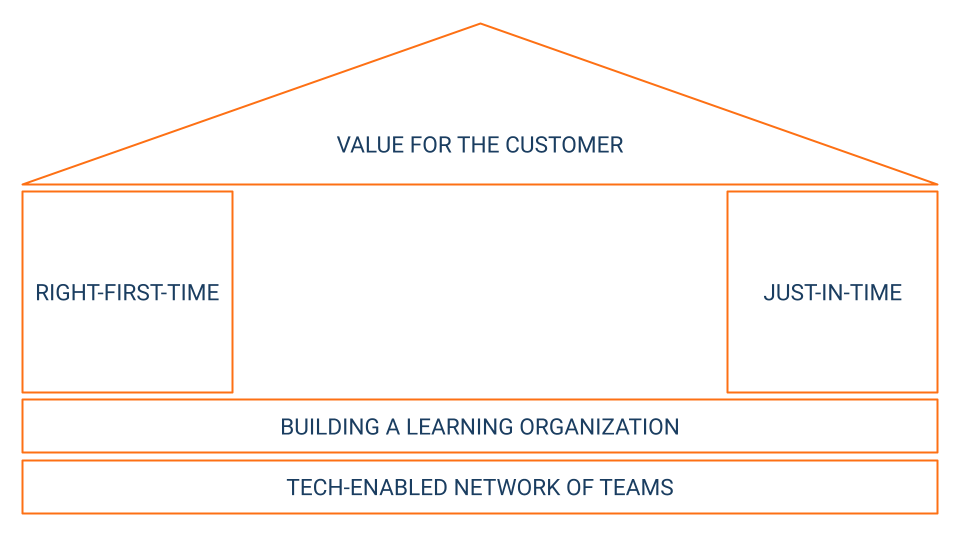
To scale successfully, you need to align your leadership with the five structural elements of the Lean Tech House:
Value for the Customer (The Guiding Star): Move beyond simple “collaboration”. Leaders must work tirelessly to clarify what “value” actually looks like for the whole organization so that every team can align their autonomy with a shared goal.
Right-First-Time (The Quality Pillar): This is the ideal of perfect quality. Instead of rushing to “move fast and break things,” aim to detect and analyze defects as early as possible—such as through unit testing or precise specifications—to build long-term intuition and speed.
Just-In-Time (The Flow Pillar): Fight the urge to work on multiple features in parallel to “feel” productive. Focus on single-piece flow, delivering small increments of value quickly to get real feedback and reduce the waste of half-finished work.
Building a Learning Organization (The Cultural Foundation): Create a culture where raising a problem is a positive act and hiding one is discouraged. This is grounded in a culture of problem-solving, where leaders teach skills rather than just providing solutions.
Tech-Enabled Network of Teams (The Technical Foundation): You cannot achieve agility on top of a messy architecture. Use technology—like APIs or modular design—to enable teams to work autonomously without needing constant, bureaucratic synchronization meetings.
The Kanban Mantra:“Stop starting, start finishing.”
If your team is struggling with “Agile fatigue,” look at your Work In Progress (WIP). Parallel work is a lie we tell ourselves to avoid the difficult conversations that collaboration requires.
The Gold: Scaling isn’t about adding more layers of management; it’s about removing the “waste” that prevents value from flowing.
The Coaching Prompt
Ask yourself (or your team) these three questions this week:
“What is the most uncomfortable problem we are currently pretending doesn’t exist?”
“If we could only work on one thing this week to deliver value to the customer, what would it be—and why aren’t we doing that?”
“When was the last time I ‘went to the Gemba’ (the actual code, the actual customer call, the actual workshop) instead of just reading a report about it?”
Want to hear the full deep dive? You can listen to the full conversation with Fabrice Bernhard on Le Podcast on Emerging Leadership right here.
You can also listen to new conversations on Le Podcast on Emerging Leadership wherever you already get your podcasts. Just pick your favorite platform and hit “subscribe” so you won’t miss any new episodes:
In this episode of Le Podcast on Emerging Leadership, I welcome Fabrice Bernhard, co-founder and CTO of Theodo, and co-author of The Lean Tech Manifesto.
Over the past decade, Theodo has grown from 10 people to more than 700, while maintaining speed, quality, and responsibility. In our conversation, Fabrice makes a provocative but thoughtful claim: all four values of the Agile Manifesto have a scale issue. Not because Agile is wrong, but because what works beautifully for small teams does not automatically work for large organizations.
Together, we explore how Lean thinking helps preserve the intention of Agile while making it work at scale.
In this episode, we discuss:
Why Agile principles struggle when organizations grow
The difference between “customer collaboration” and “value for the customer”
How Amazon’s API mandate enabled autonomy at scale
Why architecture matters as much as culture when scaling
What a tech-enabled network of teams really means
How to start evolving a monolith without rewriting everything
What it takes to build a true learning organization
Why Lean is not only good for people, but also good for business
Alexis: I’m very happy to welcome Fabrice Bernhard. Fabrice is the CTO and co-founder of Theodo, the technology company co-founded with Benoît Charles-Lavauzelles. Over the past decade, they scaled Theodo from 10 people and 1 million dollars in 2012 to more than 700 people and 100 million in 2022. They are the authors of The Lean Tech Manifesto, a book that captures their experience of scaling an organization without sacrificing quality, engagement, or responsibility.
Fabrice, welcome to Le Podcast on Emerging Leadership. How do you usually introduce yourself to someone you just met?
Fabrice: I would say that my name is Fabrice Bernhard and I’m the co-founder of Theodo. And if it’s in a working environment, which I guess this is the case here, I would say that Theodo is an international tech consultancy based in London, Paris, Casablanca, and Cape Town.
Alexis: When I read the book, I was very surprised by one of the comments just at the beginning of the book that clearly encourages people to skip a chapter, not to read about that story. And I was very curious. Of course, I read the story, and I found that very interesting. So why that comment?
Fabrice: Yeah, it’s a very interesting question. I think we wanted the book to be about Lean Tech, about our learnings and experience around adapting lean wisdom to the tech industry and tech organizations. We found that our story was a good introduction to that, to better understand the context and where we had arrived there. But we didn’t think it was a necessary part. So that’s what we wanted to convey, to really explain that you don’t need to read our story to learn about Lean Tech.
That being said, I completely understand your point. The story is a very good introduction and I think it provides valuable context to the book.
Alexis: When you look back, you were already a small company and you scaled quite a lot. What are the main points of the story you want to tell?
Fabrice: Yeah. I think in the scaling story, if you look at our bottlenecks to scaling, the first one was finding product-market fit. And finding product-market fit happened when we really deeply understood agility, agile methodologies, and we were able to bring them to larger corporates who were definitely struggling to adopt them on their own.
So that’s been the first step. And once we had product-market fit, that’s when the scaling really started. And then the key bottleneck was, how can we scale our organization and maintain this agile culture that we love and that makes our difference to our clients while becoming much bigger, and therefore facing all the challenges that typical large organizations face, which lead them to becoming big, bureaucratic organizations.
And that’s when we met a lean coach who had been through a similar journey, who had loved Agile, had tried to apply it in a large organization and realized the limitations, the problems that Agile doesn’t address when you’re a large organization.
He found Lean afterwards, found answers to all his questions in Lean thinking, and told us, you know what, I can also bring them to you and you’ll see, it will be amazing. And so that’s why we’ve been on a Lean journey ever since. That was back in 2012, and we’re now, what, in 2026. So that’s already 14 years now.
Alexis: Yeah, it’s very impressive because you mentioned something that a lot of people faced in the agile community. They were able to use the agile principles and the agile values as a team, as a small team, they were able to really improve the way they were working. But in the larger organization, it was not necessarily working. And you explained that very well, going back to the Agile Manifesto and looking at the pieces that are able to scale and the pieces that need a little bit of something else. Can you tell us a little bit about that first part?
Fabrice: What is very interesting is the first question is, what is agility? And what the pioneers who wrote the Agile Manifesto did very well is give an answer. They wrote the Agile Manifesto, which was the shared understanding of what made an agile software development team agile.
So you can always go back to this manifesto to understand what they meant by agility, which is very good. And so when you look at the principles, I think they make a lot of sense and they capture very well the essence of what it means to be agile.
And then the analysis for us was to think, okay, why can’t these principles work in a large organization? And when you take each value, each of the four values of the Agile Manifesto, and you try to imagine yourself as a leader of a large organization trying to lead with these principles, you realize all four of them have a scale issue.
They all really capture what makes a small team very effective. And the idea is good, but these four ideas just don’t scale.
Two very simple examples. One is customer collaboration over contract negotiation. It makes a lot of sense, but in large organizations you start having two issues. One is you can’t have the customer in every team, as Extreme Programming encourages to do, and which we did at Theodo. It was amazing. We had the customer in the team, and that created magic. But you can’t have the customer in every team when the project starts requiring 10 or 20 teams.
That’s one side of the coin. And the other side of the coin is when you are working for large organizations, there’s not one customer who really knows what they need. You start having multiple stakeholders with contradictory requirements, contradictory needs. And building a great product is really taking all of these into account, understanding the trade-offs, and then making hard decisions.
And customer collaboration just doesn’t tell you how to address both of these issues at scale. And what we thought is, does Lean thinking actually bring a principle that conveys the same kind of intention, but actually works at scale? And we found it.
The first principle of Lean thinking is called “Value for the customer.” And for us, it addresses exactly that thing. It addresses the fact that as a leader of a large organization, you need to work very hard on clarifying and communicating all the time what value for the customer means for the whole organization and for each individual team in the organization.
And that is very helpful. That is very powerful. That is in line with the intention of the Agile Manifesto. And it works at any scale because typically Toyota is very good at this and they have 300,000 employees. Amazon is very good at this and they’ve got a million employees.
So being obsessed with the customer is a very good principle that you will find in most organizations that feel agile and are very large. So that was one example. And then, depending on how long you want me to speak, I can give a second example.
Alexis: Good.
Fabrice: Yeah. I could give you all four examples, but I’ll just give two. And the second one, and I’ll be shorter, is the core principle of the Agile Manifesto, which is individuals and interactions over processes and tools.
And again, this idea that as a team you can rely on direct interactions to make things work is very important and very useful, but only possible at small scales.
Because as soon as you grow the number of people that need to interact, the number of possible interactions grows to the square of the number of people. And you start having thousands or millions of possible interactions, which makes no sense.
What we found in organizations that had managed to scale and keep some kind of agility is that they had been able to reorganize as a network of teams. So they had basically kept this team spirit by organizing themselves as autonomous teams.
And then the question becomes, how do you manage to create an organization that works as a network of teams in a seamless way, where teams are able to have a strong form of autonomy despite being part of a very large organization?
And we realized that all of the examples we looked at had technology as a key enabler of distributing the work and then reassembling it in a seamless way.
So that’s why we called the principle a tech-enabled network of teams. And as examples, we give Linux and we give Amazon, which we could talk a lot more about if you want, or you can read the book if you want to know more about it.
Alexis: Yeah. We have value for the customer, that’s basically our guiding star. Tech-enabled network of teams, that’s the foundation to make all those things work.
If we go back to value for the customer for a second, what does that mean for a leader in an organization, whatever the size? What are the questions they should ask themselves?
Fabrice: Lean Tech is basically our own secret sauce. So what do we do internally? It means taking the time as a leadership team, on a regular basis, to actually think about that. What is value at the whole level of the organization?
So that’s one thing. Another thing is to confront that idea of value that you have with the reality of it. Because as soon as the organization grows, what you start having is a disconnect between what you think customers want and what customers actually want on the ground, and what teams on the ground are faced with.
And so there’s a key practice in Lean thinking called “go and see,” or going to the gemba. Gemba being a Japanese word for where work really happens.
And so that’s a key practice of a leadership team in a Lean Tech organization, to often go and visit teams and be very curious, not judgmental, not reactive to issues, just really to observe how things work and confront your vision of what value is with the reality on the ground.
So that’s the second very important thing. And then there’s a lot about communicating and empowering teams on value.
A great way to communicate value is to build an Obeya. Obeya is another Japanese word that means a big room. And the key idea is that you display in your office, and it’s much better if it’s physical, you display your understanding of the value, your understanding of the key challenges to provide that value, the key learnings, the key recent learnings around that, the key next steps that need to be tackled.
And that creates a lot of clarity and instant widespread sharing of what value means to the whole organization.
And then there’s a whole aspect, and that’s a very popular aspect in the tech world, which is called team topology. So creating or redesigning the organization so that teams are aligned on the value. So identifying the value streams and making sure that the organization is organized around these value streams, so that teams know to which customer they’re contributing and what kind of value they’re contributing to that customer.
So that everyone can be empowered on what is the value that they actually need to build and to deliver. And if they have the autonomy to do that, then they engineer themselves the solution to creating that value.
Alexis: Do you have an example when you felt you articulated properly the value for the customer at a very high level, but when teams were maybe a little bit struggling with understanding the value, and you’ve seen that moving from not understanding to already understanding?
Fabrice: Ah, it’s a very interesting one. The first example that comes to my mind is not us, but somebody else.
A very interesting organization asked us to come in and evaluate them using the Lean Tech framework.
And one thing we realized is that for leadership, there was a very clear technical requirement around the latency of the product. The latency had to be below 50 milliseconds to be sellable as a home cinema product.
All the studies had shown that if it was above 50 milliseconds, customers would notice it and would not be happy with it.
When we went on the ground and we asked the teams if they knew about it, they said, “Not really. We’re aiming for 80 milliseconds. Fifty is impossible anyway, that’s why we’re aiming for 80.”
So we went back to the leadership team and we said, by the way, one thing we’ve realized by going around is that the teams didn’t know that it was a key part of the value for you to deliver under 50 milliseconds.
The leadership team got a bit frustrated because for them they had made it very clear. And they hadn’t made it very clear.
What we said is: definitely not clear enough. Not obvious enough. Not unavoidable enough that the teams would have needed to raise the issue and say, “Guys, we’re not achieving these 50 milliseconds. What can we do?”
Instead, the disconnect between leadership and teams on the ground made it possible for teams who found achieving 50 milliseconds super hard to deprioritize that challenge.
And that, I think, is a very interesting example that we see in every large organization. Some challenges are very hard. If they’re not made super clear and obvious, quite naturally the organization will deprioritize them for easier things that they can do.
And that, I think, is a harsh example of value for the customer. It’s not just communicating, but it’s also clarifying the priorities and making sure that when things get hard, people know they need to raise their hands and say, okay, we need help, rather than just reprioritize and work on something else.
Alexis: Yeah, it’s an excellent example of communication not being a one-way street. You need to enable the other way, so people can raise their hand.
I’ve heard that a lot of times. When people are actually doing the work, it’s very different. And you can be frustrated on both sides.
Fabrice: And I think it was a very good example of frustrations on both sides. Leadership said, “We had made it clear.” Teams on the ground said, “Yes, we heard it once, we raised the issue that it was hard, and nobody came to us.”
And therefore this conversation that should have happened on a regular basis happened maybe once and then never happened again.
Alexis: Yeah. Yeah. I’m curious: did they succeed in either changing the goal or succeeding in the goal?
Fabrice: I don’t have the exact answer, so I have some guesses, but I prefer not to share them.
Alexis: Okay. That’s good.
We discussed a little bit high-level value for the customer. That’s great.
You mentioned the tech-enabled network of teams. Can you unpack that for a second to define that? I know that you discussed team topologies and the idea of stream-aligned teams, and aligning teams on the value. A lot of people are trying to do that, and you can see how difficult it is when you’re really trying.
What is that tech-enabled network of teams you mentioned?
Fabrice: Yes. So it all started with trying to find how do you keep the magic of the agile principle, individuals and interactions, at scale.
And clearly when we look at Amazon, what they did back in about 2000, they had the same issue that every large organization has. They had one big monolithic code base. Everyone that was contributing to it was treading on each other teams’ feet.
And therefore there was a huge challenge on how do we synchronize when one team needs to change something that impacts another team. How do we synchronize these changes?
So they had these big synchronization meetings every quarter. And it was a big mess. And very good developers were starting to leave because they couldn’t be bothered with so much bureaucracy.
We’ve seen that in large organizations, we’ve seen that everywhere.
What they did at Amazon at that moment is that there was this debate around maybe we need more communication or better communication.
And Jeff Bezos had a very good intuition and said, no, we need less communication. The problem is that the teams are not autonomous enough. So we need to find a way for them to find that autonomy again.
And so they started this very large program of creating APIs so that each team would not need to meet with another team. They would be able to interact with them through self-explanatory APIs. So very intuitive APIs, very reliable APIs.
So that’s often called the API mandate. It required a year and a half of investment for the first teams, and then probably became faster and faster for all the teams afterwards.
And the end result was that the Amazon code base was completely broken down into modules. Each team had their own module. And every module, when it needed to interact with other modules, did it through very well-defined, very stable, reliable, intuitive APIs.
And that completely transformed Amazon. It gave them this agility back and was definitely a foundation to their super fast growth for the following years and the following 20 years.
And it was also the foundation for the invention of the cloud. Because once they realized that every dependency could be transformed into an API, the obvious idea was to say, okay, can we transform our dependency to getting a new server into an API, where you just need to say, “Please, I want a new server,” and get it.
So this is basically the story behind the principle of tech-enabled network of teams.
And in this principle, we really mix two ideas. One is that the team needs to be autonomous.
And from a people perspective, this means having a competent team leader able to help them when they have problems. And a key way to help is not to solve the problem, but to actually teach problem-solving skills.
And so that’s a key lean idea: a great team leader is a team leader that is competent and great at coaching problem-solving skills.
So that was one aspect, the people aspect. And then there was a technical aspect.
Because what we realized, and that’s also what we see in traditional organizations, is that it’s not just a people problem. It’s also a technical challenge.
You can try to reorganize as much as you want. If the underlying architecture is not modular enough, then you will still be stuck, whatever your organization.
And that’s why we added the tech-enabled part. Because we think without a big rework of your underlying technology, you will never get the agility that you are aiming for.
Alexis: Okay. This is the part I believe a lot of people listening will be a little bit annoyed with. Because they will not know where to start.
Let’s say I have a big monolith. I need to grow the team. Now the team is too big. The monolith is too big. What can I do? I don’t have the time to re-architect everything. Where do I start?
Fabrice: I don’t have a simple answer to that question, but we do have a lot of experience around that question.
I think I’m simplifying slightly when I say making the monolith modular, because we have a few examples where one of the key transformations was actually the deployment pipeline.
Alexis: Mm-hmm.
Fabrice: So moving to a deployment process that is much closer to trunk-based development. Investing heavily in automated testing. Investing in feature flagging.
That is typically, I would say, the first thing I would start with. And I’m not the only one to think that. Continuous deployment is clearly one great way to get there.
And then the re-architecting would happen, but you can’t do it all at once. I believe, and we’ve done it quite a few times, you re-architect in a progressive way.
Alexis: Yeah.
Fabrice: And that’s why it’s hard. Because it requires very good architecting skills, tech design skills.
And usually the leaders who are complaining about the lack of agility are often non-technical. So they don’t understand that they have to put energy on that.
And yeah, I guess if there’s one key message here, it’s that you cannot achieve agility just by addressing the people challenge. You also need to address the technical challenge.
And that does require getting your hands dirty and trying to understand why the current tech landscape is not working.
Alexis: I like that because it gives a sense that it’s possible. It will be step by step. There’s a real investment. And you need real engineering skills. You cannot fake it on that part.
Fabrice: Yeah, no, of course. And to be honest, the outcome can be much better than what most people believe.
We’ve just delivered the new professional bank of LCL, which is a very large French bank. We did it in 10 months, and we had about 150 dependencies to the existing IT system.
So it was a difficult project, with 150 dependencies. But once you know how to design the thing, once you have the delivery discipline, you can actually achieve the kind of speeds that you see in startups.
And one good reason for that is that startups are not new anymore. Most of them also have legacy code they have to deal with. So they’re not that much faster.
With the right technical expertise and the right delivery discipline, you can deliver a whole new digital experience for a bank in 10 months.
Alexis: You spoke a little bit about learning. That’s one of the foundations you talk about in the book, about building a learning organization. Can you tell us what you mean by that?
Fabrice: Yes. The way I restructured the Agile Manifesto, and this is a quick introduction, is that there’s a leadership aspect, and this is value for the customer, lead with value for the customer.
Then there’s a management and working organization aspect. How do you make teams able to contribute? So that’s tech-enabled network of teams.
And then there’s a whole body of knowledge around delivery and quality at scale. And this is what we call right first time and just in time, really leveraging the decades of experience of Toyota in producing much higher quality cars, super fast.
But once you’ve said all that, the key missing aspect is: how did Toyota get there, for example?
There’s an anecdote I love, and it’s probably a bit imagined, but let’s imagine Americans arriving in Japan in the eighties and asking Toyota, “Can we visit your factories? Apparently you are so much more productive than us and we want to know why.”
And the Japanese would be like, “Yeah, sure, whatever.” And the guys would come and they would try to understand everything. And then they would come back to the US, copy-paste it, and they would get some benefits, but they would also have issues.
And they would go back to Japan and say, “We tried to do the same as you. We had issues here and here. Can you show us how you do it?”
And then they would look, and everything had changed.
And that’s the key aspect of Toyota. They didn’t invent a great way of doing things. They invented the culture of continuous improvement. So whenever you come, the better way of doing things is changing.
And that’s the building a learning organization aspect. And that’s, of course, the most exciting aspect of all. It’s the one that has to do with innovation.
If we want to dig a bit into what building a learning organization means, it means one key thing. If there’s one thing to remember, it’s creating a culture of problem solving.
A culture where raising problems, identifying problems, is welcomed positively, and people are then supported and trained into problem solving them.
And that’s a very cultural aspect. And it starts at the top, with leaders showing that they will not react negatively to being told about problems.
They might react negatively to people hiding problems.
You are turning around the usual reaction to a problem. Showing a problem is positive. Hiding a problem is negative. And not analyzing a problem is potentially discouraged.
What is encouraged is analyzing the problem. And if you don’t have the skills, that’s actually a skill. You can learn it. You can teach it.
And that’s really a key aspect. And that’s something we do at Theodo ever since, I would say, 2012, when this lean coach started coaching us.
We started having dojos on problem solving. And every week, the whole organization would meet on Monday at 12. One team would present a recent problem solving, and we would challenge them and give hints and advice on how to improve it.
So the skill of problem solving became really at the heart of our culture. And I think that’s probably the key foundation of a learning culture.
Alexis: Excellent. I really encourage people to think about what happens when we ask that kind of question: “What is the problem you are working on?”
And my first reaction to that was, “I don’t have any problem.” The first reaction we have is to try to put aside all those things and say we are very successful and everything is going well.
Except that means we are not improving and we are not learning. And going to that culture is really something.
Fabrice: It is. It’s very interesting because “problem” has two definitions. And one of them is a scientific definition. And clearly what Theodo has done is adopt this scientific definition of problem, which is completely neutral, or rather positive.
And that’s important.
There’s also a very interesting reframe of what business means. It’s as if you can look at business as trying to transform the world and bring a new solution to the world, etcetera. Or you can see it as things that were meant to happen but are not happening in the best way, because there’s still a lot of waste.
And it’s a very different way of looking at business.
And I think both are interesting and valid. And of course, the other way makes you start thinking, okay, customers have needs. Whether I’m here or not, they would probably need that.
And the question is, how can I provide it, and how can I provide it in a better way? And it’s probably in the way I provide a solution to their need that there’s a lot of waste along the way.
How can I identify this waste, and how can I remove it?
And of course, that’s the most beautiful way of generating profit. Because if you respond to the need and seamlessly start reducing all the waste in responding to that need, you are generating profit while not changing anything for the customer.
And what is even more interesting is that if reducing those wastes means you have done a lot of problem solving, which means you have actually found issues in the way you provide your work, then you probably improve the value for the customer at the same time.
So you generate profit and improve value for the customer, all that in a seamless way for the customer.
So this vision of business is very beautiful.
Alexis: Yeah. And I believe that core idea of already changing the mindset we have about how we already do the work, you alluded to that before.
There are two big pillars that you are looking at: right first time and just in time. Could you give us examples of what it means?
Fabrice: There’s a really good example at the moment in AI coding. Actually, I posted about it on LinkedIn this morning.
Typically now, if you do a bit of AI coding, the easy approach is to start chatting to code and say, “Can you do this?” “No, not exactly this.” “No, not exactly this.” “More like that.”
And there’s another way, which is to actually work hard on the plan, on the specifications, and then give it all at once to Claude. And Claude then delivers the perfect result.
And right first time would, of course, be the second option.
And why is it so interesting? The second approach means you will have to learn a lot more. Because of course it will not be right the first times.
So you’ll start analyzing, okay, what did I miss in my instructions that made the AI not understand what I meant?
Alexis: Yeah.
Fabrice: And so you’re building intuitions on what works, what doesn’t work, what AI needs, what are maybe the assumptions that you believe the AI would have but doesn’t have, etcetera.
So right first time is the idea that you aim for perfect quality. So it’s an ideal.
And to do that, you look for problems as early as possible. And then you analyze them in a systematic way to think, okay, how could I have avoided that defect? How could I have detected it earlier? How could I have avoided it?
And this means you become much, much stronger. And of course, you deliver much better quality in the process.
What we’ve observed is that the more we detect and analyze defects super early on, and that is typically a very good promotion of unit testing and test-driven development, the less defects you have in production down the line.
So that’s one leg.
And then of course, you mentioned the other leg, which is just in time.
The reality is the better your quality, the less rework, and the more the value flows to the customer. So aiming for great quality means you will go faster.
But then of course there’s a whole aspect in a large organization. How do you deal with the complexity of multiple teams contributing to the same work?
And this is where Toyota brings decades of experience in an approach called just in time, with a few key ideas. Some of them are single-piece flow and takt time and pull systems and kanban.
But yeah, maybe I’m going a bit further than your initial question.
Alexis: That’s good. Let’s go there.
That idea of the one-piece flow, for example, is a very simple one, but often I see teams who are not really working as a team. Everybody works on his own thing, to the point where they develop very specific skills for those particular things.
So it’s the description of the opposite of the one-piece flow, and right?
Fabrice: Yeah, no, you’re right. It’s completely the opposite.
An easy solution to single-piece flow, and they’re not that easy, but typically Agile helps by having cross-disciplinary teams. And if the team is good and they’re able to help each other, then in a way you have single-piece flow in the sense that the request arrives in the team and then it gets delivered by the team.
Alexis: Mm-hmm.
Fabrice: But that’s important because it means that people within the team are able to help each other.
And if, I don’t know, there’s someone who’s much better at UX but there’s no UX work at the moment, they might come and pair program with a software engineer to help the software engineer go faster.
The other idea, which I think is simple to understand and very powerful, and actually not often implemented, is the idea to make sure that you deliver increments of value.
So typically, imagine you’re doing Scrum. You’re working in sprints, and you have one epic, one full feature that could deliver value to the customer.
But the team decides to work on two or three epics at the same time because they don’t want to tread on each other’s feet.
At the end of the sprint, you have three features that are half done. So you have no value for the customer. You have no learning. You can’t deploy anything in production. So your week has been, from a value point of view, completely wasted.
If instead of three people working on three features and doing half of each, the three had worked on only one feature, you could say, if you sum three times half, they will do less.
But the reality, in terms of value for the customer and for the organization, is that they’re doing much more.
Because at least at the end of the week, yes, it’s hard, yes, they’ve had to tread on each other’s feet a bit, but they’ve delivered one thing in production.
They can get feedback. They can say, “By the way, for the next feature, you know what? I completely changed my mind.”
And that’s a key idea of single-piece flow.
But how many teams are working on three, four, five features in parallel? I would say most of the teams I’ve ever met.
And therefore single-piece flow is really a principle to fight against that urge of doing things in parallel to feel more productive, which actually destroys global productivity.
Alexis: Yeah. What I really like with those two principles you highlighted is that basically it forces those conversations. It forces people to learn. It forces people to collaborate. It forces people to know how to work on the code all at the same time.
It forces a lot of those conversations we can avoid. But when we avoid them, we create a lot of waste. So it’s very interesting to look at it in that way.
Fabrice: I guess you’ve summarized a key idea of Lean thinking, which is showing the problems that are uncomfortable, but that are key to being a better company.
And then not seeing them as threats or depressing ideas, but seeing them as opportunities to problem solve and learn.
And do a bit better, and then a bit more better, and a bit more.
Not try to solve everything at once, except that things are the way they are. And the business is not dead yet.
But it could definitely be improved, and it would definitely be better for the customer and the organization.
Alexis: I really enjoyed the book, and I encourage people to read it.
We brushed a few things about the book, but there’s a lot more to say and a lot more value in it.
I love the way you explain the principles and provide examples from the tech industry, for those high-level principles that are not so obvious.
What are the things you want to close with? You’ve worked with Theodo for quite a long time now. Is it still exciting? Do you see things continue to evolve? Are you still a learning organization?
Fabrice: To be completely transparent, one challenge we’ve had has been COVID.
COVID destroyed visual management because all of a sudden we were all working from home.
And of course we had to find ways to work remotely. But our culture of really having all the indicators on the walls and giving a lot of visibility on what really mattered on every project was replaced by Notion and Miro.
And we lost some of the impact of visual management.
So that’s been one of the learnings from the last few years. And that’s not captured in the book because the book was finished in 2021–2022.
But I think we really realized the impact in the last one or two years. And we’ve been working hard on bringing visual management back.
Alexis: Yeah.
Fabrice: So that’s a current, very specific but quite strategic challenge.
And of course, the learnings now are how do you maintain this culture at even a larger scale.
A lot of what I write happens when we were scaling from 100 to about 500, and now we’re 700 and growing more. So that’s going to be a very interesting challenge.
It’s very exciting.
And the good thing about a learning culture and a lean culture where you find problems everywhere is that there’s enough problems to learn from for centuries. So I’m not worried about that.
And AI, of course, adds another layer. Not only do you have all these promises, but you also have the market throwing innovations at you that change the game.
Having a learning culture means you can adapt much faster than your competitors.
Clearly, I can see how our Lean Tech culture has given us a huge advantage with the arrival of AI.
We were better equipped as a large organization to frame that as an interesting problem, find places where AI could bring value right away, and experiment.
And a good thing about using AI where it brings value is that you can measure the impact of your experiments.
So now we already go three times faster than before, and we’re aiming for ten times faster.
So no, exciting times. I’m not bored.
Alexis: Yeah, that’s very cool.
I’ll put a link to my attempt to explain what Quentin Pleplé explained at Tech.Rocks about the factory you built using AI agents to modernize applications, because it’s fascinating, and the learning loop that’s built in to really improve the way it works.
It’s exciting times indeed.
What is one question I should have asked you that I did not, that you would like to answer?
Fabrice: You didn’t ask too much about AI, and I answered about AI nonetheless.
That’s fine.
I guess one interesting question when you talk about agility and Lean and things like that is to talk about business.
I think that’s one thing that has weakened the agile community, not talking enough about business.
At the end of the day, for a company, the key thing is: does that actually help us be a better business?
So that’s one question you could have asked.
And the answer would be: we were doing 1 million in revenue back in 2012. We’re doing over 100 million this year.
The industry has been suffering the last few years, but we’ve had a good year last year, and we’re on track to have another good year this year.
So yes, Lean Tech is great in terms of learning and people development, but it’s also great for business.
That’s what makes it a very sustainable approach to adopt.
Alexis: And that’s probably where people can really focus. If you can do it, maybe they can learn how to do it.
That’s very interesting.
Fabrice: We are happy to share.
Alexis: Glad to hear that.
Thank you very much for making the time to join me for this episode, and I’ll talk to you soon.
Fabrice: Thank you very much. Talk to you soon too.
Alexis (outro): If this conversation resonated with you, I’d really encourage you to share this episode with one or two people in your life. Someone you work with, someone you lead, or someone you are learning alongside.
Your recommendations truly matter. They help this podcast reach people who could learn from these conversations and apply them in their own context.
You can also find the full transcript of this episode in the companion blog post linked in the description. It’s available on alexis.monville.com if you’d like to revisit a specific moment or share it in written form.
Le Podcast on Emerging Leadership is supported by Pearlside. At Pearlside, we work with leaders and teams to create the conditions for responsibility, clarity, and impact to emerge.
You can learn more at pearlside.fr. Thank you for listening.
We’ve all been there: A “simple” legacy migration is estimated at 6 months. Two months in, the team discovers a web of hidden dependencies and implicit logic. The timeline balloons from 26 weeks to 70. The business loses faith.
At the latest Tech Rocks Summit (Dec 2025), Quentin Pleplé (CTO at Theodo) shared a framework to break this cycle. By merging Lean manufacturing principles with Agentic AI, his team is now modernizing legacy systems 3x faster while actually increasing code quality.
The Strategy: The “Modernization Factory”
Instead of treating migration as a manual craft, Theodo treats it as a structured assembly line. The unit of work is the “Touchpoint”—any testable element like an API endpoint, a frontend page, or a cron job.
By moving from simple workflows to autonomous agents in 2025, they’ve defined a Migration Flow that ensures every piece of code is scrutinized by both AI and humans.
The 6-Step Industrial Flow Based on the process Quentin detailed, every touchpoint follows a rigorous path to ensure nothing is missed:
Discovery (Agent-Led): An agent maps dependencies using recursive analysis to find “implicit” logic—hidden framework hooks or naming conventions—that traditional tools miss.
Reverse Engineering: This agent extracts business rules and technical logic, converting “spaghetti” into structured Markdown documentation so the “why” is never lost.
The Plan (Architect Agent): Using Spec-Driven Development, the agent writes the specs. Crucially, it must ask the developer 3–10 clarifying questions before it is allowed to proceed.
Code & Test: Developers work in Pair Programming with the AI. A QE agent runs unit and integration tests in a loop until everything passes—but humans must validate every step.
Kaizen (Continuous Improvement): Every human comment on a Pull Request (PR) is treated as a “defect”. A Kaizen Agent analyzes these via the GitHub API to find root causes and update the project’s global guidelines.
Validation: The final human review ensures the architecture meets the target standards.
Engineering Rigor: Solving the “Reviewer’s Nightmare”
One of the biggest risks with AI is the “PR dump”—6,000 lines of code that are impossible to review. Theodo solves this with the Storyteller Agent.
The Storyteller Agent rewrites the Git history into a logical narrative. It breaks a massive PR into small, atomic commits (Documentation → Pure Logic → Services → UI), making it digestible for a human Tech Lead.
The Result: 21 Weeks Instead of 70
By applying this Lean mindset, HealthHero saw their “runaway” 70-week migration completed in just 21 weeks. The speed didn’t come from cutting corners, but from automating “no-value” tasks like boilerplate and test writing, allowing humans to focus on high-level architecture and refactoring.
If this “Industrialized Agile” approach sparked your curiosity, you won’t want to miss our upcoming episode of Le Podcast.
We are sitting down with a renowned book author who will dive even deeper into how to effectively combine Agile and Lean methodologies within large-scale tech organizations. We’ll explore how to move beyond individual team “hacks” to create a true culture of continuous improvement across thousands of engineers.
Don’t miss out: Subscribe to Le Podcast on Emerging Leadership on your favorite platform to be notified the moment this deep-dive episode drops.
A Final Thought to Carry With You As we move from “handcrafted” code to the “AI Factory,” the most critical question for leadership isn’t how fast we can code, but:
In an era where agents can handle the implementation, is your team currently organized to be the architects of the process, or are they still just the builders in the trenches?
In business, we are taught to manage systems, P&Ls, and teams. But as Peter Drucker famously noted, the most difficult person you will ever have to manage is yourself.
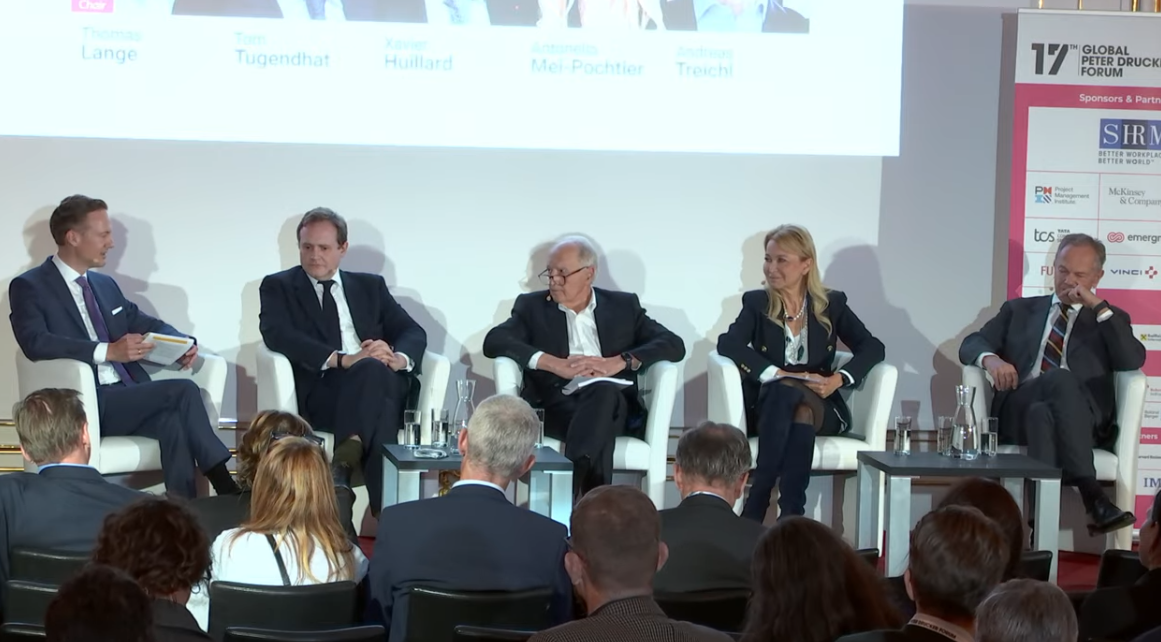
I recently attended a panel at the Peter Drucker Forum titled “The New Sciences of Managing Yourself.” The speakers, ranging from F1 performance experts to global CEOs, all landed on a singular, striking truth: High performance is not a business strategy; it is a physiological and psychological state.
If you want to lead in a turbulent world, you have to start in the driver’s seat of your own mind.
The F1 Principle: Recovery is Performance
Annastiina Hintsa (CEO, Hintsa Performance) works with 60–70% of the F1 paddock. Her secret? She doesn’t just ask drivers how they drive; she asks them who they are when they aren’t driving.
The Identity Trap: If your identity is 100% tied to your title (CEO, Manager, Founder), a setback at work becomes an existential crisis. To survive high pressure, you need pillars of identity outside the office.
The Pit Stop Mentality: In F1, you don’t stop because the car is broken; you stop to ensure it doesn’t break. Hintsa argues that sleep, nutrition, and mental energy are not “perks”: they are the prerequisites for the split-second decision-making leadership requires.
The Brain’s Verdict: Fear vs. Readiness
Eva Asselmann (Professor of Psychology) reminded us that our brains treat failure like social rejection. When the “internal alarm” (the amygdala) fires, we freeze.
Action Shapes Belief: Don’t wait to feel confident before you act. Self-efficacy, the belief that you can handle what’s coming, is built by doing.
The Story Matters: Your body feels the same during fear as it does during excitement (racing heart, sweaty palms). The elite leader reframes the story from “I’m scared” to “My body is pumping up to meet this challenge.”
The Leader’s Daily “Micro-Toolkit”
Niren Chaudhary (Former Chair, Panera Brands) shared six daily habits to bridge the gap between “knowing” and “leading.”
The Three Marbles: Carry three imaginary marbles into every meeting. Every time you speak, you lose one. Use them wisely to create space for your team to grow.
Learn and Love AI: Spend 30 minutes daily playing with AI. It’s not an end, it’s a means to stay curious.
Choose Courage over Noise: When the world feels chaotic, ignore the macro-noise and ask: “What can I control in my immediate community today?”
Practice “Wicked” Goals: SMART goals are for maintenance. WILD goals (Wicked, Illogical, Disruptive) are for transformation.
Build Grit in the Small Stuff: Do the extra five minutes on the treadmill when you want to quit. That’s how you train for the board room.
The Compassion Multiplier: Trust = (Competence + Character) x Care. Showing you care is the ultimate force multiplier.
Final Thought: The Diamond of Life
Niren closed with a beautiful metaphor. Life is not a flat marble; it is a diamond with many facets: work, family, health, and service. A leader who only shines in one facet is dimmed. To lead well is to do justice to the whole diamond.
Sustainable performance isn’t about running faster. It’s about knowing when to make a pit stop to finish the race.
Next Step for You: Pick one “WILD” goal for this month, something that feels slightly impossible. How would your approach change if you started at “impossible” rather than “achievable”?
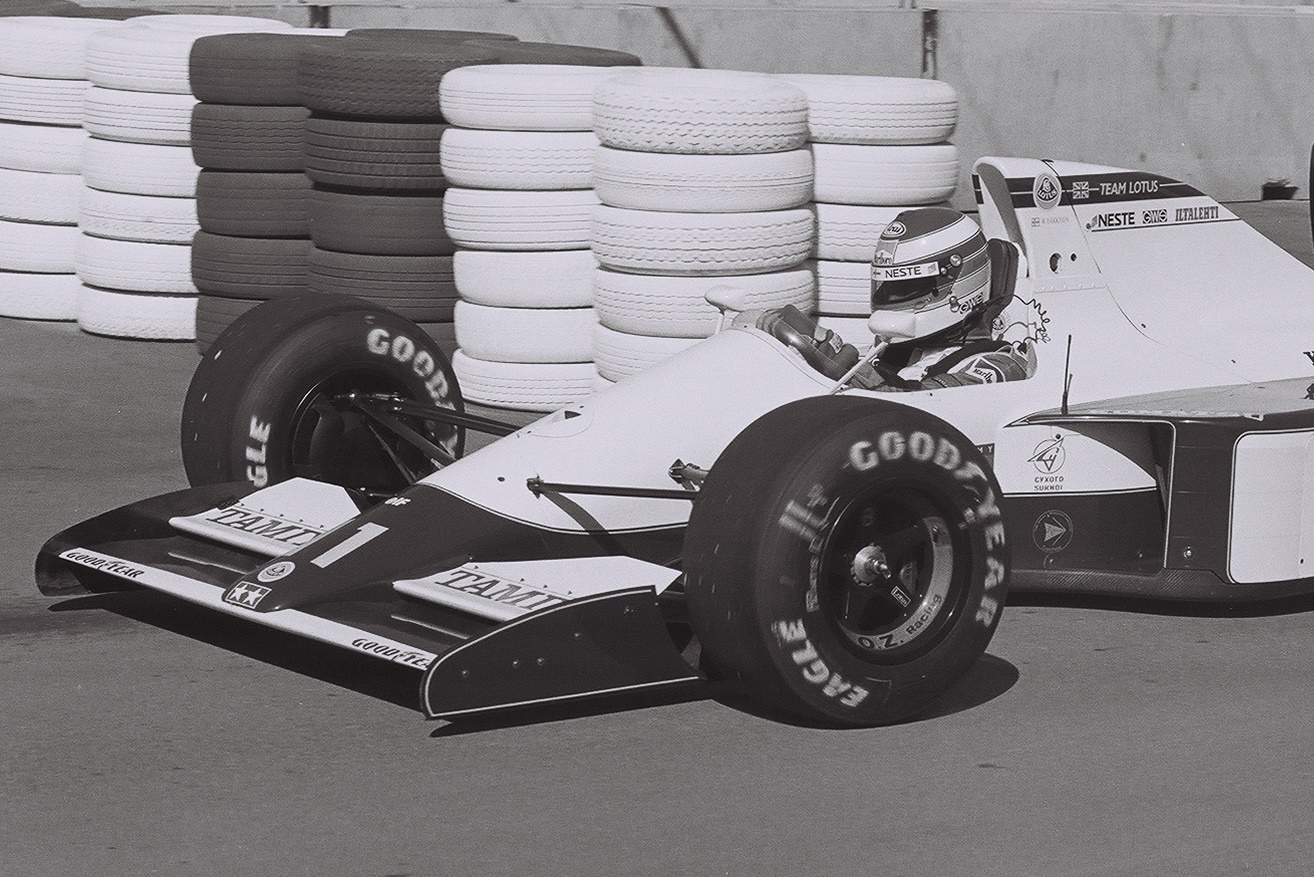
Picture by Stuart Seeger from College Station, Texas, USA – Mika’s Lotus Debut, CC BY 2.0, https://commons.wikimedia.org/w/index.php?curid=5495395
Three different people, from entirely different professional contexts, asked me the same question: “How do we actually create effective team agreements?”
It wasn’t just the synchronicity that struck me; it was the timing. It’s the start of the year, a season where we naturally audit what’s working and what’s causing friction. There seems to be a quiet, collective realization spreading across teams: We can’t keep working by accident.
From Assumption to Intention
Team agreements aren’t about rules or corporate control. They are about alignment. In the book I co-authored with Michael Doyle, I Am a Software Engineer and I Am in Charge, we describe these agreements as a living document, a shared understanding of our habits, expectations, and rhythms. It is the bridge that moves a team from assumption to intention.
We use the story of Sandrine to illustrate this. She starts her journey frustrated, feeling like her team is constantly out of sync. Her turning point comes when she stops waiting for things to change and realizes:
“How do they know what I need if I haven’t told them?”
By making her needs explicit, she helps the team do the same. That is the heartbeat of a team agreement: It begins with a conversation, not a process.
How to Start (or Restart) Your Agreements
If your team agreement is currently a forgotten doc in a wiki, or if you’ve never had one, here is how Michael and I suggest you breathe life into it:
Start with Frustrations and Joys: Don’t start with a blank template. Ask the team: What has been draining your energy lately? What moments last month felt effortless? Use these stories to find where agreements are actually needed.
Focus on “Moments That Matter:” Don’t try to legislate everything. Focus on high-friction touchpoints: How do we handle interrupts? When is it okay to say “no” to a meeting? What does “done” actually look like for us?
Co-creation over Command-and-Control: An agreement handed down from a lead is just a rule. An agreement built by the group is a commitment. If people help build the house, they won’t want to burn it down.
Review and Revise Often: Agreements should have an expiration date. Your team changes, so your agreements should too. Make them a recurring topic in your retrospectives.
A Tip from the Field
In my other book, Changing Your Team from the Inside, I explore how the simplest acts, like discussing how you prefer to receive feedback, can build immense trust. A team agreement is simply an invitation for everyone to say: “This is how I work best. How about you?”
Another Tip from the Field
I also love the way Isabel Monville approaches this. She often reframes the exercise by asking the team to look through the eyes of a newcomer: “What would a new team member need to know to be successful here? What is okay to do, and what is definitely not okay?” This shift in perspective makes the invisible “unwritten rules” visible, allowing the team to decide which ones are worth keeping and which ones are just bad habits.
Your Turn: A Small Experiment
Next time you’re in a team meeting, try asking just one question:
“What is one working agreement we could make today that would make our day-to-day easier?”
Pick one thing. Write it down. Try it for a week. Reflect. That is how agreements become culture.
Are you rethinking your team’s rhythms this year? I’d love to hear what’s working (or what’s driving you crazy). Let’s talk.
Some leadership lessons are best learned far from meeting rooms and org charts. Hospitality is one of those places.
In this episode of Le Podcast on Emerging Leadership, I had the pleasure of welcoming Francelina Amaral, a hospitality leader whose career has been shaped by service, attention to detail, and a deep respect for people. Our conversation explores what leaders in any industry can learn from hospitality, especially when it comes to onboarding, developing leaders, and creating a genuine sense of belonging.
We talk about onboarding not as a checklist or an HR process, but as an act of invisible hospitality. The kind of preparation that happens before someone arrives. The small gestures that make people feel expected, welcome, and valued from the very first moment. Francelina shares concrete stories showing how these moments shape engagement, confidence, and long-term commitment.
We also explore leadership as service. Not leadership as authority or control, but leadership that creates the conditions for others to succeed. Through real examples from her teams, Francelina explains how trust, safety, and attention to detail help people step up, take responsibility, and grow into leadership roles themselves.
Finally, we look at belonging. Not as a concept or a slogan, but as something built through everyday actions. How leaders sometimes unintentionally break belonging. And how simple, human behaviors can restore it, for both employees and guests.
Transcript of the Episode
[00:00:00] Alexis: This is Le Podcast on Emerging Leadership. I’m your host, Alexis Monville. Today I’m very happy to welcome Francelina Amaral. Francelina has built her career in hospitality, a world where welcoming people, caring for details, and creating meaningful experiences are at the art of the work. She has held leadership roles in international hotel groups across countries and culture.
Always with a strong focus on service, people, and excellence. What I find particularly inspiring in Francelina’s journey is how she connects hospitality and leadership. For her, onboarding is not a checklist, but an act of invisible hospitality. Leadership is not about authority, but about service, and belonging is something you create through everyday actions.
[00:01:00] This conversation goes beyond hospitality. It’s about what leaders in any industry can learn from it.
Francelina, welcome to the podcast on Emerging Leadership. How would you introduce yourself to someone you just met?
Francelina: I’m Francelina, I’m Portuguese. I’m passionate about hospitality, and about the service itself. I love to meet new people, to be with people, and yes. I think it’s this. I have a long career built in hospitality. And I think it’s this, I think my career reflects my way of being in hospitality, is the way that where I can feel myself at best. So I’ll say it’s this passion about people, hospitality, and working within this environment.
Alexis: You’ve spent a lot of time in environments where welcoming people really matters. When you hear the word onboarding, what comes to your mind first?
[00:02:00] Francelina: Straight away, we think about checking, you know, we think about starting something, we think about… or in my point of view, onboarding, I associate straight away with a team, with the way that we welcome new team members to our hotel, to our company, to our house. I would say it’s, for me, a very, very important moment on the process.
Alexis: You’ve spoken about onboarding as a form of invisible hospitality. What does that mean in practice?
Francelina: Because when we’re talking about onboarding, and referring to hospitality or even to other business, because I have an example, I can think about an example that really stood in my mind and made me shift a few of the things that I was doing till that moment onboarding. It’s what happens behind the scenes.
[00:03:00] It’s the moment, the important moment where you arrive to a place and you feel or not feel that they were ready for you, they were preparing for you. You either feel special or you feel just one more. You either feel connected, or you feel that, hmm, not waiting for me. Maybe it’s not the right place or moment to come.
So I think on the onboarding we have the opportunity to really make someone feel special, welcome, and understand that we are ready to welcome this person and that this person, it’s important for us somehow, based on what the person will do, what the position will be. I don’t think that at this point it’s about the position. It’s about really having someone new joining.
And I always say “our family”, because in hospitality we work as a family, as a wall, as a team. But normally I say “the family”.
[00:04:00] When I’m talking about being invisible, it’s because there’s so much preparation that we need to do if we don’t want to miss this opportunity of success. Everything starts before the arrival, let’s say. That’s why I’m saying it’s invisible. It requires preparation that starts with the HR department — the Human Resources department, sorry, I’m saying HR and maybe people are not familiar with the term — so with Human Resources.
Then we have the manager of the department that will welcome the person, or even myself if it’s someone that will be working together with me. So invisible in the sense that we gather all the information, all the important things that we put on this moment, so that people feel that since the very first moment, since the very first contact, that they belong.
[00:05:00] Alexis: Interesting. Can you share a story of an onboarding experience where you felt genuinely welcomed?
Francelina: I will tell you — and it’s a recent one. It’s not an onboarding, but it is the feeling of really feeling welcome, as we were discussing. I just moved back to France. I’ve been in France, in Paris, from 2017 to 2021. Then I left back to Portugal, and now I’m back. I’m back with the same IHG to manage a different hotel.
Of course a different property, but when I went back to Portugal I left colleagues and some friends here in Paris that we, even though we don’t communicate on a daily basis or weekly basis, we do have the connection through the hotel, through some friends that we have there on the same group.
[00:06:00] And the best experience that I have, and it is the most recent as well, is my return to France, the way that I was received and welcomed back. Since the transfer — they went to pick me up at the airport — they managed that the driver was someone that I worked with in the past. So he recognized me.
And this was like I say, oh my God. So that was the first thing. I arrived to do the check-in in the hotel where I stayed. It was not this one. I stayed in the Paris Center, in the hotel that I managed before. And the general manager, she did everything, just to the little detail.
There was the check-in, then it was one of my preferred bedrooms that she prepared for me together with the team. I had the “welcome back to Paris”. I had, of course, the bottle of champagne, not to miss when we are in Paris.
[00:07:00] But all the details were really… like I was telling her, it was so important to me at that moment that I felt like I never left. I felt like I’ve been there all the time. So yes, this is the feeling of belonging. This is giving the importance of understanding the importance that a moment like this can have on an experience that will stay, and that will lead the experience, I would say.
Alexis: Yeah, I feel it’s really inspirational because unfortunately I cannot tell the same story about an onboarding that I felt really welcomed. And I believe that teams lose something when they treat it just as a process. And what you’re mentioning is it’s really about how people feel, and really get them to feel they are welcome, they belong to that new group, even if they are just there for five minutes.
[00:08:00] And I believe it’s really strong.
Francelina: It is, Alex. We do a lot. One of our aims, and I support it a lot, is… because my career started in hospitality because someone gave me the opportunity of being a trainee in a luxury hotel. That was one of the best hotels that we have in London. So this opportunity was given to me long time ago and it stayed with me.
It stayed with me to the point that every time I have the opportunity of welcoming trainees, and I see that the trainees are really looking forward — it’s not to have a stamp on their school practice — I open the doors and I encourage all the time my department and managers to do the same.
And the good thing is, when you meet these trainees at the end or in the middle of the internship and they come back to you and they thank you, and they thank you for the way that they were welcomed at your hotel. So this shows the importance of the moment, and how the moment can affect you, or can conduct the way that you’re gonna be at this place, and even in your life, I would say.
[00:09:00] Alexis: So it’s really interesting and fascinating to me. I was lucky enough to work in one hotel you managed near Lisbon. And I thought it was very funny to see how people are handling things that could seem very simple, but it’s not so simple.
It’s not necessarily easy to park your car. It’s not necessarily easy to understand how it works because you’re new. And of course all the people who are there know about everything. They could try to explain to you or whatever, but you arrive, you are… I use the GPS to find the place. I don’t know where I’m going, so I finally find it.
Oh, I’m going there, and there’s someone welcoming me there, and I wonder where to park the car. And they say, no, just leave it there. It’s okay. Don’t worry about it.
Now they know why I am there and everything goes smoothly. And even before I realize, we are sitting on the terrace and having a fantastic chat.
So it’s very funny that it’s removing everything, removing all the frictions for someone to enjoy the place. It seems very easy. It seems very simple. I believe it requires a high level of discipline to reach such a high level of service excellence.
[00:10:00] So how do you balance the hospitality that you describe with the rigor needed to achieve that level?
Francelina: I think important for this experience… and I’m trying, or doing my best, to share what’s happening behind the scenes because yes, a lot of the preparation that you are just mentioning happens behind the scenes. So that you can arrive to a place and feel that yes, they were waiting for me. They remove all the problems or situations from the way so I can be at my best and enjoy that.
There’s two important components. One is that we need to love service. We need to love what we do. If you understand that what you are doing is to bring joy, to bring experience, to bring memories to the ones that are just in front of you, to the people that you are welcoming, then you got it.
Because if you like service, you like people, and you have the opportunity — and it’s an opportunity — to be facing guests like I faced you, like I face on a daily basis. And it doesn’t matter how important… it’s about the experience that the person in front of you can bring to your life and to you.
[00:12:00] Now I spend hours and hours with my clients, sometimes just listening to their stories, and I learn a lot about the world, places that I never been in my life, that they can share with you their experience.
So first we need to understand that it’s really an opportunity. And then yes, there’s a lot of procedures behind it, but the procedures become something that you do by heart, and not because you have a standard behind to tell you “you need to park the car, you need to open the door”. No, this will come naturally, I would say.
Alexis: It’s very interesting. So it’s focusing on how people will feel, and it’s focusing on how the people doing the job feel about it, and the rest is coming after. It’s not going in the opposite direction.
Francelina: I think — and let’s go back to the onboarding experience — if you do an experience where you manage to touch the person that is arriving, where you manage to show the person “this is how I care about you, how much I care about you”, and about what you’re gonna give to me in the future, of course — because this is the way that we welcome, and this is the way that we want you to do as well — the person will understand.
[00:14:00] And the person will give you the same… I’ll not say amount, but the same type of compromise with you, of commitment.
So yes, I would say that we are clients. I always say to my manager of human resources, I always say: we are your client. Because internally, yes, we have requests, we have needs, we have a family to take care, and sometimes it’s with this person that we have a bit more space to talk about, or to ask advice.
And the same with our guests. They stay with us, they ask advice of where to go for dinner, where to go. Of course it’s a different reality, but inside a hotel there’s another hotel, there’s the managers.
Let’s focus on the canteen, the staff canteen or staff restaurant. We have some colleagues that do their best so we can have a wonderful meal inside hotel. And this is not at the eyes of the guests, but it’s at our eyes.
This duality — if we manage to give the same importance that we give to our guests — then it works. We say: treat well a guest, he will talk to friends, he will come back, he will bring more people. So it’s really the way of keeping the business going.
Because at the end, yes, it’s a business, but it’s a business that if we do it, if it’s our passion and if we give our best… it’s like the saying: sometimes you don’t feel that you are working, you feel that you are really being part of a wonderful experience. Same needs to happen behind the scenes.
[00:16:00] Alexis: It’s very interesting that to really bring that level of care to the guests, you need to bring that level of care to the employees of the hotel.
Francelina: It’s the same. You as a guest, you will feel when an employee is doing by the book, or because he was told to do, or because it’s the standard — or you will feel because he’s doing his best. He’s really trying his best to accommodate your needs.
Of course there’s a standard. Of course we cannot be intrusive. Of course we have a few recommendations that our employees respect. But a lot of the interactions — what makes an experience different and ultimately a great memory — is what they give from them.
Alexis: You’ve seen a lot of people developing themselves, or you help a lot of people developing themselves during your career. What happens for them? What are the things that happen for them to start leading the way? How do you see that happening?
[00:17:00] Francelina: I’m going back again to my history and to my career. I was given the opportunity by my leaders at the time to develop myself. And one of the things that I have is that I’m very curious. I like to know why I need to do this, and why it needs to be this way and not that way. Not that curious anymore, but at the beginning.
Because again, I was passionate about this world of hospitality and I wanted to understand everything. So I would say that when you have in front of you a team member that is curious, that wants to understand and learn, you have a potential leader in this person. Because they will be curious, they will understand why we are doing the things the way we are doing them, and they will share this with others.
So on a team you have team members that will be there giving their best to the performance of the hotel and the experience of our guests. And you’ll have team members that will do an extra effort and will lead the process: they will correct the colleague if the colleague is not doing the right thing, they will come back to you with feedback that you haven’t seen, they will focus on details.
So when you have someone that starts to have these kinds of behaviors, then you understand that you are in the presence of someone that if you push, if you develop a bit more, if you dedicate a bit more, you can grow a leader.
[00:19:00] Alexis: It seems very easy to do when we listen to this, but sometimes it’s not easy, and sometimes even if you give the chance to some people they will make mistakes.
I remember vividly one time I was in Spain. The table we had was not far away from the bar, and we could see that there was clearly a more experienced woman talking to a very young guy who was doing the service. I could see that she was explaining carefully something and the guy was not very at ease.
And he’s going away with one bottle and two glasses… and three steps after, the bottle is on the floor and the glasses are broken.
And the woman goes around the bar, she already had a new bottle and two new glasses.
Francelina: Very fast.
Alexis: And she went to the guy. And I assumed that she would go to serve the customers, but she did not. She just gave the new glasses and the new bottle to the guy and she said, “oh, no passa nada”.
Francelina: Nothing happens.
Alexis: And she starts cleaning up the mess. And I was looking at that thinking: what just happened? And I don’t know, but the guy seemed absolutely okay after that.
And it happened in a snap, and there was no shouting, no big thing. And I’m pretty sure — I was looking around — not even all the people in the room noticed something happened.
[00:21:00] Francelina: That is a great example, Alex. This is how you build safety, how you build confidence in the person first.
You should not shout because it’s not a way that people learn. And it’s not the type of behavior that we expect from a leader or a manager or even a colleague. It’s not a way.
So what she did was to clean the situation, and to give new tools — the glasses and the bottle — to the employee, not giving him time to think “I failed”. No. These are things that happen. I’m here to support.
So she invests confidence. She gives him a boost of confidence saying “voilà, no passa nada, you go and you do what you need to do, and I’ll be cleaning up for you.” This is the foundation of leadership: when you manage to transmit confidence to your team, even though something that was not supposed to happen happened.
I like to think — and I always say this to my team — our team members are looking at our actions on a daily basis. So before being a general manager, my acts, the way I behave, is what they will see. They will see the title, of course — “Madame…” — but how is Francelina there? How come she’s there?
When I arrive, everyone knows from the teams I work with: I’m passionate about flowers, decoration, and details. So when I arrive in the morning, when I do the tour, I will have a look at the flowers. And I remember colleagues saying: “this is not in conditions, Francelina will see.” And it is true.
They will take care of it because Francelina will see, and because they understand how important it is for the way we present our lobby, or flowers in a room.
[00:23:00] So all the details count. What counts is actions, because they will see me remove something that is not in the right condition to be facing the guest.
So it’s actions. And what this manager in Spain did — encouraging the colleague to continue his job, removing the pressure of the situation — it’s one of the best examples we can have of how to build leaders and confidence, saying: listen, you go. This is teamwork.
Alexis: Yeah. And you mentioned something important: you’ll notice the details or even fix it yourself when you are doing the tour. It’s not just about telling others, it’s really acting, showing that it’s very important indeed.
Francelina: It is.
Alexis: Can you describe the moment when you see someone stop doing their job and start really leading?
[00:24:00] Francelina: I believe that is when you take ownership of situations. I would say problems, but it’s not only problems, it’s situations.
It’s when you see that someone comes to you, or to colleagues, or to a guest, and passes on: “don’t worry, I’ll be taking care of this.”
When you manage to put yourself in the shoes of a guest, of a situation, and you take the step of dealing with it, of assuming it, and saying: “I’ll come back with a solution.” This is one of the first behaviors that we see in a leader, or someone with the potential to become a leader.
When you see someone that is worried not only about the moment, but already thinking ahead.
Let’s take the example of the bottle and glasses. Maybe after the incident, the person who cleaned might talk to the colleague and say: “listen, you know why this happened — it happened because you didn’t hold the bottle as you should. I’m going to show you the most suitable way to do this.”
Maybe she’ll take this moment of stress and pressure and make it a moment of learning. Or if it’s not the fault of the colleague, she may take further action and say: maybe we need a procedure to show everyone that we cannot do it this way, it should be done another way.
This is the kind of actions you see in a leader: they don’t wait for a manager to go and find the solution.
[00:26:00] Alexis: Taking that moment as an opportunity to learn, and immediately while working on it, sharing it, trying to refine what we can do, how we can do things. I love this.
There’s a lot of leadership best practices in the world. We can see a lot of them on LinkedIn. What are the common leadership best practices that actually destroy belonging in reality, instead of building it?
Francelina: I would say what destroys not only leadership but a team, an entire team, is the lack of trust. The lack of drive. The lack of sharing.
It’s very important when you’re talking about the feeling of belonging. We are talking about more than… and going back to onboarding or to the way you welcome someone: you need to make them feel part of the problem and of the solution as well. They need to feel accountable for everything.
Of course there’s decisions and some situations that are held and managed by the manager or by myself. But if I share the reason why, if I share the result, then you will have the people with you.
Again, I like to inspire. I think I have been inspired by my leaders. And this builds trust, this builds confidence, this builds the engagement that we want.
I’m sure that if you talk to my previous leaders, they will tell you: yes, Francelina is someone that we can rely on. Because I learned so much from them that I’m there for them when they need me.
And I think this is the role of leadership: showing the way, sharing the knowledge.
Which is quite different than what we did in the past. In the past, we had a general manager or an HOD behind the desk dictating: “this is the way I want things to be done,” and no reasons why.
Sharing results — for example, in IHG, every general manager will do it the way they believe is the best for their team. But we have a culture of sharing results. We have a culture of empowering people on our teams.
And as soon as you are empowered, then you are given responsibility. Then you put more of yourself. Then you feel that you belong. Then you understand how important your work is for the success of the company, the hotel, and the goals we want to achieve.
I give you more examples of what builds than what destroys, but leadership is destroyed by lack of trust, lack of confidence, the wrong way of managing things. And there’s not one correct or wrong way, but the wrong way is when you don’t share the reasons.
I’m not gonna say the word authoritarian, but if you do it in a mandatory way: “this is mandatory, this is this.” No.
Share. Listen to your team as well. Share as much as you can. Of course a few things are not to be shared and this is okay, and they will understand. Because they know every time you can share something that will affect them, or help us move, help us achieve results, they will feel belonging and they will give their best.
[00:30:00] Alexis: Excellent. I love this. We are gently going to close. But before we close, I will ask you a question. What is the one question I should have asked you?
Francelina: What is the one… You asked the question, you asked what was the moment of my onboarding, where I felt most welcome. Probably — and this is not a question — but why Francelina, the general manager in hospitality, is present on your podcast when your industry, or your career, is built in different areas and not in hospitality.
Alexis: Yeah, that’s a very good question. Just listening to you, I was thinking: it would be so great if we had leaders in all industries behaving exactly like you described. Because I’ve been within companies, working with companies, working with clients, where they still don’t understand what good onboarding means and what is the impact.
Showing the way, going on the tour, looking at every detail, talking to people, listening to their team, working on the sense of belonging, safety, trust, building trust within their team — they still don’t understand why it’s so important.
So why it makes sense to have you on the podcast: it’s so easy. I believe there’s a lot to learn for leaders in all industries. I’m very thankful, grateful that you joined the podcast because there’s so many things we can learn from you. Thank you for joining. I really appreciate that.
[00:32:00] Francelina: Me too. It’s important. It’s a moment of sharing, and I love sharing. I’ve been doing this lately more than I used to do in the past. Exactly because going back to our industry — hospitality — I felt the need of sharing not only my experience, but sharing what hospitality really is.
And at the level of luxury, yes, but I always say that luxury… we can take luxury to all the details of the things that we do. We don’t need to be in a luxury environment. Luxury is respect. Luxury is understanding the need, anticipating the need. It’s behaving. So for me it’s all this.
And having your invitation to participate on the podcast, it’s another opportunity that I have to talk about this and to hopefully inspire not only leaders or managers, but the young generation that is still not understanding if they like hospitality, if they are willing to go to hospitality.
So if I can inspire at least one or two people with our conversation, I’m already really happy, and with a sense of achievement that makes me feel very good. So thank you.
[00:33:00] Alexis: Excellent. I love it. Thank you very much, Francelina.
Before we close, if this conversation resonated with you, I’d really encourage you to share this episode with one or two people in your life — someone you work with, someone you lead, or someone you are learning alongside. Your recommendations truly matter. They help this podcast reach people who could learn from these conversations and apply them in their own context.
You’ll also find the full transcript of this episode in the companion blog post linked in the description. It’s available on alexis.monville.com. If you’d like to revisit a specific moment or share it in written form.
Le Podcast on Emerging Leadership is supported by Pearlside. At Pearlside, we work with leaders and teams to create the conditions for responsibility, clarity, and impact to emerge. You can learn more at pearlside.fr.
Anger is one of those emotions we’re taught to see as bad, unproductive, or destructive. We learn to calm down, to let it go, to avoid it.
But what if that instinctive rejection of anger is actually making us less effective as leaders, as coaches, and as human beings?
This is where the work of Phil Stutz, the psychiatrist and author, gives us a powerful reframe.
Stutz is known for his long career in therapy (he began working as a psychiatrist in New York and later in Los Angeles) and for co-authoring books like The Tools and Coming Alive. More recently, his short essays were collected in Lessons for Living: What Only Adversity Can Teach You, a book full of reflections on real human challenges, including one titled The Positive Side of Anger.
Anger as a Signal, Not a Problem
Stutz doesn’t dismiss anger. He doesn’t see it as a flaw in character or something to be sublimated or ignored. Instead, he treats anger as information: a powerful emotional signal that something important is being violated.
When we feel angry, Stutz suggests, it is because something deeply matters to us. It’s a boundary signal, a marker that a value has been crossed or a personal standard has been ignored.
The trouble doesn’t come from the anger itself, but from how we respond to it:
If we suppress anger, it often turns inward as depression, apathy, cynicism, or self-criticism.
If we explode with it without reflection, it becomes blame and conflict.
If we instead own the anger and clarify what it is protecting, it becomes energy for change.
Stutz’s approach here is subtle but powerful: anger is not the problem, mismanaging it is.
Why Anger Is Useful
There are three important truths about anger that come through in Stutz’s writing:
Anger pinpoints what matters most. It’s not noise. It’s a directional signal that something significant for your identity or values is at stake.
Anger holds energy. Rather than draining us, when we own anger and interpret it accurately, it becomes fuel for clarity, resolve and action.
Anger is a stepping stone, not a destination. The aim is not to indulge anger, but to use it to uncover what needs to change and then move toward that change with intention.
In this sense, anger cleans the lens through which we see a problem. It helps us see beyond surface discomfort to structural issues like unmet expectations, crossed boundaries, or values under threat.
How This Applies to Leadership and Work
In organizational life, anger often shows up:
when leaders are exhausted by repeated blocks,
when teams feel undervalued,
when stakeholders ignore boundaries,
or when performance feels misaligned with values.
Too often, leaders either minimize anger or react to it without reflection. The result? Resentment, turnover, disengagement, burnout.
Stutz’s perspective gives leaders a different path: Use anger as a compass.
Ask:
What boundary is being crossed?
What value is being violated?
What concrete action would protect that value?
This shifts anger from a reactive emotion to a source of agency.
The Broader Stutz Framework: Adversity as Growth
Stutz’s book isn’t just about anger. Lessons for Living is structured as a series of essays on universal human challenges: envy, insecurity, bad habits, conflict, and yes, anger. What unifies them is a deep conviction that adversity is not a sign of failure but a teacher.
Rather than trying to avoid pain or conflict, Stutz invites us to face these experiences with curiosity.
A Practical Takeaway
Here’s a simple reframing you can use immediately — for yourself, or with a client:
Anger is not the enemy. Anger is the part of you that still knows what matters and refuses to give up.
That’s not a dismissal of discomfort. It’s an invitation to listen to what’s being said beneath the emotion.
In Practice: A Short Coaching Prompt
When someone says “I’m angry”:
Pause and validate “Anger tells us something matters here.”
Ask the deeper question “What boundary feels crossed?” or “What value is being defended?”
Solicit concrete action “What is the smallest next step that honors that value?”
Move toward ownership “What part of this is in your control right now?”
This turns anger from a stumbling block into a stepping stone.
We’ve all been there: You wrap up a powerful, high-energy, face-to-face quarterly meeting. Your leadership team is aligned, initiatives are clearly defined, and everyone enthusiastically volunteers to lead their respective actions.
You walk away feeling unstoppable… until you get back to the office.
Now, weeks later, you find yourself having to push every team member, individually and collectively, just to get the agreed-upon initiatives to budge. It’s frustrating, energy-draining, and makes you wonder: Why the resistance?
This is where a fun concept from psychology can shed some light.
Introducing: “Musturbation”
Coined by the influential psychologist Albert Ellis in the 1960s, Musturbation is his term for the human tendency to hold rigid, absolute, and irrational demands on ourselves, others, and the world—using words like “must,” “should,” and “ought.”
In the context of our post-QBR frustration, the “Musts” are likely manifesting as:
Your Internal Must: “They must execute on these initiatives without me having to chase them, because they agreed.”
Their Potential Internal Musts: “I must focus on my daily urgent tasks first,” or “This initiative must be perfect before I show anyone the progress.”
The Leadership Lesson: Stop Musturbating, Start Facilitating
The moment we believe our team “must” behave in a certain way, we replace clear, flexible facilitation with rigid, frustrated demands. We assume that agreement in a meeting translates directly into smooth, effortless execution, but that is rarely the reality in complex work environments.
Instead of operating from a place of frustration (“They must do this!”), leadership needs to:
Acknowledge the Obstacles: People return to a whirlwind of existing demands. The quarterly initiative is often a “should-do” competing with daily “must-do’s.”
Translate Agreement into Action Systems: Did you define the first next step? The accountability mechanism? The weekly check-in?
Replace Demands with Preferences: Shift your thinking from: “They must do this for the company to succeed.” (Rigid, frustrating) TO “I strongly prefer they do this, so what flexible system can I put in place to help them succeed?” (Flexible, empowering)
If you’re tired of pushing, stop assuming the “must” and start designing the system that enables success.
What is the most common “Must” you hear (or think) in your leadership meetings?
In many leadership workshops, we introduce a simple idea that quickly becomes a powerful lens: the idea of the line.
Above the line, we are open, curious, and ready to learn. Below the line, we are closed, protective, and trying to get through the moment.
It is easy to assume that one is good and the other is bad. But that is not the point at all. The point is simply to notice.
There is something almost like a leadership version of the Heisenberg principle. We cannot predict with certainty whether someone will be above or below the line in a specific situation. We can guess. We can know habits, patterns, preferences. But we cannot know for sure.
A difficult conversation, a stressful deadline, a sense of threat, a flash of insecurity, an unexpected constraint. Anyone can drop below the line. Likewise, the right environment, a supportive colleague, or a moment of clarity can shift someone above the line just as quickly.
There is no moral judgment in this. There is only awareness.
A big part of what pulls us below the line is our relationship with pain and uncertainty. Uncertainty carries the possibility of discomfort, disappointment, or loss, so our first instinct is often to avoid it. We try to control it, fix it, or eliminate it. This creates a kind of tension inside. We are not reacting to what is actually happening. We are reacting to the possibility of pain.
That is why uncertainty can feel like a wave we want no part of. If we are below the line, the wave seems unpredictable and dangerous. We brace. We contract. We try to make the wave smaller or make ourselves smaller. The energy becomes something to resist.
But above the line, uncertainty takes on a different meaning. Surfers know this well. A wave is not an enemy. It is a source of movement and energy. It is something to ride, not something to fear. When we stop trying to protect ourselves and start being willing to learn, the same uncertainty becomes possibility. It becomes play instead of pressure.
My friend John Poelstra, an executive coach based on the US West Coast whom I highly recommend, once offered a metaphor that may be even more helpful than surfing: dancing. Surfing is an individual sport. Dancing requires relationship. It requires sensing another person, adjusting moment by moment, and sharing leadership.
In a dance, the question is not Who is above or below the line?
The real question is How do we move together, given where each of us is right now?
Dancing works only when there is responsiveness. And responsiveness begins with noticing.
In teams, just like in dance, we cannot control whether people are above or below the line. But we can cultivate shared awareness. We can normalize the idea that both states are human. We can learn to pause. To breathe. To reconnect with intention instead of fear.
Above the line is not a superior state. Below the line is not a failure. Both are part of being human. The shift comes from recognizing where we are and choosing how we want to engage with the wave in front of us.
As you think about your week ahead, here are a few questions to explore:
What signals tell you that you are dropping below the line?What helps you return above the line without forcing it?How do you react when someone else is below the line?What would change if you stopped trying to avoid pain and started working with uncertainty instead of fighting it?
Andreas Treichl, Chairman of the Supervisory Board, ERSTE Foundation
The discussion revolved around one essential tension that leaders face today. When should a leader simply focus on running the business, and when should they take a public position on broader social and political issues?
What struck me during this conversation is how deeply connected this question is with the polarity between the short term and the long term. It is not a problem with a single right answer. It is a polarity to manage carefully and continuously.
The world today pushes leaders toward the short term. Shareholder pressure. Quarterly expectations. Electoral cycles. Social media outrage. Geopolitical shocks.
Yet almost every speaker insisted that leadership requires something very different. It requires seeing beyond the urgency of the moment.
Tom Tugendhat said it clearly. Politics often operates on very short time horizons. Electoral cycles and media storms pull elected leaders into the daily fight. But business has the opportunity, and even the responsibility, to bring in long-term thinking. Decisions on energy, technology, rare earths, supply chains, and defense have consequences that unfold over decades. When business leaders focus only on the short term, society loses one of the few voices capable of thinking beyond the next three years.
Antonella Mei Pochtler added another dimension. Many global companies face situations where taking a stand is difficult, because they operate across countries that are in political conflict. What position should a company take when the United States and China oppose each other, and the company depends on both markets? Taking a stand might hurt the business. Not taking a stand may quietly support an authoritarian regime. This is a long-term dilemma: protect immediate business interests or defend values that ensure long-term legitimacy.
Andreas Treichl offered a complementary warning. In recent years, many companies, governments, and institutions pushed too fast on various ESG topics without bringing people along. The result was a backlash that played directly into the hands of populists. Progress that does not match the pace of public understanding eventually works against the long-term goals it tries to advance.
This brought the conversation back to a fundamental point. For a democratic society to function, people need to understand how their institutions work. And that includes their companies.
Several speakers argued that companies should be radically transparent with their employees. Explain how the company really makes money. Explain the pressures, the constraints, the trade-offs. Help people understand why they are paid what they are paid, and what decisions shape the future of the business.
When employees understand the inner workings of the company, they become less susceptible to manipulation from populists on the left or the right. They develop a deeper sense of agency and clarity. They can then participate more confidently in long-term decisions.
This is where the polarity of short term versus long term becomes visible inside organizations too. Short-term secrecy may simplify life for leaders who prefer not to explain everything. Long-term transparency is harder, but it builds understanding, resilience, and trust.
To help visualize this polarity, here is the polarity map for Short Term and Long Term.
The panel reminded me that next-era leadership is not only the capacity to take a stand. It is the capacity to take a stand while thinking across decades. It is resisting the pressure to react to every wave of anger or confusion, and instead building organizations where people understand, participate, and grow.
It is also refusing to be neutral when neutrality reinforces oppression. Some speakers insisted that not taking a stand against an authoritarian regime means silently supporting it. Others insisted that taking a stance could put thousands of employees or billions in revenue at risk. There is no simple answer. But the conversation made one thing clear. Silence is a choice. And choices shape the long-term world in which we all live.
This brings me back to the core idea of Emerging Leadership. It is the practice of creating systems where people take responsibility for both the next step and the next generation. It is the discipline of balancing urgency with vision. It is the courage to create organizations that serve society, not just the quarter.
As we close, here are the questions I invite you to reflect on this week:
Where in your leadership are you being pulled too strongly into the short term?Where should you be taking a longer view to serve your team, your organization, or society?What would more transparency inside your organization make possible?What stand would you take if you were not afraid of the immediate consequences?