Tag: leadership

  • Leadership and Teamwork in a Crisis

    Leadership and Teamwork in a Crisis

    In this episode of Le Podcast, I had the pleasure to welcome Jeremy Brown, Chief Product and Technology Officer at Traveldoo (Expedia Group). We talked about leadership and teamwork in a conversation that quickly became emotional, because the travel industry has been hit brutally hard by the pandemic.

    Jeremy describes the last year as a shock to the system: a sharp drop in activity, painful downsizing, and a heavy human cost for the people who left and for the people who stayed.

    Leadership when the context is not yours to control

    Jeremy shares a powerful reflection: it’s easy to be a leader when everything is going well. It’s much harder when things are not going well, and even harder when you don’t control what makes it hard.

    And yet, he sees growth in himself and in his leadership team. Not the kind of growth you would choose, but the kind you can’t avoid.

    What leadership means to Jeremy

    Jeremy makes a clear distinction between leaders and managers.

    For him, leadership has two parts:

    1) Direction, and explaining why
    He uses a simple image: when you navigate a forest, the leader is the person who climbs a tree, looks out, and points the direction.

    2) Being human
    Leadership is not about performing perfection. It is about staying connected to people, admitting the struggles, and creating space for the complexity everyone is carrying, especially when work and home blur.

    He also links leadership to self-awareness: the more he gets to know himself, the better he becomes as a leader.

    From office-first to remote, then to asynchronous

    Traveldoo moved from an office-first culture to fully remote work. Jeremy explains that the first phase was about replicating office habits with video calls and Slack. Then, over time, the team used retrospectives to learn and adjust.

    A key shift: moving status reporting and coordination toward asynchronous collaboration.

    One example Jeremy shares: a release meeting that started as an in-person ritual became a video call, and later turned into a Slack workflow. The direction is clear: fewer meetings, more written collaboration, more focus time.

    Inclusion and participation in remote settings

    Jeremy notes something interesting: remote work can be more inclusive when you intentionally change behaviors.

    They introduced simple mechanics like hand signals in video calls, explicitly inviting quieter voices, and asking the question that often brings the best insight:
    “I notice you didn’t comment, is there something you want to add?”

    It’s not perfect, but it’s a real move toward better collaboration.

    Recognition, energy, and the long game

    Jeremy shares something many leaders can relate to. As a developer, he loved moments of flow: losing track of time while creating something.

    As a leader, the reward changes. It becomes more long-term:

    • seeing the payoff of investing in people
    • watching language and behaviors spread across the organization
    • noticing progress in the metrics over time

    He’s also very clear on recognition: he prefers continuous call-outs and small wins over big award ceremonies. Recognition close to the moment has more impact and is more fair.

    What drains energy

    Jeremy mentions two drains:

    • toxic or immovable behaviors that resist change no matter the investment
    • the frustration of caring deeply and feeling others don’t understand why it matters

    He connects this to his CliftonStrengthsFinder profile: his top strength is Belief, which makes him go all-in when he commits to something. When the “why” doesn’t land with others, it can be draining.

    Advice for leaders who want to grow

    Jeremy’s guidance is straightforward and practical:

    • know yourself (tools can help: CliftonStrengthsFinder, Kolbe, others)
    • choose your environment (the people around you shape your growth)
    • seek challenge (you grow when others challenge your behaviors)
    • deliver results without burning people
    • invest in relationships across the organization

    And if you’re not in an environment that helps you grow, change it.

    †

    If you think about trying to navigate through a forest, they’re the person that climbs up the tree and looks out over the forest, and points you in the direction where you need to go. I think that, typically, I would expect leaders to have a clear vision of where we are going, and perhaps more importantly, explaining why we’re going in that direction.

    Jeremy Brown

    Here is the transcript of the episode:

    Alexis:

    Hey Jeremy, thank you for joining Le Podcast. Can you tell us a little bit more about you and your background?

    Jeremy:

    Hey, Alexis. It’s great To be here. So yeah, a little bit about me. I’m Jeremy. I’m Irish. I’m actually half Irish, half Finnish. I live in Paris, where I’ve been here for about five years. Currently, I guess my background, I’m an engineer. That’s been my history, but I think I have also probably one of the most, I think, fairly diverse backgrounds for someone in my position, because while I’ve worked as an engineer on low-level things like the operating system of mobile phones, I’ve worked as a consultant doing very large scale Java implementations. I worked in pre-sales. I’ve worked in sales as an actual sales person. I, with a friend, started a startup incubator in Cameroon of all places and helped local entrepreneurs start tech businesses in Cameron 10 years ago. So it was pretty crazy. Yeah. So really lots of different things. And I would say my background and my passion is about building products and the teams and the systems that build those products. I think that’s really my passion and what everything has led me to today.

    Alexis:

    Today you are chief product and technology officer at Traveldoo, right?

    Jeremy:

    Yes. Yes.

    Alexis:

    So it directly connects to your passion of building products.

    Jeremy:

    Exactly. Yeah. And building products, and we’ve been, Traveldoo is a subsidiary of Expedia. We’ve been changing how we work as well. And I think that the majority of my work has been a little bit less on the product and actually more on how we build the product and how can we change how we do that that has a material impact on our customers and our users.

    Alexis:

    So of course, as soon as we said travel in the current context, I need to ask you a question about all that current situation that pandemic is affecting your business and the way you work.

    Jeremy:

    Alexis, this past year has been, I think, one of the hardest that I’ve personally experienced on multiple levels. Obviously, like everybody else just in a personal level of trying, the pandemic clearly had an effect on our personal lives. And we have a small child at home. He’s less than two. And we were, in March, we were all at home, and there was no crash. And we were busy juggling him and trying to get on with work.

    Jeremy:

    But of course, more than that our business is a travel and expense SAS business. And we went from people booking travel, where we were doing millions of transactions in a year to 80%, 90% down on the previous year. So from a business perspective, we’ve had, I would say, an extreme shock to the system.

    Jeremy:

    There’ve been a lot of implications to us as a company and the product team. We’ve had to let go of our contractors that we had. We’ve had to half of our team are contractors based in India, and we had to significantly downsize that team as well. And the people cost for us has been really high, not only for the people that we had to let go, and contractors, I really saw them as our own staff, but then for the people who are still here with us, they’ve had to, not only like everybody else, had to make a transition from being co-located in two different offices, one office in Paris and one office in India. But they’ve also had the personal challenges. And then, I think when you’re in one of the companies that’s heavily affected by the pandemic, it adds an extra stress and a worry for the staff compared to one of the companies where they’re benefiting from the current situation, because there are winners and losers right now. We’re definitely a loser. So it’s been hard. Yeah. That’s how I’ll summarize it. It’s been a tough year. Yeah.

    Alexis:

    I can hear that. It’s, of course, always difficult to imagine what people feel about it. I understand that you’re focused on, of course, the business is impacted, but that’s the big people cost. And I’m sure that if you see people around you let go,, it’s always affecting you. You cannot just be satisfied of being lucky and still having a job. That’s not the way it works. Of course, it’s very hard. So, yeah. It’s difficult to go to the next question.

    Jeremy:

    Well, all I would say is that that this has been, I think, a test for all of us, for myself. While it’s really tough. I would say that the growth in yourself, I guess like in hard times, you grow more like, just like you prune plants to help them grow in the next growing season. I think, I feel like the one thing that this has done for me is it’s helped me grow as a leader. It’s very easy being a leader when everything’s great. It’s much harder being a leader when things are not great, and it’s even harder when you don’t control a lot of the things that make it not great. I don’t just speak personally for myself. I speak for my leadership team and what they’ve had to handle.

    Jeremy:

    And I would also add that, we have dealing with customers who are also many of them struggling, because I would say that a large part of our business is with travel agencies. They’ve been even more heavily impacted than ourselves. We’ve been fairly fortunate. We’ve kept most of our staff from being furloughed so that we can continue to build a product. A lot of our partners that we do business with, they’re not in the same situation. So it’s been an interesting learning and growing experience, not one that you would choose to ever go through. But I’ll take it because, first of all, you don’t have a choice. But secondly, I do see the positive growth in myself and the others around me as well through all of this.

    Alexis:

    That’s really bringing me to the next question about what does being a leader mean to you?

    Jeremy:

    Yeah. I was actually thinking about this question when you sent me some of the questions you might ask beforehand. And I was wondering actually, what leader means change because of this experience as well. And I would say, first of all, I don’t know if it has. For me being a leader, there’s a couple of parts of this. I believe that there’s a big difference between leaders and managers. And I believe that a leader is definitely someone who’s kind of, if you think about trying to navigate through a forest, they’re the person that climbs up the tree and looks out over the forest and points you in the direction where you need to go. They have, I think they typically, I would expect leaders to have a clear vision of where we are going, and perhaps more importantly, explaining why we’re going in that direction.

    Jeremy:

    And really then I think the second part of leadership for me is really about being a human being. I’ve always believe this very strongly, and I think it’s become more important through the pandemic and managing things. But yeah, I really believe that not being disconnected from people, but really showing you’re not perfect and not painting a perfect picture of yourself, being human and looking into seeing how are your people doing and coming alongside them, if you can, and encouraging them to not… We’ve had people that have overworked, a lot of people, I guess. They’re out home, and there’s no, the lines blur between work and home. And you can really start to see the stress build.

    Jeremy:

    And I think the two parts to all of this is kind of showing that you yourself are having the same struggles as everybody else. Because I think that that’s important. Certainly I’m not the kind of person who would want to hide that.

    Jeremy:

    And secondly, providing space for people to manage the extra complexity that everybody’s currently managing. So I guess, yeah, for me, that leadership is about direction, and more importantly, explaining why that direction is important. And secondly, being human. The one thing I’ve learned in my journey, and I can say I’m far from perfect, but the one thing where I’ve had breakthroughs as a leader is where I’ve gotten to know myself more. The more self-aware I become and the journey I progress on that journey, the better leader I become as well. So yeah, that’s leadership for me.

    Alexis:

    It’s very inspiring. Being self-aware, being human. That’s not the first thing all times. And I think it’s really important. And I feel that the people around me are more and more aware of that and are more and more ready to be themselves and to be a real person in their work environment. And I see that as really a positive evolution of the world.

    Jeremy:

    I agree. It’s a world I want to be part of. I don’t know, Alexis, but just a quick comment on this. But I do think as work changes, creativity and collaboration are actually the things that we want to encourage in the workplace in order to really bring value to the businesses that we work in. I think that this is the kind of leadership that people respond best to to help people be inspired to bring their best and do their best. And so for me, it kind of goes together with the nature of work changing. I think the nature of leadership has to change a little bit too.

    Alexis:

    I think the kind of leader that was more kind of manager, that was showing the artifact of success could be a big car, a big watch, the nice clothes and inspiring respect or things like that, that’s already gone. That’s not the kind of feet our people are ready to follow now and wants to work with now. It’s interesting that shift that is happening.

    Jeremy:

    Yeah. And you know that because we’re not all in the office anymore, it’s harder to flex like that. It’s just you with, in your, home with a camera. You can’t flex in that same way that… I don’t know. Yeah. It’s different. When you’re in the office, there’s all sorts of power that happens that kind of, it changes clearly, but like the bad micromanagers come out still. But yeah, I think this new way of distributed work doesn’t really facilitate people to do that either.

    Alexis:

    Speaking of offices, I remember a passionate conversation with you about gathering, about how to assemble the team in a space and all to design the space to make the collaboration happen. We did discuss a lot of that. I assume that your way of working change, of course, from colocated you said that to fully remote. How you change those things? How you change your way of working to still be able to foster that creativity and that collaboration you were mentioning?

    Jeremy:

    Yeah. So I’m fortunate enough at least to have when I worked at Red hat before, Red Hat is kind of, I would say, pretty good with remote work. And a lot of, I would say, a large percentage of people who work there were kind of remote workers. And certainly, I was, though I saw my team face-to-face a lot, and we did have a lot of face time. We just definitely haven’t got that now. But here in Traveldoo, we had basically a team co-located in the office in Paris with a kind of a really office first culture. And the same thing in Cocci and in South India and Carola. And it was a pretty sharp change to not be in the office anymore.

    Jeremy:

    And I would say that the first phase of our transition was kind of just replicating the way that we worked in the office, but with video instead of face-to-face, and we heavily used, we were using Slack already, but I think we went a bit even more into Slack. And I think that was the first sort of transition out.

    Jeremy:

    And then we used the retrospective in the team, probably not as… Everyone says they use retros. We do use retros. I would say, it’d be nice if we used them more at the same time. But we tried to learn. And what we realized was, first of all, I started to hear my skip level conversations, especially with the tech leads, that they were in a lot of meetings and actually not able to code that much. And we still have that problem today, but I think we’re a little bit better than when we first left the office.

    Jeremy:

    We started to change the way we communicated. We started intentionally moving more and more things to asynchronous. I think I would say that if you looked at my calendar a few weeks after we had moved out of the office, and then you look at my calendar now almost a year later, it’s very different. We’ve definitely moved basically all of our status reporting to asynchronous. We’ve reduced the amount of time we spend in meetings. We’ve intentionally cut repeated lead meetings and asked why we’re doing that. And we’re moving more and more of what we do to even shorter form meetings. So that’s, I think, meetings is like one area where we’ve actually also, we had a release meeting, and we had people getting around at lunchtime and spending 15 minutes talking about the next release. And then that release meeting moved to a video call. And now today, it’s moved to a Slack workflow. So it’s fully asynchronous. And yeah, I think it’s incremental changes that we’re moving. And we’re moving in this continuum towards more and more written and asynchronous.

    Jeremy:

    We’re not there yet. I wouldn’t say, you look at companies like Automattic, the company that makes WordPress and so on. They’re very well known for how they work. We’re not there yet, but we’re definitely nudged towards them in how we do things, which is a very positive thing.

    Jeremy:

    Certainly we’ve seen while our team size has reduced, productivity overall has actually increased for all of us. I think that we’ve surveyed our staff, and we have a healthy percentage, like 20%, 30% staff who would like to stay remote and actually would like to even leave Paris. And we have another percentage of people who, the majority, the rest, would say, I’d like to go to the office, but I don’t want to be there five days a week, which is what we had before, where we had one or two people that worked two days a week remote, and they were the exception. So we’re really moving in a different way.

    Alexis:

    Have you noticed, of course, when we speak about companies like Automattic or Basecamp that are really working with people fully remote and putting a lot of attention to written communication and asynchronous communication, they are a thing that enables people that are usually more shy or more introverted to contribute better, and that enabled the better thinking. Have you noticed a change in the contribution of people? Have you noticed that some people were able to contribute more? Or what do you think?

    Jeremy:

    Yeah, I will say the extroverts still are the most chatty people on Slack. Their personality still comes through. Yeah, I think we’ve seen that nudging. I don’t think we’re at that stage of where Automattic are, but I do think that the one thing I will say is video calls or chat and email and all are more inclusive if you operate using them differently. Certainly, we’ve intentionally adopted a number of different behaviors, just to give you some examples, in video calls, we’ve introduced hand signals to say, I agree, or I disagree. We’ve introduced a hand signal to say, I’d like to talk. We do try to intentionally ask people who are not talking to say, hey, I see you didn’t really comment here. Have you got something to say? And I’ve always found that that question generates the most powerful insight in the meeting. So we’ve definitely, through the retros and stuff, introduced more behaviors like that.

    Jeremy:

    And I don’t think it’s as easy to do that in real life because definitely the extroverts dominate that much more. And you kind of… But you do sense the body language in a room, but it’s not… Yeah. I still think that this is still pretty inclusive, and it’s definitely, even through this, we’ve become more inclusive. Maybe if we would go back to the office, we’ll also have learned from that and still be like that. But it seems a bit weird to hold your hand up in a room and to stick your thumbs up in a room, whereas on a video call that feels now natural. So I don’t know.

    Alexis:

    Yeah. I remember the first time I had a workshop using sociocracy or using the core protocols. And you are asked to make hand signals in the meeting room and not talk to talk to signal your agreement to a proposal that is made. And it’s really odd. It sounds counterintuitive, but at the third round of the table, going around the table, it’s starts to become more interesting, because you are already focused on what people are saying. And you look around, you see the hand signal, you see that suddenly you catch the opinion of people that you would have probably not even noticed before. It creates something different. So I think it’s odd to put in place in a room in the physical environment. Interestingly, I’m curious about what will happen when we are coming back once we learned those things remotely.

    Jeremy:

    Yeah, me too. I’ll tell you the one thing that I’m looking forward to when we can like see each other is to see each other. We do have like little coffee conversations, and we realized at times that some of the middle management were getting more and more disconnected in different departments., And they have like regular coffee hours together, which has really worked out well. But yeah, I think, for me, that the hybrid approach where you charge up your face to face time, and you get that small talk and stuff, I think is super important. And I think even where teams are fully remote in the future, certainly on my side, I intend to have regular face to face time for those teams because I think it’s important.

    Alexis:

    Yeah, absolutely. In the company like Automattic and Basecamp, they have face time events when they gather all together. So there’s a need for that definitely.

    Alexis:

    We spoke about leadership and what it means. Who do you look up to as a leader? Where are you inspired from?

    Jeremy:

    There’s been a couple different books I’ve read from different leaders that have inspired me. And maybe even more than, like nudge is maybe too weak a word, like really kicked me in the direction. And I would say David Marquet and Turn the Ship Around! has definitely altered the course of how I try to be a leader. I would say that Simon Sinek has really transformed how I go into work, start with why and a lot of the thinking that he puts into work. And I would say that he’s certainly inspired what I feel is my personal purpose for what I want to achieve and how I turn up and work. So there’s probably a few others like that, but yeah, I think those are the two that instantly come to my mind when you asked that question.

    Alexis:

    Yeah, good. And what gives your energy?

    Jeremy:

    When I was a developer, you had these periods where you entered flow, and you could lose track of time, and you were achieving something and making something, and you just felt so happy, and you don’t think about it. But afterwards you realize that those are those moments. I think as a leader, as a manager, you don’t have that kind of creator schedule and a maker schedule. And it took me a long time to feel reward and energized by some of that. Today I think it’s long-term for me. It’s the investment that you make in people and the pay off that you see. And it kind of three months later, a year later, and this, you made this change for the person, or you coach them towards a certain way of turning up into work. And then you see that paying off, or you have a one-on-one with someone, and they say, I did that thing that you said, and it just worked so well. That’s the big energizing moment for me now.

    Jeremy:

    And I accept that they’re not every day, but yeah, I think that that’s very rewarding for me. And also, I think in nudging an organization over a period of time where, as a kind of a leader, you’re you feel you’re repeating yourself over and over again, saying the same things. And I think there’s two rewards. One is that the language that you insert into the situation to try and nudge things starts to be repeated by others without, the same terminology that you introduced. And the second is you see the metrics that you use to track how we’re doing actually making it significantly changing. And those are also super rewarding and energizing.

    Alexis:

    This is really good that made me think of things in a different way. Right now, this is really good.

    Alexis:

    I have a question about, of course, what drains your energy, the opposite side of that coin?

    Jeremy:

    The opposite side, so one is, I think toxic people, and maybe also just people that no matter how much you invest, you can’t seem to get them to see the world differently or to change. And I think it’s also frustrating for me because I feel like there’s probably a way to nudge everybody forwards and into different way of behaving. And there’s a level of maybe frustration in me. So that’s one.

    Jeremy:

    And I would say that we’re all different. I’m a big fan of the Clifton StrengthsFinder and the idea of each of us having unique strengths that are in different orders. And my number one strength is belief. And what that means is that it’s a kind of an actually an execution strength. And if I believe in something, I’m going to go after it with all my energy and passion and everything else. And I think one of the things that kills that and drains it and creates bad behaviors in me is where I feel like people don’t get why I’m so passionate about that thing and why they should also be passionate about it. And so that can be really, for me, at least, that really is, it drains me a lot. That’s at least the things that I think about.

    Alexis:

    I think if you form a club about on that, I would join happily. I think you are not alone with that kind of frustration and a belief that, yes, we could all and get to somewhere different ways to change our mindset. And sometimes you don’t find the way, and it’s frustrating. That’s true.

    Jeremy:

    I would just say that when you’re energized like that, you want everyone to move fast, and you can’t… The fact that it’s not moving as fast as you want is also part of that kind of frustration. But then you get these payoffs, and boom, you’re back in the game, and you’re, yeah, we did actually make progress. It wasn’t as bad.

    Alexis:

    Yeah. Sometimes you need the feedback from others saying, no, you don’t remember how it was six months ago. It seems you don’t realize the progress we made. You say, oh, okay. Oh, yeah. That was nice. Well, that’s good. You need to do that every six months, a small paragraph like this will really help me if you can continue, maybe add it to your calendar 🙂

    Jeremy:

    But I’ve tried very hard to build a culture where we speak out those things more. And it definitely energizes people, not just me. But yeah, to call out and say, thank you and to call out those little wins, repeatedly. We now introduce weekly updates. We actually have that built into it. And we have a biweekly kind of all hands just within the product and tech team. And we spend probably 15 minutes of that meeting just thanking people for the last different call outs for the last week, last two weeks. So, yeah, I think as you build that, and we’ve only been really introducing more and more of that in the last six months, you do start to see it popping up more and more, and then you get a few compliments yourself, and it’s rewarding.

    Alexis:

    Yeah. It’s incredible, the impact that it has. And it’s difficult at the beginning, but I like that way of celebrating. I feel that the regular celebration close to when the event happens is really more efficient than the big awards ceremony.

    Jeremy:

    Exactly. Yeah. Actually I just personally hate big awards ceremonies because you always have to give awards to some people, and you can’t give it to all the people who really deserved it. I’m actually really kind of an anti those. I prefer the continuous kind of call outs and encouragement than plaques and awards and things like that. Yeah. At least that’s my personal, relatively strong belief. If I was leading an organization, I definitely wouldn’t have something like that there.

    Alexis:

    Yeah. The question a little bit other is, is there something you’ve always dreamed of doing but never dared to?

    Jeremy:

    Yeah. Difficult question. I think I’m quite, I’ve taken quite a few risks in my career, but I think, and I did start a company already. But yeah, I’d like to start another company. I’d like to build a real business from scratch or acquire one or do something like that, and really built a different kind of business, one that stands for different things in society. I’m very energized to turn up to work to do that. But I think that when you run a company, you can really shape it in a different way. And ideally, more in the sense of like Basecamp or folks like that, where they’re really, they don’t have to do something specific for their VC, the funders and things like that. They can really grow the company at the pace that they believe that it should grow at. And yeah, I think that would be the thing.

    Alexis:

    This is nice. I love it. I hope you will.

    Jeremy:

    Oh, me too. Me too.

    Alexis:

    Apart from work, is there something that you’re passionate about that you want to share today?

    Jeremy:

    I’m a geek. I’m passionate about lots of things, and probably like maybe a lot of men, I’m also, my passion is like, I would say obsessions change from time to time, but I do like to get out on my bicycle and go cycling. I really enjoy cycling. And my partner and I are very fortunate also to have a son, and he’s just about to turn two in a couple months. There’s definitely my passion has shifted being a father. That’s definitely like where a lot of my energy also goes, and probably why I’m doing a little bit less cycling these days as well, apart from just the pandemic. And certainly, in the lockdown, in Paris, we had a one kilometer radius that you could leave your home. So cycling wasn’t really a thing you could do so easily.

    Alexis:

    Yeah, of course, of course. What would be the really your advice to people who want to develop themselves as leaders?

    Jeremy:

    I think a lot of people who aspire to leadership, there’s getting to being a manager of people is something that they can all achieve and be entrusted with managing a team. And I think that there’s clearly certain skills that are needed for that. And they can learn and grow that. But to really push through, to break through kind of up another couple of levels, I think that there’s a bit more that needs to be developed. And it goes back to what I said earlier, but I do think knowing yourself, going deeper in yourself, I highly recommend people to take some kind of tests, like the Clifton StrengthsFinder, and there’s others, like I think Kolbe and a few others. Often people’s work will pay for those, or even people have done a bunch of those. I think if one doesn’t really work for you, try a few, but use some of those tools.

    Jeremy:

    I think being in the right environment of having the right people around you is super important. And if you’re not getting that in the environment that you’re in, change it. Find people that are going in the same direction as you and passionate about that, because I think we take each other on the journey together. And you’re not going to really be tested in going deeper in yourself without other people willing to challenge you. And then, I would say that my current team, there are people in there who have challenged me on my behavior, and that’s helped me grow. So yeah, I think going deeper in yourself.

    Jeremy:

    And then clearly in the kind of executive world, I think there’s a couple of things here. One is that you definitely have to be able to deliver results. Ideally, the good kind of execs do that without people paying a price, like taking people with you. Second is just managing the relationships with execs of other departments that are not directly related to yours, managing the politics and the… Just it’s relationship thing. And those are critical skills, but you can test, you can, every level of your career, you can definitely develop them. But I think it gets a bit harder the more senior you go. And often people get a bit stuck at a certain level. Yeah. And for me, the breakthroughs come when you either, and I think you also, you need to be willing to move a little bit to change jobs, to get those experiences and get the right people around you, or even to fail and then move again and try again. So yeah, that would be my advice.

    Alexis:

    I love the advice.

    Jeremy:

    Thank you.

    Alexis:

    Very tempting advice. I hope that people will be appealed to that, knowing yourself and looking at your environment and look at if the people around you are helping you to grow. I think it’s a really, really good one. Love it.

    Jeremy:

    My parents taught me that, Alexis. I just hear their voice at the back of my head when I’m thinking that, because that’s from my parents. I definitely learned that from them.

    Alexis:

    Excellent. Excellent. Yeah, we learn all the time, and sometimes you remember the things we learned are coming from a long time ago. It’s really good.

    Jeremy:

    Exactly.

    Alexis:

    Thank you very much, Jeremy, for having joined the podcast today. I really appreciate your time and your insights. It was really beautiful. I’m really glad that we had that conversation. Thank you.

    Jeremy:

    Thank you, Alexis. It’s been a pleasure.

    Jeremy:

    Yeah. I’ve been a long time listener of your podcast. So it’s great to be here, and yeah, please keep going with the podcast. It’s great.

    Alexis:

    Thank you.

    Alexis:

    Thank you for listening to this episode of Le Podcast. Go to alexis.Monville.com for the references mentioned in the episode. And to find more help to increase your impact and satisfaction at work, drop a comment or an email with your feedback, or just to say hello. And until next time, to find better ways of changing your team.

    Photo by Annie Spratt 

    Le Podcast – Season Two

    Le Podcast – Season One

  • Primary Team

    Primary Team

    In The Five Dysfunctions of a Team, Patrick Lencioni tells the story of an executive team. To avoid having the functional leaders be only interested in their own department, the CEO asks them to consider the Leadership Team as their primary team.

    The idea of a primary team that takes precedence over all the others is key to overcome silo-thinking in the interest of the higher-level company goals.

    How can the primary team approach be used when we go deeper into the organization?

    Let’s take the example of Bob, a Global Sales and Marketing leader who reports to the CEO. His primary team is then the Corporate Leadership Team.

    Let’s assume that Bob’s reports are a Marketing Leader, Rahman, and three Sales Region Leaders: Yun, Igraine, and Aileen. Those four leaders form the Field Leadership Team.

    Have you noticed what I just said?

    Bob’s primary team is not the Field Leadership Team, even if he is the manager of the people in the team.

    Bob’s mission is to assist his reports to form a team so that they can lead Sales and Marketing for the company in all the regions. In addition to his reports, Bob invites in the Field Leadership Team leaders of supporting functions to share the same goals.

    Let’s cascade that at the regional level. Igraine leads EMEA. She has direct reports covering sales in sub-regions, marketing, and dotted-line reports from the region’s supporting functions: People, Legal, Finances, Operations.

    Bob wants Igraine to consider the FLT as her primary team. But, Igraine does not see that this way. She has successfully grown the business from a small subsidiary in one country to a significant business rivaling in size and growth rate with Aileen’s Americas region.

    Igraine is deeply involved with the business in the region. And every day brings confirmation that she needs to be deeply involved in the details to make sure that decisions are made in the right way.

    Igraine would like to form a leadership team with her direct and dotted-line. But where to start when you need to be calling all the shots, and you know that you need to be involved in the details.

    Igraine cannot let the business fail. She seems to be the only one who really understands the business’s details and the only one to really care or act at the right time.

    Furthermore, people are asking for change even quoting Einstein on insanity, but we have been very successful in doing what we are doing, do we really believe something has to change?

    The short answer is Yes!

    Let’s go through some of the aspects of the changes.

    Perception

    What about if what you see as a confirmation of the need to be deeply involved was in reality due to a self-fulfilling prophecy.

    When Douglas McGregor introduced the Theory X and Theory Y on human motivation and management he developed at the MIT Sloan School of Management in the 50s, he explained that they were only assumptions.

    But, I would say here. Unfortunately, if you agree with the assumptions, they will be realized.

    So what Igraine observes as a confirmation, could be in reality, just a consequence of what she is doing in managing herself and her team.

    Interest

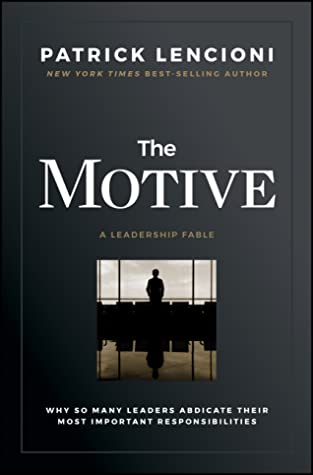
    In The Motive: Why so many leaders abdicate their most important responsibilities, Patrick Lencioni covers the question of interest that comes with what is observed above. Maybe, the motivation of the leader does not match his or her current role.

    In our fictitious example, Igraine was very successful and was promoted to take “bigger” jobs. Still, in reality, her interest, motivation, and energy come from what she was doing before.

    Either she makes the decision and finds interest in the “bigger job,” or she will not make a shift. Not only her progression will stop there, but her whole region is at risk if she does not.

    I believe this is what led Laurence J. Peter to formulate his famous principle.

    Balance on the BEPS Axes

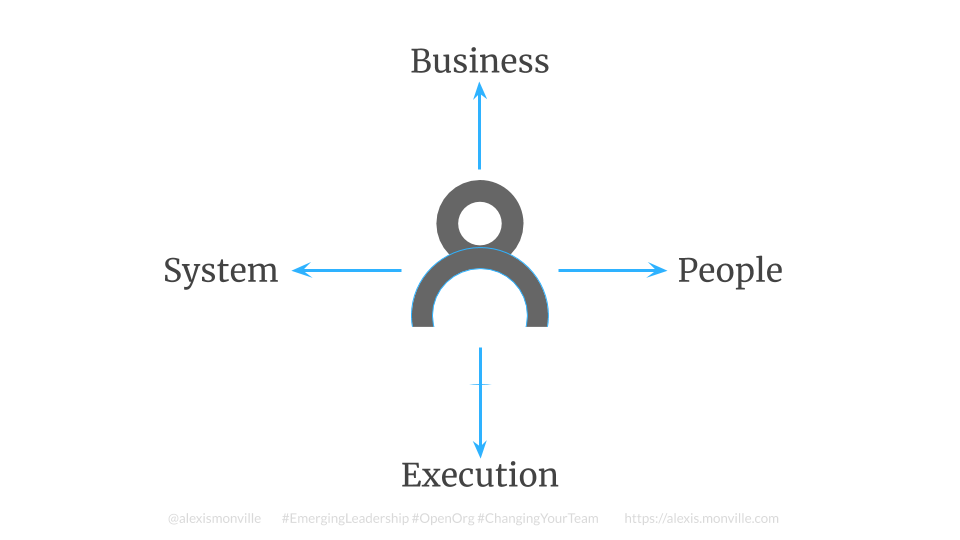
    You may have read about the BEPS Axes of a Leader before. BEPS stands for Business, Execution, People, and System and helps people realize when they don’t invest in one or more axes.

    The Business part of the equation is the most important. It’s about understanding the business and the ecosystem your organization evolves in, understanding why you provide solutions, products, features, and services, and formulating a clear vision. We should always start here

    Most people make the mistake of focusing on Execution, but this is not usually the main problem. It tends to be an issue for managers when they are deep in execution or defining the precise tasks each person should work on. By going too deep, they forgot the other axes.

    People can be more of a problem. Hiring, growing, managing performance, and self-improvement is often passively delegated to HR or managers. However, this is not always a beneficial practice.

    System is a big one, and usually, one suffering from underinvestment. As American engineer W.E. Deming said, “a bad system will beat a good person every time.” Understanding the system formed by the people, the organization, the processes, and tools is of paramount importance and will help you remove the obstacles to great work. It’s all too common to see layers of complexity piling up on top of each other. Simplicity is key.

    How to help Igraine?

    Back to Igraine. What happens is that Igraine is deeply involved in Execution to make sure the business is successful. Igraine knows the System very well and knows how to navigate the System very well.

    The chances are that the System grew around Igraine without her realizing the complexity of it. Multiple people took the lead of specific aspects forming teams that grew “natural” boundaries around them.

    The silo-effect emerges because of these boundaries, but Igraine can navigate the system without even feeling the boundaries. The problem is only visible to the other people in the organization who will experience the difficulties linked to these boundaries: slow process, busy work, inaccurate and/or inaccessible data.

    Now that the system is in place, it can take a lot of energy to change it. The teams would love some change, but usually, they identify that changes are needed in other teams. Not many people have a complete understanding of the whole system and the ones who have usually don’t experience the complexity the same way as others. So they don’t have a big incentive to change it.

    This is where Igraine’s deep knowledge of the System can make a difference. By focusing her attention and energy on changing the system to make it simple and efficient for its regular users, she can greatly impact the organization’s performance.

    The whole system connects to her, putting her on the critical path of all decisions.

    Delegation

    Telling Igraine, she should delegate will not help. She knows that. She wants that. It is just not happening. Telling her, she has to intentionally not make a decision but grow the people to make them is not enough.

    To help her, people in her organization can influence the change by taking the lead on specific decisions.

    Let’s take a concrete example: the definition of the commission plans. Do you want Igraine to decide on every one of them? Let the process runs the way it ran in the past, and this is exactly what you will get.

    You have to insert yourself into the system. Start with the Why. Write down the motivation behind the commission plans, the behaviors to influence, and how the plans’ components are meant to influence them.

    Now put your thoughts into your proposal. What do you want to achieve and how it will affect the plans: add/remove a component, add/remove a plan, align the plans of different roles.

    With that in hand, you can meet with Igraine and involve her in the high-level decision. Once you reach an agreement, you can now propose to review all the plans for your perimeter.

    In doing so, you drove a change in the system, you got Igraine to delegate something that was falling on her plate for historical reasons, and you made her decision at the level she should be involved in.

    You are not asking for more delegation, or even worse, waiting for delegation to happen. You are driving it.

    To do that with confidence, you need to balance your investment on the four axes and involve multiple stakeholders in preparing your proposal. You have to leverage the organization’s knowledge and the knowledge of Igraine to make the change happen.

    When the leaders in Igraine’s leadership team can drive those kinds of changes, Igraine will have proof that she can delegate more to her leadership team.

    You don’t need to wait for the change to come from the top.

    You can make it emerge and help Igraine make the right choice for her primary team.

  • Chief of Staff: The Role, the Craft, the Community

    Chief of Staff: The Role, the Craft, the Community

    In this episode of Le Podcast on Emerging Leadership, I had the pleasure to welcome Scott Amenta. Scott is a community builder, co-founder of Propel, and founder of the Chief of Staff Network. We explored community, leadership, and the evolving value of the Chief of Staff role in modern companies.

    What a community builder actually does

    Scott frames community building as a craft: putting people together intentionally around shared interests, challenges, and goals, then creating the content, infrastructure, and scenarios that help them connect, learn, and grow.

    He also points out how communities evolved in two parallel ways:

    • open communities that anyone can join (often on large platforms)
    • more curated communities that can be private, sometimes paid, and designed to create a different level of experience

    The Chief of Staff role: ambiguous and powerful

    One reason the Chief of Staff role is both challenging and interesting is ambiguity. Chiefs often have very different responsibilities from one company to another, depending on the executive they support and the context of the business.

    Scott describes a key benefit: the role offers broad exposure to what it takes to grow a company, sometimes earlier in a career than other paths would allow. It is a role where people from very diverse backgrounds can contribute, because there is no single “Chief of Staff profile.”

    Why build a Chief of Staff community?

    Scott created the Chief of Staff Network for two reasons:

    1. Support for the people doing the job
      Chiefs need peers, resources, and an infrastructure layer to learn faster and perform better in a role that can be lonely.
    2. Education of the market
      When a role is poorly understood, every Chief ends up having to explain it. A community can define shared language, share narratives, and collectively educate the wider industry on what the role is and why it matters.

    A Chief of Staff helps build the leadership team

    We also discuss something that resonates with my own experience: supporting the principal is not only about execution, it is also about shaping the leadership system around them.

    Scott explains that because a Chief of Staff typically does not own a specific P&L, they can focus on the holistic picture and help the organization run more smoothly by reducing bottlenecks. And yes, the principal can be the bottleneck.

    Scott’s view of leadership

    Scott offers a clear framing of leadership in three parts:

    • creating a vision and mission people can get behind
    • building the team that can achieve that vision
    • inspiring people to do hard things and stay engaged

    One idea I particularly liked is the concept of exponential add: hiring people who are not just incremental additions, but who change what the team can do. Scott ties this to diversity, not as a slogan, but as a practical advantage: diverse experience can lead to different decisions, better ideas, and more original outcomes.

    Energy, meetings, and cadence

    Scott shares what gives him energy: one-to-one relationships and seeing community members succeed.

    What drains him: internal meetings that could have been handled asynchronously and never reach a conclusion. He makes a strong point that this is also where a Chief of Staff can help, by reviewing meeting cadences and removing what is unnecessary.

    Scott’s recommendation for developing yourself

    Scott’s advice is simple and actionable:

    • find a mentor who can give direct feedback
    • find a community aligned with your interests

    His point is reassuring: for almost any niche, there is probably a community waiting for you and people who share the same challenges and are willing to help.

    Here is the transcript of the episode:

    Alexis:

    Community and leadership are the two main topics for exploring this episode of Le Podcast. Le Podcast equips you to make a positive change in your organization. Each episode turns insight into actions that you can use straight away to be build momentum and create lasting change from yourself to your team, from your team to other teams, and other teams to the entire organization. I’m your host, Alexis Monville, and I believe in the ability of people on teams to find better ways to increase their impact and satisfaction. That’s jump right into the conversation with Scott to learn more about what it needs.

    Alexis:

    Hey Scott, can you tell us a bit more about you and your background?

    Scott:

    Hey, Alexis, great to chat with you today. I’m Scott, come from New York, currently living in Berlin. I’ve spent most of my career at early and growth-stage companies really working across a number if difficult fields like operation, business development, strategy and even finance at times. I spent a good part of my career at companies going from five upwards to 500 employees, really operating in a generalist role, without any clear definition of what to call that.

    Scott:

    And it wasn’t around 2014, I joined an early-stage e-commerce marketplace called Spring based in New York. At the time was looking at chiefs of staff coming out of companies like LinkedIn and Google, and obviously hailing from the political space as well, and thought that there was a clear potential need for that same position within these early and growth-stage companies. And so started to carve out that position for myself at Spring. And in 2016, officially became the Chief of Staff there, after growing the company to around 80 employees, in two fast years. Then shortly after that, started a Chief of Staff community titled Chief of Staff Network, I’ve continued to grow that community and learn a lot from the members that we have within it.

    Alexis:

    Thanks for sharing Scott. What is a community builder?

    Scott:

    I think if you look at the history of communities online, really the first emergence of communities was on some of the major platforms like Facebook, Reddit, LinkedIn, and you see these kinds of very large groups of people that are organizing around similar personal interests or professional interests, and potentially have a lot to gain from one another, but without necessarily the same intimacy that you might get from an online meetup, as an example.

    Scott:

    I think the idea of a community builder is really a person that is willing to set aside the time to put those people together in an interesting scenarios. So, identifying common problems, common needs, common interests, whether they’re personal or professional goals and building the content resources, platform and infrastructure necessary to connect those people, bringing them together to solve and grow and learn.

    Alexis:

    Of course, I have a big bias on that. When we speak about community, my first thoughts are on open source communities. Do think there’s something to learn from open-source communities in what you are doing?

    Scott:

    Yeah, absolutely. I think the nature of communities today has evolved in two different parallels. So on one hand, you’ve got open source communities where people are free to join, free to self identify with other members of the group. On the other side you’re starting to see more of these kinds of private communities that exist. Some of which are free, some of which are potentially paid for. I think there can be value in getting a higher end experience. Not that the open source communities can’t provide that, but a higher end experience knowing that there is some gateway or wall that’s identifying members before they come across that boundary to engage and interact with other people.

    Alexis:

    You mentioned that you started that community of Chief of Staff. What is special about the Chief of Staff role according to you?

    Scott:

    The Chief of Staff role obviously has been very prevalent in the political space for, I think most of the history of America at least. And has only very recently emerged as an interesting position within early and growth stage tech companies, albeit it has existed for a little bit longer at some of the larger tech organizations, Google and LinkedIn being the two most prominent.

    Scott:

    I think what’s so interesting about the position it’s A, highly ambiguous role. And so, at every different company for every different executive that hires a Chief of Staff, that Chief of Staff tends to have quite different responsibilities. What that leads to is a role where you have people from very diverse backgrounds coming into it. I meet chiefs of staff that come from marketing backgrounds, that come from business development backgrounds like myself, that come from strategy and finance backgrounds, and, they’re entering into that position because it gives them in some senses, unparalleled access to see the entire purview of what it takes to grow a company.

    Scott:

    And what that means is, you can often have chiefs of staff that are in some cases earlier in their career, but operating at the highest levels of these organizations. I think that’s probably one of the most interesting things about the role. Certainly was for myself when, when I was younger and certainly for other chiefs of staff coming into it and growing within it.

    Alexis:

    The exposure to a larger scope is definitely different for people. It’s an interesting part of the role necessarily. Why your community for Chief of Staff?

    Scott:

    Well, I think in looking at that ambiguity of the position, two things are immediately evident. One is, chiefs of staff need resources and support and an infrastructure layer, with other chiefs of staff to help them grow and level up those skills to be able to Excel at the position. At the moment, or at least when I was a Chief of Staff, there weren’t any dedicated resources talking about the position, helping me identify the areas where I should be focused, helping me think about what my career path might be. That was immediately evident that at least somebody needed to start writing about this position and really sharing their own personal narrative and experiences to help the others that were entering in to the same challenges.

    Scott:

    The other side of the coin here is really education of the market. I was immediately aware of the Chief of Staff role being on my resume, knowing that I was going to have to take that narrative and describe my responsibilities and my accomplishments as a Chief of Staff to another company with the potential of that company not understanding what a Chief of Staff role was. My belief is that it’s not up to one individual to define and describe that role to an entire industry. It’s really up to a community to do that. I felt that there was nothing better than taking a group of people that were in our role with, again, a lot of ambiguity being able to define that experience together and therefore educate the entire industry about what that role would mean and the strategic importance of it.

    Alexis:

    I really like that community to support you so you can excel and grow. The role is the radio, the lonely role. You also bought in your principal that could be the CEO or high level executive. You’re working with the leadership team, join in a little bit of a lonely positions, where to find some support and where to find the resources and the peers that will help you to excel in your world and to grow in your role. That’s where I think the community is really valuable.

    Alexis:

    I didn’t saw about that part about educating the market, but based on the number of time I need to explain what a Chief of Staff is, I think it’s a very good point.

    Scott:

    And, I think to be fair, we’re still a long way away from a world where everybody understands what a Chief of Staff is, and again, the strategic importance of it.

    Alexis:

    In the Chief of Staff role, I really think that building the leadership team around the principal is something important. And part of the responsibility of the Chief of Staff. Do you think it’s part of that role?

    Scott:

    Yes, I certainly do. I think if you look at the Chief of Staff role and the reporting structure, a Chief of Staff doesn’t tend to be an owner of any specific P&L within the organization. What that means is that they don’t have ownership over any particular group or unit, and instead can focus on the holistic picture of the company. The organization needs to be designed around a principal and the Chief of Staff is there to support that principal and making sure that other direct reports are getting the information, getting the resources and getting the attention that they need from that principal. It really becomes this inter oping layer so that the organization can run more smoothly, more effectively without any individual bottleneck. And, the principal tends to be that bottleneck sometimes.

    Alexis:

    Very good point. What does being a leader mean to you?

    Scott:

    I look at leadership in a few different contexts. The first thing that a great leader really does is creating a vision for the team, a vision and a mission that the team can really get behind that they understand, and that they’re motivated to work towards. I think the second core component there is really then, how do you build the team? How do you choose and pick the right players that vibe together well on a cultural level, but also have the skills, the tactical skills necessary to achieve that vision. So that every new person that you add to that team is not just an incremental add, but is an exponential add.

    Scott:

    And then, I think really the third thing that drives a great leader is the ability to inspire. In order to create the motivation to go and achieve great things, to work on difficult challenges, you need to be able to inspire the people around you. That takes, I think a lot of courage to stand up, give great examples, tell great stories and make sure that people are really interested in the work that they’re doing and have that dedication to the challenges that they’re trying to solve.

    Alexis:

    Really difficult challenge. I really love the way you are framing that. I particularly love the idea of exponential add, which means that will need to look at a diverse team, not only adding skills with people that are similar, I guess.

    Scott:

    Exactly. I think that diversity means a lot to a team. So that’s diversity in experiences, diversity in terms of where that person is coming from and the types of problems that they’ve worked on before. I worked for an e-commerce company back in New York, as I said as a Chief of Staff. And very few of the people that we hired were from the e-commerce role. They were from the retail world. But that diversity led to the creation of some very unique product experiences for our consumers that were in a lot of ways, fundamentally different than what the rest of the industry was doing at the time. That really speaks to the value of hiring a diverse set of candidates that can run the organization properly.

    Alexis:

    Excellent. What do you think are really the first steps when you build a leadership team?

    Scott:

    I think there’s a few things to look for when building a proper leadership team. The first is really background and experience. I think that goes without saying. You want to make sure that the people that you’re hiring are equipped to do the job. And, going back to the three points I made around leadership, that they’re able to bring those elements to the table to inspire not just their immediate reports, but also the rest of the company. You have to imagine that any leader that you’re hiring on the executive team can step into, essentially run the entire organization if they needed to. In the absence of the CEO, for example, could that person stand in front of the company and drive the same level of motivation and inspiration that the CEO may be doing every day.

    Scott:

    I think the second piece really is around cultural fit, does that person meld well with the way that the company was built? From the beginning, the way that the employees have come to reflect their culture, do they prescribe to the values and mission that the company has, and what are the examples of that, that they’ve demonstrated in their own careers?

    Scott:

    And then I think the third element is really around work style. Is the way that they work, the way that they think about even work-life balance, does that also correspond to the way that the company has been operating? These are the things that in some cases can be written in stone, things like culture or things like work style, and it can be very difficult to have one leader that is swimming against the grain of those things and try to convince the rest of the team that it’s okay. You really need a leader that sets examples. And ideally those examples are things that the company has already been prescribed to.

    Alexis:

    Great summary. What do you look up to as a leader to learn from, to be inspired from, and of course, why?

    Scott:

    I think one person that I certainly look to as an inspiration for leadership, and certainly within the context of community building is Alexis Ohanian, CEO of Reddit. And, I think his story is in a lot of ways, fascinating, not just in the sense that he started a company, sold that company, left as CEO, and then later rejoined as CEO to lead it into its next chapter. Alexis has always been there as a person, really fostering again, back to this idea of open source communities, the idea of connecting people, helping people foster relationships online that in other ways was very difficult to do. Reddit is always been a source and destination for great information, interesting people. You name the niche should probably exist on Reddit. And, I think Alexis Ohanian’s vision is really, really behind that and he’s championed that even from the early 2000s. I’ve got a lot of respect for what he’s built there.

    Alexis:

    Very good one. Definitely something that I need to look at in more detail. What gives you energy? Where do you find your energy and what drains your energy and maybe your tactics to avoid those energy drainers.

    Scott:

    I think the thing that gives me the most energy, and honestly, the reason that I really enjoy this idea of community building is really this one-on-one relationships. Never really found myself as driven or as eager, even having worked at companies that have hundreds of thousands or millions of users, those users ended up becoming numbers on a spreadsheet and, numbers that we’re looking at in terms of retention and conversion, growth, never really with that one-on-one personal touch.

    Scott:

    What I found with the idea of community building is, even with thousands of members, you still have a very personal relationship with each one of those people. They may not be your best friend, but, you know them almost by name, you know their backgrounds, you have conversations with them. What I’ve come to realize is you can build substantial businesses that are built on top of communities and still retain that personal nature of the business.

    Scott:

    And so, every time I get off the phone with a Chief of Staff, it’s new reinvigorated energy to just keep doing it, to continue building resources, to continue fostering more relationships, to continue connecting people together. And, seeing their successes is essentially my success. That’s a really rewarding part of the experience.

    Alexis:

    So the other face of the coin is what drains your energy.

    Scott:

    Most recently, Zoom calls, but, I think we’re hopefully moving on from a world where, everything is just virtual. The thing that drains my energy the most are frankly, internal meetings, meetings that could otherwise have been solved by email, by Slack, by more asynchronous or synchronous methods of communication that don’t require 10 plus people in a room where the conversation never really comes to a conclusion, it just comes to more work and more to do is for everyone where, the problem may never have needed to be solved in the first place. I’m lucky now to be working as a co-founder of a company and, can really set the cadence and way that the company operates around that internal communication style. But it’s certainly not something I missed is working for, some of the larger companies I’ve worked with that just have way too many internal meetings and never enough time to do actual work.

    Alexis:

    That’s a good one. I like your tactics to avoid those ones because, there’s a lot that can be achieved with a synchronous communication with the tools that we have today. So absolutely. Sometimes a shared document is much better than trying to define a problem statement with 10 people in the room.

    Scott:

    Yeah. And look, I think in some ways this is the benefit of having a Chief of Staff is, they can really be there to help figure out what that cadence is for companies that have, in some ways lost their direction when it comes to too many internal meetings. Certainly something I’ve done as a Chief of Staff is really review every team’s internal cadence and do a deep dive on the importance of each one of those meetings and scratch them if they’re not necessary.

    Alexis:

    Yep. Really good advice. What would be the first things you would recommend to people who want to improve their skills in whatever their domain is?

    Scott:

    I think the first thing that I would recommend is try to identify a mentor for yourself. That mentor can be someone that works at your company, that maybe is not on your direct team, but someone that you look up to as a leader, it can be someone external to the company maybe that you’ve met through former classmates or former colleagues. But having that person, not necessarily a professional coach, although that’s equally important, but having a mentor or person that you can ask deep questions to about your career, ask questions that are more tactical focused on some of your day-to-day challenges with unabashed advice is super critical to being able to get that real-time feedback and that confidence to take the next steps in your career. Those are the things that have probably helped me the most as I look back over the last 15 years.

    Alexis:

    Very cool and very important part. Is there any resources you would want to recommend to people?

    Scott:

    From a resourcing perspective, the most obvious thing to say is, well, there’s probably a community out there waiting for you. And so, the best thing to do is to go out and look for the online communities that are available to you again, based on your personal interests, based your professional interests. I’ve seen communities in basically every industry at this point. And I think if there’s a niche that you’re interested in, it probably exists in one way or another, and those people are there waiting for you. And, you’ll be surprised at how many people share those same passions as you and are going through some of the same challenges as you as well, and are willing to help.

    Alexis:

    Wow. That was, of course the answer that you will provide, but you’re absolutely right. I like what you’re saying about, think about any niche that exists, there’s probably a community waiting for you. You are not alone. It’s a very good one, and we have the opportunity to reach out to those people.

    Alexis:

    This is very cool, very inspiring. Thank you Scott, for having joined today the podcast. Thank you very much for that.

    Scott:

    Thank you, Alexis. It was a pleasure. I really appreciate it.

    Alexis:

    Thank you for listening to this episode of Le Podcast. Go to blog-blog-alexis.monville.com for the references mentioned in the episode and to find more help to increase your impact and satisfaction at work. Drop a comment or an email with your feedback or just to say hello. And, until next time, to find better ways of changing your team.

    Photo by Priscilla Du Preez

  • Belonging, Identity, and Better Hiring,

    Belonging, Identity, and Better Hiring,

    In this episode of Le Podcast on Emerging Leadership, I had the pleasure to welcome Ally Kouao, Developer Advocate and Solution Architect at Red Hat. We talked about Diversity, Equity, and Inclusion (DEI), not as an abstract concept, but as something that shows up in daily conversations, hiring decisions, and the small moments that shape belonging.

    Allyship is not a label

    One of the strongest points Ally makes early is simple: saying you are an ally is not enough. What matters is what you do.

    Ally shares a definition that captures the intent and the posture of allyship:

    Allyship means acknowledging, accepting, and embracing our similarities and differences. It means being open to listening, avoiding complacency, making an effort to understand, and being proactive where helpful, while continuously educating ourselves and others with empathy, respect, and kindness.

    The part that stayed with me is the humanity of it: you will not do everything perfectly, and still you can show up with sincerity and effort.

    Education gives power, especially when history is incomplete

    We also talk about how much recent history is missing from many school curricula, and how this shapes our understanding of today.

    Ally’s suggestion is direct: educate yourself beyond what school offered, seek perspectives that are not centered on a single narrative, and do it continuously. The internet is free, but the intention to learn must be real.

    Belonging can be fragile for immigrants and their children

    We discuss a painful pattern: people who are second or third generation immigrants can feel they do not belong in the country where they live, while also being seen as outsiders in the country of their parents or grandparents.

    The result is a kind of “nowhere to go” feeling that can last for years. Ally’s response is not to offer a quick fix, but to name what helps: surrounding yourself with people who are open to learning and listening. You cannot force someone to change, but you can choose environments where curiosity becomes respect, not interrogation.

    The question “Where are you from?” and what it can signal

    This episode includes a moment of discomfort that is worth sitting with.

    I share how I used to love the question “Where are you from?” because it can open many doors. Ally explains why the same question can land very differently depending on context, intent, and what happens next.

    If someone answers “I’m from London” and the next question is “No, where are you really from?” the question stops being small talk. It becomes a signal: you do not fully belong here.

    Ally offers a line that should make all of us pause:

    When you ask that question, you may be prioritizing your curiosity over their feelings.

    The intent may be innocent. The impact may not be.

    Bias in hiring is real, even when we believe we are fair

    We then move into hiring, and the discomfort that comes with it.

    Most people believe they are objective. And still, patterns appear: leadership teams that are overwhelmingly similar, interview processes that favor familiar backgrounds, and subtle filters that exclude people before the conversation even begins.

    We discuss a concrete practice that reduces bias in resume screening: stripping out signals that invite stereotyping (name, address, school prestige, formatting differences) so that reviewers focus on relevant criteria.

    Ally also addresses a common argument:

    “Are we compromising on quality to increase representation?”

    Her answer is clear: we do not have to compromise. Talent exists everywhere. What changes is the effort and the system used to find it, evaluate it, and give it a fair chance.

    A simple test for hiring managers

    One story Ally shares is both funny and brutal: a recruiter gave interviewers their own early-career resumes and asked them to evaluate them. Many rejected themselves.

    It highlights a blind spot: we often forget that everyone has a starting point. We judge potential through a narrow lens, and then call it “quality.”

    A good question to sit with is:

    Would you hire yourself today for the first job you took in your current company?

    Where to start

    Ally recommends a book that offers multiple perspectives across generations:

    • Girl, Woman, Other by Bernardine Evaristo

    More broadly, her advice is practical:

    • use the internet intentionally, not passively
    • learn from diverse perspectives
    • have real conversations with people you do not yet know well
    • be open to noticing what you did not notice before

    Because improvement starts with awareness, and awareness starts with paying attention.

    Below is the transcript of the podcast:

    Ally Kouao:

    In that moment when you’re asking that question, you’re really prioritizing your curiosity over their feelings.

    Alexis Monville:

    That’s Ally Kouao, developer advocate and solution architect at Red Hat.

    Ally Kouao:

    Honestly, allyship means something different to everyone, and I think just having that shared understanding and that shared motivation to listen and to be there for the people who want their voices heard.

    Alexis Monville:

    Ally Kouao explaining what allyship means. Diversity, equality and inclusion are what we explore in this new episode of Le Podcast. Le Podcast equips you to make a positive change in your organization. Each episode turns insight into actions that you can use straight away to build momentum and create lasting change from yourself to your team, from your team to other teams, and from other teams to the entire organization. I’m your host, Alexis Monville, and I believe in the ability of people and teams to find better ways to increase their impact and satisfaction.

    Alexis Monville:

    Let’s jump right into the conversation with Ally to learn more about what it means. Hey, Ally. Can you tell us a little bit more about you and your background?

    Ally Kouao:

    Yeah, so first of all, thank you for having me on this podcast. I joined Red Hat back in 2019. Prior to that, I was actually a software engineering student in a university in Wales. In terms of my personal background, I actually grew up in London. I’ve lived in London my whole life, and I moved to Wales for university when I was 19. The rest is history. I’ve been at Red Hat for just over a year now. I’m a solution architect on the Red Hat graduate program, and yeah, it’s been a really good experience so far.

    Alexis Monville:

    Excellent. I think I first heard about you because you ran a 14-day program, To a More Knowledgeable You. And it was fantastic. Each day resonated with me big time. Could you tell us the motivation behind the program?

    Ally Kouao:

    Yeah, sure. I feel like the main reason this program came about was aside from the fluctuating levels of COVID globally, it felt like there was definitely a bark to highlight the continued civil unrest that’s been magnified and brought back to the surface after the brutalities and documented injustice that has been going on in the US. What I thought was important to do alongside one of my colleagues was to make a point of the fact that not only is it possible for black people located outside of the US to be affected by what’s going on, but there are experiences shared by black people and some other minorities in their everyday lives that have been frequently glazed over, or not much attention’s been paid to it.

    Ally Kouao:

    Yeah, so as a result, some Red Hatters and I came together and created an initiative that we now know as 14 Days To a More Knowledgeable You, that provides the safe space to offer daily insight, be it through an article or podcast episode or a personal story, into the realities of their fellow black colleagues, friends and family in the UK and Ireland.

    Alexis Monville:

    What would you say are the main aspects of the program?

    Ally Kouao:

    That’s a really good question. I feel like what really brings the program to life I would say are people’s personal stories. I think we had a total of three personal stories from three different people who contributed to the initiative. I felt like it really brought things closer to home. I think it definitely helped make people realize that there definitely is another person behind the screen, or another person at Red Hat who can relate to this sort of thing. I think it makes it even more significant that it’s personal stories in the UK.

    Ally Kouao:

    Something that I’ve definitely heard throughout my life really, even until now, just the fact that … not the fact, but just people’s opinions that black people here don’t have it as hard as in the US, I would say it’s definitely true to an extent in regards to the brutalities, but I feel like in the UK, that there’s so much more that happens under the surface such as microaggressions, that I feel would be really beneficial for people to keep an eye out for and be conscious of.

    Alexis Monville:

    It made me think a lot. It’s really comfortable for me to say that at Red Hat, we are an open, inclusive meritocracy, and I can repeat that every day, and I’m really comfortable with that, and I think it’s really good and so on. There’s no question about that. But one thing that made me realize, and I will draw a parallel with, I have three kids. I have two daughters. The youngest one is 18, so they are not really young any more. I bought from a charity organization feminism T-shirts, that were really … I thought they were really fun, and I wore one, and I offered the others to the girls and to everybody in the family in reality. The message was fun, because I thought it was fun. That will not work with everybody. And it was written, “Girls just want to have fun.” Then under that, it said, “Fundamental rights.” So it’s a good joke from my perspective.

    Alexis Monville:

    Once, I remember one of the girls saying, “Oh, and you are doing that and you’re saying you are a feminist.” I was puzzled because I thought there was no necessary connection between what she was observing and the fact that I thought I would want to consider a woman as equal, and there was no question about that in my mind. But I realized that the connection was not obvious.

    Alexis Monville:

    During the program … That was a long intro to that. During the program, I realized that in my young age, I was actively involved in anti-racism organizations, and I was demonstrating about that. And after some time, it faded away. All that introduction to ask a question. I thought I was an ally, and I wonder if I am really an ally, and I wonder even if being an ally is enough. What do you think?

    Ally Kouao:

    That was such a lovely intro to that question. I would honestly say that well, at least from my personal experience and from my personal opinion, that to just say that you’re an ally probably isn’t enough. It’s more so what you do. So obviously going back to your personal examples, it’s really good that you were active in terms of being feminist, so wearing the T-shirt supporting them … I think it’s quite hard, because quite a lot of people compare what their standards of being an ally is to what other people’s standards of being an ally is. I would say overall there is no real checklist of what it takes to be an ally, because everyone has their own interpretation of the term, and there’s no one way to do it.

    Ally Kouao:

    But something that I would say is the gist of being an ally, personally, is listening and amplifying the voice of marginalized groups, so like you said when you did it before, people who did experience racism or advocating women’s rights. I do have an extract with me of my input of what allyship means to me in one of my colleagues’ blogs on the importance of allies. So if you don’t mind, I’ll just quickly go through it.

    Ally Kouao:

    On the blog, I said, “Personally, allyship to me means acknowledging, accepting and embracing our similarities and differences. Where are differences are present, this branches out to being open to listening, avoiding complacency, and making an effort to understand and be proactive where helpful, while continuously educating ourselves and others with empathy, respect and kindness in areas where we may fall short. Allyship means understanding that at the end of the day, we are all human, and even if you can’t do everything perfectly, you’re wholeheartedly making an effort to do what it is you do to the best of your ability.”

    Ally Kouao:

    That’s just a little sneak peek of my input. For anyone who is listening to this who also works at Red Hat, I would also recommend that you check out part two of the Diversity and Inclusion: the Importance of Allies series blog post, where you’ll see a bit more about what I have to say about allyship in more detail, and hear from all the other wonderful diversity and inclusion leaders at Red Hat.

    Ally Kouao:

    Just to sum up everything that I’ve said in just one sentence, I would say honestly, allyship means something different to everyone, and I think just having that shared understanding and that shared motivation to listen, and to be there for the people who want their voices heard.

    Alexis Monville:

    Yeah, it’s beautifully written. I need to copy/paste the extract in the blog post that will be a companion to this podcast. It’s really beautiful, and it really resonates with me. It really says, “Being human,” and being your whole self and being human is something really important. I wonder if it’s suddenly that I’m getting old, and I realize more things now, but I feel I’ve learned a lot during those past years, and I continue to learn. I feel the more I learn about that, the more I have to learn and to understand.

    Alexis Monville:

    I will give you another example. I spent 15 hours with Laurence Fishburne, the American actor, and he told me the story of Malcolm X. Of course, I did not really spend 15 hours with Laurence Fishburne. It’s an audio book, and it’s the autobiography of Malcolm X, and the narrator is Laurence Fishburne. But I had that feeling, and that’s always the feeling with audio book, that you have someone who is telling you a story.

    Alexis Monville:

    All that to say that at some point, Malcolm X described the fact that he is considering the people from New York, fighting for social rights, going into Alabama, and he’s saying they are totally wrong. They should not do that, and when I read that, I said, “No, no, no, no. That’s … What is wrong with that?” He said, “They should fight for civil rights in New York, because there’s a lot to do there.” I realized that yeah, I did in a way the same thing. I was demonstrating against apartheid in Strasbourg while apartheid was in South Africa, and I hope it had an impact, but I’m not really sure about that. But what was I doing in Strasbourg?

    Alexis Monville:

    I remember one of my friends at that time coming from Algeria. He was French, but he was born in Algeria. That’s the kind of thing that you will wear all your life on your face. And he was telling me, “I’m considered a stranger, a foreigner, by everybody in there.” And I have to admit that at that time, I hope it changed, foreigners were not necessarily welcome in small cities in the country. And he told me, “I tried to back to Algeria, to say, ‘Okay, I will end my study there, and I will continue my study in Algeria.’” And he told me, “It’s not possible, because over there, they are calling me the French guy, and so I have nowhere to go.”

    Alexis Monville:

    I was horrified by that, and I didn’t know what I could do for that person. How would you say we can deal with our past as a country, and we can have people that … I don’t really know how to formulate the question, but how to deal with that kind of situation for people?

    Ally Kouao:

    Yeah. Honestly, I would say that that’s probably not the first time I’ve heard a story where someone’s recounted their experiences of going to one place and feeling like they don’t belong, and then going to place that people say they belong, and then not belonging there either. I think that’s something that is experienced by quite a lot of people, but also I can’t put a number to it. But in terms of addressing that … Sorry, could you remind me of your question?

    Alexis Monville:

    In a way, it’s addressing our colonial past, or addressing the fact that we have people that are coming from probably the … They are the second- or third-generation immigrants from another country.

    Ally Kouao:

    Yeah. Okay, brilliant. That’s put me back on track. I was just going off on a tangent forgetting what the question was. So yeah, in terms of second- and third-generation immigrants or people who’ve moved to a country because their parents did or family did, I would say in order to educate people who are already in that country, or probably not even educate people, because everyone is accountable for their own learning, I think it’s definitely worth keeping in mind that it’s important to surround yourself with people who you know are open to learning. You can’t really force it down anyone’s throat. You have to be open to the fact that people probably don’t want to change the way they want to think, or be open to the fact that people are really interested in learning more, like learning about ways that they can become closer to you or learn more about an ethnicity or a culture in more detail.

    Ally Kouao:

    I think if I had to give advice to younger generations out there, I would honestly say it’s important to educate yourselves as well, even if some people say that they belong to generations of immigrants or anything. We don’t know everything, right? There’s always something more to learn, and especially in terms of the educational curriculum, it can’t cover completely everything. And that was definitely another topic that was touched on in the 14 Days to a More Knowledgeable You initiative. Something that we noted was that in the British education curriculum, they don’t really cover all aspects of slavery or all aspects of the things that happened in the past or things that happened that wasn’t quite so English or quite so European-centric.

    Ally Kouao:

    Obviously, it’s something … In terms of the world’s history, it’s quite hard to encapsulate that all into one history lesson and one history curriculum. So I would advise younger generations of immigrants and other people who would like to learn more, to just go out and educate yourselves. The internet is very much free. There’s probably a lot of sources, a lot of stories, a lot of recounts of things that have happened in the past, and there’s no such thing as knowing it all or knowing too much, because there’s always some sort of learning that you can do.

    Ally Kouao:

    My main point here is education, that where there is knowledge there is power, and as long as more people are … I feel like the younger generation’s definitely becoming … From what I’ve seen from the Black Lives Matter protests and not even protests, but the Black Lives Matter movement, people are taking a stance on what’s going on, and people are realizing that it’s wrong, people are taking this opportunity to educate themselves a lot more, or in greater depth. I think that’s definitely a step in the right direction, but there’s definitely a lot more education or self-education that needs to be taught and given to oneself, for there to be that good amount of change and to avoid more recounts of experiences, as you’ve previously mentioned with your Algerian friend.

    Alexis Monville:

    Yeah, I love the advice of learning more about history, and especially the recent history. That’s definitely something I did not learn in school, and I had to learn that by myself, and there was a really good series in France about … It was Behind the Maps, and that was fascinating, about our recent history and all the things that we don’t know, but in a way we think we know, and in reality, we absolutely don’t know. We don’t know why it happens and when it happens, really, and all the reasons behind. And when we know something, we know only one perspective of it, and that perspective is of course biased. It’s only one perspective. So that’s a very, very good advice.

    Alexis Monville:

    I think connected to that question, there’s that question that I love to ask to people, and I realize that it’s not a good question. I love to ask a question that is, “Where are you from?” I love to ask that question, because in some contexts, people answer, “Oh, I’m from the finance department,” or, “I’m from Alabama.” And I love that, because it was a question that could open so many doors, and so many different doors, because based on what the people are thinking at the moment, they answer something different. So I love that question.

    Alexis Monville:

    I realized that that question was not so good when we moved to the US with my family a few years back, and of course, my accent, people are able to catch that I’m not from Boston, even if I just say hello or thank you. The next question from people, “Where are you from?”, and I realized it was not a good question because my wife was a little bit offended by that question, and she was systematically answering, “We are from …”, and the town where we lived at that time. So I had that discussion with her, and she was saying, “Yeah, why are people asking me where I’m from like if I don’t belong? I live here. That’s where I live. That’s my home.” She was really sensitive with that. What do you think is happening in that situation?

    Ally Kouao:

    I don’t know. I think that sort of question is a matter of people not really saying what they want to say, but not wanting to be impolite. But either way, they come out … I guess the interpretation of the receiver of that question can vary so widely, so yes, there’d be some people who wouldn’t take offense, and there would be some people who … like you mentioned with your wife, would take offense because it’s just like, “What do you really want to know from that question?” It’s not … If I give you an answer would you be like, “Where am I really from?”, or would you keep pushing until you get the answer, like you want that validation, that confirmation, that you had in your mind?

    Ally Kouao:

    This is definitely something that we touched on in the 14 Days to a More Knowledgeable You initiative, where that’s a question that’s commonly asked, and it’s not just asked of people of color, but it’s also asked of people in places where people … I don’t know. I guess it’s sometimes seen as a conversation starter, and I can see why it is, but I think it’s the way in which the question’s asked. It also depends on what answer the person who’s asking the question is willing to settle for in front of the person they’re asking it to.

    Ally Kouao:

    In terms of the initiative, we really tackled the “Where are you really from?” question, because an experience that many other black associates have been able to relate to, and I’m sure many other people would be able to relate to, being at a party or something or just meeting someone in a formal professional context, and people asking where you’re from. So if I had to give a personal example, so for example if I went to someone and they asked me, “Where are you from?”, I would naturally say, “Oh, I’m from London.” A response that I do often get is, “Oh, okay,” and then there’d be that really awkward pause, and then they’d be like, “But where are you really from? I know you’re from London, but where are your parents from?” And it’s like, well, I could do … I think it’s quite important that people are very specific in their questions.

    Ally Kouao:

    I’ve had friends who have been even more vague about their answer to make a point out of it. So someone would be like, “Oh, where you from?”, and they’d be like, “Oh, I’m from a very specific area about where they’re living at the moment,” and they’d be like, “Oh, but where are you really from?”, and they’d be like, “Oh, I’m from Britain.” And they’d be like, “Oh, but where are you from?” They’d be like, “Oh, I’m from Europe.” Like, just making a point to show that it’s just a really silly question to ask if you just keep digging it at.

    Ally Kouao:

    Yeah, I just feel like in regards to the “Where are you really from?” question, it’s often the case that people want confirmation that the person isn’t British or isn’t from wherever the location is they are, or if their location sounds completely … their country of origin sounds completely different to where’d they’d typically think they’re from … I’m not quite sure if I formulated that correctly.

    Ally Kouao:

    But one of my colleagues, he was born in Zimbabwe, I believe. He was just saying that when he asked people where they’re from who have a Zimbabwean accent, it’s because he recognizes that accent, and that’s why he asks them where they’re from, just for confirmation of where they’re from. So like I said, it’s definitely the intent behind the question. I think it’s definitely worth clarifying with the person before asking, but I think when people do ask that question, something that they do do and should keep in mind is that it’s really important to approach the question towards the person you want to ask it to with sensitivity and clarity.

    Ally Kouao:

    If you approach the question “Where are you from?” or “Where are you really from?”, in that moment when you’re asking that question, you’re really prioritizing your curiosity over their feelings. You’re prioritizing your curiosity over how comfortable they feel or how much they belong in that moment in time, so you may receive a really guarded response. So someone giving a really vague answer like, “Oh, I’m from this really specific area,” because it’s a really silly question, honestly, I don’t really think you need to ask where people are from. Then again, I can also understand the conversation. It’s like, for example, we go to one of the Red Hat events. Well, from last year, we went to a Red Hat event called RHTE (Red Hat Tech Exchange), I met so many different people, and people are asking where you’re from because they’re curious to know which office you’re located in or where your accent is from. I can see how that can take a turn for the worst, depending on the motives of the person who is asking the question or the way in which they ask it.

    Alexis Monville:

    Yeah, I think it’s a very precious … I like the point about prioritizing curiosity over feelings. It’s a really important point. Whatever is your intent or the motivation behind the question, we need to realize that it’s not a good question, that adding “really” to it will not really help. That’s an horrible question in reality. If people want to share about where they are coming from and if they are from Scotland and their grandfather were coming from Ireland or whatever, that’s their problem. If they want to share that with you at some point, maybe they will, and that’s good. But why are you asking that? Yeah.

    Ally Kouao:

    Mm-hmm (affirmative). Yeah. It’s such an odd question. There’s always that awkward pause after someone’s asked it, because when people ask me, in my mind I’m just like, “Are they trying to ask what I think they’re trying to ask, or are they genuinely curious on where I grew up and my accent?” Because I often get the question about where my accent’s from, because I’ve just moved from London to Wales, and somehow that’s just messed up my accent and people are just like, “Oh, where are you from?” So I think definitely it depends on the intent behind the question, but I would just say try and avoid it, like you said. You don’t have to know. If you did happen to know the person, and if you became a lot more close to the person or seemed to be chatting with them on a more regular basis, then you’d probably have that space or that comfort to be able to ask that question, or them be able to tell you themselves.

    Ally Kouao:

    I think it’s definitely an interesting question to ask upon first meeting someone. Some people just can’t really think on their feet off the bat, or it’s probably just to fill in the awkward silence when you first meet people.

    Alexis Monville:

    I did a training about hiring, improving your hiring practices. It reminds me something, because I was pushing some managers to say that maybe they have some biases in their hiring practices, and this is dangerous territory, and usually people are convinced they have absolutely no biases, and they are doing the right thing. What I was saying is that it’s not easy to do the right thing.

    Alexis Monville:

    There is a lot of biases that we have, and you need to admit that you are able to judge someone in the first 15 seconds you are seeing them. The problem is if you are not conscious of that, you will just use your intellect to confirm your first impression. This is exactly how the biases are working, so you need to be conscious of that. That’s why you need to write down all the questions you will ask in an interview beforehand. Then you are forced to go through those questions. You cannot escape that path and ask other questions that will confirm your first impression. So it’s really challenging.

    Alexis Monville:

    I told them I worked with a small system integrators in Paris a long time ago. It’s probably more than 10 years ago, and in the first gathering of the whole company in Paris, there was probably 150 people or something. There was something that was visibly different from other system integrators I worked with at that time. There was a lot more women, and a lot more people coming from various diversities that we have in France. France is at the crossroads of a lot of different countries, so of course there’s a lot of diversity present in the population, not necessarily in all the companies. But in that company, that was obvious that it was different from the others.

    Alexis Monville:

    I inquired about their hiring practices. That’s something our HR person is doing. She’s changing all the resumes, and stripping out all the information about the location where the people live, their first names, where they did their studies, and to keep only the things that we are supposed to make assumptions on. She’s rewriting all the resumes so they are all in the same format, so there’s no way to know things about that. And I said, “But you don’t judge people from where they live,” and they say, “Yeah, we also think that.” But the result is in our resume selection, we are selecting different people for the interview, and the result is when we see people, that we interview them and we hire them, people we would have probably never selected because they are coming from whatever, Saint Denis or whatever. Do you think that example is just an example, just a point in time? Do you think we have a problem in our hiring practices, and do you think there’s ways to fix that?

    Ally Kouao:

    That’s a really good question. I would just like to say off the bat that that hiring process or that process of hiring in regards to hiding people’s information, I think that sounds brilliant. It definitely strips back the identity that’s behind it, because there’s so much that people who’d probably be unconsciously biased on, such as the person’s name or where they studied or even their home address, like you said. So I think it’s really good that that recruiter definitely took time out of her day to put their main information into the resume, but present it in a similar format so there was no space for deviation. I think that’s definitely a good way to go about it.

    Ally Kouao:

    But in terms of general hiring processes, that’s definitely quite a tricky question, because different organizations can tackle hiring differently. It’s a double-edged sword. It depends on how you want to recruit different individuals. Overall, I think that’s important that there’s representation in a company, and a frequent argument that I tend to hear in response to that is, “Are you compromising on the quality of the candidates in favor of representation?” The answer to that can be, “We don’t have to compromise on anything.” I think there are very much skilled people of different ethnicities from different locations everywhere, and I think it’s just putting that extra effort into scouting them out and finding them.

    Ally Kouao:

    Something that I do tend to frequently see on LinkedIn is … I think I signed up to this girls’ page. I’m not quite sure where it is, but I think it’s a women’s empowerment page, and they tend to give empowering quotes or showing people who’ve started to rise into more senior positions, like women rising into more senior positions in companies, because you’re definitely seeing more of it today. You’re definitely seeing people in companies or industries where it used to be traditionally male-dominated. You’re seeing more women come through and excel in their fields and prove themselves.

    Ally Kouao:

    Something that I have seen quite a lot of, those pages highlighting women of color who are pushing those boundaries, reaching really cool careers or reaching a new level of success, and they thought it’s a really good idea to praise them, and I completely agree. Something that I did frequently see in the comments is people going, “Ah, we shouldn’t be pointing out their race at all. It should just be about their motivation. It should just be about their successes.”

    Ally Kouao:

    Something that I think is really important to note from these posts or posts that do celebrate women and women of color, is that sometimes this attention does need to be paid to them. For now, we do need to pay this attention so that it becomes something we do naturally. The reason why we are highlighting it is because it’s not something you see often, and when we do see it, we want to celebrate it because it’s something we should see more of, and I think we all want that shared goal of not having to think about race any more or think about the location that someone comes from or think about what their history was, in favor of getting that perfect candidate.

    Ally Kouao:

    But I feel like where we are at the moment, where people are still growing and learning and learning to overcome their unconscious bias, I think it’s really important we do make a point of celebrating those people who are reaching new levels that it’s not so common to see, and wasn’t so common to see before. Yeah, I think there are different ways to go about it.

    Ally Kouao:

    Going back to your question regarding the hiring process, I would honestly say … Just to link it to that little … I can’t even describe it. Just to link it back to what I said regarding highlighting women of color who are doing really well or people of color who are doing really well, I think it’s really important that we … Or I think it would be really beneficial if we did take that stance in hiring as well, so yeah, even though we are paying more attention to the fact that we are trying to have a more diverse or representative workforce, the end goal is that hopefully we won’t need think about this when we’re hiring. Hopefully it’s something that comes naturally to people and it’s something that … We hire them for what their talents are, and we don’t hire them because they don’t look like us or they don’t have qualifications that we’re also familiar with.

    Ally Kouao:

    So yeah, I think that’s my overall answer in terms of hiring. I think it’s important to pay extra attention, especially now, so that … If we pay attention now and don’t continuously stall, I feel like that will just help us to get to that end goal so much faster, and we won’t need to strip back the information like the woman you were talking about did. You could just present that person’s information, and they’d be treated just as equally as all the other candidates.

    Ally Kouao:

    I think that would definitely be the ultimate goal, definitely an approach that I think more organizations should take. I think Red Hat is definitely going in the right direction from even offering that sort of training to begin with in terms of right for Red Hat, and having unconscious biases, because it’s something that’s very real, and it’s something … Like the title says, it’s unconscious. People aren’t aware that they do have their biases until they realize that their whole team is not really representative, but there’s so much diversity and representation in the UK and Ireland, at least from my personal experience. Yeah, sorry for the long-winded answer, but that’s what I was getting at.

    Alexis Monville:

    Yeah, and I really appreciate all the details you shared. This is exactly the problem I think we have. I think it’s not easy to handle that problem, because we would like to do the right thing. We would like to think that we are doing the right thing, and it’s uncomfortable to realize sometimes that we are not. I had that conversation with the team, and at some point I stopped them and said, “Okay, so we are doing the right thing. That’s absolutely perfect, and we are all white, all male, in that leadership team. So that’s totally representative of the population of the world. You’re absolutely right, all of you. All of us are absolutely right.” And so even if we are not consciously doing something wrong, we are not helping. So there was a lot of things around that, the fact that the job description could push away categories of people directly because there was too many requirements or too many …

    Alexis Monville:

    That was fascinating to me, learning about those studies that are real studies. That’s not one idea of someone. It’s real studies that have been proven. It’s fascinating to me. I have a friend who is … His first name is Samir. He told me that when he was sending his resume, if he was stripping the “ir” at the end of his first name, he was called back for an appointment immediately.

    Ally Kouao:

    Oh. Interesting.

    Alexis Monville:

    But if he was leaving his first name like this, he had no appointment. He told me he tried that several times. Of course, he told me, “The problem is, when I’m going to the appointment, usually people who would have struck me from the selection in first place are not necessarily taking me there seriously.” But it’s fascinating.

    Ally Kouao:

    Yeah, I think it’s definitely more common than we think, that people are feeling the need to change their traditional names, because it doesn’t sound quite like what they think the recruiters would want. So for example, in Britain, some people would change their cultural or their traditional names to make it sound more European or more British, and I think that’s definitely a shame. I feel like unless someone really wants to do it because they really liked a name, I feel like the people who do do it because they feel like they’d have better chances of getting recruited, I think that’s definitely part of the problem. It’s just a shame that people would have their names changed, and it just makes it really awkward, because they get hired, they get recruited, and it’s like they don’t feel like they were able to put their original best self forward to begin with.

    Ally Kouao:

    Like I said before, it is very common where people do tend to alter their name or completely change it and strip back what they are originally just to appeal to recruiters. Yeah, like I said, that’s definitely a shame. I also saw a post … Just browsing the internet, I did see there was a post on … I think it was a recruiter talking about how there were some people in her company … Not her company, the company that she worked in, interviewing candidates, and she realized that they were being really tough on the candidates.

    Ally Kouao:

    She thought she’d play a little trick on them and give them their own resumes from when they first applied to their jobs, because obviously they’d been in their jobs for a long time. And they all rejected themselves, and it was so crazy, because I was just like … The fact that they said the people weren’t qualified enough, I thought this was just quite interesting, because I was like, “The fact that you’d … I understand that you were in a better position than where you were when you first began with, but everyone has that beginning of their journey. Everyone has a starting point.” And it was just so interesting to see that they wouldn’t even give themselves a chance if they were in that hiring seat.

    Ally Kouao:

    I feel that was definitely a good takeaway lesson, in regards to the fact that you might not see something that you see in yourself where you are now, but I think it’s definitely important to give everyone that chance, that starting point, where they’d be able to grow and excel, because that’s where they are now, and it definitely made me chuckle seeing that, because I was just like … It’s crazy, because if you can’t accept yourself from your starting point, how much harder it would be if you don’t see yourself in the person who you’re interviewing, or you don’t feel that they’re the right fit because they’re so different to what you have in mind? So I think that’s definitely something that hiring managers or people involved in the interview process should definitely keep in mind.

    Alexis Monville:

    It’s a very, very good one. I love that experiment. It’s really important to work on our biases and the way we handle our emotional system and our intellectual system, and we use it to confirm the other and so on. Ally, it was really great to have you on the show today.

    Ally Kouao:

    Thank you for having me.

    Alexis Monville:

    What would be the first thing you would recommend to people who want to improve?

    Ally Kouao:

    Ooh. Ooh. Ooh, that’s quite a good question. I’ve really enjoyed reading the book Girl, Woman, Other. That focuses on perspectives of different women of color, different ages, from different generations. I think it’s quite an interesting insight into how they grew up, how they lived life differently in Britain, in Europe. That definitely could not be the starting point for everyone, but if someone did want a source to have a little read of and become a little bit more of a knowledgeable version of themselves, then yeah, I think that’s definitely a good book to read.

    Ally Kouao:

    But at the end of the day, I can’t really tell you where to start. Everyone’s on their own journey, and everyone can consume material differently. But I’d say definitely just make use of the internet. It’s very much free, like I said before, and you can find so many good resources. Have conversations with your loved ones, have conversations with people who you might not speak to too often, and get to know them, because we’re all living different timelines, and it’s important to be aware of that, and be open to others. But yeah, that’s all from me.

    Alexis Monville:

    Excellent. Thank you very much, Ally. It was really a pleasure to have you on the show today.

    Ally Kouao:

    Thank you.

    Alexis Monville:

    Thank you for listening to this episode of Le Podcast. Go to blog-blog-alexis.monville.com for the references mentioned in the episode, and to find more to increase your impact and satisfaction at work. Drop a comment or an email with your feedback, or just to say hello, and until next time, to find better ways of changing your team.

    The music is Funkorama by Kevin MacLeod (Creative Commons CC BY 4.0)

    Le Podcast – Season Two

    Le Podcast – Season One

  • What Software Teams Can Learn from Sporting Teams

    What Software Teams Can Learn from Sporting Teams

    In this episode of Le Podcast on Emerging Leadership, I had the pleasure of welcoming Chris Foley. Chris is a Principal Systems Design Engineer at Red Hat, and also a sports coach. Together, we explored a simple question that leads to surprisingly concrete insights: can software teams learn from sporting teams?

    A great team starts with clarity

    Chris begins with something that often gets lost in modern software organizations: role clarity.

    In sport, successful teams have:

    • clarity on what each role is supposed to do
    • awareness across the team of what each individual brings
    • responsibility that comes with that clarity

    In software, teams are becoming more cross-functional: they do not just write code, they deliver and run services. This is a positive evolution, but it increases the need for explicit agreements. When “your role is not the color on the org chart,” clarity has to be created intentionally.

    Momentum changes everything

    One of the strongest ideas Chris brings from sport is momentum.

    In sport, a goal can trigger positive momentum: confidence rises, energy rises, and the team builds on it.

    The reverse is also true: conceding a goal can trigger negative momentum. If the team cannot stop it, a second goal often follows, and the game can slip away.

    In software, the triggers are different, but the phenomenon is the same.

    Positive momentum can be triggered by:

    • a release that lands well
    • a demo where stakeholders are genuinely happy
    • a burn-down that is on track
    • a big PR merged
    • progress becoming visible and shared

    Chris makes a practical point: if momentum is positive, you can build on it. Use the goodwill to unlock something valuable, like a spike in an area the team wanted to explore.

    Negative momentum also has familiar triggers:

    • a severe production issue
    • a bug that is not contained quickly
    • pressure escalating beyond the team
    • a growing feeling of being behind, losing control

    The key is awareness. Momentum is not only a feeling. It is a pattern that grows if it is not addressed early.

    Leadership is not a role, it is a behavior

    Chris maps sports roles to software roles:

    • the player is a team member (engineer, QE, docs, etc.)
    • the captain is similar to the team lead
    • the coach or manager is closer to the engineering manager

    But his point is not about titles.

    In successful sporting teams, leadership is fostered across the board. Coaches give ownership. Captains are not the only leaders.

    In software, the parallel is clear: when team leads invite others to lead on investigations, knowledge sharing, and decisions, they are building leadership capacity, not dependency.

    Teams win games

    This line matters because it shifts the focus away from hero culture.

    Chris insists that in sport, teams win games, not individuals. In software, it is the same. Quality, delivery, learning, and progress are team outcomes.

    This is why positive reinforcement inside the team matters. Recognition should not be reserved for managers. Mature teams build a culture where team members notice contributions and say it out loud.

    How do you keep score in software?

    In sport, the score is obvious.

    In software, it is easy to fool ourselves if we do not create visible checkpoints.

    Chris points to an important evolution: more frequent delivery and more frequent feedback loops make it easier to track progress and detect misalignment earlier. In waterfall-style projects, teams could “discover the score” after months. With shorter cycles, the feedback loop becomes part of the work.

    Feedback loops exist in sport too

    A useful correction Chris brings is that sport does not only have feedback during games.

    Sport has:

    • frequent training
    • short loops
    • coaching feedback after each session
    • small challenges focused on specific improvements

    This creates a learning rhythm. A coach might say: you did this well. Now reduce that mistake from ten times to six.

    It is not grand transformation. It is focused improvement.

    Training versus performance: software can rebalance

    One of the most interesting parallels is the difference between training and performance.

    Sports teams train often and perform less often.

    Software teams perform almost all the time. Training becomes rare, generic, or disconnected.

    Chris suggests a different approach: use what happens during performance to define what to train next. Not “go learn a random technology,” but focused training based on real frictions:

    • improve charting and visibility
    • automate a painful part of the pipeline
    • remove a recurring quality issue
    • sharpen stakeholder communication
    • strengthen a weak coordination habit

    Training becomes small, intentional, and tied to value.

    Play to your strengths, not only fix weaknesses

    Chris also brings a sports habit that software teams often underuse: play to your strengths.

    Software retrospectives often drift toward what went wrong, what needs to be fixed, what was missing. That is useful, but incomplete.

    Sports teams also ask: what are we already good at? How do we win on our terms?

    For software teams, this can mean:

    • using strong technical skills to raise standards and speed
    • using strong teaching skills to onboard faster
    • using strong product sense to influence direction
    • using strong communication to make the team’s value visible

    Weaknesses matter. But strengths are where disproportionate value often comes from.

    Owning the product, the process, and the tools

    Chris ends with a theme that connects everything: ownership.

    Successful teams own:

    • the product they build
    • the processes they use
    • the tools they rely on
    • the way they improve

    And they extend ownership outward by influencing stakeholders, decisions, and direction. That requires a final capability: communicating at the right level, without hiding behind jargon.

    Because the ability to explain simply is often what makes a team easy to support, easy to trust, and easier to follow.

    Here is the transcript of the conversation:

    Alexis:

    Hey Chris, can you tell us a little bit more about you and your background?

    Chris:

    Hi, Alexis. Thanks for having me. Yes, of course. So my name is Chris Foley, principal engineer at Red Hat in software for about approximately 23 years now, I was with Erickson initially out of college, worked under 3G. I have a management system, developing for about five or six years, moved into telecoms research after us for about six years and worked on kind of FP7, so Framework Seven European Research Projects. Then went back to industry and went into the financial domain and into the Airlie lifecycle software life cycle around gathering requirements, kind of done some business system analyst role there, and then went back to telecoms with a company called Oracle and worked as a senior engineer team lead in distributed antenna systems. So basically that’s networks and then to Red Hat and was involved with the mobile product in Red Hat, and fulfilling kind of engineering improvements role inside Red Hat in the child services department.

    Alexis:

    Very interesting and diverse background, Chris. We are here today because we had a chat about sporting teams and software teams, and I’m really deep into what makes a team a team. What makes a team, a group of people that will really increase their impact and satisfaction? What’s make a team a great team? You told me there’s probably things we can learn from sporting teams about that. And I’m curious about what it is and how it works for you.

    Chris:

    So maybe a little background on my sporting life. So I started playing sports right from a very early age of nearly four or five, was heavily involved in the Gaelic games here in Ireland, hurling and football played soccer. A lot of my forte is predominantly team sports, even though I played individual sports. So I feel the role as a player as a senior player on the group, as a captain, on to coach for juvenile and adults, and then even to manage juvenile and adult teams. So that’s a little bit flavor of my sporting background and I continued to be involved as a coach. My playing career is over now, but I’ve been looking up to be involved with successful teams. But also have took many of these things on sports teams. So as you know, sometimes you learn more from your defeats than your victories.

    Chris:

    There’re many aspects I think that makes a good team. A lot of the best teams have a lot of clarity in their role, in what they’re trying to do. I think that clarity of role is something that in a group that’s successful. There’s an awareness across the group. That’s an awareness individually of what your role is. And in turn, I think there’s an awareness across the group of what each individual brings to the group. That’s something that’s very evident in success for sporting teams. If we looked across at the software team and looked at that same kind of artifact currently in software, now we are actually creating very cross-functional multi-purpose teams, which is a very good thing. So they don’t just develop software. Now they actually deliver software, they develop, they write the docs, they test the architects. They have all of the components.

    Chris:

    We are trying to share that responsibility, which is very positive, but I think ensuring that we keep clarity within the group is also, we shouldn’t forget that because with clarity of where our role becomes, there’s a responsibility and there’s an ownership. And once you have that within the group, I think that makes it very strong. I think one aspect is clarity of your role and responsibilities is a fundamental piece that with a successful sporting team, they’re very clear and evident and in turn with software, especially now as we transition across to the multi-purpose cross-functional teams that we have, so we don’t just write the code and throw it over the fence, the testing team that doesn’t happen anymore. So we’re very intertwined and ensuring we keep clarity is key. That’s one aspect, I would say.

    Alexis:

    It’s a very important one. And as you said, that as we evolve to more cross-functional teams, we don’t have the traditional roles of division by functions. So your role is not the color of your chart. That’s probably something more septal. So we need to clarify the roles, make sure that the expectations are clear. We can have a real team working. What else do you think are things that are connecting what happens in sporting teams and software teams?

    Chris:

    So there’s one piece that I think that is very evident on the sporting side, but maybe yeah, I think it’s happening on the software side, but maybe people that does not as, it’s not as clear and evident. So the whole concept of momentum in sport is a very big thing. So what do I mean by momentum? Like if you look at a sporting game, one team score the goal. Once that happens, what you’ll see is that team that scores, their confidence increases, as they play the game. Even their aggression levels, all of them go upwards what’s happened is momentum has been triggered the team that are starting to harness that confidence and positivity and that momentum. And then what you’ll often see is that they’ll actually score a second goal. So they are actually build on it and they used that to their benefit.

    Chris:

    So that’s an example of positive momentum. You must also consider there’s negative moment. And on the negative side, it’s the team that’s actually conceived that goal. So they’ve taken a hit or a blow, conceded a goal. It’s their reaction to that. It will define them if that builds, that negative momentum builds and they concede that second, then potentially the game is over. So it’s how they react to negative momentum and how the team that scored, who reacts to positive. And the other thing there is to know what triggers that. In this example, the goal is very simple trigger. Now, what does that look like on the software side?

    Alexis:

    Yeah. I’m already curious how we can apply that, how we can benefit or how we can realize what are the triggers, how to build on the positive momentum or the opposite. How to make sure that we are not engaged in a downward spiral.

    Chris:

    Yes, the potential triggers, they’re there in every day software kind of live sector, right? So like if you do a release after a sprint, that’s a positive impact on the team. They have achieved. And if you do a sprint demo and it does go as well, and your product owner or your stakeholders are giving you a big thumbs up and they’re delighted with the work, that is a trigger positive momentum. If your manage a big PR, it even could put it on to that level. If you look at your burn-down chart for the team and it’s on track, or maybe it’s ahead of your schedule delivery days, all of that are potential positive triggers for the group. How do you actually build on that then?

    Chris:

    You’ve done your sprint demo went really well. And your team lead maybe there was an area that they wanted to investigate for the last couple of weeks but didn’t get an opportunity. You talk to your manager and say, “Look, this went really well. First, could we, could we do a spike into this specific area?” And your manager says, “Of course, yeah.” Your harness and the momentum at that point, the goodwill that’s around us and the team got this opportunity maybe to do a spike in an area that they’d love to investigate. So that’s a potential parallel missing the positivity and momentum.

    Chris:

    On the other side or negativity, so severity one bulb comes in on yourself for like, if you don’t get on top of that quickly, if you don’t stand the tide there potentially, that goes on for hours and maybe some days to negativity builds around the team that there’s severity one bulb in there. So really getting the group to put their shoulder to the wheel there and try and stop it in its tracks is very key, because of the rolling stone and it gets bigger and bigger. In software, it’s having the awareness of these things to happen and being able to pick up on that and either harness it or address it as quickly as possible.

    Alexis:

    Can you give me an example of one thing that really is building negativity and how you choose to address it? How you raised the awareness and the team to address it.

    Chris:

    That big bug coming in, right? So it’s not like we all look bugs in software. It happens. But if there’s not some resolution to that reasonably quickly, then the manager hears about it, the product owner hears, or most of the stakeholders, it just gets bigger. And have no, it’s not the team’s fault, but it’s the team’s responsibility to try and address that. Try and put some resolution in place such that can assess the underlying problem, if that goes on over time and it’s not addressed that increases the whole negativity increases around it. And that’s the same as conceding the score and maybe conceding the second score and another one. And then once it picks up that, as I said negative momentum, it can be very hard to stop. It’s the team lead or the manager or the engineers the group, and the team awareness. Let’s try and put a resolution in place as quickly as possible.

    Alexis:

    You mentioned in your background, in your sporting background, there were roles, like player, captain, coach, or manager, how does that relate to the roles in the software team? It’s probably very different, but maybe there are some similarities.

    Chris:

    Yeah. So I think that the player is your team member, right? So on the software side could be your software engineer, your QE, your docs person could be any of them team member. And I think the captain maps fairly clearly to the team lead. And then the coach manager side is kind of the engineering manager on the outside in a one sense or what I would say, I know from the sports side, we would have a term like teams win games, right? So it’s not really the management it’s the group, it’s the players and captain and in software, it’s that software team like it’s the engineers. They do the work, they release the software, they test the software, they ensure it’s of high quality. So I think that’s why the focus on the team is so strong, in sporting terms.

    Chris:

    And I think it’s heading that way as well on the software side. And the other thing is just to call out the captain concept there. In the sports side, yes there is a captain boss, successful sporting teams encourage leadership across the board. So they foster leadership. And how do they do that? They give ownership of, to a young player coming in and say, “You take the corners for the soccer team.” So they give them that ownership. So they foster leadership. It’s not just the captain leads. It’s everybody, if at all possible. And I think in the software side, it’s the team lead, or tech lead for the group, saying to an engineer, “Could you investigate this area and come back and talk to the group?” You’re fostering leadership there in the sense that you’re given the opportunity to investigate a new area.

    Chris:

    And then you’re asking them to come back and articulate the group. So you’re doing knowledge sharing as well. So I think a very clear overlap between what’s happening on the sporting side and on what’s happening on the software side. But I think again, really good team. It’s not about which hat you wear, are you a team member or your team captain? It’s about contributing to the goal of the team and what’s right for the group. And I think on the outside the manager, they are really like, they’re just facilitators. They’re ensuring that there’s no blockers in the way of the team. They have what they need to do their job and do it well. And that’s what you’ll find again, in the sporting side, the manager or coach really facilitates the team, once the team start to, once they really start to mature and become strong, they will drive a lot of it themselves.

    Alexis:

    You said, teams win games. I love it. But I feel that for a soccer team, it’s fairly easy to know when you win or when you lose, it’s fairly easy to identify your progress. The score is really clear for everybody. At least the results will be already clear for everybody. And you can measure the progress during the game. What happens for software team? How do you keep the score and how to make sure that we all agree what it means, what winning means?

    Chris:

    I think software is changing a lot. At least when I started working in software a good while ago, when I was that’s nearly more than 20 years ago, we were very much in that waterfall model. We started and we drawn a big plan as to what the project would achieve. And then we may be developed for months, months on end. Maybe even a year and then we’d go and try and test it all. And maybe at the end we find, “Oh, maybe this is not where we want it to be.” It was very difficult I think, to keep the score when the methodology was like that. Now I think it’s improving. I think we’re starting to deliver more frequently. I think that has helped certain teams now are starting to move towards more and more agile approach.

    Chris:

    They attempt to deliver maybe quarterly in a year or even some of them down to every sprint, which would be every two, three weeks. You will get checkpoints more frequently there. You can track them whether the team is, let’s say, winning or producing what the stakeholders are looking for with regard to, if you were in the waterfall approach, you might hit that issue until maybe six months or maybe 12 months on. So I think keeping the score on that was easier and software is in a sense, a young science towards other sciences. So I think it’s really made massive strides over the last decade, I would say. So that has helped a lot keeping the score now because there’re checkpoints, which are customer, or your stakeholders very frequently. So that’s a big help.

    Alexis:

    There’s one aspect that I don’t find exactly in the same way when I was thinking about the parallel between sporting teams and software teams. When we deliver more frequently in a software team, we have the opportunity to get feedback from our users and to know if what we are working on is the right thing. That feedback loop is interesting. In sporting teams, I’m not sure where is the feedback loop. Are the public or the fans the user of the game? Or how does it, how would you make the parallel between the two?

    Chris:

    The feedback loop on the sporting side actually happens very frequently and I would even leave the fans out of it to a degree. Yes, there’s feedback from the fans. Of course, if you’re successful or not. The feedback you’d want in the sporting world. Like if they play on say the weekend, when they train Tuesday, Thursday. After every training session, and I speak from experience here because I’m currently coaching. At the end of every training session, we would take 10 minutes talk to the players and say, “You done this well. I was impressed with…” You’re giving them very positive feedback there. Very frequently. You’re at least giving them Tuesday, Thursday feedback. On the negative side there if you want to, there was an issue often I would add in a challenge for them.

    Chris:

    Like if they can see the 10-3s I would say, “Can we reduce that? Can we get that down to six or under?” So sporting side, the feedback loop is very frequent actually. And when you’re in that environment, you’ll see that. It’s good on the software side that we get feedback from our stakeholders may be every three weeks. Maybe we could even do more within the team, within the group. What you’ll see the benefits of the feedback on with, from sporting side, you’ll see the player, reacting, the team reacting, reducing that number of threes. So maybe I think there’s a learning there in software that within the team itself, that’s okay. Maybe you don’t do it on your daily standup, but maybe your facilitation in another way in your say, three weeks sprint there’s feedback and saying this done, this was really good. That positivity is so important to the group. And I think we could harness that.

    Alexis:

    You introduced a lot of interesting concepts there. First of all yes, of course the sporting team are not performing every day. Even if they perform every weekend or every week, they will train more often than they perform. So that was the first thing that is an interesting learning probably for all teams. So let’s come back to that in a minute, but I noticed that when you speak about feedback after the training sessions, you nearly only spoke about positive reinforcement. And do you see that as the best way to provide feedback and do you see that happening in the software world?

    Chris:

    Early in my sporting career, if you went back, I think sports has changed to be honest, all you think that it was more negative feedback when I was younger in my career. I think it has changed massively. I’m not sure what exactly influenced that change, but it’s quite clear that reinforcing the positives, there’s more value. You’re dealing with human beings here. If you keep praising them, you don’t get anything back. If you try and highlight the benefits in what they’re good at and trow in the challenge, then I think that it’s to have that balance that you highlight the positives and also notice the improvements. That’s so important for any of the leading, either leading players, captain, coach noticing improvements and calling them out, and then adding in your challenge to bring them to the next level. We would always talk in the sports world about having smaller wins. It’s not about going out to win the championship. It’s about maybe improving a skill or being able to execute a skill more frequently. Positive reinforcement there brings value to the whole group. So I would say, definitely think that’s very important.

    Alexis:

    And if we look at what the software team is doing is the role of providing that positive reinforcement, providing that feedback that, “Oh, you done that really well.” Is it something that is the sole responsibility of the coach or the manager, or is it something that the team members the players could do themselves?

    Chris:

    Yeah, I think this is what the mature team that are successful and performing really well. You will see that it’s not just a manager. You have this shared awareness among the group. As I said, it doesn’t matter what hat you’re wearing in the group. You can say, “Alexis, that’s a really good job there, that’s very beneficial to the group what you’ve done.” So I think absolutely the very good team that’s performing well have a shared responsibility, not just for the work they do, but for being aware of the benefits others bring to the group and sharing that and calling that out. The responsibility lies with everybody. And it might just be that maybe you created some pipeline to test the software or something. And if I got a lot of benefit over that, just as a team member. Calling that out is really good, just that positivity within the group is massive I think.

    Alexis:

    Let’s come back to the train and perform part. I feel that the train and perform balance for sporting teams, they are performing from time to time and training a lot. And I feel that for software teams, they are performing all the time and not training at all. Do you have a different experience of that? And then how can we introduce more balance?

    Chris:

    When I originally started to kind of think through this whole thing, the angle was can software teams learn from sporting teams? I think in this scenario, I think the learning maybe go some way or the other way. And the example I gave here is that in sporting world, you could train for two weeks and maybe your game is coming in three weeks’ time. Sometimes you would go and play a challenge game. We played a game and you’d often hear the coacher or mentor saying after, “Hey guys, this has worked for your training session.” What the methods that’s common true there is that there’s more value to be got by playing rather than training. So I think the sporting world has some way some learnings there. The question then is have the software world, are they like they’re probably 95% performing while 5% training.

    Chris:

    One thing I would say is the learning that you could take from sport here is once the sporting team plays, and I know I’ve done this myself as a coach, you will see things in the game that you’ll say to yourself, actually, we need to improve somewhat there. Or I might see that player is very strong in certain skill or certain area or certain position. So my reaction would be the week after the training, I would organize the training such that I might try and improve maybe weakness that I saw, or I might say that, “Oh, this player’s really good in this position.” So I would restructure the training to see what that work again. So the training is very focused on the previous game. Now, how could software do that? Like I think the training that we do in software is, “Go do a course on NodeJS or Java or OpenShift.

    Chris:

    So it’s probably generic, but maybe we could focus our training better in smaller pieces to say that maybe the charts that we produce from the data that we gather in the system, maybe they could be better. Something very focused and small. Maybe there was a comment in a sprint review, maybe pulling the team together and focus in on how could we improve that the charting? Such that we get more value from the data we gather? So I think that there’re learnings both ways there that training on the software side could be a lot more focused for that team where as I said, I think there’re learnings on the sporting side too, that they need to play more and train less.

    Alexis:

    Yeah, it’s interesting. So we can learn from a formal training sessions and we can learn from the game we play. So what that means in the software world, even if the balance between training and performing is different we should intentionally learn from when we are performing. That’s what you say, in a way?

    Chris:

    Yes, exactly. Yeah. That’s where you learn more. And that’s where the comment that you’ll get in this. As I said, in that sporting analogy of the challenge game, the code saying this has worked five training sessions. And what they’re really saying, is the learnings that we’ve got here are so important that we wouldn’t maybe have seen in the training environment. So I think the software side, because they play so frequently, there’s continual learnings there and there’s checkpoints like our sprint review, et cetera, demos to stakeholders, there’s all the learnings there. And not even on the stakeholder side, even within the team dynamic that maybe some of the pipelines maybe not as automated as we would like. Smaller tweaks there could bring a big improvement and more automation could give us time to do other things. So there’s lots of opportunity to pieces out that with a small bit of focus training could reap our rewards.

    Alexis:

    So it’s interesting, you mentioned two different kinds of improvement, there’s improvement we can make on the product itself, on the results of what we are working on. An improvement we can make on our wealth working, on our tuning. So it’s even three aspects of it. Being intentional of seizing the opportunities to improve is something really important. How do you get to that mindset of having all the team that is really interested in working on those things? Interested in learning on improving?

    Chris:

    Like, I think the key is identifying clear value. We’re not doing something just for the sake of, “Oh, look, we’re trying to improve this.” It’s identifying clear areas where we can extract the value. So if we invest time, there’s value to be gone. If team members see that, then they’re a lot more inclined or a lot more motivated to put that effort in for improvement. That trying to identify value is of the product value that’s clear and the team are not the only people need to do that. Your product owner stakeholders, et cetera. So clear value is on the product side, clear value on the tooling, clear value in our process.

    Chris:

    So we don’t introduce process just for the sake of it. If we introduce some process that we get some value back, then the team will invest in general. But don’t just do things just because we’re seen to be trying to improve. Identifying the value, getting the team in that mindset. If you think there’s value there, let’s discuss it. Let’s have the discussion to see. So I think that’s what you’re trying to get their mindset thinking that way is to say where’s the value to be out here.

    Alexis:

    So in reality, they own improving the value on all the different aspects. So they own the process. They own the tooling. They own the product as a result. They can really work on the value on improving the value because they own those benefits too.

    Chris:

    Yes. I know at the start I mentioned ownership and responsibility. Successful teams feel responsible for the group or for what they’re trying to achieve or in the software world for the product they’re trying to build, for the process that they go through that helps them build that product or helps and release that software. That sense of ownership is absolutely key. And if you don’t have that, if you’re trying to impose teams on the team and they don’t feel that they’re responsible and own, then it’ll be different. But if they take up the mantle and seize the ownership, then again, I go back and say on the sports side, you’ll hear that the best teams are what our player driven. So the team drive them what that is, is responsibility and ownership. And they’re taking the lead. It’s the same with software. If you have that taking the lead on the product, helping steer the direction with the stakeholders, ensuring the process facilitates them well. If you have that in place, that team would be successful.

    Alexis:

    When clearly the team is not in short of some aspects and that’s outside of the team that maybe decisions are made or whatever. And you mentioned the stakeholders and working with the stakeholders to do it. So it means, yes you can earn your future in a way that you will, of course, work within your team to do something, but you will also work outside of your team to influence the decisions that are made outside of the team.

    Chris:

    Yes. I think it’s massive in the software side, because you do have the engineers working at the coal phase. So they understand the products or the subsystem really well. So I would envisage them as key contributors or key stakeholders to the direction of that subsystem or product. Obviously, they need to work with the more business stakeholders, with the architects so it’s a bigger group. But they have a big say. And I think another aspect here comes to the fore is the team need to be able to communicate that at the right level. So sometimes you’ll find engineers will talk technical. So it’s another skill set of a very good team that they can abstract that value kind of away from the technical details, if necessary, and to pitch it to the other stakeholders, to say, “Here’s an avenue or here’s a direction that could be worth considering,” Such that the stakeholders can grasp that.

    Chris:

    That it’s not entangled in technical details, that they can see the value. So that’s another part the team can, should be able to play that they communicate and articulate at the correct level, such that their view is taken into consideration at the direction of the product.

    Alexis:

    This is really an important one. I remember working with several teams and there was teams I realized in my personal reflection that I didn’t really want to work with them. I didn’t really want to talk with them. And there was also teams that I was really happy to work with them, to engage with them, to try to listen to what they were doing to try to help them. And I was thinking why it’s happening. So I was thinking maybe it’s the people, maybe there are some seeing that. And I realized, no, it was not that. There was teams when I was discussing with them, I was unable to understand what they were discussing. Everything sounded so complicated that I was unable to understand what they were trying to achieve. So I felt excluded and I was not able to contribute to help them. And there were teams, I had that impression that when they were explaining something, I was really smart.

    Alexis:

    I was able to understand everything. And I realized that it was not the technology. They were working on the same product that was just pieces of the same product. So it’s not the complexity of the technology. It was the ability to explain to outsiders what they were trying to achieve and to put it in simple words enough. So I could understand where I could play a part. And that was really incredible. And that was just a few people that were able to do that, who will care about doing that in a way. So I bet they understood that if they want to reach to external help, that was already good way to do it.

    Alexis:

    It took me some time to realize what was going on there at the beginning. I was looking ready for personal relationship. When you have a good fit with someone. And I realized it was not that it was exactly that ability to communicate at the right level. They were in a way, probably communicating with me at a more easy level. They were, their technology for them is just for me. So I would be able to help them. That was an interesting realization at some point.

    Chris:

    I think it’s very important for the software team to have that skill set. It may not be all the members of the team have that. They definitely need one, two members that can understand the business schools and be able to meet in the middle to say, “Technically, we can do this, and I know your business ask is this.” And to kind of talk in that medium, in the middle of such that we have full engagement with the business side of the house. The technical side is portrayed in an understandable way. And often I think, because I played the role as a business systems analyst and product owner, I feel the role is more play them. But I think that’s absolutely key that if the communication’s lost there, because they talk different languages. If you go down and sit in your daily stand up with the engineering team, or if you sit in maybe product roadmap discussions with the business unit, they could be talking about the same product, but are very different. Even terminology, language, everything. So being able to bridge the gap between both is I can really big scale for the team itself.

    Alexis:

    Yeah. You mentioned that you worked in the Telco world. And my first encounter with some people in Telco. I think after the five, the five first minute there was, there were so many acronyms they mentioned that I was totally lost. And I said that “Okay, I have a problem that I’m totally foreign to your world. I am not able to even think I will be able to engage with you.” And one of them said, “Oh yeah, that’s not a problem. In reality, it’s really simple. Let me draw a simple picture to you so you will understand the basic concept of all that.” And he drew a simple, he made a simple drawing about where you have an antenna or how it’s called. And then you realize that you are able to understand, you can see your mobile phone is there, that’s your internet at home is there. And that’s how it works. And then that’s how it goes back in the network. And that’s all those things.

    Alexis:

    And then he put all the acronym on it and I said, “Oh yeah, okay. I understand how it works.” And now when there was an acronym mentioned, I was able to connect that with the big picture he drew on the white board. And that was so much easier. And he did that in five minutes. And I asked him about that. And he said, “You are not the first one that is trying to come into our world. So I’m really good now at doing the drawing because I did it probably hundreds of times.” That’s absolutely not a problem. And I totally understand that you need it. Yeah. We need those kinds of people that really care about being inclusive of other people in teams. That was really an amazing experience for me too, to have that opportunity.

    Chris:

    Teams that don’t want to say controlled or destiny, or at least to kind of bring their team and their product in the right direction. We actually realize that they need to be able to do this. They need to be able to communicate and articulate at the right level with other stakeholders. So you’ll get the very good teams need and become aware of that very quickly. And then speak the language that allows that to happen. That their voice now is heard and understood. For another aspect there, I think that’s worth calling out is in the sporting world there’s a term like play to your strengths. Sometimes maybe in the software world. Sometimes we focus a little bit on where we hear a weak there. Like if you do your retro after your sprint or after your release, you’ll say like, you do look and say, look, this went well. But it often drifts towards, this didn’t go that well, this needs an improvement, which is perfectly fine.

    Chris:

    What you would find in the sporting world is they will, they’re constantly saying “We’re good at this. We have speed in our attack. Let’s try and play that game. So let’s try and use the strengths we have.” That’s maybe another learning that software could take is that understand the strengths of the team really harness them by all means improve weaknesses. A lot of the time, the strengths of the group, if somebody is really good. Maybe developer, Java developer, no, Java developer, should you have them kind of maybe architecting, maybe not. That their strength is in development. And normally what you’ll see is that their strength is there because they enjoy use, I think software could definitely look at that side somewhat more that really harness your strengths and even build on them.

    Chris:

    If you’re good at something, why not, you can get better. So I think what you’ll see is sport do that a lot. Sport and teams, they would even use the term like, they want to play the game on their own rules. And what they’re really saying there is, “we want to play a real physical game, or we want to play a really fast game.” Because that’s what they’re good at. Once a problem arises in a sporting team like that. One of our defenders is struggling because their opposition are too physical. What will happen is the coach will go and find one of their physical player to bring them across, to kind of address the issue, playing to your strengths, making them all of them and building on them is something maybe that software can incorporate maybe more.

    Alexis:

    Yeah, this is a very good one. And you think that we can really play off strengths and overcome or weaknesses playing our strands.

    Chris:

    I think there’s more to be got. There’s more value to be extracted. Those are strengths. Don’t get me wrong. You should always try and address your weaknesses by all means. But I think sometimes we don’t have that balance that the weaknesses get more attention. And we try and improve that, which is all well and good. But maybe there’s a different solution. Maybe we have other strengths in the team that we could solve that wish for the group as a whole to try and understand that. Do we have the strengths in this group to address whatever problems there, or to enhance some things? So I think that keeping that in mind is important and there’s more value to be extracted from your strengths than maybe we are doing currently.

    Alexis:

    It’s not an individual realization. It’s a realization as a team. So you are several strengths in the team and maybe you are missing some. And so you will maybe try to find that outside of the team, external support, or in your next hiring session, you will focus on specific strengths that you are looking at, that you miss in the team. So it’s not just looking at the individual and hoping that you will have perfect player that have all the strengths possible in the world. That’s looking at as a result, how the team is composed and what do you have in the team? What kind of strengths do you have already?

    Chris:

    Yes, exactly. And that’s the awareness of the group. The leaders in the group, at least the senior members should have a really good feel for the skill sets. And it’s not just the technical skill sets. One other thing we have noticed, in the software side actually, sometimes a team with a member who has a kind of teaching acumen or a knowledge sharing skill, some team members might be very kind of focused on getting their job done, where others might have a great skill to share knowledge. That’s a great skill set in the team, because if you bring in somebody in a new member having that kind of teacher/coach-like skill in your group, you can pair them up. So bringing somebody up to speed very quickly. So there’s lots of skills you can harness, but the awareness that they’re there is the first step.

    Alexis:

    Thank you very much, Chris, for sharing all that today. Maybe one additional last word?

    Chris:

    Yeah, I think it’s kind of a cross-pollination of ideas from different domains can often be very rewarding. And I think, I suppose I should maybe do the reverse and say what sports can learn from software. The team is the fundamental piece and the fundamental building block. And I do think software has absolutely realized that and are investing in that. And it’s great to see, and I think that’s a harness thing that positivity and momentum is beneficial for everybody. And if you get that team functioning well, everything else falls out of that. I think investment in the team culture team dynamics awareness is so fundamental for all enterprises, not just software. People are really now at this time, fully aware of the impact of good, strong, healthy, functional teams. So it’s great that we’re even having this conversation I think Alexis, and I appreciate the time for us to have this chat.

    Alexis:

    Thank you very much, Chris. I learned a lot today. I really enjoyed your parallel between sporting teams and software teams and yes, you’re right. Probably all teams. I really love that level of awareness is there. And I hope it will reach more people in the world. Thank you very much, Chris.

    Chris:

    Thank you.

    Alexis:

    Thank you for listening to this episode of Le Podcast. Go to blog-blog-alexis.monville.com for the references mentioned in the episode, and to find more help to increase your impact and satisfaction at work. Drop a comment or an email with your feedback, or just to say hello. And until next time, to find better ways of changing your team.

    The music is Funkorama by Kevin MacLeod (Creative Commons CC BY 4.0)

    The picture is by Danylo Suprun.

    Le Podcast – Season Two

    Le Podcast – Season One

  • Another book discussion club

    Another book discussion club

    I believe I already told you a lot about the benefit of participating or facilitating a book discussion club.

    Last week, I received in a tweet another proof of that. I was amazed by the quality of the visualization the people from the book discussion club at Conserto came up with.

    Sebastien tweeted the visualization below after their discussion around my first book Changing Your Team From The Inside. You can bet that I know the structure and the content of the book fairly well. And, when I looked at it, I was struck by the quality of it!

    In his tweet, Sebastien said: [the book] “offers a real path to initiate change for people, teams, and organization.”

    In the replies, he added: “Very inspiring, lots of tools to draw. Can also be used when forming a new team.”

    I am very grateful for those kinds of strokes. Please, keep them coming 🙂

  • Chief of Staff Academy

    Chief of Staff Academy

    A few weeks back, I attended McChrystal Group Chief of Staff Virtual Academy. I was looking to stretch my thinking to further grow in the role. Since then, I keep a copy of the Chief of Staff four quadrants on my desk to remind me where the focus should be depending on the topic, and who I am talking to.

    Source: One Mission: How Leaders Build Team of Teams by Chris Fussell

    The quadrants come from Chris Fussell’s book One Mission: How Leaders Build Team of Teams. A follow-up to the book he co-wrote with General Stanley McCrystal, Team of Teams, relating their experience transforming the U.S. military’s Special Forces into a sum of cohesive small agile teams crossing the silos.

    “No plan of operations extends with any degree of certainty beyond the first encounter with the main enemy force.”

    Helmuth von Moltke, Chief of the Prussian General Staff, 1857

    It took sometimes for military organizations to move from a detailed plan approach to a mission approach. Ironically, within enterprises, people who have never been in the military, justify their big detailed plans driven from the top using military vocabulary. Maybe, they could benefit from reading those books?

    Being sarcastic will not help if in your Chief of Staff role you aim at becoming a true thought partner to your principal.

    And this is exactly where the quadrants and the training help. Becoming a true thought partner is only the third step.

    The Virtual Academy is organized in three sessions, each of them covering a step:

    1. Bridging the Organization
    2. Optimizing Decision Making
    3. Becoming a Thought Partner

    What I liked about the training was the combination of knowledge sharing from Chris Fussell and others from McCrystall Group, with interactive learning sessions in small groups of Chiefs.

    We discussed how our focus, our impact on the organization, our role in the information flow, and the way we communicate have to be adjusted depending on the step we are currently in.

    It was highly valuable to me as I was changing role at that time from a global Engineering focused organization, to an EMEA Sales and Services focused organization. I assume it would be as valuable if you are taking on a new role, or to push yourself to grow in your current role.

    Happy to discuss it further if you are interested.

    If you are or were in a Chief of Staff role, I am interested in knowing the three questions you would ask to replace you!

  • It is not Customer-First, it is Customer-Centered

    It is not Customer-First, it is Customer-Centered

    Who wouldn’t dream of being in a People First company? A lot made it a philosophy like Vineet Nayar, the celebrated CEO of HCL Technologies, recounting in his book Employees First, Customers Second: Turning Conventional Management Upside Down.

    Being a People-First company is adopting the posture of a servant leader, as described by Robert K. Greenleaf in his book Servant Leadership.

    If you want staff to give excellent service to customers, then as a leader, you need to give excellent service to the staff.

    Alan Mulally, the former CEO of Boeing and Ford, turned over those two American icon companies by having People First in the first place of his principles.

    When the company is successful, there could be a problem with that approach. What really matters to the employee? What is really an excellent service?

    Patty McCord, former Chief Talent Officer at Netflix, explains in her book Powerful: Building a Culture of Freedom and Responsibility, that most companies have it all wrong when it comes to recruiting, motivating, and creating great teams. The question is not about the perks or the bonus plans, the question is more about high performance and profitability.

    What happens with success is that companies tend to become self-centered. It is all about them, and everything else revolves around them. They become arrogant and complacent.

    This is why a Copernican revolution is needed to shift from a self-centered approach to a customer-centered approach as Steve Denning brilliantly explains in his book The Age of Agile: How Smart Companies Are Transforming the Way Work Gets Done.

    It is not about being Customer-First in place of being People-First. It is about changing the perspective and restoring the position of the customer at the center of the preoccupation of all the people in the company.

    It is not Customer-First, It is Customer-Centered.

    Photo by Jongsun Lee

  • The 10 rules of Alan Mulally

    The 10 rules of Alan Mulally

    American Icon: Alan Mulally and the Fight to Save Ford Motor Company by Bryce G. Hoffman is an amazing book. The New York Times said about it:

    A compelling narrative that reads more like a thriller than a business book.

    I could not have said it better! I posted a while back a quote from the book which gives an idea of the toxic starting point:

    Ford’s executives no longer spent their days plotting one another’s demise or defending their turf. Instead, they spent their time working together to ensure the company’s continued success. They offered one another help and sought help when they needed it themselves

    In his first days with the company, Mulally designed a plan and stick to it for the next years. He also defined ten rules and called the attention of all his executives to the rules. The rules where displayed on the wall of their main meeting room:

    • People first
    • Everyone is included
    • Compelling vision
    • Clear performance goals
    • One plan
    • Facts and data
    • Propose a plan, “find-a-way” attitude
    • Respect, listen, help, and appreciate each other
    • Have fun… enjoy the journey and each other

    I strongly believe that a lot of those rules could be applied in a lot of companies.

  • Human-Centric Agility Coaching: The Expert Paradox and the Ideology Paradox

    Human-Centric Agility Coaching: The Expert Paradox and the Ideology Paradox

    When I first saw Geof Ellingham’s work on Human-Centric Agility Coaching, I was skeptical.

    Why do we need yet another model?
    And why “human-centric” when the Agile Manifesto already states that we value people and interactions over processes and tools?

    In this episode of Le Podcast on Emerging Leadership, Geof Ellingham — business agility champion, leadership coach, and psychotherapeutic counselor — joins me to explore these questions in depth.

    His answer to the “human-centric” question is both simple and uncomfortable:

    We haven’t really lived up to that value.

    Why “human-centric” matters

    Geof describes how much of the agile world still centers on:

    • processes and tools
    • speed, cost, and business outcomes
    • “doing agile” rather than improving how people work together

    His interest, and his outcome as a coach, is different: improving what happens within the group of people doing the work. Internal communication, collaboration, and the team’s ability to be at its best.

    A model that came from research, not ambition

    The Human-Centric Agility Coaching model did not start as “let’s create another framework”.

    It emerged from research Geof conducted while completing a Master’s in coaching. His goal was to understand what happens moment by moment inside agile coaches as they work.

    Not what coaches should do.
    What is actually going on internally.

    From deep interviews with coaches, two paradoxes consistently surfaced.

    Paradox 1: the expert paradox

    Agile coaches are hired as experts. Clients expect answers, solutions, and certainty.

    And yet coaching, especially professional coaching, rests on a different stance:

    • clients are whole
    • they have the capacity to solve their problems
    • the coach is there to walk alongside, not take control

    Geof describes the tension viscerally: the pull to step in as an expert when you see an opportunity for improvement, and the pull to step back to protect ownership and learning.

    We explore how existing coaching models don’t always capture how embodied and difficult that shift can be.

    Paradox 2: the ideology paradox

    The second paradox is more systemic.

    Ideology can be a shortcut to change. It can rally people, create momentum, and align language and behavior. “Agile” can become a shared identity.

    But if ideology takes root too strongly, it can freeze an organization into a new rigidity:

    • a new set of rules
    • a new orthodoxy
    • a new “agile machine”

    And that directly contradicts one of the deepest intentions of agility: staying adaptive.

    Meeting people where they are, without doing harm

    Geof also introduces the idea of developmental “columns” in his model. Without turning it into a diagnostic tool, the model offers a way for coaches to reflect on:

    • how clients see their organization
    • what kind of language will resonate
    • and what the next reachable step might be

    A key part of our conversation is the risk of harm:

    • models can easily become boxes
    • boxes become judgments
    • judgments become contempt

    We explore the tension between using a model privately as reflective practice and sharing it openly with clients, and why transparency matters.

    Using teams’ language instead of imposing a model

    One practical takeaway from Geof is that even if you use a model internally, working with teams is often more effective when you start from their own metaphors.

    Instead of explaining stages, you can ask:

    • “When you think about your team, it’s like what?”
    • “When you say that, what do you mean?”

    This helps people understand each other’s models of the world without forcing a framework onto them.

    An invitation to iterate

    Geof closes with an important stance: the model is not finished.

    It is shared under Creative Commons and meant to evolve through collaboration. He explicitly invites people to treat it with skepticism, curiosity, and a willingness to iterate.

    If you want to connect with Geof, LinkedIn is the easiest channel. You can also email him at geof.ellingham@gmail.com.

    A final thought

    This episode is a reminder that agility is not a set of ceremonies or a process upgrade.

    It is about people.
    And the work of coaching is not just about change in the organization — it is also about the internal stance and responsibility of the coach.

    Here is the transcript of the episode:

    Alexis:

    Geof, can you tell us a little bit more about you and your background?

    Geof:

    I can. I’ve had a very varied background. So I started life after school as a programmer, then went off to do a music degree, I became an elementary school teacher for five years. And then went back into IT again and started working for one of the big five consultancies, spent time as a consultant, had children and decided to move into a more flexible role where I could be closer to home. So I worked as a head of IT within local government for about 10 years. And then, I guess about five, seven years ago, I started training as a coach, initially as a professional coach.

    Geof:

    But I trained in agile way back in the 1990s. In my work in local government, I’ve been starting to really bring those agile practices back in, because we’re starting to deliver digital services and so on and so I started to bring the two things together. So I started off separately as someone involved in agile and someone who was a coach and bringing them together as an agile coach is something I’ve only been doing for the last five years or so. Then most recently, I got really interested in what drives people to be the way that they are, the people that they are, and I did some more training.

    Geof:

    I’m now practicing as a psychotherapeutic counselor, so that I’m kind of interested in the full spectrum of human experience, and especially internal experience and how that plays out when people are in a group setting or an organizational setting. So that’s a that’s a long story. But it’s… There are lots of different bits to my story and I tried to bring them all together in the work that I do now.

    Alexis:

    Wow, this is really impressive. I think about all what you said. My mind was stuck with being an elementary school teacher. Because I was thinking, “Oh, that’s some time I feel that I should have those skills to be able to capture the attention of a few people in the room that are not necessarily highly motivated to engage in the conversation.”

    Geof:

    Yeah, they weren’t chosen to be there.

    Alexis:

    Yeah.

    Geof:

    I love teaching. As I said, I did that for five years as a full time teacher and then three years as a part time teacher, after that, I was a music specialist and my degree was in music. So I did these big shows with kids, I took these big whole school singing assemblies, all that kind of stuff and it was very intense. And I just decided that there was no way I was going to be able to keep that intensity up for another 40 years. So either I had to leave behind this career that I really loved, and do something different, or I could watch myself fade over the years as that intensity dropped. I just decided I’d go out while I still loved it. But I do still look back on those years very fondly and I’ve enjoyed going in and doing work with my kids when they were a little younger in their schools and stuff like that.

    Geof:

    But being able to being able to hold the attention of people who have not chosen to be with you is a challenge.

    Alexis:

    Yeah, absolutely. I’m really surprised and the first time when you shared with me, your article about Human-Centric Agility Coaching, I was really surprised about the Human-Centric part. I felt that agile was already something that was putting people first in a way, the Agile Manifesto start with the idea of individuals and interactions that are valued more than processes and tools. So I saw that people were already first, can you tell us a little bit more about the model and maybe the why behind the model?

    Geof:

    So that said, there may be two parts to that question. So I’ll answer it twice, if that’s okay, more generally, why Human-Centric? Why am I interested in this, when, as you say, “It’s already the first line in the Agile Manifesto values.” And I think the reason is that we haven’t really lived up to that value. I spend a lot of time at conferences and so on and it seems to me that processes and tools remain the driving force for a lot of the economy of the agile community certainly and a lot of the focus that we have on our agile initiatives is on business outcomes or speed or cost.

    Geof:

    And it seems to me that the focus of agility, in terms of what I’m interested in, I’m interested in what’s going on within the group of people who are engaged in the work, improving their internal communication, the ability for that group of people to achieve more than they could as separate individuals. So my outcome when I’m working with teams is all about the team’s ability to be its best. And I’m not sure that that’s… I know, lots and lots of agile coaches absolutely adhere to that principle. But I think as a community, we haven’t really managed to live up to that. So I see myself as one of the many people out there trying to just come back to that, that basic value, this is what we’re trying to achieve, we’re trying to achieve a situation where with a combination of principles and values and some practices we’ve built up over time, we can create added value in all senses, happiness, outcomes for people on planet, we can be better when we work together in teams in these ways, and I keep it as broad as possible. So that’s the first answer.

    Geof:

    The second answer is about the model itself. So the model itself does not come out of me wanting to do something, me wanting to create a model, the model comes out of a piece of research. So my intention was to get into the heads of agile coaches and find out what’s really going on when agile coaches are working. We’ve got some great literature around agile coaching, like Lyssa Adkins book, most of it is about kind of what should happen, what do we think coaches ought to do? And we haven’t really got much that looks into what actually happens moment by moment, what’s the internal experience in an agile coach, what’s really going on? And I was really interested in that internal experience, because I know that for me, as an agile coach, there’s a huge amount of internal conversation that’s going on when I’m working with a team. And I know that my internal conversation will be different to other agile coaches and we learn by understanding, our own models of the world. So I set about doing a piece of research as part of a Master’s I was doing in coaching.

    Geof:

    And my question was just sitting down with coaches for 90 minutes in depth interview and no structure. It was just tell me what is going on for you when you’re working with the team. And the model came out of that research through some paradoxes that emerged there that I guess we’ll talk about. So the model was a consequence of the research rather than something I intended to produce.

    Alexis:

    Really, really valuable. I was absolutely not aware of that and I really love it. I was thinking why do we want to produce another model, yet we have a model? The perspective that you bring in, what is happening when you interview agile coaches, about what is going on when they work, I think that’s a really interesting angle and you mentioned two paradoxes.

    Geof:

    Yeah.

    Alexis:

    Those paradoxes really resonated with me. Can you tell us more about those two?

    Geof:

    Yeah, sure. So there are two, in the research they did, there are actually some other tensions. But I decided that these were the two that came through most strongly for all of the coaches that I interviewed. So the first I’ve called the expert paradox. An expert paradox is, it’s there in the name of the role agile coach, because our clients hire us to be agile experts.

    Geof:

    To understand this particular approach to solving problems of organizations and end users, and so on. So, our clients hire us as experts in agile. But we’re coaches and those of us that have done training as professional coaches will have this strong idea in us that as a coach, we’re bringing a lens, a mirror, a set of tools to help people frame their problems, but we’re not bringing solutions, that we come to our clients as whole human beings who possess everything they need to solve their problems and all we’re doing is walking with them along the way. So when you put those two things together, you get a paradox, how can I be at the same time, someone who stands back from my own expertise and walks with my client, and believes in my client’s ability to solve their own problems, and at the same time, bring expertise around how to approach problems, how to make this agile stuff work better.

    Geof:

    For all of the coaches that I interviewed, this was a really powerful paradox that they felt themselves pulled, almost viscerally in both directions. So when they spotted an opportunity to improve process, that expert really comes to the fore and wants to step in. But there’s a part of them that recognizes that the more they can step back and allow their clients to be whole and complete and in control of their own destiny, the better their overall outcomes.

    Geof:

    I didn’t think that our existing coaching models really helped us with that tension. Because if you take for example, the Lyssa Adkins as your coach institute model, which is, you may know it’s a kind of it’s a cross drawn on the ground with some segments. And the idea is that you can walk across this model and take up a different stance. So sometimes you’ll be in a coaching stance, sometimes you’ll be in a teaching stance. And that for me doesn’t capture the kind of embodied challenge of moving between those two poles, that they’re so different inhabiting the expert, inhabiting the coach, is so different, that we need to understand more about what we need as agile coaches to enable us to do that for our clients. So that’s the first of the two paradoxes.

    Geof:

    So the second is, I’ve called the ideology paradox. And this, again, came out from my interviews, this strong tension and it also comes from a piece of academic research into based at Pivotal Labs in the States. The idea here is that agile as an ideology, as a cult, as a kind of magnificence, we are the truth in a way, and we know the answer to how to make the world a better place that I certainly know that I hold within myself, I try to hold it lightly. But I know that it’s there, I know that there’s a sense of, this is something really important and valuable we’re bringing to the world, that this ideology has plays in different ways. So when we’re trying to transform an organization, we’re trying to take an organization on this journey of change towards agility, we are taking an existing culture, an existing model of the world, and we’re looking to change that model, or uproot, in some ways destroy that cultural model and replace it with something new, these new values, these new ideas, and there’s a shortcut to doing that, which is to use ideology.

    Geof:

    Ideology has always been used as an instrument of change. Because if you can get people believing in this new way, as something that, where we can bring in group thing, we can get this, everybody walking the same walk, talking the same language using the same terminology and we’re all in this together, agile is our way that actually that does help to make that transformation easier. The tension, the problem is that if we use ideology as a way of transforming, then we were still left with an ideology. And if our root value is to continue to be flexible, and continue to iterate on what’s good and to continue to adapt, inspect and adapt at every level of the organization.

    Geof:

    An ideology is just something else that freezes us and we end up trapped in ways of doing things that are just as hard to get away from the culture that we started with. So ideology is something that pulls us it’s something that’s attractive, believing that agile is somehow special, is a really attractive proposition and our clients find it attractive. But allowing that ideology to take root can freeze an organization in a state that makes you have to continue to be adaptive.

    Alexis:

    I really love those two paradoxes, I have said that they really resonated with me. I can empathize totally with that idea of you’re coming in an organization, you are the expert, you are asked to really every time improve. I remember one time, I was working with a really small startup. And they were, not a lot, but they knew that there was a lot of traction for what they were providing and so they needed to grow really fast. The people in charge, there were three of them that were managing the company at the beginning. They were telling me, “Okay, Alexis or we will do the thing.” I remember the CTO telling me, “Okay, we will hire a manager for that, manager for that, manager for that, manager for that and then they will hire their teams and so on.”

    Alexis:

    I said, “I don’t think that can work. Because you still need to deliver a lot of things. So instead of hiring those managers that will then hire their team and so on, probably we should focus on the people that will already do the work.” And the question was, “But how they will be organized?” And I said, “we will adopt an agile way of working. So your goal is to have small teams that will be able to deliver end to end value to your customers.”

    Alexis:

    And he was asking me but, “What is the target organization? At the end, how will we be organized? How the company will be organized?” I was trying to stay on my stance again, “We will have smaller teams, and they will be organized to deliver value end to end.” And we’re thinking, “Oh, but I understand what you say. But can you draw me the organization in the end?” I said, “No, I can’t because I don’t know, we will design the organization along the way. There is no model, there is no end game. We need to agree on those principles and we will design the organization along the way.” And he was still trying to ask me that, “I’m pretty sure you know but you don’t want to tell me.” I tell him, “I don’t know.”

    Alexis:

    That was really hard for him to discuss with the expert. And at the same time that the expert is studying that. I don’t know, I don’t know the results. I know we can do it, I know we’ll do it along the way, but I don’t know the end game and the results.

    Geof:

    Yeah, exactly.

    Alexis:

    It was really a hard time. If you explain that, that was my expert, thought of… destroyer that I was feeling that was okay. I need to old on that line. Because if I don’t, then I will design everything by myself and it will be totally wrong for the people in the company.

    Geof:

    Yeah. So you’ve led me beautifully into the model and I wonder whether this is a time to kind of bring the model out of the box and start talking about it a little bit. Because I think that particular encounter that you had really is one of the things I was trying to address in the model.

    Alexis:

    Yeah, please.

    Geof:

    So the model is organized into columns and the columns are based on work by a whole sequence of academic and practical research is going back to Piaget, who was working in child development 150 years ago. And the terminology I’ve used comes from a guy called Bill Joiner, who writes about leadership agility. But the basic principle idea is that as children, we go through stages of development, and they’re pretty well understood now. Children start off as babies not being able to differentiate themselves from their parents and from the world. And then they learn that they’re separate and you go through these very explicit concrete stages of development. The idea that was put forward by this, all of this chain of researchers, and people will be familiar with things like Laloux and Reinventing Organizations and Spiral Dynamics, there’s a whole bunch of stuff out here. They’re all based on the same principle, which is, “As adults, we also go through these stages of development.”

    Geof:

    We start off and in turn, in terms of the first column in my model, we start off with what Bill Joiner calls expert, and an expert, it’s all about our skill, our ability to perform a task really well. And we see the world in quite mechanistic ways. So I’ve… The title of the column in the model is machine. So we kind of see the world as a machine and our idea is that if we can just put the things together in a way that we understand it’s kind of all logical, it all fits together and I understand what my purpose is in this machine. I’m really expert at it. When I become a manager, I can tell other people how to be expert. I can teach other people

    Geof:

    It’s very mechanistic view of the world and many people. So Bill Joiner reckons that something like 35% of people in management roles are still locked into this kind of expert role and the accounts that you had was with someone who had that view of the world, they want to see their organization as a machine, that’s the way that they conceive of how things work. So I’ve got a machine at the moment, it works like this, you’re going to come in, and you’re going to help me build a new machine that works differently. So show me what it looks like, what’s the blueprint, I want to be able to see it then I’ll understand.

    Geof:

    And if people are in that column, that’s where you have to meet them. So the challenge that many coaches come across is they’re looking to move people into a different way of thinking, and the person they’re talking to just doesn’t yet have the language or the model of how the world works enables them to participate in that conversation. So we have to move people across the columns. So the columns in my model go, start with this machine, the next column is family. So this is what Bill Joiner calls achiever and this is where we start to understand that the groups of people in organizations have these kind of, these complicated power structures going on and these different in groups and out groups and ways of communicating and that people have all kinds of little daily struggles and conflicts that are some sometimes part of the business of the business.

    Geof:

    Sometimes they’re to do with people’s personal lives, and it all comes together in a big mess. And that organizations aren’t like machines that actually the groups of people within organizations act much more like families where power is contingent, the idea that families have a head of the household and anyone listening who has a family knows that that’s not how power works in organizations. Power is slippery and difficult, and it’s all over the place. And a family doesn’t work like a machine and things are always changing, people are always finding different roles.

    Geof:

    So the reality is whatever structure you have written down on paper, that’s not really what’s happening in your organization, stuff is moving around. So that’s the next step is to recognize that and to stop being so focused on what people are doing, and start being focused on what people are achieving. So we stopped being interested in the process, and telling people what to do, because that’s what experts do, is they say do it like this, and it’ll work, we start stepping back and saying, “Okay, this is what I want to happen.” And you lot organize yourself and make it happen.

    Geof:

    So people who are in that second column are able to step back a little bit, if the person that you’ve been speaking to, within that green family kind of column, they would have been able to meet you more easily and be a bit more flexible and say, Okay, I get it, it’s going to be a little bit complicated, it’s going to emerge, and stuff will happen. So that’s the second column. The third column is living system. So this is what Bill Joiner calls catalyst. And at this point, people are able to move a step further and start seeing that their organization isn’t a little bubble, separate from the rest of the world, but the actually is part of a much bigger set of systems.

    Geof:

    So this is the living system column, we start to see that those power structures that I talked about at family that are kind of flexible and fluid, that actually there are systems at play here. But the team itself is a system, each individual person is a system of thoughts and desires, that groups of systems the different teams interact with each other in systemic ways. And that you can follow, you can understand what’s happening when you start to look at those interactions and start in a systemic way and you can start to see the organization as part of a wider world.

    Geof:

    People who are able to meet you at that in that column and build your records. There’s only 5% or so of managers who are in that column, people are able to meet you in that column will get agility in a completely different way to the expert, because they will immediately understand that what we’re doing here is working with a system and helping the team to see its own systemic processes to be able to understand what’s happening between you and me and this person over here and to be able to inspect and adapt not just the work that we’re doing but but who we are as a group of people. So they’ll meet you in a different place.

    Geof:

    Then my fourth column is called wonderland. The idea that almost it’s kind of post agile, really, this is where we’re stepping back from the idea of ideology completely and saying, “All right, we are now about being curious about everything, about getting out of any silos that we might be in being open to experience, we might start really allowing different value systems to compete within the same organization in the same team, where we’re able to deal with things like conflict in a completely different way, we’re able to take the scratchiness and challenge the world and just get interested in and use that as a source of information.”

    Geof:

    So those are the kind of four columns and one of the first reasons that I wanted this model was as a way of helping us to understand as agile coaches, where we are meeting our clients. So first question is, where am I? So as an agile coach, where do I recognize myself in these columns? And it might be that in some parts of what I do, I’m in one column in some parts of what I do, I’m in another. None of this is black and white. This isn’t about putting people in boxes. But it’s about understanding, what’s my capacity for taking that curious route. There’s a concept called transcended include, which is that every time we move through the levels, we still have all of the capabilities we had in the previous level.

    Geof:

    So as I move through to living system, and I’m getting to the point where I’m past the kind of this is how agile should work. I’m getting really interested in systems and I’m using systems thinking, and I’m working with teams and that way, I can still step into expert, I can still go back into that first column and inhabit that. But I can do it from a different stance. So I take my curiosity and I’ll step in deliberately, intentionally into that expert teacher role. And I’ll share that with the team I’m working with now say, “Okay, I think that there’s something I know about that that might be able to help you here. Do I have your permission to put a different hat on and to step in?” And I can do that in a way that that allows me to still be me, I don’t have to be a different person. But I can just step into that different role and then I can step back again, or what I’m interested in helping coaches to do with this model is to find the learning edge of their clients and meet them there.

    Geof:

    So if you understand that your client is sitting in that first expert column, they’re going to be focused on process and machine. So we have to meet them there, we have to show them something that they can get a handle on. But in doing so we want to pull them into this next stage into family, we’re not going to get them into systems thinking straightaway, we’re going to have to take them through and just help them to understand what’s going on within their teams that they might be interested in, isn’t just about their role definitions and how they handoff works one another. It’s about the quality of the communication and relationships between people in those teams and that’s where we need to focus on next energy.

    Geof:

    So that’s really where the model comes from. It’s taking those paradoxes and recognizing that both of those paradoxes exist because of the need to move between these columns as an agile coach in a way that professional coaches don’t have to, if you’re a professional coach, you typically operate within one column with one client, I’m either here to… I’m here as a skills coach, I’m going to teach you how to do something, I’m here as a transformational coach, I’m going to sit back and work with you and you’re going to tell your story and we’re going to create a new narrative for you however we’re working. With agile coaches, we’re constantly having to move around these different columns. If as an agile coach, we are still ourselves, but they’re very much on the left hand side of that model, we just need to recognize our own limitations in what happens when we meet a client who’s further to the right.

    Alexis:

    This is exactly that kind of difficult realization. I was looking at, where my client is not necessarily where I am now and I think a that’s an important thing to realize that if you are in the system, you are in a complex system, you are part of it, whatever you want, you are still there. That’s really an interesting first thought on that. The thing that I’m struggling a little bit with is considering the client, considering a team or as being in one column. How do you deal with teams that the individuals in the team, the people in the team are not in the same column? How do you deal with that situation?

    Geof:

    So the individuals within teams are rarely in the same column, certainly in my experience. Again, for me, what’s helpful about the model is understanding, so where’s the center of gravity of the team? What does that mean for the people who are outliers? So if the center of gravity of the team is in that family column, then you’re probably going to have some experts there who are struggling with the fact that, what they want to do is just do their job. So my job is to sit here and write this code, or my job is to whatever and their understanding of their role is they have something to do in which they have expertise. And yet around them, this team is, is having completely different conversations about trying to collaborate on this and do this, be adaptive in this way, and it just doesn’t make sense.

    Geof:

    So what we’re going to have to work out is how do we manage that potential discrepancy? Are we going to do some work with the team to help them to get into each other’s models of the world. So some of the work that I’m doing at the moment is with Caitlin Walker, systemic modeling. She’s a British woman who has worked for years with groups and started her work with teenagers who were disenfranchised, disillusioned about school and she realized that when you have a group that’s really heterogeneous, lots of really different kind of things going on in that group and there’s conflict, that giving people the language to understand each other’s model of the world is really important. So if I have a group that’s like that, then I might bring in some of that systemic modeling language, to help the people in the teams to get into when you say this, this is what I’m making up about what you mean, now you tell me what you really mean and I’ll try to understand what your model of the world is and then I’m going to share that with you.

    Geof:

    This is my model of the world, when I say this, this is what I mean, and really giving people the language to understand that we have different models of the world and if I’m going to challenge my own model, my biggest challenge to my model is that despite the fact that I said earlier, I don’t like putting people in boxes, I think it’s difficult to use a model like this without putting people in boxes. So if there’s a way of evolving this model in the future, to be less boxy, that’s what I would want to do next. Because as you say, “People don’t inhabit these boxes, teams certainly don’t. But I do think that there is value in understanding, I think these four columns give you a way of understanding where abouts people are in relation to each other and therefore, where the potential tensions might lie, and how you can think about, do you just have to just allow those tensions? Do you find a way of bringing people into the same space? Do you just help people to understand what’s going on for each other? So you have some choices to make.

    Geof:

    I think the model helps with just understanding where people are and what choices you might have, what levers you might be able to pull.

    Alexis:

    Yeah, and those columns are even more like scales and that’s how you are somewhere on the scale.

    Geof:

    Yeah.

    Alexis:

    I assume that if you are making assumptions about other people, you will probably move yourself on the scale to try to fit what they want or what they need. I can observe that in my team when some people are really hierarchical in their mindset. So they assume things about the boss, that the boss should do certain things. And they expect the boss will do that. But unfortunately for them, the boss is not in the same hierarchical view of the world. So they frustrated about the lack of things that the boss should do. It’s an interesting situation to be in. So I’m trying to meet them somewhere in the middle and it’s an interesting situation to be in, try to say, “Okay, that’s your expectation about the world and you need to realize that the older people expect you to do things.” That’s that’s an interesting tension.

    Geof:

    Yeah, for sure.

    Alexis:

    So, if we see that as scales, we can move along those scales to adjust to where the people are. Explaining the model can help them see that the others are not necessarily seeing the world the same way?

    Geof:

    Yes.

    Alexis:

    Okay, and you’re really using the model this way with your customers, with the teams you are working with?

    Geof:

    Yeah, so one of the one of the challenges is, so at the moment, the model is still very much in its kind of early iterations. It’s in its current form for quite a while, but COVID has kind of interrupted a lot of things. So I’ve been using it. I haven’t been using it explicitly with clients, so I haven’t been sharing it and I have mixed feelings about sharing it. And the reason I have mixed feelings is comes back to this question about putting people in boxes and about the idea of assessing people. So at the moment, I’m using it as a way of, as part of my reflective practice. So I will, if I’m working with a team, I will use the model as a way of thinking about, “Okay, so here are my key individuals whereabouts do I think they are? Where would I meet them? What does this help? What does this tell me?” So I use it as part of my reflective practice, but I’m not sharing the model explicitly.

    Geof:

    Now, there’s a part of my coaching practice that says, if I’m using a model, to think about my clients, then generally speaking, I want to be open and share that model with my clients. Because, there’s danger of doing violence to clients by modeling them without them knowing that’s what I’m doing. So there’s a bit of a tension there. So at the moment, I’m using the model in my reflective practice, but I’m not explicitly using it with teams, and I’m not sure that in its current form, I would advocate using it in that kind of transparent way with teams. I might use some of the language and certainly, I might use some of that some of the underlying language about our views of the world, how do we think that organizations work? But I would probably do it in a more of that systemic modeling way that way of getting people to use their own language about how do they see the world?

    Geof:

    So if I think that what’s going on in a team is that some people are locked into the machine expert column, and some people are kind of happily living in the family, and maybe even getting into living systems, what I might do is invite people to talk about, “Okay, so when you’re coming into the organization, and you’re in your team, and you’re working with your team, that’s like what?” And see what people come up with and see what metaphors might arise from people and see, it might be that somebody says, “Well, I kind of see the team a bit like, it’s a bit like a watch, there’s this really intricate little cog, that’s me, I’m over here, and then there’s this big hand over here that goes round.”

    Geof:

    So you might start to hear the metaphors coming out, you might find that machine metaphor come out. And somebody else might say, “No, it’s more like, I feel more like we’re, we’re kind of like pebbles in the ocean,” or whatever it is that comes out. So I think I would, at this point, I would use the model as a way of doing reflective practice. But in my work with teams, I’m more likely to use their own language, and test my reflective thoughts against what comes up in the team’s own words.

    Alexis:

    Excellent, I thank you for sharing that. I remember when I read the Laloux book about organization, that’s Preventing Organization, I think, I was really excited about trying to explain to different stages of organization. I was ready already to explain that to everybody.

    Geof:

    Yeah.

    Alexis:

    And I realized that the first time I started to explain the different levels, I was definitely in an oriental organization really no machine organization. And they were thinking, “Okay, it will not end well,” because I’m trying to explain something that will not really resonate with them and basically, I will tell them, “You are not good. That’s not how you should be, that will not work.” And I was thinking, “Okay, now I need to escape that conversation. This was exactly not the thing to do.

    Geof:

    Yeah, exactly. And to build on that, not only when we’re doing that, not only if we expose the model, we risk doing harm, but actually if we keep the model to ourselves, but we’ve already made that determination, there’s a risk of harm because there’s a risk that we’re holding that organization in contempt because of the hierarchical view that we have about what a good organization looks like. I think that the one of the things that models can do if we use them well is to recognize some of those internal biases and the contempt that we might be holding, and use the model as a way of providing a warning that Okay, so if I think this organization is a machine orange, what does that mean about the way I’m going to think about the people in this organization and what care do I need to take to ensure that I’m seeing every human being in this organization as a fully competent human being?

    Alexis:

    Yep. This is a very good point. Our expectations or our biases, and when we start elaborating organization or even worse people, we are blocking our thinking and we are not able to interact with them in an efficient way in a really human way. We are seeing them as problems instead of seeing them as human beings that are fully responsible of who they are, how they are interacting with the world?

    Geof:

    Yeah, exactly.

    Alexis:

    I was surprised in organization that are more mechanistic more machines, the people in those organizations, some of them are, let’s say, comfortable with their position and their role. And some of them are suffering in those position and would like to change things. How to come in support of those people, all of them is an interesting challenge.

    Geof:

    Yeah, absolutely. Because, as I said earlier, one way that organizations do that, is this use of ideology and to some extent the way that we use frameworks, I think falls into this, You see people, almost subverting some of the ideas of agility by saying to someone who’s comfortable in that orange expert column, are actually you can still be like that in this new world. I’m just giving you a new process, I’m just giving you a new machine, it’s okay. And there’s a danger in doing that and there’s comfort in doing that. So there’s a real tension in the way that we approach those people who are very comfortable with the world the way that is. Yeah, I think that’s a really good point.

    Alexis:

    Yeah, I remember to using Scrum. Yeah, as you said, as an ideology that will enable you to start a transformation, to start to change. With some teams after the first or two or three iterations, they were starting to reconsider the framework itself, they will start to reconsider that they could change things, how they were doing things, because that was not necessarily the best way for them. Which was really interesting and I’ve seen teams using exactly the scrum by the book for months. And you say, “Okay, there’s something broken there.” The probability that it’s still the best way of doing things for you is really low. So instead of using the framework as a starting point, you are stuck with that framework now. That’s your new way of working, that is not necessarily the best way.

    Geof:

    Yeah, your new machine.

    Alexis:

    Yeah, exactly. When we send order, and when we see the columns and the tables, and it can feel a little bit like the metrology model that some people are selling and it’s really scary. But when we listen to you explaining the model, it changed everything and now, I’m totally with you on calling it a Human-Centric approach. Because I understand that it’s really what it is, based on what you say, it’s really fascinating. Is there other things that you would like to share today?

    Geof:

    I think the thing that I would like to share is that this model is very much a first iteration. And I touched on this earlier, this is not how it ends up. This is a first attempt at taking what I learned from this research and putting it onto paper in a way that I think certainly helps me to think about where things set, I know that my personal bias is to work in a bubble for longer than is helpful. So really, what I want to do at this point is invite people to kind of join a conversation with me, if people think there’s value in this model, then to get into a conversation about, “Okay, what next? How do we try out some of these ideas in practice? How do we get some feedback on what happens when we use them? And what might the next version of this model or next iteration look like?” It’s published under Creative Commons, that’s my intention, it’s not mine, my intention is that if there’s value in it, then I’d like the world to do something with it.

    Geof:

    So I think that’s the thing I would say is don’t treat it as a fixed artifact. Don’t treat it as something that I think is finished, treat it with some skepticism come at it with curiosity and intend to iterate and collaborate. And anyone who would like to collaborate with me on it, please do get in touch because I’m going to be putting together a group of people who are interested and we’ll collectively see what happens next.

    Alexis:

    Very cool. I love it. And to contact you, they can contact you through LinkedIn?

    Geof:

    LinkedIn is probably the easiest way. My email address is geof.ellingham@gmail.com and Geof is G-E-O-F, slightest strange spelling, but LinkedIn is probably the easiest place to find me.

    Alexis:

    Perfect. I will put that in reference and I will of course put the article in reference of that recording.

    Geof:

    Right.

    Alexis:

    Thank you, Geof for joining the podcast today. That was really amazing to have you. I’ve learned a lot and I bet the people who listen, we’ll learn a lot too. I’m eager to continue to discuss with you after that. Thank you very much.

    Geof:

    You’re very welcome. I’ve really enjoyed having the conversation. Just to add that every time I have a conversation about the model, I learn new stuff about what might happen next. So these conversations are just so valuable.

    Alexis:

    Thank you for listening to this episode of Le Podcast. Go to Alexis.monville.com for the references mentioned in the episode and for more help to increase your impact and satisfaction, drop a comment or an email with your feedback or just to say hello, and until next time to find better ways of changing your team.

    The music is Funkorama by Kevin MacLeod (Creative Commons CC BY 4.0)

    Picture by Dylan Gillis.

    Le Podcast – Season Two

    Le Podcast – Season One

  • The Job of an Open Leader: Context, Trust, and Growing Others

    The Job of an Open Leader: Context, Trust, and Growing Others

    Open leadership is often described through principles such as transparency, inclusivity, or collaboration.

    But what does the job of an open leader actually look like, day to day?

    In this episode of Le Podcast on Emerging Leadership, I had the pleasure of welcoming Preethi Thomas, Software Engineering Manager at Red Hat, to explore this question through her own journey and experience.

    From individual contributor to manager

    Preethi’s career started as a software developer, then moved through quality engineering, before she joined Red Hat as an individual contributor.

    Like many experienced engineers, she eventually reached a crossroads:

    • stay an individual contributor, or
    • move into a management role

    What helped her navigate that decision was reflection, guidance from her manager, and the OPT model used at Red Hat.

    Finding the right intersection: the OPT model

    The OPT model stands for:

    • Opportunity
    • Passion
    • Talent

    Preethi shares how she realized that her passion was centered on people and growing others, that she had the talent to support that, and that she needed to actively look for opportunities to explore management.

    Participating in Red Hat’s Aspiring Managers Program gave her the space to experiment, learn, and decide intentionally.

    The four axes of leadership

    During the conversation, we explore leadership through four complementary axes:

    • People: attracting, developing, and supporting others
    • Business: understanding strategy, customers, and the broader context
    • System: removing obstacles and improving the environment
    • Execution: delivering outcomes

    A key insight Preethi shares is that execution is often a result of the other three. When people, business context, and systems are taken care of, execution follows.

    Context and trust as foundations

    A recurring theme in the episode is the importance of providing context.

    Preethi explains how transparency and communication help people understand the “why” behind decisions, connect their work to the bigger picture, and collaborate more effectively.

    Context and trust, together, become the roots of collaboration.

    Open organizations in practice

    We also explore the five characteristics of open organizations:

    • transparency
    • inclusivity
    • adaptability
    • collaboration
    • community

    Rather than ranking them, Preethi highlights how they reinforce each other and ultimately build trust.

    Inclusivity, in particular, shows up through everyday signals:

    • who speaks and who doesn’t
    • how disagreements are handled
    • whether people feel safe to contribute

    Open leadership means noticing these signals and acting when something feels off.

    Mentoring: you need a village

    One of the strongest threads in the conversation is mentoring.

    Preethi shares how having mentors radically accelerated her growth, and why she believes:

    “You need a village to help you succeed.”

    Mentoring is not transactional or time-boxed for her. It is a long-term relationship where both mentor and mentee learn, reflect, and grow.

    She also encourages everyone, regardless of seniority, to both have a mentor and be a mentor. Everyone has something to teach, even if they don’t realize it yet.

    Learning, confidence, and short-term wins

    Transitioning into management came with its own challenges. Preethi reflects on:

    • the importance of short-term wins to build confidence
    • how difficult it can be to recognize relational work (like one-on-ones) as “real work”
    • why naming and valuing these responsibilities matters

    These insights apply well beyond management roles.

    Books and resources that shaped the journey

    Preethi recommends several books that supported her growth:

    • The First 90 Days
    • The Manager’s Path
    • The Making of a Manager
    • The Five Dysfunctions of a Team

    Combined with mentoring and reflection, these resources helped her navigate different phases of her leadership journey.

    A final thought

    Open leadership is not about control or visibility. It is about creating conditions where others can grow, contribute, and scale their impact.

    As Preethi beautifully puts it, the job of an open leader is to help others succeed — and in doing so, to build something far greater than individual performance.

    Here is the transcript of the episode:

    Alexis:

    Can you tell us a little bit more about your background?

    Preethi:

    Thank you, Alexis and thank you for inviting me for this opportunity. Like you said, my name is Preethi Thomas. I’m a manager for the Containers team at Red Hat. So a little bit of background about myself. I have a background in computer science, I have a master’s in computer applications from a university in India, and I moved to the US. I worked for a little bit in India, maybe, a few months in India before I moved to the US. So I’ve been here 20 plus years now. I started off as a software developer, remember programming and visual basic C, C++.

    Preethi:

    I can remember when it probably was because of an opportunity that I moved to quality engineering. So at the time when I moved to quality engineering there was a lot more manual testing and things of that sort going, but then I enjoyed that part of being on the customer side of things, maybe the first customer getting to use a software. So I went back and forth. After I moved to the US, I went back and forth between development and software engineering, or software development and quality engineering or quality assurance for a little bit.

    Preethi:

    Once I had my kids, I decided quality engineering was more where I could focus a little bit more while managing my kids. I found my passion there. So later on, I think I applied to Red Hat three times before I finally got a job at Red Hat. I got hired at Red Hat and as a quality engineer so I was an individual contributor. So I think that is where my most of my career for worse apart until like maybe a few years into the career I was at the cross roads as in where do I move? Do I stay an individual contributor or move to a leadership role?

    Preethi:

    I think my manager at the time kind of guided me through my questions. So at Red Hat, we followed the OPT model. I remember listening to a session at QE camp in Brno about the OPT model. And that’s when I really thought about what it is that I’m passionate about and where the opportunities are.

    Alexis:

    You need to tell us a little bit more about what is the OPT model?

    Preethi:

    All right. So the OPT model is the intersection of the opportunities, your talent, and the passion. I always have felt that I am passionate about people and growing people or being there for people. And I thought as a parent and my passion, I have the talent to do that. And then the next thing was the opportunity. So finding that opportunity, and I wasn’t sure where I would find that opportunity or how to go about that.

    Preethi:

    Doing a little bit more research into it, I found there was the training program that Red Hat offers called Aspiring Managers Program or AMP training. So I took that and I decided that I wanted to try it. Two years ago I decided to take it the opportunity or move into management. And then here I am. So far I have to say, I’m enjoying this.

    Alexis:

    You were an individual contributor, or you were already within Red Hat so within an organization that is an open organization where the individual contributor can really be real leaders and you wanted to go to management. Nice thing I like with Red Hat is that Aspiring Manager training that can give you a lot of tools, insights if you decide to stay an individual contributor to really increase your impact as a leader, as an individual contributor, or can help you decide if you really want to switch to manager.

    Alexis:

    So you already mentioned that you wanted to go there because you like growing people, helping people be the best of themselves. What were all the aspects that were attracting you to be a manager?

    Preethi:

    I felt at the time that I was a little bit more focused on just what I am doing. So I liked the thought that just to get a little bit more perspective into the company’s vision, or yes, as an individual contributor, I could do that, but I felt like I would have a little bit more opportunity to learn that and be passionate about what the company is passionate about and be able to help other people who likes to be the individual contributor and help them along as well. And get them to understand that make the connection a little bit better.

    Alexis:

    I love it. When I try to describe what is the role of leader, I have a four default axis. My first axis is the execution piece. That’s how what you deliver or what your organization delivers. And second axis, it’s the people, it’s how to attract, retain, develop people so they can really be the best of themselves. Usually I’m saying the people part is the first axis by the way, but that’s too bad. I failed on that.

    Alexis:

    You touch on what we can do for the business. That’s my other axis, the business axis where we think about the strategy, we think about where the industry is going, we think of what our customers really want to achieve and how can we support them with our partners are doing, with all the communities are doing and how we can be involved in that or support that or change the way it works already to think larger than what our team is really doing. And our team can contribute to that or influence the direction where we are going.

    Alexis:

    And the last axis is the system part. We live in the system, we have to improve that system so that the people can work in the right way. That’s a bad system will beat people each time so that we need to really improve the system. And I think as a leader, you need to consider the four axis to be able to work on that. How do you feel about those four axis, execution, people, business and system?

    Preethi:

    Yes. I think I completely agree with you on that four axis, because we need all that to have a successful product or a company. I think I would probably call execution as the last piece, at least in my opinion, because once you have a strategy, once you have a business problem that you’re trying to solve, and you have people and you’re taking care of your people and removing obstacles-

    Alexis:

    The system part, absolutely, removing obstacles is a great summary of it. Yep.

    Preethi:

    Yes. The system part. And then once you have all those three taken care of, I think the execution comes naturally, or that is, I think I would say execution is a product of the three.

    Alexis:

    It’s relatively a rare that people have that level of clarity. I had some into your contributors or even manager when I was asking them about their role, they were 100% focused on execution. And when I was asking about all those things, either they were saying it’s a, “That’s a manager problem,” or “That’s my manager’s problem,” it’s not theirs.

    Preethi:

    Yeah. I think for, especially for people, when you take care of people and create context for people, the why, it makes them understand the bigger picture. As an individual contributor, I think there were times that I was too focused on what I was doing. So I think once I started thinking outside of the box I think it kind of, I made the connection and then that my passion increased.

    Alexis:

    The open organization it’s said that they have five main characteristics, transparency as a foundation for everything, inclusivity, adaptability, collaboration, and community. Do you feel that in your work you experience in a way those characteristics? Is there one in particular that you feel is really really important compared to others or are they all important?

    Preethi:

    I think each of them has its own… I mean, each of them are important in its own way. A product of all that together is the trust. And without trust, I feel like you lose that. So when you have open communication and transparency, I feel like you are creating a culture of collaboration. So then it becomes easy to gain people’s trust and help them move forward. However, as a leader you create that passion in them by following these open management principles. To me, transparency is extremely important. So I think transparency and communication helps create that context for my people.

    Alexis:

    Creating context for the team is really important. By being transparent, we can provide the information that everybody needs to make those decisions. What about the inclusivity, welcoming others’ perspectives?

    Preethi:

    Yes, absolutely. So to have a healthy and collaborative community, you have to be inclusive. As a woman there is different contexts that you see, there is people not being inclusive. So you kind of notice a little when you are a minority group if I say so. Then I think that having a healthy, inclusive community makes it easy for people to grow and collaborate better. So if you have a hostile community, people don’t want to be part of that. So like a meeting, the end result of not being inclusive is you end up having a retention problem. People who are of a diverse opinion may not want to be in that organization when it is not inclusive. Like I said, I think the five aspects, I don’t know what is better than the other.

    Alexis:

    That’s probably not the right question. It seems that they are all really important.

    Preethi:

    Mm-hmm (affirmative).

    Alexis:

    You’re right. On the inclusivity aspect, I feel that it’s sometimes difficult to realize if the team or the community is inclusive enough. What are the signs we should look at?

    Preethi:

    Well, I’m not an expert at that, but then again, I’ll try. I don’t think there is a bar as in how much inclusivity is enough. So I think the more inclusive you are, there is always room for improvement. I think a couple of things that you would notice if a community is not inclusive would be fewer contributions from the outside of the project or someone, especially on a company sponsored project. If you have fewer people coming in contributing, then that means there is something not right.

    Preethi:

    Another way to look at it is be mindful of the platforms that you use in the communication channel, email lists, or even GitHub conversations where you get those hostility to see if there are people being really mean to each other. Okay. It’s okay to have really good discussions and sometimes the discussions getting heated, but then there is also… I think, looking for signs of those… If the results have really heated discussion as people leaving the community, then you’re not doing something right. I think there are, I think, signs that you can watch for, if you are paying attention, it’ll show itself out.

    Alexis:

    How do you get people in your team paying more attention to those signs and how can you help them to fix those issues?

    Preethi:

    Really paying attention, and making sure that if there is a conversation that happens, that you noticed and making awareness for that. If one of your associates is you see that something’s happening, sometimes you’re not watching it all the time, or someone raises it to you, that there is this incident that happened and getting to the why behind it, and being able to talk and coach your people on the right behaviors. Or even making sure that they are aware that some of these might have caused someone to feel a certain way or not included in that, I think making sure that you say something when you see something.

    Alexis:

    I love it.

    Preethi:

    To me, something that I feel, if I feel something is not right, that doesn’t mean that you feel the same way, but then I have that opportunity to raise it to you saying, “Okay, I felt this. It doesn’t mean that you may have…” But then the next time this happens, you might think, “Oh, this may be something that is going to be offensive to X, Y, and Z.”

    Alexis:

    Do you feel that it’s the job of the manager in particular, in that context or is it the job of anybody in the team?

    Preethi:

    I think it’s the job of anybody in the team. A manager may not be watching all the conversations or everything that is happening, especially in the open source community, right? If you have a set of standards, making sure other people in the team are aware of this. A manager cannot be a gatekeeper for the community. We can make sure the expectations are known to the team so that the team can to be inclusive. It’s everyone’s responsibility to be inclusive.

    Alexis:

    Yeah. Excellent. So, that’s where I can see the power of the team agreements, or the code of conduct in communities so we can raise the awareness of what are the expected behavior from each other. As you said before, when you see something, you say something and you are expected to speak up when there’s something that is not going well.

    Alexis:

    I know you mentioned, if I recall to encouraging and using mentoring in your team to help people grow in their roles. Can you tell us more about that?

    Preethi:

    Oh, absolutely. That is something that I’m very passionate about. I think in my journey to be here right now, you need a village to help you succeed. I have a village of mentors, but then I did not have a formal mentor until like maybe four years ago or five years ago. So once I got a mentor, my growth has been exponential. I think it helped me come to terms, to crystallize my goal so what I want. I came in even to the point that as in, even though it was in the back of my mind, it was I found it from within me, but then someone helped me get to that by asking the right question.

    Preethi:

    The thing about me, I think I’ve read somewhere that you use a mentor for a certain period of time, and then you find other mentors. But then with me, I’ve had excellent relationship with all my mentors and you know that as well. I keep learning from all my mentors. So I don’t want to stop the relationship. I say, “Now okay, this is two months into it. Okay, I’m done. I achieved this goal so let me move on to another mentor.” It’s not that for me, it’s my village of support that I need. Because I’ve personally experienced that relationship and what it can do to grow you in your career, as well as, as a person, I really encourage my team to be mentors and mentees.

    Preethi:

    Each one, wherever they are in their career I think they have an aspiration to do whatever the next thing is. And everyone has something to teach. That I think, it took a long time for me to realize that, “Okay, there may be something that I can teach others too.” And then I’m like, “Okay, I can be a mentor for someone and I have something to offer as well.” So yes, I think mentor and having a mentor and mentee is super important. And that is something that I think you learn from a mentor as much. And you learn from your mentee as well.

    Alexis:

    How it works for the people that you nudge or you pushed to become a mentor of others, we always have something to teach to other how to… How it works? Because I guess some people were more reluctant than others to try to be a mentor.

    Preethi:

    So in my team, I think I’ve mentioned this too, I’m very open and creating that context is really important to me. I’m open and honest about my journey as in how this has helped and how this relationship is super important and how that can help them grow as an individual contributor and however they want to grow their career. I keep repeating or I’m honest about and answering about any questions that they have in those contexts and my experience, I’m always willing to share that my experience that can inspire others.

    Preethi:

    I think when people hear stories and when they see the value, people do not hesitate. And I always tell them that even now sometimes I feel I don’t have anything to offer to a mentee, but then I have to think of myself and my journey, there may be someone who was looking for something, what I was looking for at the time that I was looking for.

    Alexis:

    Very good point. I have an experience like, I think last week I had a discussion with a mentee. She started the call asking me question about what I was doing. And I was surprised because usually people start with, they come with their problems and they want to discuss those problems. They don’t necessarily come to ask me questions. So I was not ready for that. I started to discuss that and at some point she stopped and says, “Oh, this is interesting, what you are saying, because it make me think about something I’m working on right now. I didn’t think I was ready to discuss that, but maybe we can discuss that topic.”

    Alexis:

    Until we discussed her topic and I realized discussing her topic that we were in the discussion designing something that could be a solution to one of the problems I had. So it was really interesting to see, okay, that we went back and forth discussing both our different challenges we were working, perfectly helped each other design solutions for us. I’m always saying it’s a social learning experiment. And we both learned that one call, that was 40 minutes call and it was really the embodiment of everything I’ve seen. Those relationships, those discussions are really special to me. That’s really something that I hope everybody will be able to experience.

    Preethi:

    Yeah absolutely.

    Alexis:

    Have you experienced things that are similar to that?

    Preethi:

    Oh, absolutely. Red Hat has the mentoring program, I have a mentee now and we were talking about something or even last week. As I’m asking her questions I keep thinking, “Okay, this is where I was, and I think this is, while I’m preaching, am I doing this as well?” So maybe there is a room for improvement for me in implementing what I am suggesting, or we are talking about. So what is it that…

    Preethi:

    I think it kind of instills the qualities a little bit more into your brain too, like inspires you to try them out as well, to come to a solution that works. You’re helping someone, but then at the same time you are learning as you go. You come up with ideas that you can try on yourself as well. Yes. So I think I’m completely with you on that.

    Alexis:

    Excellent. We covered a lot during that call and I’m really glad that we cover those things about being an open leader, could be an individual contributor or the manager. When you started your journey, what is the one thing you wish you should have known?

    Preethi:

    I think more recently, the one thing that I would say, or I don’t know if it just ended up being one thing, it probably ended up being multiple things. So, it’s like, I felt like I had the tools to try it out, but then again, I didn’t have like a practical experience. I remember reading this, I came upon this book, First 90 Days when I started my management journey, I think I started reading that around maybe around 60 days into my new job and I was, “Maybe I should have done a little bit more research and read this book before I started.” Because in that book, there was things like, okay, what are your short-term wins and your long-term wins.

    Preethi:

    I think that short-term wins really would have helped me realize, okay or give you that confidence that, okay, you may be on the right path. It’s like for the first three months, I felt like I didn’t know what I’m doing. I was doing it anyway. Just thinking, “Okay, this may be right or maybe, otherwise someone will tell me,” but I think having those tangible things that you can check off that first few months of you are navigating a new job or new role would definitely help you give you that inspiration to go on or the motivation to go on.

    Alexis:

    It’s interesting because it’s at the same time, the inspiration to go on, it’s the motivation to go on. And it’s really building the confidence that you need to do all of that.

    Preethi:

    Exactly.

    Alexis:

    Short term wins are really, really important in that process. So it’s already good one. I think whatever role you’re starting, it’s really an important insight.

    Preethi:

    One of the biggest thing that I felt when going from individual contributor to a management role was that quantifying your achievements or quantifying what you’re doing. It took me a long time for example, it took me a long time to admit that, to myself, that my one-on-one is part of my job or it is something that I can say, “Okay, this is my responsibility.”

    Preethi:

    To me, it felt like, “Okay, I’m just having a conversation. I’m not verifying a bug. I’m not writing any code.” It wasn’t quantifying enough for me. Seeing that written down as in, okay, this is part of my job, this is my responsibility, this is a check mark that I can do, was important to me.

    Alexis:

    Excellent. Is there a question I should have asked you?

    Preethi:

    I think along with the mentors, my manager, I think the village, the village that helped me grow and still continuing to help me grow has been I think another thing that I’ve picked up over the last two years that has been a little bit more helping me grow more it’s been some of the business books. So I think a couple of a few books that I really enjoyed and helped me find these little nuggets everywhere so I have these post-its from multiple books that is on my desk in my room. So I think a couple of books that I really want to call out are The First 90 Days, I really recommend it to anyone who is starting a new job.

    Preethi:

    So the two other ones were to help me earlier on in my management path is A Manager’s Path and The Making of a Manager, both are written by people who’ve been in individual contributors in tech space growing into management. And then they’re really honest, really stories about things that didn’t work for them, things that kind of, they figured out on their journey. Those have been really helpful for me.

    Preethi:

    And then I think I’ve felt like I’ve been going from what I can do as a manager and now I’m getting into how I can help my team. So I think I’m in my journey in that right now. So how can I, as a manager, help my team grow, be there for my team. The Five Dysfunctions of a Team, it was another great one that I really enjoyed reading. I feel like I’m growing in the books that I find too.

    Alexis:

    It’s really interesting because that in the book you mentioned, I read a few of them. When you combine the book reading, when you combine that with having several mentors, like you said, I love your expression that you need a village to help you succeed, I think combining that book reading, mentoring, and probably having those kinds of distribution about the insights or the nuggets you find, this can be already powerful in helping you in your journey. Thank you for mentioning those books. I will put that in reference in the blog post that will-

    Preethi:

    Oh, thank you.

    Alexis:

    … at Le Podcast. Okay. Anything else you want to share to the audience today, Preethi?

    Preethi:

    I think one other thing that I would definitely say is I’m really thankful for the Red Hat mentoring program. And I think that really helped me grow and really gave this opportunity to connect with you too. I think, with my personality, I’m an introvert, so I would not have on my own have had that opportunity to reach out to you and talk to you before. So I think that got us to here. So I’m really grateful for the program that I have found me mentors. And I think I’ve really enjoyed this journey so far and shout out to all the people in my village.

    Alexis:

    Excellent. I hope they will listen to you and appreciate your progress in your journey. I’m pretty sure your mentees will also love that and see the path forward for them, that they will help other people to grow and in this way scale their impact. And I think this is really the job of an open leader, really helping the others to scale their impact. Thank you very much, Preethi, that was really great to have you on Le Podcast.

    Preethi:

    Thank you so much for this opportunity. I enjoyed this as well.

    Alexis:

    Thank you for listening to this episode of Le Podcast. Go to blog-blog-alexis.monville.com for the references mentioned in the episode and to find more help to increase your impact and satisfaction at work. Drop a comment or an email with your feedback or just to say hello. And until next time to find better ways of changing your team.

    The music is Funkorama by Kevin MacLeod (Creative Commons CC BY 4.0)

    The picture is by Jehyun Sung.

    Le Podcast – Season Two

    Le Podcast – Season One

  • The 4 BEPS Axes of a Leader

    The 4 BEPS Axes of a Leader

    The 4 axes of a leader emerged from conversations in which I was trying to explain what a manager is not expected to do. The attempts to tell people that they should not split the work items, or distribute the work between the team members were leading to a lot of incomprehension.

    With the help of a group of manager, we improved the definition of the aspects a manager should consider, by dividing the role into four axes:

    • People: Hiring, growing, managing performance, and self-improve,
    • Business: Understanding the business and the ecosystem the organization evolves in, understanding why we provide solutions, products, features, services and formulate a clear vision,
    • System: Understanding the system formed by the people, the organization, the processes, and tools, remove the obstacles to great work,
    • Execution: deliver the work!

    I use the four BEPS axes in coaching and mentoring sessions to foster conversation about the current focus the people currently have. BEPS stands for business, execution, people, and system and helps people realize when they don’t invest at all in one or more of the axes.

    I also asked them where on each axis the activities they are doing or other people are doing land. It is always interesting to have them describe what other people, especially the ones they admire, are doing.

    I started that work with managers and realized working with individual contributors that it would apply exactly in the same way. As an individual contributor, if I am focused solely on execution, I am missing opportunities to increase my impact and satisfaction.