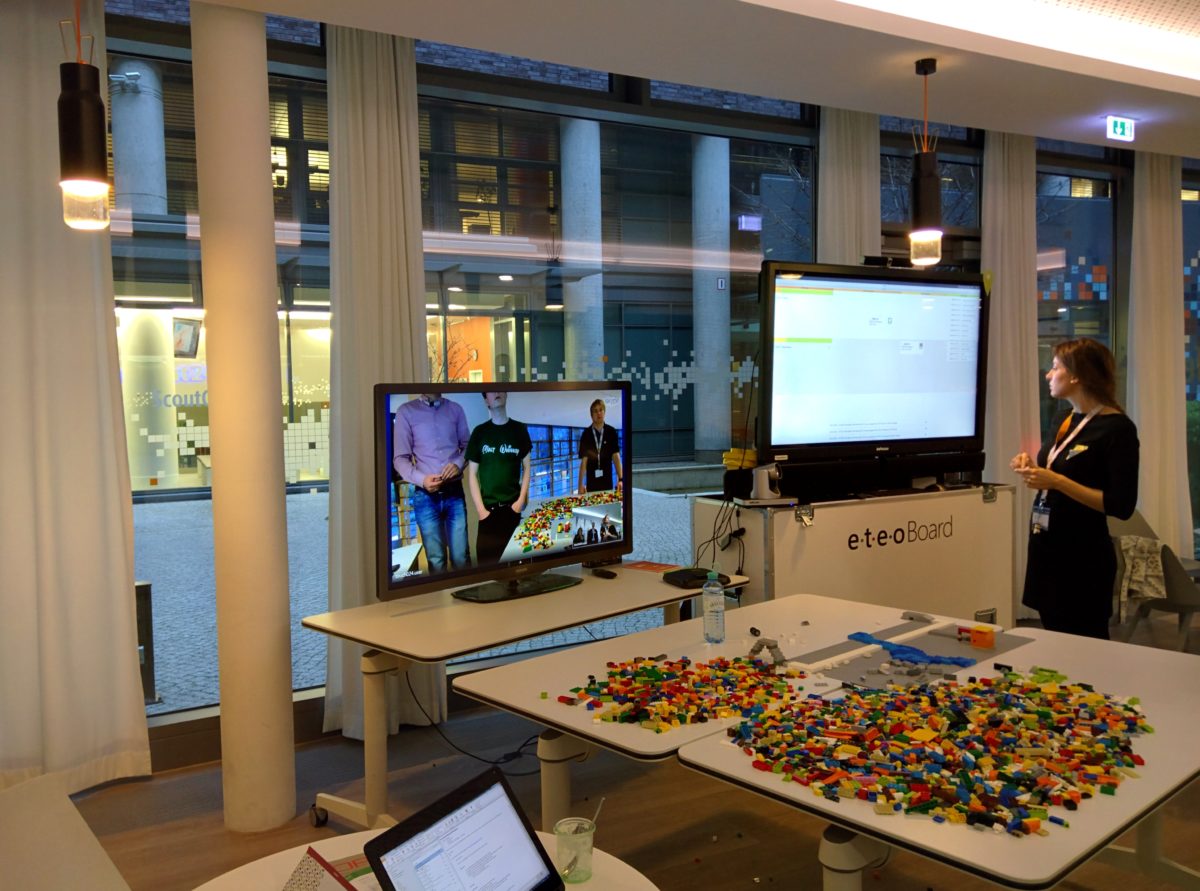
I was in Berlin for 2 days to participate to #DATFlock2015 the conference to discuss, learn and share about Distributed Agile Teams.
The program was a mix of open space sessions and workshops prepared in advance.
OKR, Feedback and Reward
Two sessions where particularly useful to me:
- How to use OKR?
- Fearless feedback and fair reward
Two sessions proposed by Petra Liesmons and Kitty Iding, thank you! Those subjects and the way they were covered are confirming the work I am currently on, to implement those ideas with the teams I work with.
Take away and personal thoughts from the OKR session:
- Improvement on the way to explain OKR, especially the difference between key results and actions. An important aspect, because people tend to be confused and propose actions as key results, for not so good reasons. For example: because we are doing that today, it’s an important things to do but it’s not connected to another key results… The last point would be a good signal to stop doing that, or to reconsider the OKR already defined.
- Other important point that is subject to discussions is that OKRs are not cascading from the company level to the team level. There’s objectives and key results at the company level. They will be used to guide the decisions of teams which will define their objectives and key results. One team is able to contribute to a part or all the objectives and key results of the company.
- Key Results should be a stretch. They will show our ambitions. They should be difficult but not impossible. So it means we need to change the habit to reach 100%. An habit that tends to lower the objective, so we are sure to overcome it…
- And obviously this bad behavior is increased if kpis are connected to reward. So OKR should not be connected to rewards.
- Key Results represent success, impact, the behavior we want to drive in the company.
- OKR is not a top down approach, we need everybody involved in the definition, the scoring, on a regular basis. For example, on a yearly basis for the company OKRs, on a quarterly basis to reconsider OKR for a team, on a weekly basis to score the current Key Results for each team.
- OKR are public in the company, and time should be taken to align the OKR between teams
- We probably need sanity indicators like happiness index of team members to check the side effects
 Take away and personal thoughts from the feedback and reward session:
- To receive clear feedback from the team, it is necessary to clarify expectations, so to define the roles: manager, product manager, product owner, scrum master, developer, tester, etc… depending of the organization of the company
- One model to define roles and responsibilities could be to use the model from Matti Klasson. There was a discussion around the idea to use dos and don’ts and we agreed at the end that it was better to reformulate with dos than to have a long list of don’ts
- The World Cafe format to define the different roles seems to be the more efficient one. I need to find a way to do that in a distributed mode
- Introducing personality types (with tools like mbti, ensize, insights…) can be a way to help people understand the different personality types and in this way give feedback in the best way so they can be received
- One suggestion to help people handle the feedback they receive is to give them personal coach. The personal coach are volunteer from the teams that will coach 4 to 5 individual. Those people will form a virtual team and will be themselves coached and trained.
- The reward part of the discussion introduce the idea of peer to peer face to face scoring on each person compared to the roles they handle. The personal coach will help the person to review the scores. The person is responsible to define the scores she think good for her. The manager has access to all the scores and people will be ranked for each role. Then there’s a comparison of their score ranking and their compensation ranking, and an adaptation if necessary.
Organization and Architecture
 I also appreciate the keynote by Johannes Mainusch On day 2. Particularly the part showing the connection between the size of a team, the number of relationship to maintain between the people and by consequence the decrease of work done when you add too much people on a team.
The conclusion of the speaker was that they needed team not to small to be able to pair program and to be able to form new teams by spliting the teams (like cells).
The idea to have architects that will be part of each teams and that work together to male the architecture changeable, to insure that the cross functional teams can be independent.
 And of course I will definitely use the ELMO facilitation technique, that can also work for a distributed team in a video conference call. Each team member has a paper, it could be with Elmo, and when a conversation is taking too much time, they can rise the Elmo, that stands in this case Enough Lets Move On (ELMO).
A fishbowl was organized during the second day, and to open it Lisette Sutherland explained why she invited Yegor Bugayenko, founder and CTO of Teamed.io. Yegor is working with distributed people all over the world and states that team building activities are useless. A sign of bad system and bad management that tries to bribe the people and replace discipline with friendship.
It was definitely interesting to have a respectful opposite point of view in the conference. Yegor explains in this blog post the experiment he tried during his workshop session.
The main ideas: the customer wants the software and is not interested in a team, and a team is less efficient than well orchestrated individuals. I have one main disagreement there… But we will come back to it later.
How Yegor’s system works?
Projects are splitted in thousands of tasks of 30 minute each. The task will be proposed to developers that will take or leave. The system is a pay per task, and you get paid only if you succeed to deliver the task with the expected quality level. They need to keep in my that it’s an half hour task, so if they are not able to understand the class they will need to use in a glimpse, it means it’s a bad class that needs to be refactored, so they need to create a new task to get what they need to work on the initial task and put it on hold. They will be paid also to create task. Another person, in the architect role, also paid per task, will validate if the new task is needed.
The risk are solved by numbers. They choose to put 25 developers on a project that needs 3. If one fails to deliver the half hour task (small risk), the task will be reassigned to another one.
Distributed people, not distributed teams
It’s a system that may not work for everybody. Yegor claimed that a lot of people want to work with them, so they have the opportunity to choose. They give tasks to new comers on open source projects to see how they behave, if it’s ok, they will enter the pool and will be given customer projects tasks. If I remember well the metrics is only 1 out of 20 that will be able to continue.
Unicorns
One person during the fishbowl sat on the empty chair and said that the Unicorns (startup with more than 1 billion dollar valuation) demonstrate the validity of cross functional teams, people working together and so on… The humble response of Yegor was that one or even one hundred examples like this are not enough to demonstrate the causality of those successes… How many teams are doing the same things without achieving amazing results? And that’s a good point, we tend to interpret the situations according to our own beliefs…
Disagreement, Creativity and Innovation
The main disagreement I have is around creativity and innovation. Cross functional teams will enable to have different kind of people working together with the same purpose. And from the frictions produced during this collaborative work great new ideas will come up. Agile practices are crafted to organize those conversations and to generate those opportunities.
Bad Agile
The problem is when we look at bad agile implementations. Teams that claim they are “doing” agile but:
- No collaboration in the team (Assignment of one story per person for example)
- No discussion with the product owner
- Stories that are todos without purpose
- No reviews with the customer
- No collective splitting stories into task
- No pair programming
- Review by one architect
- Tests by QA outside of the team
- …
If we combine those bad practices with bad management that is not knowing what should be done, changing priorities everyday, fixing unrealistic goals and so on…
We come up with question around how to implement efficient software development systems and warnings around applying only a part of a system without understanding the consequences of those choices.
Thanks to Lisette, Lucius and all the contributors to this great event.

 As the company was growing fast, we wanted to know if we were heading in the good direction, and if employees were really happy. And the best idea we found to get this information was to ask people on a day to day basis, using 3 simple buttons and a form to collect feedbacks so we can know what we could continue doing, what we could change or stop doing.
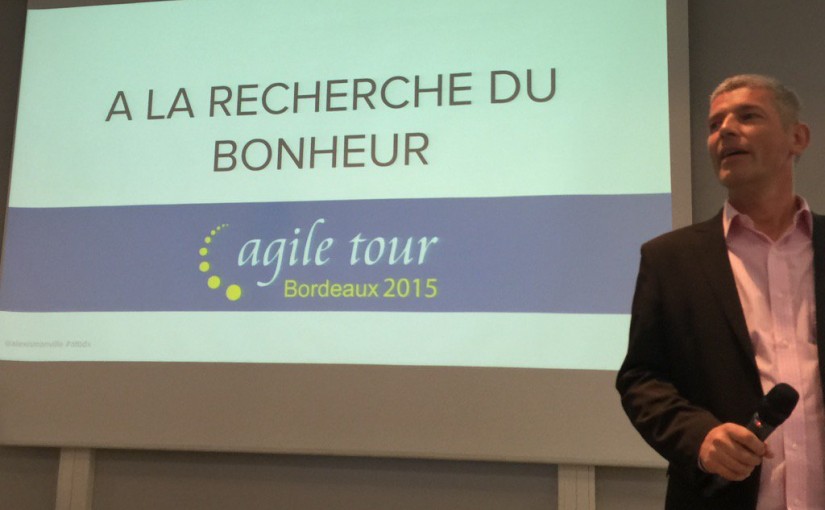
 Answer may not surprise you, it’s not a new car, even a fancy one. Circumstances like that will have an effect on our happiness level, but we will go back to our set point soon or later. The most important finding, according to me, is that our happiness depends by 40% on our activities, and not on our genes or the circumstances. We can choose to have an impact on our happiness level.