Author: Alexis

  • Agility, Innovation, and Leadership with Jurgen Appelo

    Agility, Innovation, and Leadership with Jurgen Appelo

    What does it take to help organizations stay innovative, adaptive, and human as complexity keeps rising?

    In this episode of Le Podcast on Emerging Leadership, I sit down with Jurgen Appelo — author, speaker, and entrepreneur — to explore the stories behind his books, the communities he helped grow, and his perspective on leadership in modern organizations.

    Jurgen is best known for Management 3.0, which emerged from a practical question he faced as a CIO: what is the role of the manager in an agile organization? At the time, agile focused mostly on team practices. The leadership part was missing. Jurgen chose that gap as his niche and wrote into it.

    The leadership trait he returns to: experimentation

    When I ask Jurgen what leadership trait matters most, he refuses the simplistic answer. Social systems are complex. There is no single magic trait.

    And still, one idea keeps coming back: experimentation with fast feedback loops.

    The core of agile thinking is learning quickly through small experiments. Jurgen argues that the same logic applies to managers and leaders. Leaders also need tight feedback loops — and often their “customers” are the employees. Retention, engagement, and trust become central signals.

    Community as belonging, even for introverts

    We revisit a shared memory: the first Agile Lean Europe event in Berlin more than ten years ago. Jurgen reflects on how communities matter, especially for someone who is introverted and spends much of his time reading, writing, and building things alone.

    Community provides belonging. Across Europe, weak ties stay alive. You see familiar names in different constellations, and events feel like homecoming.

    Management 3.0, Happy Melly, and other initiatives are, for Jurgen, subcommunities inside a broader ecosystem of agile and lean oriented people.

    Every book is a different baby

    Jurgen’s books each had a different origin story and process.

    • Management 3.0 took years and required deep research.
    • How to Change the World was a self-publishing experiment.
    • Managing for Happiness was intentionally designed as a full-color, horizontal, practical book.
    • Startup, Scaleup, Screwup came from a publisher request and was built through interviews and travel under a tight timeline.

    And then he drops a detail that makes me smile: his fifth book will be a novel. Yet another experiment.

    Teacher and practitioner are different roles

    One of the most honest moments in the conversation comes when Jurgen explains that he is a better writer and speaker than practitioner.

    He uses analogies from music and sport: great teachers aren’t always great performers. Great performers aren’t always great teachers. Different talents.

    Jurgen’s role, as he sees it, is often a 30,000-foot view. He spots patterns and builds models. That makes it easier to propose frameworks, but it also means he doesn’t spend his life inside large organizations as a consultant. He gets his “feet in the mud” mostly through his own ventures and experiments.

    It is a refreshing stance, and it clarifies what kind of value he aims to provide.

    What makes a great talk

    Jurgen describes his style as infotainment. Not fluff. Not slides full of bullet points.

    A great talk requires:

    • understanding the audience before you start
    • choosing the right stories for their reality
    • making people laugh
    • delivering takeaways

    “No bullet points” is a rule he repeats. Stories, humor, and relevance do most of the work.

    The pandemic, travel, and painting walls

    Like many speakers, Jurgen’s business collapsed when events were canceled in March 2020. He watched the dominoes fall and had to experiment with new models.

    But he also made a discovery: he does not want to return to the old rhythm of travel. In 2019, he traveled around 250 days a year. Too much.

    During the pandemic, he bought a house and learned to paint it himself. The satisfaction of looking around and seeing what you built with your hands stayed with him. He wants more of that kind of life.

    So he chooses hybrid. Back to stages, back to people, back to cafés across Europe, but not at the same cost.

    One action to develop as a leader

    Jurgen’s personal development habit is simple and consistent: podcasts.

    He listens while walking, commuting, traveling — and he deliberately draws inspiration from domains far from management. Economics, medicine, design, science. He mentions listening to a Nobel prize winning economist who pushed field experiments, and he recognizes the same logic as agile.

    Learning, for him, is cross-pollination.

    Closing thought

    Jurgen’s message is not “copy me.” It is “keep experimenting.”

    Small loops. Fast learning. Broad inputs. Strong communities. Honest self-positioning.

    And a reminder that leadership in complexity is less about a single trait and more about building the conditions to learn and adapt.

    Listen to the episode here:

    Here is the transcript of the episode

    Alexis

    Hey Jurgen, what is your role, and how would you describe it to someone you just met?

    Jurgen

    Ah, my role I usually describe that as I am an author and speaker and also an entrepreneur on the side.

    Alexis

    Excellent, What was the pivotal moment that led you on that trajectory?

    Jurgen

    Well I think the pivotal moment would be the release of my book Management 3.0. I have been a manager for a good number of years. In my younger days, originally a software engineer, I studied at the University in Delft, but my interests were much broader than just programming. I was never really a geek or nerd, if you could say that. I was interested in marketing and finance and lots of different stuff.

    Jurgen

    So it was sort of obvious that I became manager, team leader, manager etc… And then the chief information officer. In that role, I introduced agile practices in the organization where I worked, I introduced scrum and had to figure out what is the role of the manager in an agile organization because at the time this was not really addressed. It was mostly team practices I’m talking 2001 to 2010 here. So I sort of claimed that as my niche and I wrote a book on it: Management 3.0 and that became a bestseller. Even before it came out, I quit my job because I already got requests for events workshops that I started to develop. From that moment on I have been acting independently doing lots of things cool stuff and first for seven years focus on Management 3.0 and licensing around it and then I went in other directions experimenting with other ideas.

    Alexis

    So it’s it’s really interesting to me I feel that in the twenty first century there’s a lot of things that changed and are changing and we continue to change. What do you think is the main leadership traits people should care to develop.

    Jurgen

    Well this is the typical question. What is the 1 best thing while the actual answer is always. There is no one most important thing because we’re working with complex systems and social systems. They are too too complex to to just summarize everything in one sentence. But, that being said, a couple of things come to mind. First of all, experimentation, fast feedback loops, that also applies to management and I would say this is perhaps the core of agile thinking: fast feedback loops so you learn quickly and with small experiments figuring out what the customer wants, what the customer needs, how they respond to ideas. Exactly the same applies to managers and leaders when they want to create better organizations. The customers often for them are employees they need to make sure that people don’t leave and this has become more and more important nowadays.

    Alexis

    Excellent. Thank you for that! I was lucky enough to meet with you in person during the first ALE event in in Berlin. I guess it was more than ten years ago

    Jurgen

    Oh cool. Yeah, that was a special one. The very first one. It is always nice to have memories of the very first time an edition of the event takes place.

    Alexis

    Yeah, the feel of the event was really of community and friendship. I would like to ask you what is the place of communities in your life in your work.

    Jurgen

    Wow good question. At the time I was sort of responsible for that event Agile Lean Europe. At least I came up with the name, I even came up with a logo of Agile Lean Europe and then other people took over and started organizing the event in Berlin that you refer to.  Of course I very much felt at the center of that community and still do. I’m happy that there’s a new event being organized this year in Toulouse apparently. It’s especially for someone like me who’s actually an introvert and loves being on his own day after day thinking and reading and writing and creating stuff. It is important to feel part of something, to have a sense of belonging. For me, that is the agile lean community in Europe. I know so many people because I have attended hundreds of events across the continent in almost every country I think. I follow people and they follow me online so we can chat on Twitter or Linkedin or Facebook or whatever. There’s always these weak connections that no matter what the distance is across Europe you feel connected with each other. That’s a good feeling, especially as I said for people such as me who do a lot of things on their own remotely. It feels like homecoming when I am at an event and I see friends and followers and people that I know from across ah Europe. I feel okay this is the place I belong these are the cool people that I want to hang out with. That is I think the purpose of of community to to give you that place of belonging even when most of the time you travel around the world and you sit alone in coffee bars or hotel lobbies.

    Alexis

    Yeah I feel in your different businesses or in in the the work that you are doing that communities are always really present like with management 3.0 or with the Happy Melly we can see a lot of people gathering with each other to achieve a greater purpose. Is it really something that is real or is it my perception of it.

    Jurgen

    No, that’s just people gathering together around a specific topic like indeed there is a Management 3.0 Community. Of course there are other communities that I am either responsible for or involved In. But for me, they’re all part of a larger community out there as I said which is agile and lean oriented people. They sort of gather together in these subcommunities in different constellations. So you keep running into the same people and basically and which subcommunity you find yourself in and that’s nice and I think that’s important to have that.

    Alexis

    You mentioned already the management 3.0 book. You wrote several books. How to change the world was already a nice small one that you offer for free on your website. I will put the link to that and. The experience with Managing for Happiness was probably an interesting one. And the latest Startup, Scaleup, Screwup. What is that experience of writing books. You’ve said you want you like to be on your own thinking, writing, reading. What are the different experiences you had with those books.

    Jurgen

    Well, it’s a cliche but it’s true. Every book is like a different baby  in a sense. They’re all different kids with different personalities and different histories. So Management 3.0 took me several years to write. A lot of research went into that, a lot of reading of popular science books and articles etc. That was a very different project compared to the last one for example, startup scaleup screw up where basically the publisher said can you please write another book doesn’t matter much about what it is but we want to sell another one that was sort of a compliment of course because when publishers want another book. It means that they earned money with your previous one.

    Alexis

    Um, yeah.

    Jurgen

    I thought at the time. Okay, well, if I were going to write another book I want it to be about the stuff I’m doing now which was I was leading a startup at the time and trying to make that work so that seemed like a good combination. In that case, the creation of the book took me, I think, about eight, nine or ten months. It had to be done within a year and I traveled a lot. I spoke with a lot of people across Europe startups and scale-ups so I did quite a quite a few interviews. There were very different process for that one a very different kind of book. But I enjoy each of one of them. Indeed as you said how to change the world was a very small one that was a self-publishing experiment. And managing for happiness is again different. It is horizontal book, not vertical, very colorful. That was my requirement with a publisher at the time that I wanted a full color book so they’re all different and the the fifth one is going to be a novel so that’s again, a completely different book that I am working on now and that’s and that’s fun I’m I mean always trying something new that I haven’t done before.

    Alexis

    I’m glad that you’re working on the next one. I will be interested in reading that novel. That’s excellent. You’ve been recognized by Inc.com in the top 50 management and leadership authors. And I know there’s a story behind that. There’s probably hundreds of writers in the field of leadership and Management. What makes some of them more successful than others is is it their expertise as practitioners or what?

    Jurgen

    Interesting that you say that, I just published the blog post today actually with my learnings of the last three years of running a lot of experiments and one thing that I realized is that I’m a much better writer and speaker than practitioner when it comes to management and leadership. This sounds weird, but if you compare it with other disciplines – for example, the best teachers of music are not necessarily themselves the best musicians and vice versa, the best musicians are not necessarily good teachers of making music. It’s the same as sports if you have great sports coaches. The best in the world. It doesn’t really mean that they themselves are really good in the field as athletes and also great athletes are not necessarily good coaches. So there’s a difference between being a teacher of something and being the practitioner of something there. Actually different talents and that’s something that I have noticed myself I love the teaching aspect of it I like creating workshops. I like writing about things. I like talking about stuff and yes I am also as I said an entrepreneur on the side because I also like the practical experience. But it doesn’t mean that I’m the best manager or leader out there. In fact, I would say I’m a mediocre one for sure. Don’t hire me as a manager because I happen to write books on the topic. That’s it’s very different like. The top rated Nobel winning economists are probably really bad at running companies because it’s something different observing and writing about it really understanding how field works is very different from operating in that field and being successful as a practitioner that’s something that I had to realize in the last three years where I sort of found out. Well actually I suck in some areas but then I have great insights because of my learnings and I’m able to write about it and then I inspire other people who are practitioners and they can use my input and so that’s win-win I suppose. That’s why I say first I am a writer and speaker and I do some entrepreneuring on the side because it’s fun to have practical experience and to fail and sometimes succeed. I will never be the best entrepreneur out there but the best entrepreneurs out there are actually pretty bad speakers and writers so we all have our own roles I suppose.

    Alexis

    Yeah, exactly and I really like the fact that you are looking into that and you are still doing Experimentation. You’re still working on different projects. So You can also test Idea yourself um and not only inspire people I think the 2 things are already useful and I’m I’m always always a little bit worried about the people that are only doing the teaching part.

    Jurgen

    Yeah, for sure I agree there sorry to interrupt but, and and my approach is slightly different from others because there there are plenty of authors and speakers out there who are coaches or consultants. They go into companies and they help managers and leaders or or other kinds of employees doing their stuff and that’s great. There’s nothing wrong with that. There’s just a different approach and I am not like that. I have a different role I often say I operate at a thirty thousand feet view. I have more of an abstract understanding, I see patterns across the world that also makes it easier for me to come up with new models and new insights. On the one hand, that’s a benefit. On the other hand, the drawback is that I do not have the deep experience of observing what happens inpecific companies on the inside. So I don’t really stand with my feet in the mud so to speak, except for my own little companies where I run experiments and that sort of compensates for me for the lack of direct experience I have with large corporates or whatever because I’m not very interested in coaching in consulting, I would not be there. Definitely not be the best person to do that.

    Alexis

    Thank you. You’re already a very successful speaker. How would you describe what you bring as a speaker and what are the key to success for a really great speech.

    Jurgen

    It is infotainment. You need to make sure that you have a message that there are takeaways. You need to understand the audience. So I always ask my clients: what kind of people are there in the room? Is it only engineers, or is it across the company, or is it mostly management and things like that. How many? So I usually have an intake before an event so that I know what kind of audience I Encounter. You need to entertain people. You need to make them laugh and tell interesting stories and experiences and not just show models or bullet points. Definitely no bullet points. That’s basically it. Tell stories, be funny and make sure you understand what the situation is that the audience finds themselves in so you can relate and make the right connection because I have a vast library of content stuff I can talk for hours. Literally I’ve done that a few weeks ago when I recorded a course for a client in Brazil. The recordings were in London and I just used my existing materials. I thought, my god, I have so much I talked for 5 hours and I was still by far, not through everything that I had.

    Alexis

    Whoa.

    Jurgen

    Ah, so I have quite a bit of stuff that I can make selections from. Understand the audience, be funny, share stories, and that will take you 80% towards success, I suppose.

    Alexis

    Thank you. Do the pandemic and that shift to a hybrid world of work affect your work as a speaker? Will you go back to events or will you do everything from your home?

    Jurgen

    Well, first of all the pandemic was terrible of course for my line of business. I just looked it up yesterday I had my last trip home from Melbourne Australia where I had done a workshop on the fourth of March of 2020. So exactly seven days later the world health organization named the Covid Virus a pandemic officially. So, I was home just in time and then all events in my calendar were being canceled one after the other it was like dominoes they were falling over and I was like oh my god what is happening here. All my income for the rest of the year was evaporating basically. Never waste a good crisis as they say so I experimented I came up with alternative ideas I ran online meetups and and workshops and it became other business models. I actually learned from that experience that I don’t want to go back fully like the way things were because in 2019 I travel I think about maybe two hundred and fifty days per year and that was absurd that was a lot, and I don’t want to be away from home that often anymore I have a wonderful house. We bought a house two months before the covid pandemic hit coincidentally. Just in time, interestingly enough and that was a great coincidence. The house needed quite a bit of painting, so I developed a new skill I am now really good at painting walls and painting doors and everything and it turns out I enjoy that I enjoy being able to do something with my hands and make the space that I live in look beautiful that is so satisfying and I would never have experienced that if if there hadn’t been the pandemic. I would just have paid a professional painter and that would not have been the same thing now I sit in my chair and look around me and I think cool I did that and I’m I’m very happy with that. I want to be home more in the house that I, to a large extent, painted myself. So for me also it it is a case of I will be in a hybrid situation I do want to go back to travel because I miss the coffee bars in Stockholm and the people in Warsaw and etc etc. But yeah, not two hundred and fifty days per year anymore a bit less.

    Alexis

    Yeah, that’s good to find that balance but I’m glad that you’re back to events because I’m eager to hear you speak again. So it’s perfect!.

    Jurgen

    Yeah, it would be awesome! I have a trip to Prague upcoming and then from may I have quite a few trips scheduled across Europe mostly and I very much look forward to that to be on stage again.

    Alexis

    Perfect I think a lot of people are waiting for that to! You worked with many leaders and among those you admire? What’s the the one treat that stands out to you. And how is that treat is important to you in the way you see leadership.

    Jurgen

    So well, that’s interesting. Actually, you’re the second person who asked that question this week, and I was also not able to answer it last time because I read many articles, I listen to many podcasts, lots of books. There are many sources where I draw my inspiration from, and to be honest, there is not one single person who inspires me most. There are dozens if not hundreds for different reasons. I could name one random person. Richard Branson I admire him for the way he manages his companies and and the message he gets across: Be there for your people first, the people come first and then they will take care of your customer. They make sure that the customer comes first I totally agree with that message and it’s amazing that he built like 400 virgin companies all under one umbrella. But that’s completely different from others who I don’t know who have been active in complexity science or something where I admire the likes of I don’t know, Stuart Kaufman who wrote amazing books on explaining how life evolves and I have drawn inspiration from that for complex systems such as organizations. And yeah, so the many people I’m not able to come up with with one name. Also, I don’t think it would be fair to come up with the one person that I admire the most. It’s is heavily context dependent on what kind of topic we are talking about and. So if you narrow it down to a very specific topic then it would be easier to come up with names.

    Alexis

    Yeah, it’s and it’s ah it’s interesting and I love that you picked something that I think is important for leadership that idea of people first is something that is important. So you picked one thing there. Ah yes I know it’s random, but it’s an interesting one. What’s one action you’ve taken in the past to develop yourself as a leader and what did you learn from that.

    Jurgen

    I listen to podcasts, as I said. Just today as well, I think an hour or something because I had a long walk through the city from my home to a coffee bar that I enjoy and back. Ah, and I tried to use that time of walking around and sitting in public transport and I amlooking forward to the traveling then I can do even more podcast listening and those moments that you stand in a security line or sit in a taxi on the way to the hotel and things like that. For me, that’s a great way to encounter new ideas that I have not heard before or just being inspired by thoughts from very different domains I listened to a Nobel prize-winning economist today who got his nobel prize for the very agile idea of running experiments, field experiments because he said that most of economy was a lot of theorizing coming up with theoretical models of how the world is supposed to work. But he said very few actually went out of their offices into real life just running experiments on businesses and people to see how they behave in response to which interventions and that was very new for economy and perfectly obvious in Medicine,  for example, you do controlled trials you have random blind tests and everything but that was a new idea in the economy. You got a nobel prize for that and that what I listened to was it sounded really agile. So I thought that was super cool. Super interesting and that’s what I do to be inspired I watched the podcast and there were obviously a lot of reading but that is one tip that I can give people just subscribe yourself to lots of fascinating podcasts out there and being inspired by what happens in completely different domains because you can learn from Economy. You can learn from Health Care. You can learn from design or whatnot.

    Alexis

    Excellent I love the advice. Thank you very much.
    Jurgen Appelo is a serial founder, successful entrepreneur, author, and speaker.

    Thank you for having joined me on the podcast today.

    Jurgen

    It was a great pleasure. Thank you Alexis.

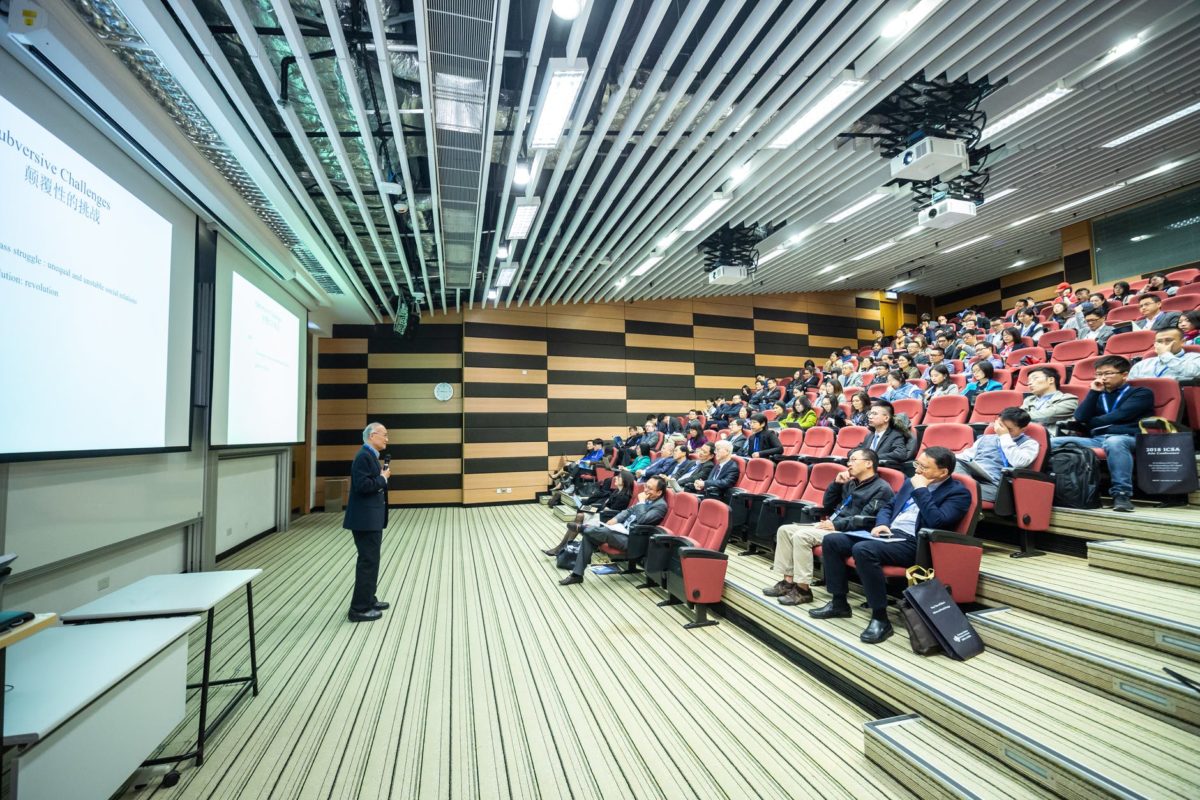
    Photo by Afta Putta Gunawan from Pexels

  • What to Nurture in Sustainable and High-Impact Organizations?

    What to Nurture in Sustainable and High-Impact Organizations?

    by Alexis Monville and Jérôme Bourgeon.

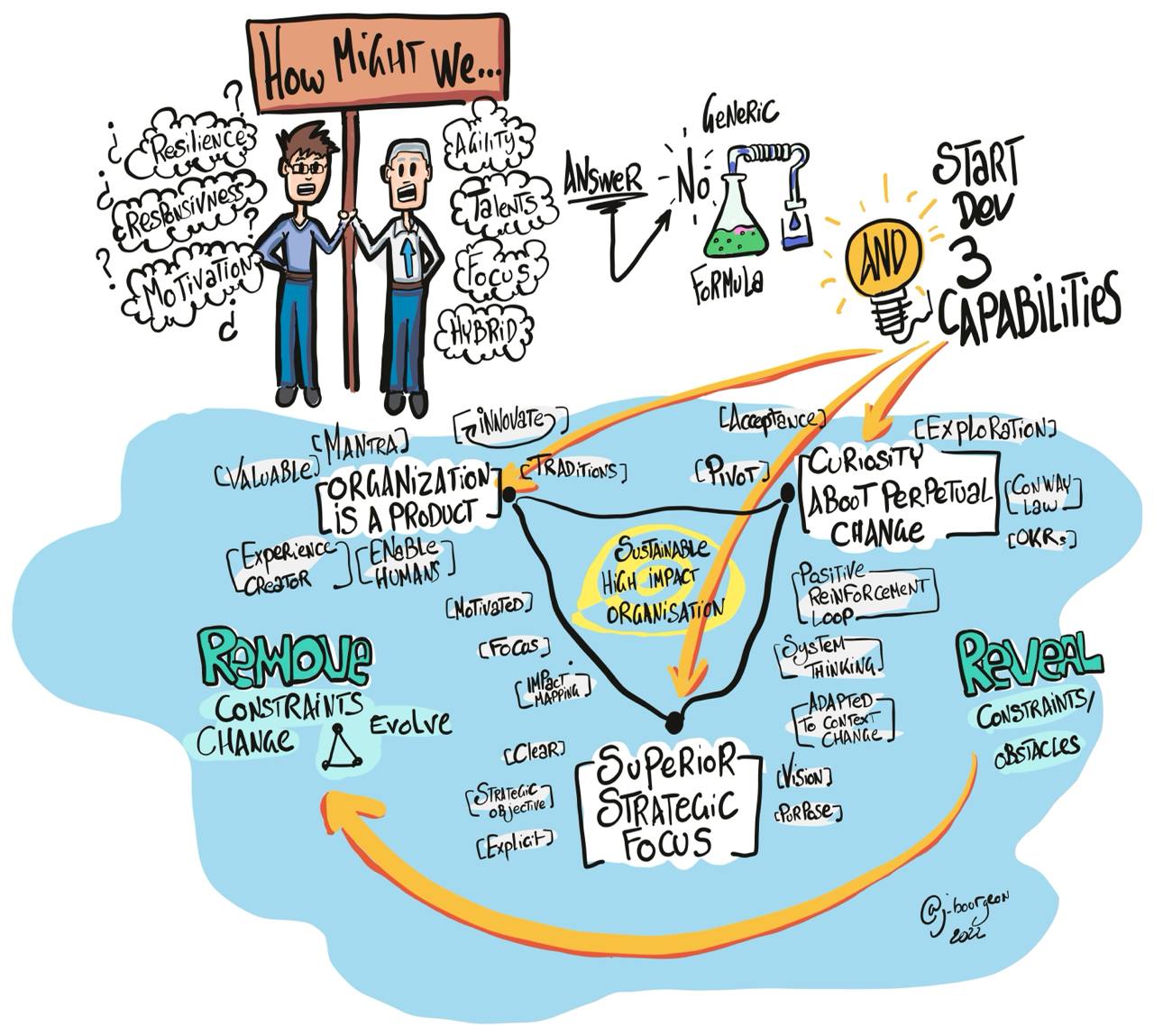
    When old innovations depreciate quickly, and new ones become a standard in a short time, how to facilitate your organization’s resiliency, agility, and responsiveness to an ever-changing ecosystem? How to attract and retain talents? How to keep them focused, motivated, and engaged in our ever more challenging new hybrid world?

    Some companies seemed to evolve organically to fit their economic and sociologic context, no matter their sizes. How are they accomplishing that wonder?

    No magic formulas are available on the market. You would have already applied it to your organization.

    Igniting the change in your organization requires the development of three capabilities. In developing those capabilities, you will uncover the magic formula for your organization and shift its culture.

    This article provides you with the questions to assess where you stand in developing the three capabilities and suggest tools you can use to push the development further.

    Superior Strategic Focus

    An organization can achieve extraordinary results when all people row in the same direction. We love to start here because everyone smoothly agrees that a clear purpose, vision, and strategic objectives are fundamental to success.

    One approach to facilitate the shared understanding is engaging the organization, starting with the leadership team, in drawing an impact map. The impact map represents a shared understanding of the assumptions about the future and pushes all people in the same direction.

    Questions to reflect on:

    • Why do we exist, and what do we do? How would people in your organization answer those questions? Are they in agreement?
    • How does your organization define performance?
    • Which of your business assumptions is at risk of being invalidated?

    The Organization is a Product

    Building the organization like a product is our mantra. An organization that provides an incredible experience to employees in a hybrid world. An organization that enables them to do their best work, providing a fantastic experience to partners and customers.

    The “way we do things here” has some time to be protected. Some traditions and rituals are essential pieces of the culture. Sometimes they have to go or evolve to let the organization move to higher levels of development.

    Applying the Impact Map to the organization is a way to do that. Explore how to create working agreements. Explore how new rituals fit the new hybrid world: company roulette and culture on a plate (ask us if you want to know more about those).

    Questions to reflect on:

    • What is the last story you heard in your organization that moved you?
    • What is the next feature your organization needs to provide to generate more value?

    Curiosity about Perpetual Change

    As humans, we crave stability. It does not exist. Ourselves and our environment change constantly. Being curious about change and accepting the reality of perpetual change is dawting individuals and organizations. Building positive reinforcement loops facilitates acceptance.

    Observe the organization in place and compare it to the original design. Observe the connection between the organization and the product and services of the organization (Conway). Explore how to develop Objectives and Key Results (OKRs) to foster positive reinforcement loops.

    Questions to reflect on:

    • What could be the next capability your organization needs to create?
    • What have you changed your mind about recently?
    • Which of your beliefs have you let go lastly?

    Starting the three capabilities development journey shifts the culture, and brings meaning and purpose to your organization. The first steps reveal obstacles and constraints to remove to achieve more sustainability and higher impact. Motivation and engagement grow with a higher focus, a better organization, and a freshness of curiosity.

    In the long run, the development of the three capabilities creates the condition for your organization to evolve organically, enabling your business to develop and pivot when needed.

    Illustration by Jérôme Bourgeon

  • Reputation: What You Don’t Own

    Reputation: What You Don’t Own

    What is reputation? Why does it matter? And why do so many companies only start thinking about it when it is already too late?

    In this episode of Le Podcast on Emerging Leadership, I talk with Laurence Duarte, who defines herself as a business fixer and a protector. For the last six years, she has developed expertise in criminal risk and in protecting what she considers the most important assets of any company: people, property, proprietary information, and reputation.

    Laurence has a gift for making reputation simple to understand, without making it simplistic.

    You don’t own your reputation

    One distinction sits at the heart of the conversation:

    • Brand is what you own.
    • Reputation is what people think about you.

    Reputation is perception. And perception lives outside your control.

    That is why many leaders avoid the topic until a crisis forces it into view. But by then, rebuilding trust can become painfully slow.

    Why reputation matters

    Laurence explains reputation as the “willingness” of stakeholders to:

    • buy from you
    • invest in you
    • work with you
    • believe you

    A strong reputation supports:

    • faster recovery during crises (reputation equity as a buffer)
    • ability to attract better employees
    • premium pricing and stronger loyalty
    • higher market value
    • credibility when you communicate

    In other words: reputation is not a soft topic. It shapes hard outcomes.

    Two examples: Facebook and Spotify

    We explore how reputational events can trigger very different reactions.

    When Alexis heard about Facebook and election manipulation, he closed his account. It was emotional. Not perfectly rational. But real.

    With Spotify, he noticed something else: in conversation with friends, he found himself defending Spotify, despite concerns. Laurence points out something important: reputation works at multiple levels, and loyalty behaves like relationships. The longer the relationship, the harder it is to leave.

    This is where reputation equity shows up: past goodwill can delay the break, even when present choices are questioned.

    Reputational risks and the reputational gap

    Laurence introduces the idea of a reputational gap: the distance between what people expect and what you can actually deliver.

    A company can have:

    • too much love (high expectations that reality cannot sustain)
    • too much hate (perceptions that exceed the reality of what is happening)

    Both are risky.

    And a dangerous version of the gap is the one many consultants recognize instantly: values written on the walls, fear visible in the people. When words and reality diverge, trust collapses.

    Laurence also highlights other drivers of reputational risk:

    • criminal or hostile actions: cyber attacks, counterfeiting
    • toxic environments
    • shifts in societal expectations
    • stakeholder pressure (media, regulators, NGOs)
    • weak signals from employees that go unnoticed or get hidden

    A key idea: companies are no longer black boxes. They are glass boxes.

    Employees as the first shield

    Laurence is explicit: employees are not just stakeholders, they are often the first reputational shield.

    In a crisis, employees will either:

    • protect the organization, or
    • confirm what outsiders suspect

    A healthy culture is not only “nice.” It is protective. It shapes what gets reported early, what gets fixed early, and whether weak signals are allowed to surface.

    Reputation shields: what protects you over time

    Laurence describes a framework built on anticipation and protection:

    • identify and monitor risks early
    • build reputation shields that reduce damage and accelerate recovery

    Two shields apply to every company:

    1. People and culture
    2. Trust (earned through consistency between what you say and what you do)

    She adds that sustainability is increasingly a shield too, because expectations have changed. It is not enough for a product to work. People want it to feel right.

    Everyone owns the responsibility

    One of the most practical reminders in the episode:
    Reputation is not only a communication topic, or a legal topic.

    Everyone contributes:

    • supply chain
    • product
    • leadership
    • operations
    • HR
    • engineering
    • customer-facing roles

    Reputation is the accumulation of decisions, not a department.

    The leadership trait that matters most: self-awareness

    When I ask Laurence what trait stands out in the leaders she admires, her answer is immediate:

    Self-awareness.

    Because what happens inside a leader drives decisions. And success can carry the seeds of future failure if leaders stop questioning themselves.

    She links self-awareness to:

    • better decisions
    • less blame and self-pity when things go wrong
    • stronger integrity and authenticity
    • more courage
    • more responsibility for consequences

    She also shares her own development path: learning about emotions (fear, guilt, shame), and exploring embodiment as a way to notice what the body is signaling.

    Closing thought

    Reputation management is not only about avoiding scandals.
    Done well, it becomes:

    • situational awareness
    • strategy seeking
    • a competitive advantage
    • and a leadership practice grounded in truth

    Listen to the episode here:

    Here is the transcript of the episode

    Alexis

    Hey Laurence what is your role and how would you describe it to someone. You just met.

    Laurence

    I like to define myself as a business fixer. So most of the time my clients call me because they don’t know what to do and so my job is to help them to protect their company and to grow. Sometimes we need fresh eyes and that’s why I am here. So yes I think this is how I like to define myself as a business fixer and as also a protector, I like to protect business. That’s why for the last six years I developed an expertise in criminal risk and how to protect the most important assets of a company. The most important assets of any company are property… people. I should have started by people. Of course, it’s people first after you have properties you have proprietary information and of course reputation, I think it’s where why we are here today to talk about reputation.

    Alexis

    So tell me more about that. Why is corporate reputation really important?

    Laurence

    I mean um because it’s ah what will define as a willingness to your cop consumer but also your investors your um, your employees to work with you to buy from you. Ah, it’s ah how is it perceive you and so that’s why it’s um, it’s so important reputation. It’s um, ah, it’s yes, it’s how they will their willingness to work with you.

    Alexis

    So tell me a little bit more about what is reputation and what difference you make between the brand and the reputation?

    Laurence

    Most of the time the issue comes from this. We think we own reputation and actually, we don’t own reputation we own brand. It’s us. It’s like you Alexis. You are Alexis and what people think about you. It’s your reputation and this is what it is. It’s a perception and so that’s why we don’t own reputations. That’s why it’s sometimes very difficult for people and that’s why they don’t really want to talk about reputation. You know they wait for to meet reputation in bad situation and suddenly it’s like oh my goodness I have a reputation but most of the time it’s a little bit too late because it’s very difficult to grasp and to control and we know how much we love to control things, especially in the business field. But. Fortunately, they are ways to understand to monitor and in a way to I would say not control but at least to protect from reputational risks because reputation has so much impact in company. The first thing that most of the time we think about reputation, is reputation equity when you have a crisis, it will be some kind of a goodwill and it will act as a buffer so you have a crisis that suddenly, because you have a good reputation. It will help you to recover far more quickly. But it’s not only about that as I said, it will help you to attract a better employee. It will help you to achieve premier premium prices, to retain higher customer loyalty, and also to have better market value and also which can be a really huge advantage it will help you with the credibility of your communication. So see, when you talk about a good reputation, It’s like you are welcome everywhere and it’s really something that matters a lot.

    Alexis

    Let’s take examples. I would like to pick 2 examples and tell you how I felt about those company and their reputation and you can help us with that. So when Facebook… We heard about what they did to help manipulate elections. That’s my understanding of it, I closed my Facebook account and I said okay I don’t want to have anything to do with that company anymore. I’m not saying it’s rational. That’s what I felt that’s what I did.

    Laurence

    Yeah.

    Alexis

    That is what happened now when Spotify more recently. There was all that the discussion around Spotify and what they were doing and what they were not doing I realized that I was in a conversation with friends and I was advocating for Spotify. And I was thinking. That’s really interesting. What is going on there? What is happening is that reputation equity that you’re talking about.

    Laurence

    Yes, so thank you for sharing these 2 examples and to see how mature I would say a conscious consumer you just and you are not the only 1 more and more you have a change in the culture and the society because of hyper transparency the fact that now we know everything very quickly and suddenly we have to if the company is not able to make a clear choice. We will make the choice. In terms of Facebook, It’s exactly what you decided to. Do you decide? No, I don’t want to put some money in a way even if it’s free. We know that as they use our data so it’s not free and you decided to close. For Spotify, It’s another example and it’s a tricky one because, reputation works at several levels. It’s also, it’s like how you like the company and it’s like being in love. So if you are just in love for two days it will be easy to drop. But if you have been in love for a long time. It will be of course more difficult to drop I have the same issue with Spotify like you. It’s like I was thinking I should stop because I don’t like what they do but I am so used to Spotify so I feel that I don’t know what to do is it easy to switch to another company and it’s really where we stand as a consumer with our consciousness and also with our activism and it’s exactly what the company needs to monitor where we stand. And that’s why it’s very important to know one part of understanding our how I can say it risk exposure. It’s like you have to understand what is going on in the society. And so it’s good to see the expectation of your consumer and how we change over time as well as ah, knowing the outrage most of the time we think that it’s not our concern like outrage like we have metoo movement. We have black lives matter. We have the climate youth movement. You can’t say that you haven’t seen them coming. So, of course, like for Spotify. They knew that at some point it will come and so if they have this type of very armful content, violent content for many people they have to do something about it. And so if they don’t do something about it. Suddenly it’s our responsibility and I am not sure that we really like to take this responsibility because we buy a service and we don’t want to have more disruption from this service about our ethical behavior.

    Alexis

    So companies can work on that, companies and individuals can work on that to look at their reputational risk. Okay, what are those determinants of the reputational risk?

    Laurence

    The reputational risk. First, the main thing it’s like you need to check your what we call the reputational gap and it’s like as I like to define that as is if your true character exceeds your reputation. It’s like too much love or too much hate or, high expectation or lower expectation, and at some point, it has to. it’s like the 2 polarities and so you need to be sure that what the people are expecting from you is what you can offer. And so it’s not if it’s not the case and sometimes we may see oh they really love ah so much and so this is good.

    Laurence

    It might be not good because if it’s not a reality at some point they will feel betrayed and if a consumer feel betrayed, especially the most supportive one, there is no comeback from that. The backlash is far more violent for this type of consumer. So this is the first thing it’s what we call the reputational gap. Then there is another thing that you have to check. It’s like a criminal attack because it’s how your reputation can be harmed as well. So if you have cyber attack. If you have counterfeiting projects, if you have a toxic environment. It will create a lot of bad conditions to create in a way reputational risks. So it’s the same. It’s necessary to be seen then as we talked already, it’s important to check as well as the change in the beliefs, of your consumer and what they are, what they want from you. Before we wanted just to have a product that works well that’s it. Now we want a product that is guilt-free and that it’s not it has to work well, it has to feel right. It’s exactly what happened is in a way with Facebook and Spotify. You don’t want to use or to buy products that can harm the planet that can harm other people so it’s what are the most important things to check. And of course, it’s also important to see what people are thinking about you in terms of stakeholders. It’s not just about your consumer It’s also about, your usage of the media, the social media. It’s also about the government, the regulators, the ngos. Can be a really good signs kind of even if most of the time we think that ngos bother us but actually they are not, because they will show you where you have to work in order to build up and protect your reputation.

    Alexis

    This is really interesting that you look at all the stakeholders I can always imagine that we can draw an impact map looking at all the stakeholders Do you include in that analysis of the reputational risk the employees themselves of the company.

    Laurence

    Oh yes, employees are very very very important and you can see, it’s like tons of little weak signals, it starts always by small signals and it’s like are you able to catch them before it’s too late or not. So when you are able to catch them. Employees are very important. Of course, we have an issue. For example, it’s what we call a reputation company bias. So, if you’re in a company that is most of the time very aggressive, very competitive and they don’t allow failures they will hide a lot of things so it will be always everything is okay, everything is all right. I am working for the best of the best of the company. The problem with that, it’s not the case, most of the time it’s not the case we always have some issue here and there, and the fact that we can’t see it’s like you protect a toxic environment, you protect failures, you protect mistakes and missteps, management missteps and at some point, it becomes too loud and as we know a company is not a black box. It’s a glass box so everyone can see inside the company but it’s too late. It’s too late. That’s why it’s important to check and create a healthy culture in a company because as I say employees are the first reputation shield when you have a crisis. You know they will be the first to protect the company. So it’s better to have a healthy culture in the company because it will help you at so many levels.

    Alexis

    This is really fascinating. So ah I’m really interested in looking at that gap, the gap between reputation and reality, and if I take that from an employee’s standpoint I remembered working with company as a consultant where there was on the walls really inspiring statement about transparency and great really great values. But when you were looking at the people. Ah, they were all, in a way scared. They were really managed under high pressure and lot of fear. So It was completely disconnected from what was written on the walls. Ah, that’s those kinds of gaps between what the company wants to say and reality?

    Laurence

    Yes, I mean how you build trust I like that because trust it’s also another major reputational shield. But trust you don’t buy it. Trust you have to prove trust and so it’s this. You don’t have to have a gap between what you say and what you do and it’s very important to know that and I think it’s it depends on the true character of people. But of course, it starts with people, a company is nothing without their people. So It’s unfortunate that what I call posture slashing. It’s like you have all this bright things, you all this bright content, all this beautiful communication. And suddenly you have a crisis or suddenly something happened and you can really see that actually it was just like a posture and there is nothing. You know it was empty words and we can’t have that now in our society. During this time people with just empty worlds. It will not Work. You will be called out and of course, for you as a consultant, you have seen that because you can see a discrepancy between what was written on the wall and the reality of the leadership and the management and it’s very unfortunate because it creates a lot of damage in terms of leadership and this is not good.

    Alexis

    So that’s not only what you say that’s of course what you do, but it’s also what people expect from you.

    Laurence

    Exactly! You know it’s like that’s why you have to be sure that your consumer, your stakeholders what is going on in the society because it changed so that’s why. Sometimes, people say, oh I am doing all the right things, so it’s enough. It’s not enough. You also have to create some kind of environment that enables to see what is going on in order to adapt. That’s why I think most of the time people think about reputation risk and management as a cost. It can be also a very good competitive advantage because you know what is going on. You have a lot of data. A lot of intelligence and if you are able to understand and to seize the issue before your competitor in a way and to add that in your strategy in order to fix and to develop you will protect but also grow your business far better and in a far more sustainable way than others that didn’t do the same type of work. So it’s like strategy seeking as well as situational awareness you know it’s both the 2 ways that need to be implemented.

    Alexis

    You mentioned it just before and also in your latest report, you talk about reputation shields in companies. Can you elaborate a little bit on that?

    Laurence

    Yes, I found that we need to implement some anticipatory issue management. This is very important. You have to see and to anticipate, to identify, evaluate and monitor the risk and then you also have to have the reputation shield and there are 2 that are the same for everybody. The people, your culture that will work as a very good reputational shield when you have some crisis. It will help to what I noticed studying all the criminal risk, It always comes from people. So if you have a good culture, a good culture and your employee will protect you, will protect your business. Then Trust, you need to build. Trust you need to build transparency. You need to have at every step of your company people who say okay I say that I do that and I prove and you can see you can verify that I did it. So This is very important and then it will adapt. You know of course sustainability. It’s very important. It’s another reputational shield and in my latest report because it was a beauty industry I Also said that the fact that you communicate a definition of beauty that is non-competitive non-hierarchical, non-violent is a very good reputational shield because it’s what the women consumer want and it’s what they need and they will call out if you don’t do that.

    Alexis

    This is really really interesting. That means all your relationships with all your stakeholders including of course your employees. That’s the shield that you can build and that will protect you in case of crisis. And that’s not only the convenience of having a job or using a service that’s really building that shield over time that will really protect you.

    Laurence

    Yes, and as well as I think what is the most important thing for people who listen to this podcast. It’s like they need to see as leader that everyone have a responsibility for the reputation of their company. Most of the time what I have seen is like: we think that reputation belongs to Communication, It belongs to the legal affair but actually, it’s not the case, everyone has a say and has a responsibility. Even the people who are in charge of the supply chain, for example, they have a responsibility. Because when you build the global supply chain, it’s the same. You will have to choose some countries and you have some countries that might be better in terms of accountability but might be a big risk in terms of reputation and so that’s why I really think that everyone has to be aware and understand their role in the reputation building.

    Alexis

    Excellent and so you work with CEOs and Leadership Teams to help them manage that reputation shield.

    Laurence

    Yes, so the first thing is to understand what is reputation, then to implement a framework to be able to monitor the reputation and to see the risk. To understand the risk and to mitigate them of course to prepare when you have some crisis because I mean you always have some crisis, especially in a big company. It can happen. And to build the reputation shield, so it’s a lot of awareness that I am developing with CEO and the leadership team around this issue. Because what people tend to forget, It’s like 90% of the market is made by intangible assets that are brands and so you can imagine the damage of crisis of scandals, the disruption, the loss of market value when you are hit by a scandal and so suddenly you suffer from a bad reputation.

    Alexis

    That’s excellent and speaking of leadership and helping leaders, you worked with a lot of leaders and among those you admire, what’s the one trait that stands out to you. And how is that trait important to you in the way you see leadership.

    Laurence

    I would say Self-Awareness. I really think it’s the base. The base of the base. You can’t be a good leader if you don’t know what is happening inside you. Because what is happening inside you will drive your decision and sometimes you will have good decision or bad decision. And I have seen that so many times we CEO at the big company and suddenly, It’s not suddenly actually, because of their success and I always think that in the success you have the seed of Failure. So If you’re vulnerable to see and to continue to ask some questions like why, why and to avoid as much as you can the blame and self-pity when bad things happen and so for that you need to be self-aware. You need to ask a question from the inside. What is happening inside? What are my drivers? How do I feel about this and that and to be able to take a step back and to think and to see what is at play? I think we take far better decision and we realize that our actions have always consequences and that’s why I mean it’s strategy seeking in a way. So but it’s very important and then it’s I think it’s it goes far better far beyond that skills. I think Self-awaness. It’s very important because It’s a source and when you have this source after you know you will have authenticity you have Integrity. You will have honesty, you will have courage and so on.

    Alexis

    Beautiful. Ah, tell us one action you’ve taken in the past to develop yourself as a leader and what did you learn from that?

    Laurence

    I think self-awareness. Ah I think it’s ah, always important to see what’s going on. So my action has been to work around that you know to learn, to read books about what is happening inside, to understand more about emotions, where does it come from. For example, shame, guilt, and fear. And the checking. I found the embodiment movement. Very interesting. It’s like suddenly you realize that you have a body and so the body has some information for you and most of the time we cut from the body and I think it’s interesting to see oh I am feeling fear at the moment. Why? And so it helps to balance and it helps also to be more conscious as a leader it creates a level of consciousness and I think when we raise the level of consciousness we take better action and I think we are more free and so I think happier.

    Alexis

    really interesting and I guess a lot of food for thought there. I assume ah people will think about that pain in their back or in their neck in a different way now. Okay, thank you very much. Thank you for having joined me on the podcast today Laurence.

    Laurence

    Thank you very much Alexis.

    Photo by Jess Bailey Designs from Pexels

  • Offsites: The Missing Ritual of Remote Work

    Offsites: The Missing Ritual of Remote Work

    With the pandemic, many companies got “proof” that work could continue remotely. Less commuting. Fewer offices. Lower travel costs. But a deeper question remains: if we can do so much online, will we still need to meet in person?

    Jared Kleinert is the CEO and Co-Founder of Offsite, a company that provides end-to-end retreat planning services and software for remote and hybrid teams. In this episode of Le Podcast on Emerging Leadership, we explore why in-person gatherings still matter — and how to make them truly useful.

    The future of work is not one-size-fits-all

    Jared’s view is nuanced: many people want remote or hybrid work for flexibility, autonomy, and quality of life. At the same time, he believes intentional in-person time remains powerful.

    The key word is intentional.

    Instead of “office by default,” Jared advocates a cadence of gatherings:

    • executive teams may meet quarterly
    • whole-company gatherings may happen once or twice per year
    • and the purpose should be clear: relationships, alignment, strategy, skill-building, shared experiences

    Offsites, done well, create momentum that carries into the remote day-to-day.

    Before the offsite: plan early, plan with people

    A successful offsite starts long before anyone boards a plane.

    Jared shares practical planning horizons:

    • 10 people: start 2 to 3 months ahead
    • 10 to 100 people: start 3 to 6 months ahead
    • 100+ people: start 6 to 9 months ahead, sometimes a full year

    Before locking in venues and logistics, he recommends gathering input:

    • travel constraints and blackout dates
    • dietary preferences
    • inclusion and safety considerations
    • what people want from the agenda
    • a baseline engagement signal (for example an eNPS-style question) to compare before and after

    Early planning also creates leverage:

    • better venue choices
    • more negotiating power on room blocks and meeting space
    • fewer hidden surprises (fees, taxes, Wi-Fi, outlets, room setup constraints)

    During the offsite: facilitation changes everything

    Jared is direct: facilitation matters.

    A skilled facilitator helps teams:

    • stay on schedule
    • invite healthy debate
    • ensure participation (not just the loudest voices)
    • make difficult conversations workable
    • turn time together into decisions, alignment, and progress

    Even without an external facilitator, teams benefit from facilitation notes, templates, and clear session design. In other words: offsites don’t succeed because you booked a nice hotel. They succeed because the conversations are well held.

    After the offsite: don’t waste the momentum

    Many companies drop the ball after the gathering.

    Jared suggests three key moves:

    1. Run a post-offsite feedback form within a week
      Ask what worked, what didn’t, and re-ask the same engagement/connection questions you asked beforehand.
    2. Translate decisions into execution
      If strategy and priorities were discussed, move them into the tools people actually use (Asana, Notion, your wiki, your delivery system).
    3. Start planning the next one
      A cadence creates something to look forward to, and it sustains connection in remote contexts.

    Relationships: a life and leadership advantage

    Jared is known for relationship building, and his framing is simple:
    the quality of your life is shaped by the people you meet and what you learn from them.

    He shares his networking framework in three layers:

    • connect with yourself (clarify where you want to go, what you can offer)
    • connect with others (outreach, introductions, real conversations)
    • connect at scale (newsletter, podcast, community, one-to-many value)

    A key theme: networking works better when you start by giving.

    A leadership trait Jared admires: entrepreneurial mindset

    When I ask what he notices in leaders he admires, Jared points to an entrepreneurial mindset:
    people who don’t wait for a rulebook, who act on problems, who take ownership, who build.

    In a chaotic world, that posture matters.

    Listen to the episode here:

    Here is the transcript of the episode

    Alexis

    Hey Jared! What is your role and how would you describe it to someone you just met?

    Jared

    My role I’m the co-founder and CEO of Offsite. Offsite provides end-to-end retreat planning services and software for remote and hybrid companies. As the CEO, I wear many hats. So some days I’m selling some days I’m fundraising other days I’m managing the team. At a high-growth company that means recruiting, it means keeping everyone engaged and happy, it means getting everyone aligned on the company’s direction. It’s an all-encompassing job and every day is pretty unique.

    Alexis

    Excellent, What was the pivotal moment that led you to start Offsite.

    Jared

    I’ve been a remote worker my entire career. I’m 26 at the time of recording. I was fortunate to start my entrepreneurial journey at a young age at 15 and not that anything that I started in my teens really got anywhere but I was able to work for a VC-backed startup in Silicon Valley from 16 to 18. That company was called 15Five. Today they’re over 300 employees. They are an employee engagement and culture management software product that powers 40000 different teams around the world with employee engagement and retention and I got to be there when they were less than 10 people working directly under the 2 cofounders and so. That was a really exciting experience because I was working remotely from South Florida in the United States where I grew up and I was working for this Silicon Valley startup the only way I got to meet the co-founders and the rest of the team was by going to these team retreats or off-sites and so just the experience of being at a high-growth company in its early days being able to attend these offsites as an employee and understand the impact that had on the rest of my day-to-day work when I wasn’t seeing my colleagues, participating in zoom meetings weekly when we weren’t meeting quarterly for these offsites. Yeah, that was just overall a very formative experience.

    Jared

    So after I left 15five I took like a 7-year speaker author consultant turn where I was started a few small businesses: a marketing consulting business, an event business where I was hosting entrepreneurs once a quarter for these similar types of offsites but they were more of a mastermind with entrepreneurs getting together and helping each other grow their businesses. I wrote a couple of books. I was a TEDx speaker and did some corporate speaking so all these ideas sort of came together. What is seemingly like a very disparate and chaotic like career path has all sort of come together for building a company like Offsite.

    Alexis

    It’s really interesting that you already speaking about the kind of chaotic career path and you are only 26. It’s a little bit funny that you already have more than 10 years of experience. It’s quite impressive. I have a question about that new world of work. We heard a lot of time that with the pandemic companies that wanted to reduce travel and expenses received absolute proof that everything could be done remotely. I wonder if the new world of work would already spare the commute and costly offices and if it happens will we ever need to already meet in person.

    Jared

    And yeah I mean I think the future of work is different for everybody and so I would guess or bet that the vast majority of people want to work remotely or in some sort of hybrid setting where they don’t have to commute. They can spend more time with family they can travel and bring their laptop and work wherever they want when they’re traveling be able to go to doctor’s appointments or work out in the middle of the day if they want to, really optimize their schedules. But there will be some people that enjoy an office environment and don’t get me wrong I love meeting my team members in person here and there I’m more than willing to get on a plane and meet potential investors or clients I love going to conferences and events. And so I think how we work will be different for everyone but at a company level, I don’t think we will have a lot of companies that choose to have an only in-person company experience if they can avoid it there are a lot of benefits to having a remote-first or hybrid company and so that’s sort of where we’re going.

    Jared

    At the same time as you mentioned there is a huge benefit to getting people together in person but doing so very intentionally. Again I’m biased. But that’s where the idea of an offsite comes into play and having a cadence of these in-person experiences where you’re able to bring people together. Maybe once per quarter or as in the entire company together once or twice a year have. Two or three days of programming where you are deepening relationships with your team. Maybe you’re doing some skill-building. Maybe you’re doing strategic planning for the quarter ahead or the year ahead. But you’re also having fun and you’re having just a unique shared experience. Unique shared experiences that build relationships and so I think that’s the wave of the future. It’s something that if you look to the past the top remote or hybrid companies have been doing for a decade like 15Five or the company that owns WordPress which is called Automattic or Buffer, Zapier, Basecamp, or Gitlab. They’ve all been doing this for the last decade.

    Jared

    What we’re trying to do is just create software to make the offsite planning process easier because there has never been software to solve this really painful and expensive problem for whoever’s planning the offsite which is typically a chief of staff such as yourself. It’s someone who’s a people leader at a company a department leader. Maybe even a CEO of smaller company. They shouldn’t be spending their time planning an off-site but at the same time, It’s very important to plan offsites regularly if you’re remote or hybrid. So I think that’s part of the future of remote work and it may change. It may be in 20 years we’re all taking meetings in the metaverse. I have no idea but I do think it will be unique for everyone.

    Alexis

    I hope not to be honest! You mentioned the gathering and the idea of scheduling them in advance and add think a cadence of them I Really like that. What needs to happen before the gathering to really ensure success and what are the successful patterns and maybe the common mistakes people are making.

    Jared

    Yeah, so planning a successful offsite happens in advance as you were saying and so considering your team size if you’re planning an executive team meeting of 10 people, you could probably start planning that two or three months out of time. If you’re planning for 10 to 100 people just to simplify the conversation, you might want 3 to six months. If you’re planning anything over 100 people like an all-hands meeting, you may want six to nine months to plan that ahead of time or you might even take an entire year to plan that. In the planning process, you want to facilitate a couple of pre-off-site feedback forms that will include getting the basics from employees of travel information, dietary preferences, any blackout dates, maybe someone has an important life event that they can’t get out of or if there’s a certain executive that you need to have at your meeting, you have to make sure that they’re available before you’re starting to book an offsite these are some of the basics you need to get. Before you start planning but you also can use the opportunity to start having a conversation with your team about what would make this an amazing offsite for them or what are they hoping to cover on the agenda at the offsite. You might ask a question like an employer net promoter score or an E-NPS Score to be able to track the engagement of someone at your company both before and then maybe even after your offsite and see if that grows over time. Hopefully, it’s trending in the upward direction. And these are the conversations you want to have well before the off-site occurs from a logistics standpoint you also want to think about where you’re having the off-site and ideally book your venue well in advance if you plan ahead of time then you can have a lot of negotiating power with a hotel or a meeting space, be able to choose the best option for you logistically, but also negotiate your room block and negotiate discounts or concessions on meeting space on food and beverage make sure that there are no hidden fees, that the taxes are clear. So these are all the things that you want to start thinking about well ahead of schedule you want to put it on people’s calendars so that they can plan to travel you want to encourage them to book their flights ahead of time to save money or possibly even book those flights for them.

    Jared

    And then you free yourself up to focus on the agenda and make sure that you’re scheduling an offsite that really maximizes your time together and so if you’re planning ahead of time then you can develop an agenda with your team’s input that really accomplishes your business objectives for having the offsite while also allowing plenty of flex time for breaks and for team building for fun activities. You could even then share parts of that agenda with your team to encourage them to do pre-work or sort of preparation ahead of the offsite so that when you’re having certain debates or making certain decisions or doing certain training at the offsite, people have already thought in advance about what you’re discussing and they’re not just hearing about it for the first time when you’re together. So  I could go on for another 30 minutes but these are all the things you can consider if you’re planning ahead of time.

    Jared

    The challenge is that a lot of people aren’t used to planning offsites. They may not have the expertise to plan an amazing offsite you might be an amazing department leader like a sales leader or you might be an amazing executive assistant but you might not be a world-class offsite planner. It’s a totally different animal and so you may not have the expertise to plan this. You may not know how to best negotiate with hotels and other vendors. You may not know all the nuanced details that you need to consider like the number of outlets in your meeting space or the wi-fi speed. At your meeting space or dietary considerations from your team any travel sensitivities from maybe minority groups and making sure you’re going somewhere that everyone is going to feel included in safe there’s a lot of details that go into planning these offsites and so. The earlier you plan the more time you afford yourself to work through some of these challenges the better prepared you can make your team and likely you’ll save money as well compared to planning at the last minute not having as many of your team members showing up and then not. Using the time together most effectively.

    Alexis

    Yeah, that’s true that covers a lot of different skills. It’s not only the event Planning. It’s the content of it and getting the input from the team and building something that will make the time together already Meaningful. So There are a lot of different aspects. When I think of facilitating successful collaborations I already picture the facilitation that happens during the gathering as a really important aspect. Do you feel the facilitator or the facilitation of the event is something important?

    Jared

    Absolutely, I’ve been hired to facilitate executive offsites at the fortune 1000 level before I started Offsite. That’s another experience that leads me to want to start a company like this and grow it. It depends on what type of offsite you have and the team dynamics. But for most teams and for most companies bringing in an outside facilitator who is skilled in that ability will allow you to stay on schedule will allow you to have important conversations. With empathy and with a healthy debate encouraged with participation courage from everyone present and so yeah, we definitely believe in the power facilitation part of what we’re building at offsite is a marketplace of hotel partners that we have and part of the marketplace is not just hotel partners that you can have your offsite app but also various facilitators that you can hire that we’ve already screened for you that we’ve prenegotiated rates with so that you can trust who you’re hiring know what their fees are going to be ahead of time and then simply book them and invite them to your offsite and so we’re definitely encouraging more teams to consider facilitators.

    Jared

    We also have an agenda builder feature that we’re creating. In that agenda builder feature, you can think of it as sort of a template series of templates for your meetings, and once you start with one of our templates, there will be notes for whoever’s planning the offsite on how to facilitate those sessions themselves. So even if you don’t hire a facilitator you already have the programming notes and the shorthand notes on how to actually facilitate a session by yourself because to your point, facilitation is very important and so if you’re not going to allocate a budget for hiring a facilitator. We want to make sure you still have a great experience and that is a wholly unique skill set and so with a little bit of coaching and notes where we’re making sure that companies are having better offsites than they would have without us.

    Alexis

    And I imagine that in the agenda builder if you hire an external facilitator, the external facilitator will have also the opportunity to enter the agenda builder and to help you use the default Modules in the best way. We covered before the offsite, during the offsite and there’s after the offsite, after the gathering. Could you tell us what needs to happen after.

    Jared

    After the offsite I think is a missed opportunity that a lot of companies have is not doing a post offsite feedback form. You want to make sure within the week of your offsite you’re sending feedback form to your team asking them for feedback on certain sessions to share ideas that they gathered from the offsite that could have a positive impact on their role, their team, their company. You certainly want to ask them how they are feeling about their colleagues, and whatever questions you prompted them with beforehand such as an Employee Promoter Score or a one out of 10 about how connected they feel to their colleagues. You want to ask that same question after the offsite and see if the gathering made a difference or not. And then you want to ask them when they want to do it again and where they where they want to have their next offsite and so I think establishing a cadence of these offsites is important so that you constantly have something to look forward to as an employee working at home or working at a coffee shop. Maybe you’re lonely one day and instead of starting to look for other jobs or sort of losing productivity having another offsite to look forward to makes a big difference on the day-to-day front.

    Jared

    Another thing that companies sort of drop the ball on is actually leveraging any of the ideas or next steps that can come from an offsite and so if you’re doing strategic planning during your offsite. How are you translating the ideas that come from your offsite to your project management tool like Asana or to your Notion, wiki, or whatever you’re using to run your company. How are you taking the ideas and the decisions that you make during the offsite and translating that into your day-to-day work and so you want to think about. How you’re going to leverage the offsite and continue benefiting from it afterward and you want to continue the conversation by doing a post offsite feedback form asking for how the offsite went how it could be better next time and then starting to plan your next offsite immediately afterward.

    Alexis

    You have been named by USA today, the most connected millennial, and of course, I’ve watched your TED talk. That’s really impressive. Can you tell us why you believe it is important to build relationships?

    Jared

    I think the quality of your life is a direct result of the people you meet and how much you learn from them and so that all translates to networking and relationship building being mindful about who you spend time with how you go about. Strengthening those relationships, staying in touch with people, and until we are all in the metaverse and until we’re all sort of part cyborgs I think the human connection we have with each other is is one of if not the most important things that determines our life.

    Jared

    I believe there are even scientific studies that talk about longevity and one of the sorts of top predictors of longevity is the amount of friendships you have. It’s not necessarily whether or not you smoke or how much you drink or how much you exercise, but it’s about the quality of your relationships and, so it has an overall impact on your health, your wealth, your career trajectory and so I’ve just spent a lot of time thinking about how to build relationships, how to how to deepen those relationships and how to ultimately, do meaningful things with that access whether it’s writing books that inspire others or get the opportunity to do keynote speeches or Ted talks that others will view or create companies or communities. I’ve just sort of leaned into the whole networking relationship-building thing. Ah, it’s probably the only thing I’m good at. I am not good at anything else. I’m not a technical founder of a startup. I’m decent at marketing. But I wouldn’t say I’m a world-class marketer but I am world-class at ah, yeah, building relationships and bringing diverse perspectives together to hopefully accomplish bigger things for society.

    Alexis

    So we will benefit from your world-class skills there. What would be the critical advice to someone who wants to develop their network to build those relationships?

    Jared

    I actually have a book that is about to come out called Networking. I break the book into 3 parts. The first part is connecting with yourself. The second part is connecting with others and the third part is connecting with others at scale. The best place to start is connecting with yourself and that means a few things first it means understanding where you want to go in your career, in life and so there are various exercises in the book like a vivid vision exercise where you write down like in journaling where you want to be in 3 years and in all aspects of your life, romantically with money with your career where you live etc and start to chart an intentional path for your life 3 years out you also want to think about a relationship action plan. What types of people do you want to meet in order to accomplish some of your goals on that vivid vision exercise and then you want to think about what you can do to provide value to those types of people. So what actions can you take to deepen relationships whether it’s sending a birthday card or calling someone on their birthday or sending someone a congratulatory text message after you see a career update or making a valuable introduction for someone to a new client or investor or employer. These are all specific actions. You could take to deepen the relationships. You also want to think about, just what’s going to make you stand out whether it’s credentials whether it’s, unique personality traits or experiences or views of the world, different communities. You can introduce other people. Thinking about where you want to go, who you want to meet, and ultimately how you’re going to build and deepen relationships with them. That’s all the work that needs to be done before you go and connect with others. So that’s the connecting with yourself category.

    Jared

    Connecting with others. That part of the book talks about how to send cold emails effectively how to ask for and receive warm introductions and just all the different tactics you can use to go about building your network. If you don’t do the connecting with yourself work. It’s going to be much harder to build relationships when you start going out into the world and connecting with people and you’re going to have a challenging time, actually keeping those relationships going. Yeah because there’s there’s no sort of goal in mind for deepening those relationships or no purpose

    Jared

    So then it’s connecting with others at scale and we’re talking about yeah things like podcasting where you can offer value to your network in a one-to-many fashion or having an-mail Newsletter. We’re starting a community whether it’s in-person or online. There’s all these sorts of more advanced tactics where now that you have a really big network. How do you continue staying top of mind? How do you continue providing value? How do you leverage that network whenever you need support. There’s a  lot to it and I’ll probably keep updating the book once or twice a year because I’m sure some of the tactics around networking will change especially with new social media channels or new ways of working. But at the end of the day. It’s sort of connecting with yourself and then going out and connecting with others in a very intentional way where you’re looking to provide value upfront and then sort of leverage the relationships respectfully and intentionally as you develop though.

    Alexis

    Yeah, and it’s very interesting because of the way you frame it. Some people think of networking or building a relationship as a way to get from others and the way you are framing it is thinking about what you can give. And I Really like that because then when you are clear about where you want to go and what you can offer to the world then you can connect with people. So that’s a fair summary of what you said?

    Jared

    Yeah, great job.

    Alexis

    Do you believe that it has to happen in person?

    Jared

    No. I definitely think the in-person connections allow you to deepen a relationship maybe more quickly than doing it online but I have plenty of yeah, online friends or virtual friends that I’ve never met in person. Or I’ve been able to, build relationships with over, 8 years and maybe finally just met them in person a few weeks ago for the very first time. But yeah, this can all happen online I do recommend trying to use Zoom or use some sort of video platform as much as possible because the sort of best type of connection is going to be in person in my opinion then it’s going to be a video chat then it’s going to be audio like a phone call. And then it’s going to be your email or sort of social media exchanges and text messages are probably last yeah text is not great. But it’s really about the quality of interaction and being willing to just  explore deeper facets of that conversation with someone. This is we’re like we’re not talking about the weather here or we’re not talking about sports we’re talking about things that we’re passionate about and we’re going to resonate with each other because of that and yeah, that’s going to carry our relationship for yeah months even if we didn’t speak again for another three months for some reason we’ll look back at this conversation say wow that was a really interesting conversation and I learned a lot. Those are the type of interactions that I try to have with people where I’m not wasting time with them. But rather we’re having these deep and meaningful interactions and that allows us to develop a very rich relationship over time.

    Alexis

    Really important. You worked with a lot of leaders and among those you admire? What’s the 1 treat that stands out to you?

    Jared

    And well the one trait that stands out of yeah I guess an entrepreneurial passion or like a mindset of entrepreneurship. There’s a lot of problems in the world. And many of those problems are growing exponentially and I think the only way we solve a lot of those problems is to get more people to act on their passions in life and be entrepreneurial and then unite in solving those big pressing problems and so I wrote a couple of books where I was profiling top-performing millennials from business owners, to olympians, to actors, to nonprofit founders. I’ve been fortunate to consult New York Times bestselling authors and small business owners that have built successful companies. And whether they’re business owners or they’re they work in corporate or they’re athletes like they all have a sense of entrepreneurship about their careers and lives or even in solving problems. Like a nonprofit founder where they’re not sitting back and asking if someone else is going to solve a problem but they’re actively taking steps to better their own lives, better their careers, solve problems that they’re passionate about and so I think that’s really important and it probably extends even to my hiring practices like I overwhelmingly have tried to hire entrepreneurs at my company or people that have a side hustle or some sort of entrepreneurial spirit about them because I don’t want them to sit around and wait for directions on how to solve a problem. I want them to just go and solve the problem. And I think we need more of that because there is no rulebook anymore. The world is so chaotic that there are no safe institutions anymore we have to figure out how to solve these problems or we’re doomed. I would use another word but I don’t know if we’re allowed to use it.

    Alexis

    Yeah, let’s keep that for the imagination of people. Jared, you are the CEO and Co-Founder of Offsite. He is also the founder of Meeting of the Minds, as well as a TED speaker, you are an award-winning author, and as I mentioned before the “Most Connected Millennial” according to USA Today. 

    Thank you for having joined me today.

    Jared

    Yeah, thanks for having me appreciate it.

    Photo by Quang Nguyen Vinh from Pexels

  • A New Habit for the New Year

    A New Habit for the New Year

    Changing Your Team From The Inside chapters end with an activity for the readers to try. The exercise suggested at the end of the first chapter, titled Be The Change, is the Best Possible Self. When you follow the last link, you can learn how to do the activity and why you should absolutely try it.

    Thanks to the newsletter from the Greater Good Science Center of the University of Berkeley, I was reminded of the activity. A newsletter you may want to subscribe to. You may even want to follow their flagship course on The Science of Happiness.

    When you have a more optimistic vision of the future, you are more likely to take the necessary steps to get there, which means installing new habits in your days.

    Last year, in the new year post for this blog, I talked a little about willpower, bringing back the previous new year post, mentioning Kelly McGonigal’s book The Willpower Instinct. Let me do it once again. Being harsh when you miss a day or a commitment, especially when you want to take on a good habit or quit a bad one, triggers guilt, which pushes you to seek comfort. Comfort you may want to find in the very thing you are trying to stop doing. In short: be kind with others and with yourself.

    Speaking of habits, maybe you want to make a new habit of listening to exciting podcast episodes? What about you start listening to Creatures of Habit, another great episode of Hidden Brain, a podcast by Shankar Vedantam.

    Whatever you pick as a new habit, I wish it will serve you well, and that you will achieve your best possible self in 2022.

    All the best!

    PS: I would love to take some time to have a chat with you. Ping me on LinkedIn to make it happen 🙂

    Le Podcast – Season Two

    Le Podcast – Season One

  • A tale of a leadership team workshop

    A tale of a leadership team workshop

    Day One: Coming Together

    For some leaders from different organizations that will merge into one in the upcoming weeks, the face-to-face meeting is the first opportunity to meet in person with each other and their new manager. Even if the three facilitators made sure to greet everyone as they entered the room, the tension was palpable over the friendly chit-chat.

    The organizational structure has been announced over the last week, but not all leaders have been appointed yet. The departure of some leaders has already been communicated, and the others intuitively feel we are not done yet with those kinds of announcements.

    The oversized room feels comfortable. The tables are in a U-shape facing two giant screens on which we can already see the faces of the four people who were not able or willing to travel. Participants are used to the social distancing rules and leave one empty seat between them, spreading across the room.

    We are together for two and a half days to establish, define, and align the mission and the organization’s strategic objectives.

    One of the facilitators kicks off the meeting with some housekeeping words and gives the freshly appointed senior vice president the floor for opening remarks. She speaks about the opportunity for the organization and the chance to start together. She thanks the participants for their hard work and acknowledges their deep experience and vast expertise.

    She is able to show some vulnerability mentioning she feels tired and nervous. Easy to understand that she could feel that way, as she was appointed six weeks before to tackle the critical challenge for the organization.

    She asks people to be honest, speak up, be ready to let go of the past, and consider everything as fixable. She brilliantly closes by mentioning how if we are successful, employees, partners, and customers will look at us differently.

    Now we can really start, and the facilitator is back at the center of the room to establish the ground rules and make the participants express what they need. A good time for the facilitators to share their roles. One stays in the background, takes notes, monitors the chat, and shares the documents. The two others alternate being in and outside the circle. The one outside warns that she will take the liberty to reformulate straightforwardly what she heard expressed indirectly.

    Alternating at the center of the circle, she asked: “Think of a person you have not good thoughts about.” It was quite amusing looking at people looking around in the room, while an image popped into my mind instantly. Are those views really personal, or are they organizational views? Do you think what you think because people are part of another org? Then, she asked to put those past thoughts in the past files and give people a chance in the present moment.

    Now is the time for something big hairy, scary, stinky… Do you guess what is coming? Elephants, of course! Being open is being known, expressing what is only known by you so that others can know it. Participants are asked to express what they need and make it about themselves. The round table allows each participant to say something, building on what the others already shared. It is a nice combination of hopes and fears. Only one participant declined to say anything, revealing frustration from one facilitator who dropped: “You have three days, man.”

    In her closing comments, the organization leader mentions how she feels pressured to solve all the problems mentioned. She highlights the opportunity for the leadership team to select what problems to solve first and solve them together.

    If you feel it is time for that team to get to work, you are going way too fast, a leadership team needs maturity, and one cannot rush maturity. The facilitator is back in the center speaking of “pre-resilience”: the resilience you built in the past, and that is now in your “bank”.

    The organization leader is now in the center to share a story of resilience that will make the whole audience shiver, close to shedding a tear. Asking people to share their stories of resilience in a large group would be too much for many of them. The participants split into groups of four and spend the next 45 minutes sharing their stories. Interesting exercise of sharing vulnerabilities, that group of Senior Directors and Vice Presidents are all human, in the end, facing their own life challenges.

    Now that we have gone through the first phase of team formation let’s get to a shared understanding of what the employees in the organization and the rest of the company, the customers, and the partners think, feel, and do.

    Once again the group is split into small subgroups to reflect and propose their understanding. The readout is shared after the session with the whole group. The discussion is positive and fluid. The group of remote people demonstrated excellent engagement and collaboration, providing the rest of the group with a great readout.

    The last session of that first day is dedicated to defining who we want to be as a leadership team. What would we be ready to commit to? Similar things are brought in all formation discussions of teams. 

    Two things I found worth sharing here:

    • Someone proposed to add “assume positive intent,” which drove a lively conversation around the proposal. People approved, but it is not an excuse to be a jerk; you have to give people good reasons to assume positive intent!
    • Someone proposed to add “calling out” people on their bad behaviors not respecting the shared commitment. The proposal sparked another lively discussion. I loved the resulting proposal that instead of calling people out, we should maybe consider calling them in, as they belong to the group, or calling them up to their potential.

    All agreed that we would all have to invest some time in building relationships and that the face-to-face meeting was only a first step toward that goal.

    It is time for a nice dinner together to close the day.

    Day Two: Working Together

    “Can you count to 15 as a team?” asked the facilitator as the second day started. The facilitator immediately starts saying: “one,” one participant says “two,” and three participants talk over each other, saying “three.”

    We failed the first attempt, as each participant had to say one number without ever talking over another person. We are not allowed to “strategize” as the facilitator starts again immediately with “one.” We improved. We “only” failed at “five” this time.

    The facilitator reminds us that we have to include the people online. Another attempt, another failure. Frustrating. I am sure that we could do it if we had the time to agree on a strategy. But it is not allowed.

    Instead, the facilitator asks us to take a few deep breaths, close our eyes, and focus on our breath returning to normal. She uses a lovely “meditation” voice, and we continue to get back to the breath. We slowly emerge from that short meditation session by opening our eyes again.

    We then made another attempt. A successful one! Interestingly, I was absolutely sure it was my turn to speak when I said “ten.” How did I know? I don’t know. It seemed we felt more confident and more focused after that short meditation session.

    I am convinced that first success helped us for the rest of the day. We started bringing some other elephants into the room just after that. An excellent way to start the day!

    In her opening remarks of the day, the organization leader starts with an outside-in view, goes through the company goals, and how critical today is in defining the purpose and objectives of the team, and not only what we will do, but how we will do it.

    The framework used to work on the mission and purpose is simple and efficient. We just have to fill in the blanks.

    This organization exists to…

    We will do this by…

    So that…

    We decide as a group to focus only on the first and last “blanks”: This organization exists to […] so that […]. Building on the team formation work that was accomplished the first day, that quite a large group of people emerges after 45 minutes with a sentence. A sentence that we are all ready to consider as the sentence representing the purpose of the organization.

    Now is the time to fill in the middle blank with 3 to 5 strategic objectives, and for that, we are back in small groups, that the facilitators designed to be slightly different from the previous ones.

    We are back in the large room, and I am a bit anxious that the other groups will not align at all with each other. The readout starts, and I am happily surprised that the first group has strategic objectives that are nearly 100% aligned with what we have. The wording is different, by this is quite close.

    We discussed the rationale behind the wording of each proposal as a team. It progressively becomes clear that we can converge the four groups into one proposal.

    The facilitators will close the day saying that they will craft a converged proposal.

    We then applied the same framework to craft the leadership team mission providing clarity and driving consistency.

    And we call it a day! Another dinner is ready for us, and people start to get closer to each other.

    Day Three: Coming out with one Leadership Voice

    The last day will be a half-day, and I feel it is enough! The idea is to be able to express all that we discuss with one voice—being able to deliver the message to the different audiences we will address.

    We have 20 minutes to prepare a 2-3 minutes pitch to the audience of our choice.

    Before getting each of us to deliver our pitch, the facilitators propose to warm us up with a Leadership Karaoke. What are the rules of the game? Simple: each of us will go on the stage in turn, and say: “What you always want to know about…” which will prompt the facilitators to go to the next slide. Then, we will have to speak for 2 minutes… Of course, the slides are kind of random, from a picture of a hot dog, Hannibal Lecter from the Silence of the Lambs, an electrical telegraph device, or a slide mentioning “company values”… We had a lot of fun and debriefed as a team on the best way to engage the audience.

    After the next break, we all went back on stage to deliver our 2-3 minute pitch. After each pitch, the facilitators encouraged us to send a direct message to the person who just presented mentioning one thing we liked, one thing to consider to upgrade the pitch.

    A very energizing session in which we confirmed our alignment. We also learned a few things to refine our understanding or increase our impact.

    Of course, the last person to go on stage is the organization leader. The address also serves as closing remarks and farewell as some are already traveling back home while the others will stay a bit more to prepare the next day Townhall.

    The Next Day

    I am sitting at the airport lounge when I join the virtual Townhall gathering all the people who will be part of the new organization. I witnessed an impressive leadership team delivering a clear and consistent message. Furthermore, the way they complemented each other when answering the question was very impressive.

    This is just the beginning for that newly formed Leadership Team, but this is a very promising one!

  • Invest a few hours to excel at public speaking

    Invest a few hours to excel at public speaking

    A few months back, I was doing some research on public speaking, and I stumbled on this short video of one of the world’s experts in public speaking Conor Neil. What I learned in the video changed forever the way I envision starting and finishing a talk.

    Yes, there is a grownup way to say: Once upon a time…

    Funny enough, I found a reference to Conor in a post from Michael Thompson which gave me the courage to send emails to people I don’t know to thank them for their great work. Something you may want to try!

    Michael, the co-author of I am a Software Engineer and I am in Charge, told me that even when you are not keen on public speaking, you can always use the improvement to make an impact when the moments arise, like saying something poignant at a birthday party, or maybe setting the best tone possible when meeting someone new.

    Speaking about meeting someone new, I recommend using the One-on-one Discovery technique and/or prepare The Story of Your Life in 5 words as recommend in the episode of the podcast Hidden Brain.

    I think there are many ways to use public speaking skills beyond the fear laden speaking in front of 300 people that most people think about (well at least I do) when we utter the words “public speaking”.

    Michael Doyle

    You may need more to be convinced that you can excel at public speaking. What about you try the MIT Course in which Patrick Winston teaches How to Speak.

    Then you can get to work on how your talk sound with Julian Treasure. His TED talk, How to speak so that people want to listen, has more than 45M views! In his talk, you will learn about: register, timbre, prosody, pace, pitch, and volume.

    Once you learn from those world experts, you have to seize all the opportunities to practice. In the next meeting, the next internal lunch and learn, the next internal conference, maybe a meetup about something you are passionate about, or even submit your first talk? You can also join a local Toastmaster?

    I experimented with the teaching from those world experts in the last talk I gave at the Tech Leadership Conference. Happy to hear your thoughts about what I should improve!

  • Playful Leadership: Helping Others Be Their Best

    Playful Leadership: Helping Others Be Their Best

    Portia Tung is an Executive and Personal Coach, an Executive Agile Coach, a play researcher, and a keynote speaker. In this episode of Le Podcast on Emerging Leadership, we explore something many workplaces still misunderstand: the gift of play.

    Portia offers a definition of leadership that stays with you:

    “Leadership is helping others to be the best of themselves.”
    — Portia Tung

    And she makes a strong case that play is not a distraction from serious work. It’s one of the ways we become more creative, more connected, and more human.

    A simple one-to-one that changes everything

    Portia wrote The Dream Team Nightmare, a novel where your decisions determine the outcome. Inside that book, she shared a one-to-one exercise that I’ve reused countless times since.

    Portia calls it a ping pong or table tennis introduction:

    • pair up
    • each person asks three questions
    • take turns, one question at a time
    • one rule: you can always ask for a different question

    It’s an icebreaker, a warm-up, and a trust-building tool. The rule looks small, but it changes everything. It creates safety for the asker and the answerer, and it frees people to be honest.

    It also reveals something surprising: people rarely mirror the same question back. Instead, they bring their own curiosity, and the relationship becomes real.

    Play is serious, and it’s safe

    Portia’s play research brings a key idea: true play is safe play, fair play, and being a good sport.

    And that means play requires courage. If you show up with a mask at work, people won’t play. If you show up as yourself, you invite others to do the same.

    This is where play becomes a leadership practice, not a “fun activity.”

    Work and play are not opposites

    Portia challenges an old assumption: that play is what we do after work, and work is what we do before we earn the right to relax.

    She draws from Dr. Stuart Brown’s work and explains that:

    • work gives purpose and helps build competence
    • play supports creativity, learning, and human development
    • we need both to be whole

    Separating “serious work” from “human connection” is one of the reasons people feel they need to hold their breath all day… and only become themselves after two glasses of wine.

    How to introduce play in serious environments

    A practical highlight of the episode is Portia’s approach to introducing play in workplaces that might resist it.

    She often avoids the word “game” at first. Instead she offers:

    • a simulation
    • with clear goals and acceptance criteria
    • and a real invitation: participate as much as you choose

    It’s not hiding play. It’s respecting adults and giving them choice.

    She also references tools like the XP Game to help teams see how they behave during delivery, without preaching.

    The 5 Rs of playful leaders

    Portia noticed something about change agents, even when they have no formal authority. The people who help transformations move tend to share five traits:

    • Resourceful
    • Respectful
    • Responsible
    • Resilient
    • Real

    Those are the leaders people trust, the ones who can invite others into experimentation without forcing them.

    Leadership beyond ego and title

    Portia shares how uncomfortable she was for years with leadership, mostly because she saw too much leadership-as-ego.

    Her “working assumptions” evolved into something simpler and stronger:

    • leadership is personal
    • leadership is being authentic
    • leadership is raising your hand first when you make a mistake
    • leadership is helping others become their best

    And transformation doesn’t happen through a methodology machine. It happens one person at a time, enabling themselves.

    Where Portia gets her energy

    Near the end, Portia shares a checklist she uses to choose engagements. It starts close to home, then widens:

    1. Is it good for me?
    2. Is it good for my daughter?
    3. Is it good for my family?
    4. Will it make the world a better place?

    It’s a grounded way to protect energy, stay aligned, and still do ambitious work.

    References mentioned in the episode

    The Four Seasons of Play (Portia’s events) to the episode here:

    The Dream Team Nightmare

    Play: How It Shapes the Brain, Opens the Imagination, and Invigorates the Soul by Stuart M. Brown Jr.

    The XP Game

    The Deming Red Bead Experiment

    Here is the transcript of the episode

    Alexis:

    Hey Portia. How are you? And can you tell us a bit more about you and your background?

    Portia Tung:

    Salut, Alexis. Delighted to be here today. I at work as an executive coach and executive agile coach, as well as a play researcher. And I’m doing very well under the circumstances that we’re all under at the moment.

    Alexis:

    I’m doing very well under the circumstances, you need to tell me a little bit more about that. What changed in your work with working with people and teams?

    Portia Tung:

    I presume we’re referring to the pandemic and how my work has changed. And I think what’s been fascinating is with everyone going online, that we’ve actually changed the way we interact with each other, but more fundamentally the way we perceive and treat each other. And one of the things I’ve noticed is that certainly in the people I interact with, there’s a lot less shaming of not knowing how to do technical stuff online, but much more supportive and nurturing ways of interacting with one another. And I think in many ways that’s been a gift from COVID, Alexis.

    Alexis:

    Wow. It’s an interesting thing to notice. Before the pandemic, would you say that majority of your time was working face to face with people and teams or you were already working online?

    Portia Tung:

    I would say it was a mix because of the different organizations work in and they range in terms of trust. I would do some of my work online, so remotely, but also face-to-face, but I would say it was predominantly face-to-face.

    Alexis:

    I need to switch nearly all of the sudden to full online, or are you back to do some face-to-face now?

    Portia Tung:

    Oh, still all online. And Alexis, like I said, it’s been a gift. And what I mean is it’s been a real challenge of how to share my passion and energy and knowledge and experience through this online medium, which people have been so critical and possibly weary or afraid of. And in my experience, when you are able to bring your true, authentic self to work and to your family and to those around you, the medium isn’t so important.

    Alexis:

    We need to go deeper into that. But speaking of gifts, you offered me a gift a few years back, you don’t know that. The gift was a book. You wrote a book, The Dream Team Nightmare. And for me, it was already a fantastic book. I think I tried to ride all the different options that you have in the book, because it’s an interesting story. And there’s one thing that I still have with me all the time. It’s the way that the heroin is meeting with people one-on-one and your way of doing one-on-ones to discover someone else, it’s something that I, since then, I’m sharing that with a lot of people around me. I’m doing it and I’m showing it and I love it. So it’s really gift and that’s that gift of how to create a relationship. Can you tell us a little bit how it works, how the idea come to you and how it really works?

    Portia Tung:

    Sure. So it works as both an icebreaker between people who’ve never met before, but also as a warmup exercise for people who already know a bit about each other, but maybe not as well as they assume. So it’s a game of table tennis is the way I call it, but without the table and without the ball. And the idea is you come in a pair and each person gets to ask one another three questions.

    Portia Tung:

    So in a pair and each person gets to ask the other person three questions and they take turns, right? So they swap around. So the first person will ask one question, and then the second person will ask their first question. And so it goes. So, a bit like ping pong, table tennis. That’s the way I explain it. And there is only one rule to this game that I suggest, which is we each reserve the right to ask for a different question.

    Portia Tung:

    And then, so we start and I invite them to say, well, who would like to start? And they might say, oh, you go first. Or they might choose to go first. And it’s a lot of fun of what gets revealed about the relationship and about each other as we play with this introduction.

    Alexis:

    I was always surprised with the questions people are asking. The easy thing is if I ask you the question, what would be your dream job that you will do or your dream activity if you were not doing what you are doing right now?

    Portia Tung:

    That’s what I’m doing now, Alexis.

    Alexis:

    This is a beautiful answer.

    Portia Tung:

    And I think it’s really interesting, the importance of setting intention. But my latest intention, I’ll circle back to the question is to live my dream. I think for dreams to come true, you have to live them. And so by living them, they become real. And you know what the secret to it is, you have to remember to be present because you can’t live your dream if you’re not in the present and that’s why it can not become real.

    Alexis:

    Oh, whoa. There’s a lot to unpack with that.

    Portia Tung:

    And Alexis, I love, I just love French cinema and I’m sure there’s some kind of film in that, but I will answer your question, which is what would I be doing if I could do my dream job as it were. And it is what I’m doing now, spending time meeting remarkable, playful leaders who are trying to make the workplace and indeed the world a better place through their passion and through nurturing people. And that’s what I do in organizations working mostly with senior leadership now, and those teams there, but also on occasion with agile teams as well, working on delivery.

    Alexis:

    Excellent. And with the way of doing it in the ping pong way, I always assumed at the beginning that when I start by asking you a question, the person in front of me will just return the same question and in reality it nearly never happened that way. They always have a different question, which I found is so enriching and so surprising though that I already love that fact. What would be your question?

    Portia Tung:

    To you?

    Alexis:

    Mm-hmm (affirmative).

    Portia Tung:

    What is your favorite place to be on this planet?

    Alexis:

    Oh, I don’t know. I don’t know. I never thought of it this way. There’s a lot of places that are so beautiful. There’s a lot of places that I would like to visit, but I feel that I’m very well where I am now. I think it’s more the people I am with. I have to admit, I would love to meet more people and to travel a little bit. That’s probably being in the same place for more than one year now. I think I love where I am now.

    Portia Tung:

    You love where you are now. That’s an incredible answer, Alexis.

    Alexis:

    It’s funny. I never thought of it this way.

    Portia Tung:

    If understand correctly, then that means you are exactly where you’re supposed to be.

    Alexis:

    Yeah. And at the same time when I say that, I’m thinking, there’s so many options and probably I should explore, I should ask myself the question. I had that idea of at some point wanted to live in a farm to do permaculture on to eat what the farm will produce and so on. But it’s, first of all, I know nothing about all that. Of course, I cannot do it, I need learn it first. So there’s a few obstacles in the way, but it’s always something that is for the future.

    Alexis:

    It’s not something for now. So I think that’s a good question to ask yourself, regularly: “am I at the right place right now?” It’s interesting. So I guess with those two questions and our answers, the people that are listing can understand how powerful it can be to just try to answer openly to a question that you don’t know in advance. And I think that’s the power of that ping pong interview that you propose. And I think it’s really a gift.

    Portia Tung:

    And Alexis, I think a key reason why you seem to enjoy the exercise so much and the people you play it with seem to find it so enriching is because you help create a safe environment, right? That magic rule of we each reserve the right to ask for a different question, really frees people up from the questioners point of view, but also from the person answering’s point of view. And I think that really helps create that so-called psychological safety and trust between two possible strangers.

    Alexis:

    It’s true. And the simple fact that you’re seeing it, that you can pass or you ask a different question, it’s a better way of phrasing it, it nearly never happens. Usually you are ready to answer any questions. There was probably once there was a question where I was really just … I felt uncomfortable to share something about that, but it happened once and I did it a lot of time and I realized that I was about to say no, ask me something else. And I finally answer anyway.

    Portia Tung:

    Oh, that’s lovely. And what did you discover? Did you discover something useful as a result of answering?

    Alexis:

    It was how people would perceive me. That was something that I did not realize that I would send that message to some people, they will see me in a certain way. I was a little bit surprised but I guess that was connected with the circumstances and the particular place we were and so on. So, that was interesting.

    Portia Tung:

    And, Alexis I’d like to add as well, the power and this ever so seemingly simple ice breaker slash warmup exercises that it takes real courage to actually offer it in the first place. And that’s the way I work ever since kind of really deepening my play research because true play is safe play, fair play and being a good sport. And with play, you need to show up as yourself. There’s no pretending because if you put a mask on and you’re in a different kind of Alexis or a different kind of Portia when you’re at work and it’s not really you, people won’t play.

    Portia Tung:

    They’ll say, oh no, that’s not for me. Let’s just move on to why we’re having this meeting. But the fact that when you offer it and people receive it, is a clear sign of your presence and your courage and of course your playfulness and that’s ever such a great superpower to have.

    Alexis:

    Absolutely. So you mentioned that you are working with team and leaders. You said it in a way that you want to help them achieve their goals in a way. And how do you work with them? Tell us more with how it works when you engage with teams.

    Portia Tung:

    For me, I think play is a mindset and it’s a set of behaviors and I don’t think they’re really opposites, but it might be because of bad marketing or misconception of what it is. And this dates back right back to the middle ages, right? At best play was perceived as a distraction back in the middle ages, and at worst it was considered something evil brought on by the devil, right?

    Portia Tung:

    And children would be smacked for playing when they should have been sweeping chimneys or doing other things throughout the history of humanity. So I think play has had a lot of bad press and misconception for a long time until we really looked at child development and really human development and the necessity of play. So play leads to creativity and innovation, as we can see in the creative companies amongst us like Apple and Google, but work isn’t the opposite of play.

    Portia Tung:

    Work is what gives us a sense of purpose and it allows us to improve our competence. And these are observations made by Dr. Stuart Brown, who was a play expert and wrote a book on play called Play. And I think that’s really important to recognize that actually play and work are not opposites, but they’re very complimentary. And without one you couldn’t really be a whole person, you need to do both together. The kind of like yin and yang.

    Alexis:

    So a sense of purpose and a way to be together that will unleash the creativity to serve that purpose. That’s a little bit the way you want to frame it?

    Portia Tung:

    Yeah. So when I work with teams and leaders, most of them will have looked me up. So they’ll know that play is my bag. So people who come to me like yourself have already, in some ways accepted an invitation and openness to be playful. So it’s not that difficult. People who might not know my play reputation and they might never know, simply perceive me probably as someone who’s quite resourceful, respectful, responsible, resilient, and real.

    Portia Tung:

    And those are the five Rs, I call them Alexis, the five Rs of playful people. And I actually stumbled across them because when I started playing more in organizations and taking riskier decisions in terms of how far can we go with this transformation, what I noticed is that the people around me, the true change agents and they didn’t need to be people with titles or leader in their title, they would be people who would be very responsible, very resourceful, respectful, resilient, and then they’d be real as well.

    Portia Tung:

    So when I discovered these five Rs, I call them, these key characteristics of playful leaders, if you like, that enables me to then go into my toolkit or treasure box, I call it my treasure trove of tools and techniques to then offer them much like the icebreaker exercise. And it’s finding the right fit with the person that you’re meeting and playing with.

    Alexis:

    So I guess in teams, even if someone hire you because of your playfulness in teams, some people will not see that play is part of what needs to be done. They will want to be serious. They will want to be to the point, how it works with them?

    Portia Tung:

    Yes. So I rarely offer play upfront. So I will say something like, well, you’ve invited me to give you some agile training, so we’ll be doing a simulation. I don’t use the word game because it might scare some people. So it’s not that I’m trying to hide it. It’s just, it’s a simulation. We have some clear goals and acceptance criteria for why we’re doing the simulation.

    Portia Tung:

    We’ll be able to use the simulation. My favorite one is the XP game invented by Pascal Van Cauwenberghe and Vera Peeters. And that’s a fantastic way of seeing how a team will behave and perform during an actual sprint or iteration, right? So when I offer something, I rarely call it a game. I don’t necessarily have to mention play. And it’s so funny, Alexis, I think if we talked 10 years ago, I’d be much more flamboyant and say, oh, let’s do play, get out your bags and Lego and have lots of colorful things in the room and do that right upfront in the first instance when I meet a new group. And I think it can be quite intimidating.

    Portia Tung:

    And in many ways, now I look back at it, it can be disrespectful if people don’t realize that it’s an option. And I think this is the key thing, right? So true play as Dr. Stuart Brown describes it is safe play, fair play and being a good sport. So in that sense, I now make sure that I say whatever we do in the next 90 minutes during the simulation, it’s an option. It’s an invitation. You decide how much you take part in and how much you sit out. But, rest assured how much you get out determines on how much you put in. And then I leave it as that. And this ability to treat people with respect and as adults is really important in play and relationships.

    Alexis:

    I guess it will give a lot of ways to people to really find their way to invite others in an activity that is a little bit different from what they are proposing usually. I use the word stimulation a few times too. I remember one time I played the red bead experiment, that thing that was invented by Deming to teach people statistics a little bit, and to teach them about the bad management practices.

    Alexis:

    And I played that with a customer and one of the workers in the game was in fact, the CEO of the company. And that was interesting because of course that worker wanted to do great in front of her team. And of course the game is strict against her, so the worker cannot be good. That’s nearly impossible. That would be pure luck. And so I was playing the manager and the manager is ready harsh the game. And so I was ready harsh with her, and at some point I said, “We will poorly stop the simulation there,” because she told me something like, oh, you know what, I will break your face.

    Alexis:

    And I said, “Maybe we need to pause the game for a second,” but she’s really into it. And now we need to cool down a little bit, but that was really interesting how powerful it was. And it changed the relationship in the team and it changed the way she was reacting to some surprises in the work we were doing. So it was really powerful. So I really loved it. I was maybe a little bit more careful with the way I was introducing it in other teams.

    Portia Tung:

    Well, Alexis, risky play, there’s an element of play, right? Because without taking risks, why would you bother? Where would be the fun in something that’s 100% safe? That would just be boring, right? So it’s great you took a risk and that this leader when offered the chance to grow and reflect, took the opportunity, and that’s a great gift to offer. And this is the thing about play, I guess in some ways, it’s a tool that’s so powerful that you really need to take care of how you handle it and what happens, not when it backfires, but what happens when you are under-prepared yourself? Because I had a similar incident playing the XP game where I happen to have a business analyst in one of the teams, she was a real business analyst in real life.

    Portia Tung:

    And during one of the rounds, they hadn’t gathered the requirements at all. So when I was the product owner and I declined and said, “No, that hasn’t passed the acceptance criteria. You’re going to have to rework that.” She threw the user story back at me. And it was fascinating because she was part of a third party working for the organization that I worked in as a permanent member of staff, which made me realize, oh gosh, if people behave in this way, right, to their client, what is it like in real life?

    Portia Tung:

    And this is the power of play, right? When we get into play, we become ourselves. Our minds are curious. And so actually, thanks to kind of neuroscience we recognize now when you are curious, because your mind is open, because it can’t be any other way, it cannot be critical as well. And so you start flowing 100% as yourself. And if you are maybe super competitive, because that’s your thing, then that will come out. And so it’s about really creating a safe environment where people can be their true selves, learn from it and not feel judged by others.

    Alexis:

    And I feel it’s much more powerful. Usually the way we were organizing or of day when we had the face-to-face meetings, it’s you are in the meeting room working already or looking at presentation, engaged in discussions, really serious, and then at the end of the day, you are going to play a bowling or whatever, or game or something that is really pure distraction. And then you have dinner or the opposite.

    Alexis:

    It was interesting to see that people are saying, but that part of the meeting, when we are done with the meeting at the end of the day, we are going out, we are having dinner, having a drink, playing a game, that distraction part is really great to build bonds in the team. It’s really the team building part.

    Alexis:

    And I was trying to tell them, can we bring a little bit of that in our day because why not? Why not building those bonds? Why are you not building those relationships? Why not being ourselves in the day? Why do we have to separate both? And it’s sometimes a little bit difficult, but do you think we can do to help to foster that, to create more that space in the day?

    Portia Tung:

    That’s a great question, Alexis. I think it’s important to reflect on the history of humanity and where we’ve come from as well, the really bigger context of this because in Western culture, we’re so good at dividing things up, from school subjects, science and history and math, they’re all different apparently, but actually, the children know that they are more intertwined than the adults think.

    Portia Tung:

    And likewise it is with the socializing and the working right, in humanity’s bit to optimize where we want to be and who we want to be, we kind of cut out the fun because we think that’s extra. But if you look at child development, it’s absolutely essential for physical development, cognitive development, social development and emotional development. And if we don’t really look at people and teams as a whole in this way, the result is yes, we compartmentalize everything, we will have fun between six and eight o’clock. And only in the evenings, only after we’ve had a glass of wine with our colleagues and then we can be ourselves, right?

    Portia Tung:

    And that always makes me giggle because it’s a bit like, you have to hold your breath throughout the day until that two glasses of wine, which is a very unreasonable ask. And I think that’s also why children find it so difficult to be amongst unplayful adults because they have to hold the breath and not be themselves. And that’s not the way for healthy living. So what I tend to do is encourage play through modeling that playful mindset and behaviors. So from the moment I meet people, we do the icebreaker exercise you’ve enjoyed. I write my emails in a playful way. I sign them off as wishing you a playful week.

    Portia Tung:

    And I know some people might find that offensive, but that’s not my intent. And it is a genuinely good wish. So I am really, I guess, thoughtful if you like about the way I approach people and express myself. And in that way, people are very quick to then say, oh, I’m glad you said that because I stayed up all night the other night playing chess and I had such a great time. And often I’m like, oh, they’re a chess player. And that’s why they were so tired at the standup. Now I understand.

    Portia Tung:

    And I think that’s really about what it is. When we are a playful leader, we bring our full selves to work. We are prepared to take risks. And the biggest risk of all is to look in the mirror and acknowledge what is in front of us.

    Alexis:

    Oh yes. Absolutely. That brings me to a question about leadership. I strongly believe that leadership is not about title. It could be for people that are really people manager of course, but also for individual contributors, it’s not really about titles or your role. What are your beliefs about leadership? What does being a leader mean to you?

    Portia Tung:

    So I would say I wouldn’t call them beliefs. I can share some stories and maybe describe as working assumptions so they can change, working assumptions about leadership. When I reflect back about my relationship with leadership, Alexis, I would say I’ve been uncomfortable with it, probably for most of my working life and so much so I would shy away from it. And I think in the first six, eight years of my working life, when I started off as a Java developer and then, moved into development management and then, agile coaching, I remember thinking this leadership stuff isn’t for me, why are people so bothered about the titles?

    Portia Tung:

    This is about getting the right things done and doing them right. It’s as simple as that. And because of the differences in our understanding of leadership, mine is much more aligned with yours, it really put me off and I would spend so much time reading books, from Tom Peters and all of this stuff and Warren Bennis and in the end I stopped reading them because I was like, well, hang on a minute, in the textbooks, it says to be a good leader is to eat last like Simon Sinek and all of this stuff.

    Portia Tung:

    And the leaders around me weren’t doing that. They were too preoccupied with what other people’s saw in the reflection in the mirror than what actually needed to be done. So for the first part of my working life, I was really put off leadership. And it’s only really until the last few years when I got more and more into the play research, I said to myself, what is it that I’m so afraid about leadership that I don’t want to associate myself with it?

    Portia Tung:

    And I realized it is about people who put their ego first and put themselves first rather than the greater good. So I changed the game and came up with this idea of playful leadership. And for me, that concept means being your authentic self. So when you make a mistake, you’re the first one to raise your hand. And if you haven’t had the presence of mind to spot it in time to raise your hand first, then I thank the person who points it out quickly.

    Portia Tung:

    I know these sound like such simple things, but they’re very difficult to do in the environments that we find ourselves in. And when I reflect back on, I’d say my golden moment as a leader, it’s when I was at school. I remember when I was 17 and the head teacher said to me, “So Portia, we’d like to make you an offer.”

    Portia Tung:

    And I was like, “What’s the offer?” And she said, “We’d like to make you head girl,” the person who would represent the school because I was in the oldest year at my school and I said, “Oh, that’d be great.” And I was ready to snaffle it up and embrace it. She said, “It comes with some conditions.” And I said, “Oh, what’s that then?” And she said, “You have to promise us that you will not sacrifice your grades in order to take this role too seriously in doing the best for the school.” And she said, “We’ve talked about it with all the teachers and they feel that’s the biggest concern. And if you are unable to do that, you cannot have the head girl-ship.”

    Portia Tung:

    I was like, oh God, they know me so well. So I made sure I studied hard enough, but maybe not quite as hard as I could’ve. And I had such a great time being a head girl. And when they offered it, Alexis, it wasn’t because of the title I wanted, it was because I thought, phew, I can stop hiding all the good things I want to do and was doing for the school in my spare time, because I felt it was such an enriching thing to be part of a community and helping other people become best versions of themselves.

    Portia Tung:

    And I think that’s what put me off in the workplace. When I started work, I felt so cheated, Alexis. I was like, this is nothing like what school and university said that leadership would be, what am I doing here? And it’s not until I really embraced my playful self and started taking risks and say, no, actually I’m not going to be that kind of leader that people seem to model and revere.

    Portia Tung:

    It’s not just about the money that can not be the only measure of a human being success, that I changed the game and then I played it my way. And I think that’s really the key for me. That’s what leadership is. And where I’ve come to with the thinking now is my focus is on personal leadership, leadership coaching with individual leaders. One-to-one because that’s how we create change, right? We don’t just wheel in an agile machine that then gives off a beautiful floral scent. And then everyone goes, oh, we’re ready to do agile, and everything will be optimized. That’s not how change happens, right? Change happens with one person at a time and it’s them enabling themselves.

    Alexis:

    Yes, absolutely. One person at a time and they are enabling themselves. I love what you said about helping others to be the best of themselves, the best version of themselves. How do you find that energy for yourself?

    Portia Tung:

    Oh, you as such fun questions, Alexis? Well, I have a checklist. So I realized that when I became a mom eight years ago, my brain was unable to contain a lot of information and make good decisions in real time. So I came up with a checklist and as I observed looking at my work in progress and seeing how much I had on my plate, as a mom and a working mom as well, I realized I needed a set of criteria by which I made decisions in my life.

    Portia Tung:

    And I have different sets of criteria, ranging from personal values to the day-to-day. But the checklist I’d like to share with you is this, in the top of the checklist is number one, is it good for me? Whenever I make any decision, is it good for me? If it’s no good for me then it’s off the list and I’m not doing it.

    Portia Tung:

    The second item is, is it good for my daughter? So obviously, if it’s quite stressful as an engagement, and that means I’m going to come home a little bit more negative and grumpy than I would otherwise, is it good for my daughter? Well, if it fails that test, then that goes out the window. Then the third one is, is it good for my family? So I think about my husband, my daughter and me, so the whole family and if it fails that, then it goes out the door.

    Portia Tung:

    There was the fourth one, actually, since we were friends and which is, will it make the world a better place? And if it passes that test after the first three, then I’ll go, yeah, I’m definitely doing it. And I think for me, it’s become like a shopping list of criteria. When I started looking for clients and ways of creating change, that’s how I shop around for the engagements that I’m able to take part in, because I think it’s so important to have a fair exchange, right?

    Portia Tung:

    I want to be the best version I am when I rock up and work with my clients and teams. And that is the balance of exchange. And in return, together we maximize the return on investment for their effort and time.

    Alexis:

    I think it’s really a beautiful way to end that conversation for today. I would love to have more conversation with you and I hope they will make the world a better place really seriously. Thank you very much Portia up for that conversation today.

    Portia Tung:

    Thank you, Alexis. Mille Mercis.

    Alexis:

    Thank you for listening to this episode of Le Podcast. Go to blog-blog-alexis.monville.com for the references mentioned in the episode, and to find more help, to increase your impact on such section at work, drop a comment or an email with your feedback, or just to say hello, and until next time to find better ways of changing your team.

    Photo by Ben 

  • Emile wants to solve consistency the open source way

    Emile wants to solve consistency the open source way

    Do you remember Igraine from the Primary Team story? Igraine leads the EMEA region of a global company. Bob, Igraine’s manager, told the Field Leadership Team that he wanted to get more consistency from the three main regions and that Igraine, leading EMEA, Yun, leading APAC, and Aileen, leading Americas, should come up with proposals. Bob wants to drive more consistency to scale the business and avoid duplicating efforts in the three regions.

    At this point of the story, Igraine invited Emile, the consultant passionate about Leadership and Organizational Development, to discuss how to solve the challenge. Emile built a rapport with Igraine when he dared to discuss the Tribal Leadership stages with her. Find more about that in Are you at the right table?

    Emile is super excited about the opportunity. He heard noises from the grapevines that the pendulum was about to swing from decentralization to centralization. Some even say that there will be complete top-down control from the global organization over the regions.

    Emile has another idea in mind to solve the consistency and duplication of efforts issues. He reached out to Veronica, the head of the Sales Operations team in EMEA, to get a sense of the concrete problems and evaluate his idea.

    As the three regions grew independently, they put processes and tools to support their sales team. The global team at that time has no interest in standardization and was ready to invest in more people to solve the reporting issues caused by the inconsistency between the regions.

    How to solve that?

    Emile wants to solve consistency and duplication of efforts in the open source way.

    The open-source model is a decentralized software development model that encourages open collaboration, meaning “any system of innovation or production that relies on goal-oriented yet loosely coordinated participants who interact to create a product (or service) of economic value, which they make available to contributors and noncontributors alike.”

    Levine, Sheen S.; Prietula, M. J. (2013). “Open Collaboration for Innovation: Principles and Performance” Organization Science.

    Emile proposes to identify the top 3 processes that are the most time-consuming for the teams. And then, Emile offers to engage the three regions in staffing cross-functional teams with people from the three regions to make the processes consistent and select the tooling. Veronica is onboard with the idea! She is ready to join forces with Emile to convince others that the open source way will be better than centralization like for software development.

    Emile imagines that with three successes, they will select the next three and even have a more open approach to get people to volunteer to contribute to the selection and the resolution of the next challenges.

    When Veronica and Emile go to Heiden, who leads the finances team for EMEA, he took a good 30 minutes to poke the holes in the approach.

    After that, he pauses and laughs. Veronica and Emile are puzzled.

    Heiden, just says: “okay, you are really serious about it, and I agree that we should try.” He then continues waving the book Humanocracy in front of the webcam: “Like Gary Hamel and Michele Zanini said in the book, central planning, and central control is the model of the old USSR, not the model an innovative company should embrace, right?”

    Let’s propose the open source way!

  • Blessed, Grateful, and Human

    Blessed, Grateful, and Human

    In this episode of Le Podcast on Emerging Leadership, I’m joined by Avi Liran, Chief Delighting Officer at Delivering Delight.

    Avi has been a CMO several times, an entrepreneur, a trade commissioner, and an investor. He also shares something rare in leadership conversations: he made a lot of money three times and lost it all three times. Those experiences shaped his decision to focus on what he calls a “delightful workplace” where people can lead others to success.

    When I asked Avi how he was doing, he answered:

    “Like every day, I feel blessed and grateful.”
    — Avi Liran

    That answer looks simple. It carries a whole worldview.

    Delight starts with authenticity

    Avi’s first ingredient for delightful leadership is not charisma, and not being liked.

    It is authenticity.

    Leaders don’t need to perform. They don’t need to become someone else. They can have bad days. In fact, Avi connects delight to a deeper definition of happiness: sometimes it is the ability to be sad and still be supported, or supportive.

    Know your values, know your why

    Avi repeatedly comes back to values. He asks leaders to identify them clearly, and many people need time to answer.

    Values are not a nice poster on a wall. They shape why you lead, how you decide, and what you believe about people. That belief matters: if you believe people are good, you lead differently than if you believe trust must always be earned first.

    Avi also invites leaders to look back:

    • who were your best leaders, peers, employees
    • what adjectives describe them
    • and what kind of leader you want to be, so others will follow you

    The delightful leaders he has met share something in common:
    they are focused less on what they get, and more on creating success for others.

    The power to ask

    One of the most practical parts of the conversation is about asking.

    Avi argues that many situations do not change simply because people do not ask directly. Fear of rejection and fear of “no” keep people silent, indirect, or overly explanatory.

    His approach is blunt and kind: ask for what you need.

    It sounds obvious. It isn’t common.

    And it connects with another idea he repeats throughout the episode: build a better relationship with the word no.

    “No” is rarely the end

    Avi suggests listening carefully to what comes after a no.

    “No” often means:

    • not now
    • I’m busy
    • come back when you’ve upgraded your approach
    • you’re asking the wrong way
    • you’re missing something

    If you listen and adjust, you can return stronger.

    He also adds a useful stance: when you ask for help, come as a giver, not as a taker. Relationships grow when you bring value, not when you extract it.

    Toxic people, boundaries, and staying yourself

    Avi does not pretend that leadership is always positive. He acknowledges toxic colleagues, bosses, and customers.

    His framework includes:

    • empathy, compassion, and kindness when possible
    • and when it isn’t possible, a surprising tool: pity

    Pity, for him, is a way not to take toxicity personally. It becomes a reminder:
    it’s not about me, it’s about their pain.

    He also insists on boundaries, not as self-protection only, but as clarity for everyone.
    Boundaries prevent the minefield.

    Engagement is your brand

    One of Avi’s strongest points is about engagement.

    He argues that disengagement is a choice, and that choosing disengagement hurts your brand. Even in a difficult environment, you can choose to:

    • learn
    • contribute
    • build capability
    • prepare your next move
    • stay the best version of yourself today

    It is not naive optimism. It is personal leadership.

    Leading on a bad day: “Blessed, grateful… and”

    The episode closes with a practical method Avi uses when people are having a bad day.

    He reframes the reality of life: we tend to focus on what is missing, but many foundational things are already there. From that place, you can be authentic without pretending.

    Avi’s final formula is simple and powerful:

    Blessed, and grateful, and sad.
    Blessed, and grateful, and angry.
    Blessed, and grateful, and frustrated.

    It makes space for real emotion, without losing perspective.

    And it creates psychological safety for others to do the same.

    References mentioned in the episode

    • Avi’s TEDx talk (mobile phone analogy): Can you train yourself to deal with difficult times?
    • Chip Conley
    • Everlasting Optimism: 9 Principles for Success, Happiness and Powerful Relationships by Lenny Ravich
    • Marina Bay Sands
    • WildCard Conference
    • Mojo Session with Emily Chang (The Spare Room)
    • Tony Hsieh

    Listen to the episode here:

    Here is the transcript of the episode

    Alexis:

    Hello, Avi. Can you tell us a little bit more about you?

    Avi:

    Bonjour, Alexis. Hello from Singapore. A little about me. Well, I was made in 1962 in Tel Aviv. My parents had a radio and a sofa. Since I like to sing, I think I know where they made me. As an Israeli, I’m a little bit aggressive and creative. I was an officer in the army, an economist, MBA in entrepreneurship and marketing, and I was a CMO of two companies.

    Avi:

    Afterwards, I joined the government. I was a Deputy Director in the Foreign Trade Administration. Then, I went to be the trade commissioner in Singapore. Created two funds between Israel and Singapore, then worked with Singapore Telecom to invest in nine companies in Israel. I made lots of money three times. Lost it all in the dot com in 2008 and another time that was pretty embarrassing to come to your family and say, “Oh. We made so much and we lost it all.”

    Avi:

    In 2006, I got a book that is called Everlasting Optimism that made me laugh and changed my life course to go and add value to other people, because I realized that I’ve been through so many things and I still managed to keep my spirit, make other people delighted. I say, “Why not we going to go and have a delightful workplace, where people are going to wake up, and they’re going to be able to lead their teams to success?”

    Avi:

    We started to research it, because when we started the first workshop, people started to change. We were crazy about it. How is it possible?

    Alexis:

    That’s quite impressive. I will have a lot of questions about all that, coming after that. First, how are you today? Seriously?

    Avi:

    Like every day, I feel blessed and grateful.

    Alexis:

    Okay. You’re delivering delight and you are blessed and grateful. There’s something that is missing for me. What does it take to be a delightful leader?

    Avi:

    Well, I think the first thing is you need to be authentic. The last two and a half years, we’ve been embarking on the research about first time leadership. We interviewed 220 leaders in 37 countries, in six continents. More than 50 percent of them are ladies, because when we thought about leadership, we were under the impression that you need to be likable in order to get promoted, in order to be successful.

    Avi:

    What we found is that, if you ask any good leader, “Do you want the people that you promote to be likable?,” they actually said, “Absolutely not,” because they may compromise on making tough decisions. They may be pleasers, which will make them do the wrong decisions, because they’re going to go for short term.

    Avi:

    Interestingly, instead of that, they say, “What we expect them to be is authentic.” That is the first prerequisite. People want you to be you. People don’t want you to be fake. People don’t want you to be Bill Gates. People don’t want you to be Steve Jobs. You are the version of yourself and you are entitled to have a bad day.

    Avi:

    Researching about positive psychology and happiness, the first thing that I could tell you about being a delightful leader is, for yourself and for others, sometimes happiness is the ability to be sad and being able to be supported or supportive to people that are sad.

    Avi:

    That’s the beginning of where we start. Be authentic. That’s the first ingredient. In my program, there are two parts. The first part is the why of becoming a delightful leader. Then, I take you and I bring you to explore your values. I’m going to ask the audience, “Do you know what are your values?” Surprisingly, when I ask this questions, nine out of ten people need time to think. They can’t tell me immediately, “Number one. Number two. Number three. Number four. Number five.”

    Avi:

    The second interesting thing, that nine out of ten will tell me integrity, or honesty, or trust as the first or second value. Nine out of ten will stop at three. The reason is, they have so many other values to bring, and only two left.

    Avi:

    The first thing I’ll encourage you, if you want to decide to be a leader, you need to know, “Why do you do the things that you do?” That’s where your values are. Also, I must say that where your beliefs are. If you believe that people are good, you are going to behave in a different way than if you believe that everybody is bad. If you believe that everybody needs to earn your trust first, or you’re a more trusting person, or somewhere in the middle. This will affect your why.

    Avi:

    The second thing that they do over there, is I ask questions about your experience. Who were your best leaders? Who were your best peers? Who were your best employees? I ask you to draw the adjectives and try to portray what kind of leader did you enjoy the most. Interestingly, chances are that that is who you want to be, so other people will follow you.

    Avi:

    We have many exercises to really try to find, “What is your leadership credo?” Why do you do what you do? Why do you want to lead people? The delightful leaders that I’ve met, thousands of them, have something in common. They are not looking for what is there for themselves. They are looking, as delightful leaders, how to create success for others. That is something that is common to all the delightful leaders that I’ve met.

    Avi:

    The second part of the program that I lead is about the how of delightful leadership. How do you become a delightful leader? I can expand later on.

    Alexis:

    When you ask the question, “What are your values?,” I paused for a second. That reminded me of an exercise that we did with Chief of Staff, that was identifying our values and see where the connections between the values that we had. Interesting what you said, because we all needed some time to answer that question. That was not one person needed some time. That was all of us. I’m not surprised with the nine out of ten. Who do you look up to as a leader?

    Avi:

    I’m inspired by everything. I have a tendency to be very jealous of successful people. I use the energy of jealousy in order to learn from them. For example, when I was doing research, I found a gentleman named Chip Conley. He was the founder and CEO of Joie de Vivre hotels. Later on, he became the Chief Commercial Hospitality Officer of Airbnb, as a modern elder. He was responsible to let them understand what hospitality means.

    Avi:

    I saw what it did and I tried to get to connect to him, because I wanted to learn from him. I managed to pass his secretary and they were very nice. He finally gave me five minutes of his time. He said, “If you want to meet me, come to San Francisco.” I bought a ticket. I flew to San Francisco, stayed in his hotel for one hour to meet him.

    Avi:

    That hour became a relationship of mentorship. He came to Singapore. I arranged for him to perform for my clients, who learned immensely from him. Then, I managed to read all his book, learn about his program, watch him delivering, understanding.

    Avi:

    One of the things that I would recommend, just think about who impresses you. Just try to get to them. Don’t take no as an answer. About no, this is something very Israeli that people may wish to know. Number one, a lot of people would like to give you what you want. You just need to get to them. Number two, when you go to ask someone to help you, come as a giver, not as a taker.

    Avi:

    I managed to get gigs for cheap, that made thousands of thousands of dollars for him, that he saw that I’m not a taker. I’m not there to get something just from him. Have a new relationship with the word no. When you receive a no, whether you’re trying to sell something, whether you’re trying to get something, no usually has something after the word no. No, which means not now. No, because I’m busy. No, because you need to upgrade yourself before you come to me. If you listen to the things after the no and upgrade yourself, you can retry.

    Alexis:

    It made me think about something that one of my friend’s told me last week, I think. I was trying to ask him something. At some point, he paused and he said, “Okay. I’m interesting with what you are saying, but you know what? One thing that could be helpful is, when you want something, ask it directly. You spoke for five minutes to explain to me all the rationale behind what you wanted to do. I was listening. It was interesting, but I trust you. I don’t need all that. If you need something from me, ask directly. It’s okay. If I need to know more about it, I will ask you. Don’t worry.” I said, “Oh. Okay. That’s interesting.” Why I do that?

    Avi:

    You mentioned a very human phenomenon. When people feel that you want to ask something, they don’t want you to go around the bush, because they don’t like to be manipulated. They could see through you.

    Avi:

    Interestingly, one of the features … We have more than 30 features of how you become a delightful leader. What I do is, I make an analogy to the mobile phone operating system. I call it Delight Operating System. I ask people to imagine that they could switch on and off options on their phone, like flight mode, or flight mode off. I say, “Flight mode or delight mode?”

    Avi:

    One of the settings of becoming a delightful leader is the power to ask. I suggest to people, ask for what you need. Let me do an experiment with you. Alexis, would you help me now? I would like to ask you to give me a raving round of applause right now. Would you do that for me?

    Alexis:

    Of course. With great pleasure. I would like to try that. I will do my best to do it. Of course, it’s just me.

    Avi:

    Fantastic. If you’re listening to me at home, please do that as well. Okay. Now, why did you do that?

    Alexis:

    Because you asked.

    Avi:

    Exactly. Now, if it was so easy to ask and receive, why do people don’t ask for what they need?

    Alexis:

    I don’t know. They are afraid to be rejected. They are afraid of receiving a no.

    Avi:

    Why do most people don’t ask for what they need, if it’s so easy? When I ask this question, someone in the audience will say, “Because we are afraid.” Then I ask, “Why are you afraid?” Then the answer is, “Afraid of rejection.” I would say, “That’s okay. You’re going to be rejected many times in your life.” That’s, again, the relationship that you have with no.

    Avi:

    A very interesting story, when I worked with Marina Bay Sands, we work with them for seven months. When we started to work with them, they got a very bad review. 140th place on TripAdvisor. Within seven months, they went to 36th position. At the end of the first workshop, a gentleman called Evo, who was one of the top managers, arranged for us a banquet. It was a fantastic party with champagne and everything. It was really fantastic.

    Avi:

    Then, he wanted to buy the book of Everlasting Optimism. We asked him, “Why would you like to spend your own money? Why don’t you ask your boss to buy it for everyone, so you don’t have to buy it?” He immediately went to the boss, he asked, and he got it. He was so enthusiastic, because he immediately applied the power to ask.

    Avi:

    Next to him was Sonja and Michael. There was a refrigerator of Coca-Cola. Sonja looks at Michael and says, “You know how many times I asked to get this Coca-Cola fridge for my team?” Michael say, “But you didn’t ask me.” She said, “Michael, may I ask you to have this fridge?” He said, “Yes. This fridge is going for your team.”

    Avi:

    Sometimes, people are so happy to give it to us as much as we are happy to give to us. If you are a parent, many times people are just waiting for the kids to ask them for advice, ask them for something. A lot of people are waiting to give you what you want. At the same time, the engine of delight will be very helpful for you, because when you deposit so much things inside, people will love to give you whatever you wish for.

    Alexis:

    Maybe it doesn’t feel as real. It doesn’t feel really possible for everybody, because sometimes you really deal with people that are really toxic. That could be a toxic colleague, or a toxic boss, or a toxic customer. It doesn’t fit that picture that you draw just before. How do you deal with that?

    Avi:

    I’ll give you a theory and a story. In one of the chapters in my book, I talk about your universe. I ask you to draw your solar system, and put on your solar system, you are the sun of your own solar system. Alexis is the sun of Alexis’s solar system. Avi is the sun of Avi’s solar system. I’m a planet on your solar system and you’re a planet on mine.

    Avi:

    I ask people to decide what are the orbits and name the orbits. It’s family, and close friends, and less close friends, and colleagues, and so on. We have rules for each one of these orbits. I ask you to write down, “What are the rules? What are the expectations that you have from each one of the orbits?”

    Avi:

    Then, I ask you to put the people that are most important to you and place them on the orbits. If there is a mismatch between the expectation that you have, with the orbit that the person is, sometimes what you need to do is to take that person and put them on a more remote place. On that remote place, you have less expectations. You’re going to give less and you’re going to be much happier.

    Avi:

    You need to, first, align your solar system. What you’re talking about, about toxic people in our life, I make an analogy for them that they are black holes. When you see someone is a black hole, you have to be careful. Either you place it a very remote orbit or, alternatively, first you can talk to them.

    Avi:

    To your question about toxic bosses, I hear this a lot, and I will give you an interestingly unconventional answer. I usually suggest to leaders to deal with people with empathy, compassion, and kindness. However, not always it works.

    Avi:

    Now, the first assumption that I have is that every person that I meet has pain, has experienced problems in their life, have been humiliated in the past, maybe have been abused. Maybe they have, at home, a kid that is suffering from severe autism or maybe there is someone that just passed away. Maybe they have a terrible health condition that they are not able to tell to someone.

    Avi:

    Once you make the assumption that whoever sits in front of you has a pain in their life, I’ve yet to see a person that does not have any pain in their life. Separation, death, loss of money, loss of friends. I didn’t see yet, the perfect person that doesn’t have pain in their life.

    Avi:

    If you could have the first three of empathy, compassion, and kindness, and you can manage with that to not get into a problem or a heated discussion, you’re a winner. Sometimes, the toxic people would be beyond repair and you will not be able to affect their life with your kindness. At that time, I think the secret weapon that I call it pity. The minute that I have a pity for a person, that person is not anymore in my level. It’s like looking at the drunk person. If a drunk person was going to tell me, “Blah, blah, blah, blah, blah.” I don’t pay attention to that, because I know that that person is drunk. I classify that person that is drunk.

    Avi:

    Instead of taking the toxicity from that person, I just bend and let it go above my head. That’s basically helping me not to take it personally. Here is something that I put in my head as a mantra. It’s not about me. It’s about him. It’s about her. It’s her pain, not mine. She or he is trying to inflict their pain on me. Sorry, it’s not my pain. I will want to stay myself. I have a brand. I’m Avi. I’m kind. I don’t want to go and become toxic to the toxic.

    Avi:

    Having say that, I am enjoying making something that is called boundaries. Again, a lot of people think that making boundaries is to protect myself. I say no. Putting boundaries is to help everybody, because beyond the boundaries, there is a minefield. When you cross the boundaries of someone, you’re definitely going to go and explode. By me putting a sign, “This is my boundary,” if you’re going to cross that boundary, everybody going to explode. You’re going to explode and I’m going to explode.

    Avi:

    This is kindness, because when you don’t tell people where the boundaries are … Two stories. One about Major Biran. He told me I’m never going to be an officer. I’m going to be an officer over his dead body. I was frustrated. I really wanted to become an officer in the army.

    Avi:

    Then, one of the reservist guys, his name was Efi. He came to me and he said, “Avi, can you put your hand on your shoulder?” I did and he said, “Imagine that the pigeon has pooped on you.” Then, he showed me how he scratches it, and push it away from the shoulder, and take it out. He said, “That’s what you need to do as shit is being dropped on you. What you don’t do, Avi, and this is what you did. You took the shit in your hands and put it on your face, and then you tried to talk to everyone. I am shit. That is not helpful. Just take it away. It’s not for you. Anybody that would have walked there would get the shit. It’s not for you. It’s not about you. It’s about the bird. The bird has shit. That’s it.”

    Avi:

    That was extremely helpful when someone tried to insult me. I am a human being. Sometimes, I’m going to get upset and that’s okay, because I’m human. Most of the time, I will either use empathy, compassion, and kindness. If we have time, we’re going to talk about the differences. If that doesn’t work, I’ll use pity.

    Avi:

    Seriously, when you pity someone, you can’t get angry at them. They’re like a cripple. They’re like a child. You don’t go and judge them, and you keep your brand, and you keep who you are up.

    Avi:

    The second story is, after being CMO, where everybody listened to me, I have teams that I say, “A, it’s A. B, it’s B.” I got paid very well. I joined the government. I got 20 percent of the paid. I got employees that are totally disengaged. I got a toxic boss.

    Avi:

    By the way, I saw that engagement or disengagement is a choice. A lot of people say, “No. How you can be engaged when your boss is toxic, when the environment is like this?” I said, “You chose to be here today. If you don’t like it, why don’t you find another place? Make yourself the best talent that you can. Hunt for another job, but today you are here. Make it a great day. Be the best version of yourself. Get to learn something new.” It doesn’t make any sense to be disengaged, because you’re hurting your brand.

    Avi:

    What I managed to do is, I managed to interest my team, that was absolutely disengaged, to understand what they do, why they do, and the impact that they do. For example, we had the First Minister from India came to Israel. I told them about all the things and about the excitement. I taught them everything that I learned about India. They were so excited with me, because we were creating history together. Suddenly, I had a team that were much better.

    Avi:

    With my toxic boss, I ended up to be his boss. If you are handling people, believe in yourself and be your own brand, and you’re going to be able to overcome as long as you are there.

    Avi:

    One last story. On the first day of officer course, they throw us in the desert. Minus three degrees. The winter of 1983. We didn’t have good clothes. We didn’t have food. We didn’t sleep. They were really making us tired and exhausted, and they were bullying us as a part of the first week.

    Avi:

    Now, 78 of 80 were miserable. Two out of the 80 were extremely happy. Why? Because the same time will go if you suffer or if you enjoy. It’s the same no food. It’s the same no sleep. It’s the same harassment. If you keep your smile, and you help each other, you create comradery. The best time to get relationship is the time of tough time. You see who you are really in tough times. Not when everything is great. Some of my best friends are from exactly that time, when we had hardship.

    Alexis:

    I first saw you in a conference you gave at The World Conference. I had the pleasure to be invited by some of the organizers, Simon Jaillais and Jerome Bourgeon. I’m really grateful. I need to thank them. I hope I did. This was really an interesting conference.

    Alexis:

    I joined that conference and I’ve seen the mobile phone analogy. I was thinking, “Yeah. In reality, this is exactly that. This is exactly what I’m trying to say.” I’m trying to say that to myself and I’m trying to say that to others, that at some point, you’re making the choice. You cannot change the circumstances, but you can change how you deal with that.

    Avi:

    Actually, we are living great life. I totally agree with you. Thank you very much for the compliment. I try every day to learn new things, and to hone what I do, and see more research, so when I speak to you and speak to others, I can give them more example, more rigor, more research, more studies, so when I tell you, “This is what I suggest that you consider,” it’s based on measurement. It’s based on something that they see that really works.

    Avi:

    What I notice is that people that make these choices have three things that they always have. Number one, they make everybody around them more successful. Number two, they are true investors in other human beings. As investment means, there is a return on investment. They get 10 times fold more than what they give, because they sow seeds like farmers. From seed to tree, there’s a lot of investment, but the tree gives you so much yield. The best time to invest in people is when they need you. That, they’ll remember forever. The third thing that happens, when you make everybody more successful, when you invest in people, you’re also so much happier. People love to follow you. People trust you.

    Alexis:

    Beautiful. In a way, this is putting pressure on yourself to do things, but it’s something that you can do. That’s not something unreachable. That’s not, “I want to be like someone else.” You mentioned that before. That’s more, “Yeah. I can do something to help people that needs it around me. I always can do something that’s not something impossible to do.”

    Avi:

    What I found in my life is that, being likable, being loved, being trusted, being happy, when we set them as a goal, we’re going to fail and we’re going to miserable. If we’re going to do the right things, if we’re going to be loving, people will love us. If we’re going to be contributors, people will trust us. If we’re going to do it consistently and unconditionally, that will happen. We’re going to be likable if people will see that we are congruent and authentic. We deliver and we care for them. These are all results. They’re not goals.

    Alexis:

    That’s the consequence of what we are doing.

    Avi:

    Yeah. If you just focus on, “Why do you lead?” If you lead and you just want everything for yourself, you’re going to struggle, because all the time you need to feed yourself and to feed your ego. I have a theory about the ego that it’s very, very thirsty. When the ego wants to take is when you screw it up, but when the ego gives, you get everything.

    Avi:

    I want to change the definition of self interest. If you want to be successful, it is your self interest to delight other people, not the other way around. If you’re going to try to delight yourself … You know, I love Tony Hsieh. Rest in peace. The one that created the culture of Zappos. He became a multi-millionaire. He made a very happy company. He was obsessed with happiness, to the extent that he was not happy himself.

    Avi:

    That’s where I caution all the delightful leaders. Happiness is not pursuit. Don’t run after it. Create it for yourself and others, and invest in yourself, and make sure that when you talk about the how of delightful leadership … The first thing that I do with a leader is talk to them. Make them go through, “How are they going to understand their own well being and their own resilience?” The second is how they communicate effectively with clarity, and joy, and care. The third one, how to lead with positivity.

    Avi:

    With all of the things that we’re going through, there’s a lot of fun things that we do. There’s a lot of rigor of studies that shows you that exactly when you do that kind of a thing, you really get things out of that.

    Alexis:

    The WildCardConf was a conference organized for charity. I heard that you are doing also other things for charity purpose.

    Avi:

    I do it for me. I don’t believe that there’s anybody on earth, including of Bill Gates, that do this for others. When we do it for others, we are admittedly nourished. We are physically and emotionally wired for contribution. We are wired for giving.

    Avi:

    The minute that you are kind to someone else, you give a dosage of significance to someone else, what happens in your brain is the hippocampus releases oxytocin, which is the love hormone. It makes you feel loved. It’s the same hormone that the lady exudes when she delivers a baby. That immediately kick starts the reward circuitry in your brain releases dopamine, that makes you happier. You get a cocktail that comes with serotonin, that makes you feel a sense of belonging.

    Avi:

    What happens, three people enjoy. The giver, the receiver, and even the witness. What happens when I give to somebody else? I become happier with myself. I have higher self esteem about myself. I say, “Avi actually is a nice guy.” I see myself in a better light. My confidence goes up. My happiness goes up.

    Avi:

    I don’t give bullshit to other people that I do things for others. I actually do it for myself. I enjoy it. When you’re going to smile, when you’re going to get the value, when you’re going to get value from this podcast, I’m going to be extremely happy, because I felt I got a new friend. This is fabulous.

    Alexis:

    I was also grateful that you invited me to one of your module sessions. The one with Emily Chang. She shared about the spare room idea. The idea that you always have a spare room. If someone needs it, you can welcome them to your place. That was her thing to offer. Not everybody would want to have someone at their place, but she is able to do that. She can be a host, and she has a spare room, and she can welcome people and help them when they need to. That was her offer to the world.

    Alexis:

    I really like the way she framed that. Thank you. Thank you, Avi, for organizing that. It was really good.

    Avi:

    The one that is coming up this month, with Dalia, really absolutely gorgeous story of transformation. Lead Like a Girl. It’s a great thing for the months of the World Women Day.

    Alexis:

    Sometimes people will ask me that question and I cannot fake that I’m really having a bad day. How can I still be a delightful leader, delight the people around me, when I’m really having a bad day? How can I handle it?

    Avi:

    I got this question first time seven years ago, from a lady called Rawa in a HR conference. She was the HR director of the University of Dubai. I asked her, “Rawa, tell me. When you are on a bad day” … And I said, “When people ask you, ‘How are you?,’ what are you saying?” I opened it to the audience. The audience say, “Good. Okay.” Some of them even say, “Great. Fantastic.”

    Avi:

    I told them the different between what you feel and what you say is the energy that’s going to be evaporated from you at the end of the day. If you need to pretend that everything is great, you’re going to be exhausted at the end of the night. I ask them, “Okay. If I’m going to give you two words plus one, that every time you’re going to say them, you’re going to feel better, the people around you are going to feel better, and you’re going to be authentic, and you’re going to be able to tell everybody exactly how you feel, while uplifting them.” If I’m going to tell you that, would you be happy, Alexis?

    Alexis:

    Yeah. Of course. Of course, I would be happy.

    Avi:

    What I would like to ask you, and the audience that is listening, I would ask you to put your hands next to your eyes, as if they were blinders for horse. You put them for the horse to see only the way straight. You can imagine, as you put your hands there, that when you wake up in the morning, the only thing that you see is what is not there. You see your errands, the problems that you have, the things you need to solve, your schedule, your to do list, the people that harassed you, the people that are trying to get you, and so on. That is primarily majority of what happens now in your life, what you need to do. But is that really the life that you have?

    Avi:

    Now, what I’m asking the audience at this point of time, I say, “Every time you’re going to say yes, I want you to say it loud.” I will need your participation, Alexis, for that. At the same time when you say it, I’d like you also to move your hands one inch to the side and one inch up, every time you’re going to say yes. Are you ready?

    Alexis:

    Yes.

    Avi:

    Okay. Did you sleep on a bed?

    Alexis:

    Yes.

    Avi:

    Okay, so you put your hands one inch to the side and one inch up. You know that many people did not have a bed. Millions of people sleep on the floor. Do you have a place to live in?

    Alexis:

    Yes.

    Avi:

    Okay. Another inch to the side and up. Over a billion people don’t have a place to stay. Do you have running water?

    Alexis:

    Yes.

    Avi:

    Yes. You know that over a billion people need to walk more than a kilometer to get water. Are you living in a free country?

    Alexis:

    Yes.

    Avi:

    Yes. There are many people that live under oppression. Do you have a job?

    Alexis:

    Yes.

    Avi:

    Yes. Do you have people that you love and they love you?

    Alexis:

    Yes.

    Avi:

    Yes. The list go on and on. By this time, if you said yes to everything that I asked, you may have your hands like a Y from the YMCA song. They are open towards the sky. If you have all this, this is the reality that you live in. Not what you don’t have. This is the reality that you have at this moment. If you have all this, are you blessed?

    Alexis:

    Oh yes.

    Avi:

    If you are blessed, can you be grateful?

    Alexis:

    Absolutely. I should be grateful.

    Avi:

    What I ask you to do is take your hands, and put them in namaste position, and say, “I’m grateful.”

    Alexis:

    Yes. I’m grateful.

    Avi:

    Alexis, please ask me, “Avi, how do you feel on a bad day?”

    Alexis:

    Avi, how do you feel on a bad day?

    Avi:

    Blessed, and grateful, and sad. Blessed, and grateful, and angry. Blessed, and angry, and frustrated. I understand that 90 percent of my being is blessed and grateful. The 10 percent is a temporary negative feeling that I experience. I have no issue expressing that, because what it means as a leader is that I’m authentic. People understand that this is a tough time for me. I still understand the context of my life, that 90 percent is working.

    Avi:

    Today, I heard a story of a brave father that has to take care of a kid that is dysfunctional at age of 12. It’s amazing how much that leader helps the wife and the kid, and still manages so much. He is smiling and he feels blessed, grateful, and extremely concerned for my son. That’s okay.

    Avi:

    By having this blessed and grateful mentality, you’re going to be authentic. You’re going to be empowering other people to show the true feelings. You’re going to create this psychological safety for people to tell you, “I don’t feel good, but I understand that I’m blessed and grateful.” Then you can say, “You know what, Janet? Why don’t you rest for an hour. I’m going to take your duties for the next one hour.”

    Avi:

    Actually, it happened to me today, because Kim, who is my PA, she is on medical leave. What I asked her to do is, “Please don’t work. You need to rest.” Delightful leadership is exactly about that. Be authentic and put your money where your mouth is. It’s so easy to tell Kim, “We have so many things to do,” but I take over. That’s a delightful leadership. That’s investment. That’s understanding that other people have their days and so are you.

    Avi:

    Maybe a story within a story. I was one of the youngest basketball coaches in my country. Actually when I was 18, I could dunk, even though I’m just 186 centimeters. On the last leg of coaches school, we were trained by the deputy head coach of the number one team in Israel, which was also the champion of Europe, is Maccabi Tel Aviv.

    Avi:

    What he did, he made us all play on the first day of the camp from 8 o’clock in the morning until 12 at night. We were scrimmaging. It was crazy. We were so exhausted. The next morning, all of us had a smell of Bengay. You know the cream that you put when you have cramps all over?

    Avi:

    He told us on that morning, “We did it to you on purpose. We want you to feel how it is. When you’re going to be a coach, you’re going to be tempted to put your star to play from the minute the game start until the end, so you’re going to get the most points. You don’t understand that you’re going to kill that person. You’re going to make them injured. We wanted you to feel, so you’re never going to remember in your life. You are outside. They’re in the trenches. You are asking them to do things. You need to understand their limitations and you need to take care of them. They are your responsibility. If you’re not going to do that, they’re going to end up exactly like you now.”

    Avi:

    That was a lesson of leadership that I know … As a delightful leader, taking care of your team is your number one responsibility. Delightful leadership is a responsibility, not a privilege.

    Alexis:

    Thank you very much, Avi. That was a perfect way to end that discussion. Thank you for joining the show today. Thank you for listening to this episode of Le Podcast. Go to blog-blog-alexis.monville.com for references mentioned in the episode and to find more help to increase your impact and satisfaction at work. Drop a comment or an email with your feedback, or just to say hello. Until next time, to find better ways of changing your team.

    Photo by Kenny Krosky 

    Le Podcast – Season Two

    Le Podcast – Season One

  • Start with Music

    Start with Music

    A few weeks back, I joined yet another online meeting, and something felt instantly different. Smooth music was playing in the background while the host welcomed me to the meeting.

    The host was Michael Doyle, and that was the first time I was exposed to that approach of welcoming people in online meetings. I tried to think about what felt different, and it is tough for me to describe—something like a cool down, calm and relaxed atmosphere. The meeting then went very well, and I was delighted with the outcome.

    Was it only chance? Was it only about the people involved? I needed to test that in other settings.

    I picked a team and a meeting that would be much more challenging, and I played smooth, positive jazz music to open the meeting.

    People were surprised. They made a few comments about the music and what it reminded them. If we were not in the middle of a pandemic, the meeting would have probably been in-person, and we would have been in a hotel, so I guess that is why the first thing they mentioned was the elevator, the hotel lobby, and the breakfast lounge. The chit-chat went very smoothly and relaxed. I felt the meeting went very well.

    As a result, I decided to play the music again during the breaks. I will do that again!

    What about you try that too?

    Do you know any research on the topic? I would love to read some!

  • Build the Right Product, with Gojko Adzic

    Build the Right Product, with Gojko Adzic

    In this episode of Le Podcast on Emerging Leadership, I’m joined by Gojko Adzic. Gojko is an AWS Serverless Hero, a long-time product builder, and the author of Impact Mapping (a book I still use constantly, especially when working on OKRs) and Specification by Example.

    We talked about building products, avoiding waste, and creating a shared understanding of value across business and technology.

    “If you are not keeping score, you are practicing, not playing.”
    — Gojko Adzic

    “The hardest single part of building a software system is deciding precisely what to build.”
    — Fred Brooks

    The story behind Impact Mapping: great code, zero value

    Gojko wrote Impact Mapping after a brutal experience: a team that was technically excellent, ahead of its time in automation and delivery, and still delivered no value.

    They built with high quality, high speed, and high confidence. They also burned through the budget.

    That moment forced a shift: technical excellence matters, but it is not enough. Product decisions, assumptions, and value validation have to be part of the work, and engineers need to engage with product thinking, not as gatekeepers, but as collaborators who can help challenge ideas and shape better decisions.

    What Impact Mapping is

    Impact Mapping is a simple visual method to connect:

    • a business goal
    • to actors (who can influence that goal)
    • to impacts (behavior change)
    • to deliverables (what we build)

    The key idea is the middle layer: impacts as observable behavior changes. Impacts give teams a shorter feedback loop than business outcomes like revenue or market share.

    If we change the product and people:

    • stay longer
    • complete tasks faster
    • make fewer mistakes
    • adopt a feature
    • return more often

    …then we have evidence we are moving in the right direction.

    Impact Mapping creates a bridge between the “problem world” and the “solution world” through measurable behavior change.

    Simple is not always easy

    Impact Mapping is simple to explain quickly. It is not always easy to do well.

    But the point is not perfection on day one. The point is to create a shared map that reduces uncertainty, helps prioritization, and supports learning as the team iterates.

    Scoreboards, leading indicators, and accountability

    Gojko connects Impact Mapping to execution discipline: focusing on what matters, measuring leading indicators, and revisiting decisions frequently.

    The message is practical:

    • do not measure only outcomes you’ll see in 6–12 months
    • measure what helps you decide what to do next week
    • make the “score” visible to the team
    • build a cadence to inspect value and adapt

    This is how you avoid the trap of delivering what someone asked for and calling it “valuable” just because it was requested.

    Pair programming, quality, and sustainability

    Gojko also shares how he works today across two products:

    • one built with continuous pair programming for shared context and quality
    • one built solo to maximize flow and creative immersion

    Pair programming can be demanding. It can also be a powerful way to produce a better product, avoid corner-cutting, and design more thoughtfully, especially in very small teams.

    “If you are not keeping score, you are practicing not playing”

    Gojko Adzic

    Conflict, alignment, and the power of examples

    When collaboration becomes tense, Gojko relies on two patterns:

    • provoke clarity by offering an option people will react to
    • bring the conversation back to concrete examples

    Examples cut through ambiguity across roles. They create shared reference points that business, design, engineering, and testing can all discuss.

    This connects directly with the spirit of Specification by Example: examples are not only about tests. They are first a tool for understanding.

    The industry evolves in an upward spiral

    Gojko ends with a broader reflection: the software world moves in cycles, but progress is not purely repetitive. It’s an upward spiral.

    When one bottleneck is solved, the next becomes visible. Teams improve development, then testing becomes the bottleneck. Teams improve delivery, then product discovery becomes the bottleneck.

    We keep returning to Brooks’ point: deciding what to build remains the hardest part.

    “The hardest single part of building a software system is deciding precisely what to build.”

    Fred Brooks

    Listen to the episode here:

    Here is the transcript of the episode

    Alexis:

    Hey, Gojko, glad to have you here. How are you and can you tell us a little bit more about you and your background?

    Gojko:

    Hey, wonderful to be on the show. I’m a developer, currently working on two products. I’ve worked as a consultant, I wrote some books, effectively, I really like coding. And since I started on a developer job 20 something years ago, I realized that in order to do good coding, I have to learn how to do good testing, how to do good product management and a bunch of other things. And my interests seem to be going around in a spiral, I tend to learn a lot about doing some coding thing. And then that leads me to making more complex product so I need to learn more about how to test it well. That leads me to figuring out well, how do I reduce the amount of things I need to do in order to do all of this well, so I need to learn more about product management, and then it gives me more capacity to do more development and start new products. It’s kind of going on in a spiral and every time I touch one of these subjects, I end up writing a book about it, I guess, is a way of doing a memory dump so I can free more random access memory for myself.

    Alexis:

    I love that. I love the way you are describing that. And I love the fact that it’s a virtuous spiral that is leading to more books, because I already enjoyed reading your books. So that’s a really good news. Of course, one of those books that I’m using radio a lot is Impact Mapping. Can you tell us a little bit more about what led you to that book? And probably what is impact mapping? You will need to explain that once again.

    Gojko:

    What led me to the book is I was CTO of a company that basically ran into a wall and spent all the money that it could spend. And it did that in the worst possible time where kind of 2008, 2009 it was almost impossible to get any good investment, and we ran out of money. And I was a minority investor in that company as well so I didn’t take any salary. And I was left almost without the money to pay the rent next month, that’s how stupid I was. And we were incredibly, incredibly efficient in terms of software production. It was by far the best team I’ve ever worked with, even till today, in terms of technical competence. And we were doing things that became buzzwords later before they had a name. So we were doing stuff like continuous delivery before people knew the continuous delivery buzzword, we were doing cloud based deployments back then, we were doing almost 100% automated testing. And it was wonderful. The code quality was wonderful, but we delivered no value.

    Gojko:

    And because we were really, really efficient, we efficiently burn through our core budgets. And as a CTO of that company, I was really embarrassed when it came to the point that I had to admit to myself what we’re doing is wrong. Because I thought we were doing so well. Up until then I really focused on on the technical quality of what the product is. And I’ve realized that there’s a lot more and as a technical person, I need to engage a lot more with product people. Not in a sense of not trusting them, but in a sense of being able to more efficiently challenge their ideas and help them make better decisions, and help facilitate a discussion between technology and product. And that led me to a lot of research and trying to figure out what we did wrong. And I started studying the emerging discipline of product management in software and how to kind of people do product management and deal with assumptions. That’s, I think, roughly around the time when the Lean Startup came out, and the software world really started awaking to how much we waste on stupid work and stupid products.

    Gojko:

    And one of the really wonderful things about software for me is it’s almost like magic. You literally turn ideas into products. You sit and drink coffee and turn something you have in the back of your head with some magic words. We don’t use Abracadabra, we use const value, and for each and things like that, but that’s magic, create products out of nothing. But at the same time, if what we build is missing the point, then you can spend a ton of cash and it just vaporizes, it disappears in thin air. There’s nothing to show for it. And the research I was doing back then to figure out what we did wrong and how would I never repeat that mistake in my life led me to learn about this technique called effect courting that the E news agency in Sweden was developing. And I just saw how incredibly wonderful that is for facilitation.

    Gojko:

    And the reference book for what they were talking about then was in Swedish day, there was an English version of that book, but wasn’t that popular. And I have very high respect for E News people and I don’t want this to sound like I’m kind of disparaging them, but I don’t think the book was accessible to the average software developer or the average software stakeholder. And I decided that I’m going to just try this out, and trying it out I saw how good it can be. And then decided to kind of write a book that will make this technique more approachable to people, especially doing interactive software delivery. And that’s basically the story of the book.

    Alexis:

    Excellent. I love the story. And I love it. It’s anchored in something that is really important to you. People always love to talk about their successes and how great they were, nut it’s always interesting to learn about something that didn’t really work well in the end, and what you can learn from that is really important. So I love the story behind the book.

    Gojko:

    Yeah. I think there’s so much wasted potential today in what we do as an industry. I mean, if you look at how much software gets produced and how much energy and how much effort people spend building these things, and then you look at the results of some of these efforts, most of it is just going to mediocre, most of it doesn’t go anywhere, a lot of it is kind of pointless. And it’s very difficult to even know in the short term if what we’re delivering makes sense or not. One of the best examples of this, a few years ago there was a project that the British Broadcasting Corporation where it was shut down, it was a personalization project for the video player, and it was shut down after a few years when they spent something like, I think 75 million pounds, can find the link and send it to you so that you can attach it in the podcast. I don’t remember exactly now. I think it was about 75 million pounds, something like that. It was shut down because it delivered no value.

    Gojko:

    And because this is a publicly funded cooperation, it’s a public broadcast that the government Office of National Audit got involved to figure out how can you possibly spend so much money on software and deliver no value. And the conclusion at the end, I’ll send you the link to that you can put it in the podcast links for your audience, was they could do it because it was urgent. And what that meant is that every month what they delivered, somebody was evaluating to say, well, is this good? Is it bad? Is it valuable? And the stakeholders were deluding themselves where they were making the decision if something was valuable or not. And it was basically somebody in the company told some developers, “Well, I want this feature.” They deliver the future and say, “Well, is it valuable?” They say, “Well, yeah, that’s what I asked you to do.” And it’s completely pointless. It’s just running around in circles and having no way to actually understand if we’re going in the right direction or not.

    Gojko:

    And I think impact mapping is the easiest solution I found to that problem. It’s not the best solution, there are probably better solutions out there but they’re very, very academic, very difficult to apply. The most popular process for goal driven requirements engineering in the academia is something called the iSTAR. And the basic book on iSTAR is about six or 700 pages. You must provide some wonderfully precise way of measuring value, but I don’t think any of the people I ever worked with would understand that and have time for it, where impact mapping is something that you can explain in 10, 15 minutes to business stakeholders and one afternoon later they will already have an impact map. And that’s why I love about the practice. It’s it’s kind of fast, it’s collaborative, and it really helps people solve an actual problem.

    Alexis:

    Can you explain impact mapping in a few minutes for us?

    Gojko:

    Absolutely. So impact mapping is a visualization technique that helps developers, business stakeholders, product representatives, analyst, UX people, people from different backgrounds, have a really good conversation on how the plan or a proposed deliverables connect to the value and how do we know that we’re going in the right direction, what is the value of what we’re going to deliver. And they help people visualize the big picture for what needs to be achieved and create a good way of measuring if we’re going in the right direction or not. Impact mapping does that by connecting the business goals through impacts, through changes to the users behavior or changes to the customer’s behavior, and to the deliverable. So it presents this middle layer that helps us measure change in a short term. What’s really wonderful about that is that behavior changes are observable on a shorter timescale. So if we change some software over there, and people start staying longer on the website, or they start interacting better with their friends, or they can administer Linux systems easier, or they can create larger server farms faster, then we’re delivering value. And behavior change is something that can be measured in the short term, it can be measured with a trial population of users, it can provide a leading indicator of value. And that’s why it’s so important.

    Gojko:

    And I remember reading Michael Jackson’s book, of course the consultant architect not the singer, I don’t think the singer wrote any books, about problem frames probably 20 years ago, or even more. And he said that one of the biggest problems in software delivery is creating a connection between the problem machine and the solution machine. And impact mapping creates a connection between the problem world and the solution world through these impacts and behavior changes and allows us to see where we’re going, allows us to measure that what we’re doing makes sense and allows us to focus on solving problems instead of just delivering solutions.

    Alexis:

    That sounds really easy said this way. And I think it’s exactly why the approach is so useful. It’s because it’s really easy. And once you started asking yourself the questions, it really helps you to do exactly that; connect the impact you want to achieve with the solution you want to break. And that’s really, really helpful. I love that.

    Gojko:

    So one of the one of the books I really love, I read this book a few years ago and I’m really sorry I’ve not discovered it a longer time ago, is Four Disciplines of Execution. For people that have been doing a good product management or can do delivery in a good way, there’s nothing revolutionary new in the book, but they’ve explained things so well it’s amazing. So I think even if you are the total expert in your field, it’s worth reading that book because the book is so well written and the ideas are so well explained that it’s totally amazing. And they boil down the difference between organizations that are excellent in executing their plans, compared to organizations that are not who they execute in their plans to kind of four big differences. The first big difference of the first kind of discipline of execution is focused on the wildly important, which is really keep your eyes on the ball and focus on the ball and work towards that. Impact mapping helps with that, because you have this one goal at the center of the map, and you’re really focusing on delivering that.

    Gojko:

    I’ve worked with organizations where once we start creating an impact map and have 50, 60 ideas in a backlog connected to a single impact, and the first two epics deliver the impact, then we can just say, “Look, we don’t have to do the other 48, we focused on the goal. We’re not focused on delivering the solution, we’re focused on delivering the results. And we’ve delivered the results so let’s move on.” The second thing they talk about is focus on leading metrics of value, on leading indicators of value. They say that every organization can very easily measure at the end if an initiative succeeded or failed. If you start something to increase your market share, or increase revenue, or increase profit, six months after you finish or a year after you finish, you will be able to know if you did it or not. Very easy. The measurements are there. But those measurements are irrelevant, really, for knowing what should you do next week. Like if you have 50 user stories that address the same impact, which of these user stories should you do and which you shouldn’t do? You can’t know that if you only measure the results six months later. If you’re like, the BBC in the eye player project, and four years later you wasted 75 million pounds, that’s game over. We need leading indicators of value.

    Gojko:

    And impact mapping helps incredibly with that because it provides this glue layer in between that is these impacts that we can start measuring, are we going in the right direction or not. And there’s a wonderful story from Mark Schwartz in his book, The After Business Value, where they talk about this project they’ve done at the US Immigration Services, where it was a massive, massive government project but they looked at how many cases a human case worker can process per day. And that’s a leading indicator of value that then you can focus on. And they were measuring the behavior change for these people. So every time they deliver a piece of software they were measuring if humans are processing more cases per day. If yes, we are delivering value, if not, what we deliver is incomplete, pointless, damaging whatever. And impact maps help amazingly with that. The third discipline of execution that they talk about in the book is to create a team scoreboard. Create a way for the team that delivers to know are they going in the right direction not. Not to have to wait on external feedback from some third party that three years later says well, this is valuable or not. But look at really focusing on providing value to the people that providing information to people that deliver so they can make better decisions.

    Gojko:

    And they have a wonderful quote in the book, I love it. They say if you’re not keeping score, you’re just practicing, you’re not playing. And for a lot of organizations, we throw some software against the wall, we have no idea if it delivers any value or not. And again, impact maps help with that because they make it clear, well, this story is related to this impact. Our scoreboard, the way we measure the score, should be is this impact happening or not. And this opens up some really, really interesting discussions that can happen. There’s a wonderful piece of research, and I’ll give you the link, I think it’s interesting for your readers to understand as well, from Microsoft, where a guy called Bronco Harvey went to analyze if the stuff that was promised in PowerPoint actually came through for some initiatives. And his conclusion was that about 1/3 of initiatives that they looked at actually moved the numbers that were supposed to move in the right direction, about 1/3 actually created no statistical impact on the numbers that were supposed to improve, and about 1/3 actually damaged the numbers they were supposed to improve.

    Gojko:

    Microsoft is a pretty good software development company, and if you look at it from that perspective, they don’t get things always right. And of course, they don’t get things always right because the business people are not clairvoyant. They don’t have a crystal ball, they don’t control the competition, they don’t control the market. And writing the scoreboard allows us to actually see in a shorter cycle are we delivering or not. And the fourth discipline of execution they talk about is creating a good cadence of accountability. The last discipline they talk about in the book is creating a cadence of accountability. And really, that means reviewing the plans as we’re going along very frequently, and being honest about are we delivering value or not. Being honest about is what we’re doing providing what we expected it to provide. And if not, then there’s something unexpected going on. Then we need to do a bit more research, we need to inspect whether there’s something blocking our users from realizing the value we expected. Or maybe the ideas we have they’re just bad ideas. And from that perspective, impact mapping really helps connect all these things together. And it’s a wonderful visualization technique that’s really simple.

    Gojko:

    And you said it was easy, I think there’s a nice distinction we need to start making between simple and easy. I think impact mapping is simple as a way we can explain it in 15 minutes. I don’t think it’s incredibly easy to do, there are some challenges about doing it. It’s not too difficult to do, but it’s much, much easier to do than a lot of other very complex bureaucratic things. And that’s why I love it.

    Alexis:

    Yeah, that’s true. It’s simple to understand, it can be hard to get to a map that you really like. The thing is, it’s easy to start, you can have something really fast, it will not be perfect but if you accept that you will keep that map and you will continue to improve it, you have something you can work on, and you can improve it. And it’s convenient to visualize it. And it really helps with prioritization and saying, okay, we will focus on that particular impact now. And that’s good. We are good with that. So yeah, you’re right. It’s simple, it’s not necessarily easy.

    Gojko:

    One of the things I think helped me a lot was reading that habits book on how to measure anything. That’s kind of when I was doing this research for my benefit on how do we get good business metrics out, I came across that book, and it’s a wonderful book. And in the book, he talks about how lots of people discovered metrics that are not perfect, because they don’t totally eliminate uncertainty. And he says that good metrics don’t necessarily need to eliminate uncertainty, it’s really difficult to eliminate uncertainty. But good metrics help reduce uncertainty. So I think impact mapping is one of these things where it will reduce uncertainty and the more you do it, the more it will reduce uncertainty. And even if you start and you don’t get the perfect map, you don’t get the totally mathematically correct thing you need to do, it’s useful, as you said, because it’s better than what people were doing before. So it reduces it a bit.

    Alexis:

    Yeah, exactly. Exactly. When we scheduled the call, you told me that you were available before a certain time in the day, because after that you were programming. And of course, I’m very interested in collaboration and in close collaboration like pair programming. Is it something that you are always doing, pair programming? Or is it something that you’re doing just for the moment for a specific product you’re working on?

    Gojko:

    I work on two products at the moment. One is relatively kind of successful and more stable. We’ve been developing that since 2013. And there are two people working on that product, There’s me and a colleague of mine, David, and we pretty much pair program all the time on it, because that allows us to share the knowledge of what’s going on. And that allows us to create a better product, that allows us to keep each other honest, and not cheat and not cut corners. And it genuinely leads to much better design, because we can have two pairs of eyes looking at something instead of one pair of eyes. And we develop this product that basically stands on its own, it doesn’t require almost any support. And it allows me to travel around when there’s no Corona and the planes are flying, and it allows David to do his own things in his time.

    Gojko:

    So it’s very important for us that the quality of the product is allowing us to work at a sustainable pace. Because there’s only two of us, we cannot spend time fielding customer support calls or fixing bugs and things like that because then we’re not producing value on the product. So what comes out has to be really, really good. And I think pair programming is absolutely critical for that. Having said that, I honestly enjoy programming more on my own. I find a lot of joy in programming. Programming is one of the best things I can do to lift my spirits up and enjoying my day. And pair programming can be brutal, it can be very difficult because you’re always having to explain everything you’re doing. And I found that I cannot get really immersed in the problem, I can’t get in the flow if I’m pair programming. As I said, it does produce a better product. And from a product development perspective, it’s the right thing to do. From a enjoyment perspective, I also like spending a long period of time just on my own, listening to music and very quietly being immersed in a problem and trying to solve it. And that’s kind of what brings me into the flow.

    Gojko:

    The other product I’m building is a very young one, I kind of literally launched it commercially less than six months ago, I think in October. It launched commercially in April last year, it launched as a betta. It’s a video editing tool that is saying that people who are not video editing professionals and they want to very quickly create a video from assets such as images or screenshots, and it does. For developers and techie people in particular it’s really good because it allows you to convert a markdown file into a video, which means you can have video on the version control. And it helped me a lot doing stuff for the previous product, actually. That’s how I came with the idea. Because there’s only two of us, we have to do programming, we have to do support, we have to do sales, we have to do product management. And one of the things I ended up doing is creating videos for users to learn how to use the product. And then every time we changed something small on the screen, I have to re record everything again. And because I’m not a video editing professional doing a five minute demo video takes me two or three hours or took me two or three hours.

    Gojko:

    So I started looking for ways to automate that. And then I figured out well, I can just automatically compose screenshots into video and even integrate with text to speech engines that have improved significantly over the last five or six years. And they can do English better than I can. I mean, I can’t get rid of my accent so if you hear me speak in a video, that’s not as nice as hearing a nice gentle voice that speaks in a perfect English accent. And I can do that with machine learning voices now. So basically you get the markdown document, you compile it, and it gives you a video. And then I realized, when I automated for this other thing, there’s a product here. So I’ve kind of extracted that into a separate product and launched it. And for that, I’m programming on my own. And I enjoy that immensely. So I can spend 10 hours immersed in a problem and not notice how much time has passed. And I realized if I work on my own, I enjoy it a lot more. But pair programming creates a better product.

    Alexis:

    This is excellent. So the first product is Mind Map, right?

    Gojko:

    Yes, the first product is Mind Map. It’s a mind mapping tool mostly used by schools and universities. We have some kind of project management cases and also some people are using it for describing the testing plans and outlining books and writing, but it’s mostly used in educational setting.

    Alexis:

    And the second one is Naraeet?

    Gojko:

    The second one is Narakeet. Yes, exactly. Thank you very much for investigating so much. That’s amazing.

    Alexis:

    Yeah. I have to admit that I’m really excited about Narakeet because I wanted to have a short video to explain something. And now that I know that I can even just create a slide in Google slide and start from there, I’m really excited about it. I’m working on it right now.

    Gojko:

    Thank you very much. Yes. So it started this a bunch of shell scripts actually to get everything editing. I don’t know, I have this flaw in my mind where if I see something that I do five times, because I’m lazy in a good way. I don’t like repeating myself. And if I see something I do five times manually, I cannot have an urge to automate it in shell scripts. And this thing actually started as a shell script, and then evolved into a nice web service for people. So I’m really glad you can use that as well.

    Alexis:

    This is really good. This is really good. I have a question for you. When we are in close collaboration with someone, it’s sometimes a little bit difficult to get things across in the right way. How do you deal with that? How do you deal with the potential conflict? How do you deal with not being on the same page when you work so closely with people?

    Gojko:

    So I have two techniques I tend to apply to resolve situations like that. One is, I don’t know who I stole this idea from, so I can’t really give you the exact source of this. But I think I stole it from Michael Bolton, the tester not the singer, of course. The idea that I phrase it like now, I think he phrased it slightly differently, is that it’s much easier for people to complain than to tell you what they want. So if I’m working with people and I can’t really get them to say what they actually want, I throw something that I know that they’re going to complain about. Like I propose something idiotic, and then we get to a good conversation that actually makes sense. The other technique that really helps me clarify things is to offer realistic examples. And I think, examples of how something is supposed to work, examples of how we might want to use something, are again, concrete enough for people to really understand that there’s an additional case here, or we’ve not covered everything, or we need to discuss something in a better way.

    Gojko:

    And examples are a wonderful technique. This goes back all the way to I think Jerry Weinberg’s work on exploiting requirements from 1989, or even longer, on giving people something that is concrete that everybody can agree on. In a complex organization that delivers a product, you have people from lots of different backgrounds, and they all use different sources of truth and different forms of explaining information. UX designers use wire frames, developers use code, testers use some kind of testing scripts, business people use PowerPoints. And it’s really difficult for all of them to agree on anything. But everybody can talk about realistic examples. And that’s something that has turned out to be an almost universal tool for good communication.

    Alexis:

    Excellent. Is this the route ideas that lead to write the book Specification by Examples?

    Gojko:

    I think so, yeah. Spec by Example, again, came out of a slightly different journey for me, where I was working for a company where they had lots of database developers who only looked at Oracle PL SQL code, and application developers who looked at Java back then I guess, or C# wasn’t out yet properly. And business analysts wrote all these kind of log documents where nobody was reading them. And I was really trying to figure out how do we avoid the long testing cycles? And how do we avoid getting stuck in something that we deliver and at the end it turns out it was the wrong thing. And that led me back then to discover, I think, fifth from what coming home and fitness that came around that time. And I started thinking about this from a perspective of this is going to help us automate testing. But I realize there’s so much more to this. And it’s actually kind of a good communication technique. And test automation really becomes secondary, once you have a good understanding. It’s easy to test, but kind of the tests almost become secondary. So the book Spec by Example came out to kind of that learning journey.

    Gojko:

    I told you earlier, I think, once I remove a bot with me doing code, I realize something else is a bottleneck. And in that case, testing was the butt link so I had to learn how to do testing. And that led me to this whole idea of what was back then, example driven development or acceptance test driven development. Behavior driven development as a phrase didn’t exist yet back then. I think Dan North came up with that phrase around the same time. And most people would call that stop behavior driven development now, but there was a very interesting situation where we actually… I think XP, when XP became popular or started becoming popular, early 2000s, developers were the first to jump on the train. And then we remove the bottleneck, lots of organizations removed the bottleneck from development. And then they all realized, well, the next bottleneck is testing. And as Jerry Weinberg says, once you solve your number one problem, your number two problem gets a promotion. I think the community that invested a lot in solving this kind of developer tester communication gap and that’s what led me to examples and Spec by Example.

    Alexis:

    Yeah, it’s excellent. I love the idea of looking at the world process and looking at the bottlenecks. You remove the first bottleneck on development, you have a bottleneck on testing. And then you can say, “Oh, yeah, we need to deliver.” You solve the bottleneck on delivery, although it’s absolutely perfect. And then you realize that you are not delivering the right product. And you are going back to the beginning saying, “Okay, what is the missing link between the users and the value they want and the definition of the product itself?” And you solve that also a problem. It’s interesting how you connected all those dots. I love it.

    Gojko:

    Yeah. I think it’s not cyclical, I think it’s an upward going spiral. You solve one problem and then it takes you to another problem. And I think our industries is very cyclical but the cycles are quite long. If you look at what’s happening now in the technical infrastructure space, in essence, we’re almost back to the time of mainframes, or the time of mainframes is coming back again. In the 70s and early 80s before the PC revolution, people were renting, effectively, CPU cycles from mainframes with timeshares and things like that. And now you have people renting CPU cycles from Amazon, or Google or Microsoft, either using virtual machines or using severless functions now. And in a sense, it’s a much better mainframe and much more accessible mainframe than it was before, but it’s timeshare, we’re coming back to that. And-

    Alexis:

    Exactly.

    Gojko:

    … really interesting after this timeshare, there’s going to be the new equivalent to the PC revolution or something like that, where we go back to client server software in some new way. But my best guess is it’s going to be client server software on very small devices like IoT, or things like that, that’s kind of emerging. And we’re going to end up in in really silly situations and some wonderful situations. You can really see some examples of that. I think there was an outage at Amazon in the US East one region, that’s kind of the first Amazon cloud that went up in North Virginia. There was an outage a few months ago where the message distribution system, Kinesis, that they use, brought down a bunch of other services. And there were people locked out of their homes because they had these smart lock devices that were talking to the Amazon cloud. And now you have this mainframe going down, and people can’t go into their homes. And that’s ridiculous. So after the mainframe, we’re going to go back to smarter clients. Because if the cloud goes down, you still still need to go back to your home, obviously. So cyclical, but the cycles are slow and people don’t really notice that much.

    Alexis:

    Yeah, I think during the PC revolution people were mocking the, I don’t remember who was the person at IBM that said we will probably need five computers in the world at the beginning of the computer story. And people were mocking those saying, now you can see how many computers we have now, but from a big mainframe perspective, we are probably on our way to have five big computers in the world.

    Gojko:

    There is three computers that, maybe four computers really matter. I don’t know enough about the Asian market. But really, we have Amazon, and Microsoft, and Google. And I think, unfortunately, IBM missed the game. It’s incredible how IBM kind of totally missed the mobile, and the web and the clouds. And it’s very interesting to see if they will catch up. Oracle is trying to build their own cloud, but I don’t know anybody who’s using that. And you effectively have three computers that matter. And maybe there’s Alibaba or somebody like that in China, I’m not really sure about that market. I think that’s an emerging markets. And I need to learn more about that. But yeah, we’re coming back to three or four computers effectively, and everybody else having down terminals that connect to that.

    Alexis:

    Yeah. And the smart computer at the edge, that’s exactly that edge revolution, because the example you mentioned about not being able to go back to your home, that’s exactly what you don’t want when you have a car and the intelligence should be in the car and some of the data should be in the car because you want the car to be able to break or find its way to some places without the need to even connect it to the network.

    Gojko:

    And things are so so connected that it’s ridiculous now. I remember, two or three years ago, Amazon S3 went down for a couple of hours, I think. And it took down half of the internet with it, it took down Reddit, it took down about a bunch of other services. So everything is connected to everything else now. And that’s amazing, because you have this kind of information distribution that anywhere you go in the world, you carry all the world’s knowledge in your pocket effectively. But because everything is connected to everything else, crucial service like that going down for a couple of hours might mean yeah, car stop working now, and that’s ridiculous. So yeah, we are going back to those cycles. But the reason why I mentioned this, I think is we’re having the same type of cycles, I think, in the software development world as well. Because we unlock one bottleneck as a community and that changes the context, and then we go and unlock another bottleneck. And then at some point it comes back. So I fully expect at some point that programming will become the bottleneck again, and then we’ll have to come up with much, much better techniques for programming or better languages or better ways of doing things.

    Gojko:

    And whether that’s because everybody settled on JavaScript, that is the worst possible language you can think of in terms of language design. But it’s incredibly productive for people, and it turns everywhere. So now we have these monstrosities like TypeScript that’s trying to kind of fix it, and WebAssembly that’s trying to allow compilation of JavaScript and other things. And maybe when it comes back to that, we’ll have better languages, finally, to work that run everywhere. Who knows? But it is a cyclical thing. And I think it’s worth reading stuff that happened in the previous cycle. When I was trying to figure out how to improve the developer testing cooperation at this large company, I was reading stuff that people were writing about in the 80s and 70s. And there’s lots of good material there. People today, chase the current fad, and always look at whatever next shiny thing gets invented. But we tend to… Software industry is not really old but it’s already gone through a couple of these cycles. And it’s really worth looking at what people were writing about in the previous cycle to figure out what ideas can we take from that and apply in the new context.

    Alexis:

    Yeah, I agree. You, if you look at Frederick Brooks or Melvin Conway, you can see those things that oh, yeah, they exactly describe the problem I have now and it was 40 or 50 years ago.

    Gojko:

    Fred Brooks said the most difficult problem in software is deciding exactly what to build. And look at where most people are now, or at least people I have worked with as a consultant. The bottleneck is not in programming, the bottleneck is not in testing, the bottleneck is in product management for a lot of people. So we came back to the most difficult thing being deciding what to build.

    Alexis:

    Exactly. It’s really an interesting conversation. I’m really grateful you accepted to join the podcast today, Gojko. Is there’s anything else you want to share today?

    Gojko:

    Well, I don’t know. Let’s leave it at this, I think. It was a really enjoyable talk. And thank you very much for inviting me.

    Alexis:

    With great pleasure. Thank you, Gojko.

    Alexis:

    Thank you for listening to this episode of Le Podcast. Go to blog-blog-alexis.monville.com. For the references mentioned in the episode, and to find more help to increase your impact and satisfaction at work. Drop a comment or an email with your feedback or just to say hello. until next time to find better ways of changing your team.

    Photo by ThisIsEngineering from Pexels