A few months ago, Kevin Fishner presented me with an intriguing challenge: to list my top non-fiction books. As simple as it sounds, this task quickly unfolded into a reflective journey through the pages that have shaped my understanding of leadership, personal growth, and organizational development. But how does one confine such a wealth of knowledge and inspiration to a mere top ten? The truth is, it’s not just about ranking books; it’s about recognizing the unique value each one brings to different stages of our journey and the varied challenges we face.
In this list, you won’t find a conventional top ten. Instead, I offer a collection of books, each holding a special place in my library and my heart. These are books that have not only influenced my thoughts but have also been integral tools in my workshops with teams during my career and now at Pearlside. They are more than reads. They are experiences shared, lessons learned, and wisdom applied. From fostering an understanding of team dynamics with Patrick Lencioni’s insightful fables to navigating the complexities of global business using Erin Meyer’s ‘The Culture Map,’ each book has been a key in unlocking potential – both in myself and in the teams I’ve had the privilege to coach and guide.
Join me as I share this curated list, a tapestry of narratives and insights that have been pivotal in my journey as a co-founder and leadership coach. Whether you are at the onset of your career, leading a startup, or steering an established organization, these books offer a compass to navigate the ever-evolving landscape of leadership and personal growth.
In the realm of leadership and team development, certain books have transcended the role of mere guides, becoming instrumental tools in my workshops at Pearlside. These selected works offer theoretical insights and have proven to be practical in real-world applications. Let’s delve into these cornerstone books:
The Five Dysfunctions of a Team by Patrick Lencioni: Lencioni’s captivating fable delves into the heart of team collaboration – or the lack thereof. In my workshops, this book serves as a mirror for teams to reflect on their own dynamics. Through its compelling narrative, it provides a framework for understanding and overcoming common obstacles to teamwork, turning theoretical concepts into tangible actions. I wrote a post reflecting on my experience with a leadership team here.
The Advantage by Patrick Lencioni: Building on the themes of his previous work, this book offers a holistic view of organizational health. Our workshops explore Lencioni’s model as a roadmap to achieving business success through cultural coherence and leadership clarity. It’s a powerful guide for leaders seeking to cultivate a vibrant and productive workplace culture. I wrote about this here.
The Culture Map by Erin Meyer: In today’s globalized business environment, understanding and navigating cultural differences is paramount. Meyer’s book is a key resource in our workshops for developing cultural intelligence. It equips leaders with the tools to effectively manage and lead across diverse cultural landscapes, enhancing global collaboration and empathy. I used again the Culture Map in a workshop just a few weeks ago.
What Got You Here Won’t Get You There by Goldsmith Marshall: This book addresses the subtle nuances of personal growth and behavioral change essential for leadership advancement. In our sessions, we use Marshall’s insights to help leaders identify and rectify the small, yet impactful, habits that can hinder their progress, fostering a mindset geared towards continuous improvement. I explain how I conduct the workshop here.
Understanding A3 Thinking by Durward K. Sobek II: A3 thinking is more than a problem-solving tool; it’s a methodology to foster critical thinking and communication. I love using the approach to structuring thought processes and decision-making, enabling leaders and teams to tackle complex challenges systematically.
Reviewing the list, I realized that I used many other books in my workshops, books by Deming, Drucker, and Senge to name a few. It gives me ideas for more writing!
Here is the alphabetical list of books:
A Brief History of Time – Stephen Hawking
A Business and Its Beliefs: The Ideas That Helped Build IBM – Thomas J. Watson Jr.
A Little History of Philosophy (Little Histories) – Nigel Warburton
American Icon: Alan Mulally and the Fight to Save Ford Motor Company – Bryce G. Hoffman
An Everyone Culture: Becoming a Deliberately Developmental Organization – Robert Kegan
Blink: The Power of Thinking Without Thinking – Malcolm Gladwell
Built to Last: Successful Habits of Visionary Companies (Good to Great, 2) – James C. Collins
Business Model Generation – Alexander Osterwalder
Changing on the Job: Developing Leaders for a Complex World – Jennifer Garvey Berger
Chimp Paradox: How Our Impulses and Emotions Can Determine Success and Happiness and How We Can Control Them – Steve Peters
Collaboration by design: Your Field Guide for Creating More Value When Bringing People Together – Philippe Coullomb
Competing Against Luck: The Story of Innovation and Customer Choice – Clayton M. Christensen
Creativity, Inc.: Overcoming the Unseen Forces That Stand in the Way of True Inspiration – Ed Catmull
Delivering Happiness: A Path to Profits, Passion, and Purpose – Tony Hsieh
Freedom, Inc.: Free Your Employees and Let Them Lead Your Business to Higher Productivity, Profits, and Growth – Brian M. Carney
Good Authority: How to Become the Leader Your Team Is Waiting For – Jonathan Raymond
Good to Great: Why Some Companies Make the Leap… and Others Don’t – James C. Collins
Great by Choice: Uncertainty, Chaos, and Luck–Why Some Thrive Despite Them All (Good to Great, 5) – James C. Collins
Homo Deus: A History of Tomorrow – Yuval Noah Harari
How Not to Diet – Michael Greger
How to Win Friends and Influence People – Dale Carnegie
Humanocracy: Creating Organizations as Amazing as the People Inside Them – Gary Hamel
I’m a Joke and So Are You: Reflections on Humour and Humanity – Robin Ince
Immunity to Change: How to Overcome It and Unlock the Potential in Yourself and Your Organization (Leadership for the Common Good) – Robert Kegan
Joy, Inc.: How We Built a Workplace People Love – Richard Sheridan
L’art de devenir une équipe agile – Claude Aubry
Lean Management: Mieux, plus vite, avec les mêmes personnes. – Pierre Pezziardi
Legacy: What the All Blacks Can Teach Us About the Business of Life – James Kerr
Leonardo da Vinci – Walter Isaacson
Les mots sont des fenêtres (ou bien ce sont des murs): Introduction à la Communication Non Violente – Marshall B. Rosenberg
Man’s Search for Meaning – Viktor E. Frankl
Managing for Happiness: Games, Tools & Practices to Motivate Any Team – Jurgen Appelo
Never Split the Difference: Negotiating As If Your Life Depended On It – Chris Voss
Outliers: The Story of Success – Malcolm Gladwell
Radical Candor: Be a Kickass Boss Without Losing Your Humanity – Kim Malone Scott
Radical Product Thinking: The New Mindset for Innovating Smarter – R Dutt
Reboot: Leadership and the Art of Growing Up – Jerry Colonna
Reinventing Organizations: A Guide to Creating Organizations Inspired by the Next Stage of Human Consciousness – Frederic Laloux
Search Inside Yourself: The Unexpected Path to Achieving Success, Happiness (And World Peace) – Chade-Meng Tan
Shoe Dog: A Memoir by the Creator of Nike – Phil Knight
Spiral Dynamics Integral: Learn to Master the Memetic Codes of Human Behavior – Don Edward Beck
Stupid, Ugly, Unlucky and Rich: Spike’s Guide to Success – Richard St. John
Surely You’re Joking, Mr. Feynman!: Adventures of a Curious Character – Richard P. Feynman
**Talking to Strangers: What We Should Know About the People We Don’t Know** – Malcolm Gladwell
Team Topologies: Organizing Business and Technology Teams for Fast Flow – Matthew Skelton
The 4 Disciplines of Execution: Achieving Your Wildly Important Goals – Chris McChesney
The Anatomy of Peace: Resolving the Heart of Conflict – The Arbinger Institute
The Art of Gathering: How We Meet and Why It Matters – Priya Parker
The Artist’s Way: A Spiritual Path to Higher Creativity – Julia Cameron
The Autobiography of Malcolm X – Malcolm X
The Coaching Habit: Say Less, Ask More & Change the Way You Lead Forever – Michael Bungay Stanier
The Culture Map: Breaking Through the Invisible Boundaries of Global Business – Erin Meyer
The Diamond Cutter: The Buddha on Managing Your Business and Your Life – Michael Roach
The Dream Team Nightmare – Portia Tung
The Fifth Discipline: The Art & Practice of The Learning Organization – Peter M. Senge
The Five Dysfunctions of a Team: A Leadership Fable – Patrick Lencioni
The Goal: A Process of Ongoing Improvement – Eliyahu M. Goldratt
The Hard Thing About Hard Things: Building a Business When There Are No Easy Answers – Ben Horowitz
The Happiness Advantage: The Seven Principles of Positive Psychology That Fuel Success and Performance at Work – Shawn Achor
The Lean Manager: A Novel of Lean Transformation – Michael Ballé
The Manager’s Path: A Guide for Tech Leaders Navigating Growth and Change – Camille Fournier
The Meme Machine – Susan Blackmore
The Phoenix Project: A Novel About IT, DevOps, and Helping Your Business Win – Gene Kim
The Qualified Sales Leader: Proven Lessons from a Five Time CRO – John McMahon
The Rider – Tim Krabbé
The Righteous Mind: Why Good People Are Divided by Politics and Religion – Jonathan Haidt
The Sketchnote Handbook: the illustrated guide to visual note taking – Mike Rohde
The Soul of a New Machine – Tracy Kidder
The Southwest Airlines Way – Jody Hoffer Gittell
The Starfish and the Spider: The Unstoppable Power of Leaderless Organizations – Ori Brafman
The Toyota Way: 14 Management Principles from the World’s Greatest Manufacturer – Jeffrey K. Liker
Thinking In Systems: A Primer – Donella H. Meadows
Thinking, Fast and Slow – Daniel Kahneman
Training from the Back of the Room!: 65 Ways to Step Aside and Let Them Learn – Sharon L. Bowman
Unflattening – Nick Sousanis
Understanding A3 Thinking: A Critical Component of Toyota’s PDCA Management System – Durward K. Sobek II
Visual Teams: Graphic Tools for Commitment, Innovation, and High Performance – David Sibbet
When Breath Becomes Air – Paul Kalanithi
When They Win, You Win: Being a Great Manager Is Simpler Than You Think – Russ Laraway
Whiplash: How to Survive Our Faster Future – Joichi Ito
Why I’m No Longer Talking to White People About Race – Reni Eddo-Lodge
Why We Sleep: Unlocking the Power of Sleep and Dreams – Matthew Walker
Work is Love Made Visible: A Collection of Essays About the Power of Finding Your Purpose From the World’s Greatest Thought Leaders (Frances Hesselbein Leadership Forum) – Frances Hesselbein
Work Rules!: Insights from Inside Google That Will Transform How You Live and Lead – Laszlo Bock
#Workout: Games, Tools & Practices to Engage People, Improve Work, and Delight Clients – Jurgen Appelo
The journey through these pages has been more than an academic exercise; it has been a voyage of personal and professional discovery. Each book on this list has left an indelible mark on my approach to leadership, team building, and personal growth. They have been companions and guides, challenging my perceptions, affirming my experiences, and inspiring new ways of thinking and leading. In my work at Pearlside, these books have informed our methodologies and helped shape the transformative experiences we strive to create for our clients.
In sharing this list, I invite you to view these books not just as a collection of titles, but as a mosaic of knowledge, each piece offering unique insights relevant to different stages of your journey. Whether you are navigating the complexities of team dynamics, cultural diversity, personal growth, or organizational change, these books provide a wealth of wisdom to guide you.
Call to Action:
Now, I turn the page over to you. What are the books that have profoundly impacted your journey? Which titles resonate with your current challenges and aspirations? I encourage you to share your thoughts and recommendations in the comments. Let’s continue this conversation and enrich our collective journey with diverse perspectives and insights.
In our latest episode of Le Podcast on Emerging Leadership, I am honored to feature Ioanna Mantzouridou, Co-founder & CEO of Dextego. Join us as we delve into Ioanna’s inspiring journey from her roots in HR to leading an innovative AI coaching platform.
Key Highlights of the Episode:
Journey to Dextego: Ioanna shares her transition from considering a PhD in organizational psychology to spearheading an AI-driven talent development platform.
Dextego’s Mission: Learn about her vision for reducing talent attrition through personalized soft skills training and the role of AI in democratizing leadership development.
Overcoming Remote Work Challenges: Insights into the challenges of developing talent in remote settings, especially during the COVID era.
Empathy in Leadership: Discover Ioanna’s emphasis on empathy, discipline, and a continuous learning mindset when building her team.
Addressing CEO Challenges: Ioanna discusses balancing fundraising, sales, and maintaining vision in the early stages of a startup.
Innovation Culture: How employee-driven innovation and aligning with company strategy can revolutionize workplaces.
Success Metrics at Dextego: The focus on top talent retention and the transformative impact of personalized development tools.
AI Tailoring for Career Stages: Exploring how Dextego’s AI coach adapts to individual skill levels and career phases.
Ioanna’s Leadership Evolution: Her personal growth since starting Dextego and embracing ambiguity and vulnerability.
Advice to Her Younger Self: Ioanna reflects on the virtues of patience and enjoying the journey.
Upcoming Events: Get a sneak peek into Dextego’s future events, including LinkedIn Audio and LinkedIn Live sessions, and the exclusive ‘Dextagon’ event for HR leaders.
Don’t miss this episode if you’re interested in how AI is transforming leadership and talent development. Tune in to gain invaluable insights from a visionary leader in the tech world.
Alexis: [00:00:00] Welcome to Le Podcast on Emerging Leadership. I’m your host, Alexis Monville. Today, we are thrilled to bring you insights from a distinguished guest whose dedication to enhancing leadership through technology sets her apart. Ioana Mantzouridou, a community builder, talent development strategist, and fervent advocate for applied AI, join us to share her groundbreaking journey. As the co-founder and CEO of Dextego Ioana is pioneering and AI coaching platform dedicated to revolutionizing talent development. Johanna, how do you introduce yourself to someone you just met?
Ioanna: Awesome. That’s a great question. So I would say that my name is Ioana, I’m the co founder and CEO of Dextego, an AI coaching platform for reducing top talent attrition by half. I’m from Greece, so I’ve been living in the U. S. for seven years now, [00:01:00] and really focused on leveraging technology to push human capital further.
That’s my quick intro.
Alexis: Excellent, I love it. What inspired you to start Dextego?
Ioanna: So, my background is in HR I actually thought I was going to pursue my PhD for a second on organizational psychology, but then I ended up working in startups. I was the VP of people and chief of staff at the, at the end of another B2B SaaS startup here in New York. And I quickly realized, you know, the importance of developing talent and also the challenges.
that come with this development when it is in a remote setting, because especially during COVID, you know, everyone started working from home and I saw how hard it was for us to develop entry and mid level managers. And that’s primarily because [00:02:00] soft skills like communication, collaboration and leadership take time to be developed, right?
You need life experience. You need to go through situations where you talk to multiple people, you negotiate, you handle conflict between colleagues. And so it was very hard for us to do this and talking to other, you know, HR leaders and learning and development experts. I quickly realized it was not just a struggle we faced, but the whole industry, and that the current organizational tools we had, e learning tools, learning management tools, were not sufficient enough, because they lacked the personalization needed to develop such skills and also the interaction with the learner and the experiential learning, if you wish.
Alexis: hmm,
Ioanna: That is the moment when I realized that I had to do something and I created the team around [00:03:00] Dextego to develop an AI coach that can democratize access to such skills across the organization, especially for anyone outside of the C suite that couldn’t afford an executive coach or didn’t have access to an executive coach.
And make it in a way that it can leverage also the company’s internal know how. So we can integrate with the existing systems that a company has again, whether this is a learning management system or PDFs or, you know, information they have, we can fine tune our model to that so that it can speak their language and really maximize, the value it can give to its employee to support them during their day.
So high level, that is, you know everything behind the reasoning. And for me personally, there’s another layer of equity, which [00:04:00] in my opinion, you know, people with soft skills sometimes tend to have. Access to more opportunities, whether we like it or not. Because they’re not afraid of asking for help.
They’re not afraid of meeting people. And on the contrary, you have some people, like introverts, that without the perfect pitch, they won’t go out of their way to, like, go to conferences or meet mentors. And as a result they might stay behind. And I think this is very unfair. And it shouldn’t be the case.
But the right training can equalize, you know, the playing field for, for everyone.
Alexis: Very, very, very interesting. So I love, the mission of Dextego and how it, it aligns with , your leadership philosophy. you spoke about hiring new people and growing talents. So tell me what, what qualities do you look for in team members?
Especially in those [00:05:00] early stage of of a startup.
Ioanna: Yeah, I love this question because I was just talking to a friend of mine who were talking about the fact that outside of the U. S. recruiters tend to see employee, both as a person and as a professional. But in the U S we tend to have this distinction between okay, professional versus personal, like the same thing for coaching.
Sometimes you go to a corporate coach and they just talk about how to boost your revenue. And then you go to someone that has more of the personal life coach approach and you see that the way they coach people is different. And to me, Also coming from Greece, I think the lines get blurry a little bit.
And I like to work with people, but also hire people that I can see myself spending time with outside of work. So to find this like culture [00:06:00] personal fit I think it’s very hard, but it’s the number one thing I look for. I look for people that have empathy, because when times get rough this empathy will allow us to work well together and overcome any difficulties.
I like people who are very hardworking and disciplined. So that I can count on them and I know that if they say, you know, they will be on a task, they will actually do it successfully and on time. That doesn’t mean perfectly, that just means that, you know, they, they do what they say. And I think that is something I really value, trustworthiness.
And lastly I love to work and hire people that are always eager to learn, like they want to be developed, because if you don’t have that willingness, no matter, you know, what your employer throws at you, it won’t [00:07:00] land, right? So this, I would say, is the most important part.
Alexis: So let’s let’s speak about a specific challenge that you faced as a CEO and how you managed it.
Ioanna: Very interesting. There is a lot I can think right now, but if I was to pick one, as a CEO, you know, for an early stage company, there are two main things you should focus on, and this is fundraising, if you are not bootstrapped, and getting sales in. I don’t think that what I’ll say is just specific to me, honestly, it’s probably something other founders of our states face, but I think there is always a difference between where you’re in now and where you want to get as a startup, right?
Like you have limited resources, so you do what you can today, but you have this grand vision. And so [00:08:00] that gap is sometimes. It’s very difficult to put in words and to be explained to someone that just is getting introduced, for instance, to your venture. So when I’m talking to investors or I’m talking to potential partners and companies that are super established and it’s, it could obviously be a risk of association for them to work with a company that’s new, that doesn’t have the brand awareness and recognition in the field.
I found myself many times, you know. Struggling to find the confidence. To persuade them that they should work with us now, because I know how far we can get, and that this might take some time, but if I, as the CEO, don’t speak into existence this vision today, right, to get to that level, then what am I doing?
So, it’s Someone gave me very good advice. [00:09:00] It’s the fear, you know, of overselling and under delivering sometimes that holds us back. Or, you know, imposter syndrome, all these things, different terminologies, but I cannot wear all the hats at the same time because I won’t move the company further.
Like I have to think, okay, right now, I’m selling, then I’m doing customer success. Then I’m doing investor relations. So I think the biggest thing I’ve learned. This last month since starting Dextego is how to split these roles. So don’t get overwhelmed and don’t act for the best, you know, of the company.
Alexis: that’s in a way balancing the, the needs of different stakeholders. By playing different personas and you know, yeah, that’s, that’s really hard when you need to do a lot of different things by yourself. Yeah.
Ioanna: You know, as a chief of staff, it’s the same thing, but now it’s, I would say, with more responsibility.
Alexis: Yeah, that’s absolutely true. Yeah.[00:10:00] how do you feel, how do you believe we can really foster an innovative mindset?
Ioanna: Even a time where Suddenly, the innovation doesn’t come from the top. It comes from the bottom. I think employees have so much power today to drive innovation and to speak up about what they want to see in a company. So I think, you know, the responsibility is. Spread across organization like anyone today can bring innovation, I think, to a company because we see, and I’ll speak on the L& D side, like 70 percent of employees today say that they’re willing to leave.
To go to a company that develops them. So, similarly, I feel like there is a lot of fear from leadership to not satisfy employees when it comes to [00:11:00] innovation, to leveraging AI in particular because the employees could easily go somewhere else. So to me, to drive innovation successfully, you just have, if I speak to an employee now, right, you have to understand how the outcome, the ROI of whatever solution you’re bringing in will help leadership achieve their goals.
So if you speak their language. They will say yes. I think most of the times employees find such cool tools they want to use, but they can’t make a case to actually implement them because they’re missing that piece of, okay, but how will it really help us achieve our, like, five year plan or, you know, our quarterly goals.
And at the end of the day, whether we like it or not, the leadership cares about these things because they have to report to someone else. So I would say. It’s more [00:12:00] about understanding the strategy of the company and identifying the right type of innovation rather than a question of is the company open to innovation, yes or no?
Alexis: it’s very interesting because you are looking at some success metrics that, that could be met using something. for your company, what, what success metrics do you focus on and why?
Ioanna: Yes. So we focus on top talent retention. Because no matter who, what CEO you take from what field today they really care about their top talent, right? They care about the people that can call and they know they will get it done. these are people that they’ll do anything to keep in their company.
And so when you’re able to bring them a tool that is very personalized, that it matches their needs where they are today and you help them develop for the next day. You’re able to retain [00:13:00] them, but the other part and I made a post about this is totally on the company is how the company does the right change management to explain to the company that implementing a tool like Dextego is for them.
It’s not just the checkbox. It’s something that they understand they need for their personal and professional growth, whether they’re. Working at this company or not, but as a result, the employees will become loyal because they will. be part of this company where the culture is always about personal development and moving forward and improving each other.
But today, unfortunately for, you know, the lack of technology, technological advancements in L and D for the last years, HR leaders have had the misconception that they have no power because they can’t drive revenue. They can’t drive a significant[00:14:00] you know, metric in the company. So for us being able to deliver reduction of top talent attrition by half in just a quarter makes them the heroes they wish they were all these years.
And now we can have a seat at the table and really have others understand that they can make or break a company. At the end of the day, we know without talent. You got nothing. No matter what strategy you have on paper, you have no one to execute. So, to me, it’s a very important metric, and we see it across industries from, like, consulting firms that are really suffering from attrition, to startups, to big enterprises, and it’s a way to impact, you know the workforce overall, and knowing that, It’s for their own development.
It’s, it’s a, to me, it’s a just cause.
Alexis: So you, you mentioned that the tool is [00:15:00] adjusted to the needs of the people.
Ioanna: Yes.
Alexis: what kind of adjustment are, I mean If I, if I’m early in my career or if I am a little bit later in my career, like me, for example, with over 50, how does the tool with, will adjust to our needs?
Ioanna: Excellent question. So, let’s take an example of something that will not adjust first. Like you go to a learning management system and you take the same course. On leadership that everyone else in your organization takes, for instance, right? What we do with DexEgo is the AI coach is able to understand through your answers, the way you answer to scenario based challenges, your level of skills, and adjust the level of Difficulty or the types of questions it asks you, and I’ll give you an example, to really make sure you develop the right skills.
So, [00:16:00] for instance, let’s take an example of a salesperson, and the scenario could be, hey, you have this client, that they’re throwing you this objection. How would you handle it? So you record yourself through video. The coach is your facial expressions, your tone, your pits and content of what you’re saying.
And it gives you personalized feedback back on what you did great, what you can improve. And over time, by you completing some more challenges, it understands. For instance, you might lack negotiation skills so you can close the deal. So we’ll give you more feedback and more related challenges to these till it sees that you improve.
And what we have behind the scenes to track that is our proprietary coachability index framework, which shows you. Basically, how coachable you are, how fast you’re implementing that feedback and how you’re improving your [00:17:00] skills over time. Because at the end of the day, it doesn’t matter if you start at, let’s say, 4 out of 10 in negotiation.
What matters is that you’re able to improve to 8 to 9 over time. And that’s, I think, what any employer cares about today because we’re moving into this skills culture. It’s not just what you have on paper. Can you actually learn on the spot and develop? And can we see you becoming an important part of Our company, you know, in years to come, I
Alexis: Excellent. So now I turn back the questions to you, to you. Have you evolved as a leader since starting Dextego?
Ioanna: think so. No, for sure. I think you know, in startups, we have talked about this before one year equals 10. If you will, you learn so much, you see so much, you meet so many people like every day [00:18:00] putting myself out of my comfort zone being in like a situation for the first time. I love it.
It’s super, Intriguing and challenging, but it allows for a lot of self reflection. I think the people that are following my journey can see that, you know, since the last time we meet, for instance, a lot has happened, or I’m improving, or the way I handle things is developing. So, I, I feel like I get feedback from others, and also from my self reflection, I can definitely see that growth.
I think the most challenging thing is to be okay with ambiguity, right? And vulnerability as a leader, whether you’re like a leader for the first time or the 10th time in your career, there will always be some ambiguity. And I’m definitely learning to, to handle that better than I did some months ago.
Alexis: [00:19:00] So if you, if you could give an advice to your younger self. Before starting Dextego what would it be?
Ioanna: that’s a great one. You know, my number one weakness, I’ve always said, is my patience. I’ve always said that. Since I was young, I feel like I’m very impatient. So, life has a way to Teach you to become patient or else, you know I wouldn’t be able to do what I’m doing now, but I would tell myself that it’s okay when, when things take time, there’s actually a beauty in it.
Cause you can. Be more excited when you get to the end result, and you can Develop more as a result as well. So I would tell myself to, to be patient and to Enjoy each moment, whether it’s tough or not. I think looking back, obviously every difficult moment in your life has made you right for who you are [00:20:00] today.
And if you took that away, you wouldn’t be who you are. Thanks. My little speech to my younger self.
Alexis: I love it. Thank you for that. Oh, can you tell us about an upcoming event? You’re particularly excited about?
Ioanna: Yes, a lot. We have three events in November on LinkedIn Audio and LinkedIn Live. We’re talking about leadership. We’re talking about why mentorship programs fail and how to overcome that. About flexibility. And then in 2024, I can say we’re preparing what’s called Dextagon. It’s basically an invite only event for HR leaders and C suite here in New York. But yeah, I, I won’t say much more. It will be very exciting and we’ll talk about human potential and how to drive us further as a human race.[00:21:00]
Alexis: Excellent. I love it. So where can people learn more about Dextego and get in touch with you?
Ioanna: They can go to our website at dextego. com. That’s D E X T and ego, dextego. com as well as our LinkedIn. And mine as well, you know, Ioana Mantzouridou and check out all our events and upcoming shows.
Alexis: Excellent. Thank you very much Ioana for joining the podcast today.
Ioanna: Thank you, Alex. Thank you very much for your time.
“Every new beginning comes from some other beginning’s end.” This ancient wisdom resonates deeply through the cycles of life, reminding us how impactful the understanding and embracing of endings is to welcome new chapters truly.
So, what does it take to pause and reflect meaningfully at the closing of a chapter? Just writing a summary or takeaway? What is available currently to help us have a powerful insight to take to the next chapter? How is it related? What do we really leave behind or run away from?
In our individual interactions and experiences, we’ve been easily caught in the tapestry of human behavior. Time and again, we could notice a distinct pattern. While there’s an abundance of guidance on starting afresh, finding the new shiny thing, climbing the corporate ladder, or handling workplace conflicts, there needs to be more dialogue on a fundamental aspect of our professional journey: the ending.
So, why would acknowledging the end be so vital? The essence of it is simple yet impactful. Proper closures lead to authentic new beginnings. A hasty or unclear conclusion can often leave behind a trail of unresolved feelings and doubts and hinder commitment to new ventures. In contrast, a well-navigated closure can usher in clarity, contentment, and renewed purpose.
During one of our personal explorations, we chanced upon Daphne Rose Kingma’s remarkable book, “Coming Apart: Why Relationships End and How to Live Through the Ending of Yours.” While its primary focus was on personal relationships, the depth of its insights is undeniable. Like passing through a door, which place are we going away from, what does passing the door mean for us, and where to?
From Daphne’s work, we can understand that we look for a new identity once a personal achievement is completed. Seeking new relationships and new horizons is our way to find new personal tasks to complete for this new identity to take shape. So, what do we want to step away from, and what are we really seeking for? Since our workplaces’ perception is established with the relationship we entertain, how can we use this treasure trove of wisdom in the domain of professional life?
The challenge was evident. Adapting a deeply personal narrative to the structured realm of professions isn’t straightforward. But our shared mission is clear: to equip individuals with the insights and tools to transition through career endings with grace, insight, and resilience.
And so, our guide, “Pivoting Forward: Understanding Career Endings and Preparing for New Beginnings,” came to life. More than just a reinterpretation of Kingma’s work, it’s our sincere attempt to bridge the personal with the professional, recognizing that our careers, akin to our personal relationships, form an integral part of who we are and see ourselves.
In “Pivoting Forward,” we offer an insightful compass to help navigate the intricate journey of closing a meaningful chapter. We believe that with the appropriate perspectives and insights, every conclusion can pave the way for a brighter, more aligned future.
In wrapping up, every groundbreaking vision sprouts from keen observation, empathy, and a desire to effect change. “Pivoting Forward” is a testament to this belief. Through this guide, we hope to shine a light on one of life’s most underrepresented yet profound transitions, offering a hand to those on the brink of a new professional dawn.
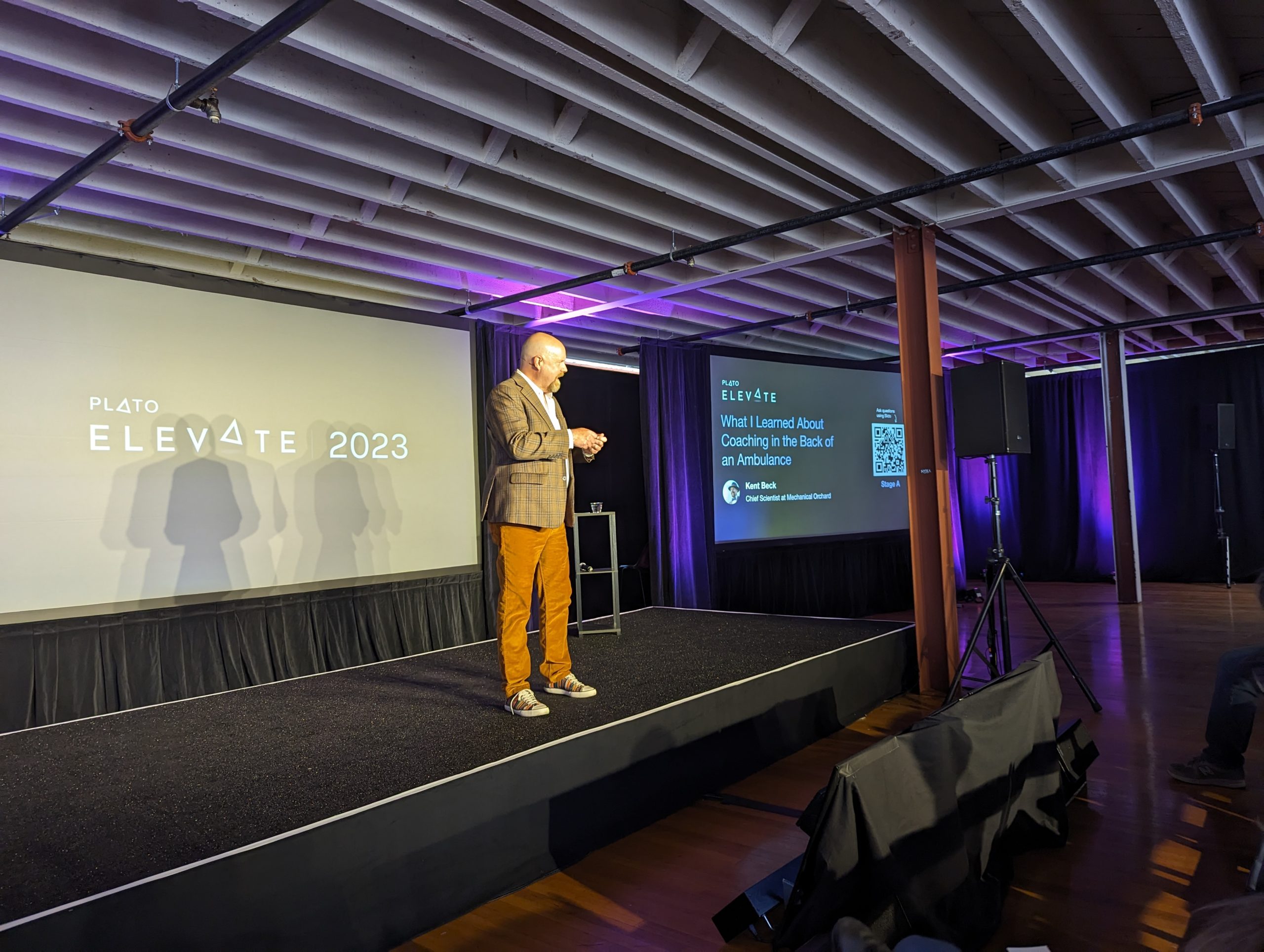
On November 8, 2023, Kent Beck, an influential software engineering figure and the Agile Manifesto’s original signer, delivered a profound session at the Plato Elevate conference in San Francisco. His talk, titled “What I Learned about Coaching in the Back of an Ambulance,” offered a journey through his illustrious career and the evolution of his coaching philosophy.
In the early ’80s, Beck’s time at Tektronix Labs was pivotal, shaped significantly by his mentorship with Ward Cunningham. Cunningham, known for inventing the wiki, instilled in Beck the rhythms of engineering and a burgeoning belief in pair programming. The scarcity of terminals meant sharing one, which led Beck through an organic learning progression—from observing to correcting, suggesting, and finally, taking the lead. This experience laid the groundwork for his later methodologies.
Fast-forwarding to 2011, Beck faced a humbling moment, considering himself the “worst programmer” at Facebook. This prompted a shift towards coaching, where he dedicated himself to mastering various techniques. Beck shared an anecdote about employing the ‘mirroring technique,’ which involves repeating a person’s last word to spur their thought process. This method, often used in negotiations, proved to be a powerful tool in coaching, revealing the strength in simplicity and active listening.
However, the pressure of keeping all these techniques top of mind led to an incident that found Beck in the back of an ambulance, momentarily robbed of his speech. This experience was a catalyst for change. He emerged with a renewed approach to coaching: to be fully present and authentic. Beck emphasized the importance of preparing for each session with the intent to deliver unequivocal value, helping individuals transition from good to great.
Kent Beck’s journey is a testament to the continuous process of learning, adapting, and evolving. His latest endeavors, including his book “Tidy First,” reflect his ongoing commitment to refinement and excellence in software engineering and coaching.
For those intrigued by Beck’s wisdom, his presentation on “Tidy First” is available for further exploration on InfoQ, shedding light on the intricacies of refactoring and clean code.
In a rapidly evolving world, Beck’s reflections at Plato Elevate remind us of the timeless value found in mentorship, the iterative nature of skill acquisition, and the courage to adapt our approaches for the betterment of ourselves and those we aim to uplift.
When you hear the word “sand,” what comes to mind? For some, it’s the tiny grain that can jam the gears of a well-oiled machine. For others, it’s the beginning of something beautiful—a pearl. At Pearlside, we choose to see the pearl.
Why? Because we believe in the transformative power of perspective. Just as an oyster turns a grain of sand into a valuable gem, we help design and build sustainable and high-impact teams and organizations. These organizations are not just efficient; they are places where people are highly satisfied and engaged. They are environments where individuals can turn challenges into opportunities, much like an oyster transforms a grain of sand into a pearl.
The Anagram of Leadership
You might have noticed that “Pearlside” is an anagram of “leadership”—well, almost. While it’s not a perfect match, it’s close enough to make you think. And that’s intentional. At Pearlside, we don’t chase after perfection; we embrace the beauty of imperfection. We accept failure as a stepping stone towards success and view it as an opportunity to learn, adapt, and grow.
The Iterative Journey
In today’s rapidly evolving landscape, clinging to outdated models of leadership is not just ineffective; it’s detrimental. That’s why we’re committed to redefining the concept of leadership to make it more inclusive, sustainable, and impactful for the modern world.
We understand that this is a journey, not a destination. It’s an iterative process that requires ongoing learning and growth. We are collectively committed to this journey, not just for ourselves but for everyone around us. Through practical experience and hands-on opportunities, we aim to facilitate growth for individuals and organizations alike.
The Ultimate Goal
Our ultimate goal is to transform the way leadership is understood and practiced. We want to create a world where leadership is not about authority but about empowering others, not about individual achievements, but about collective impact; not about maintaining the status quo, but about driving meaningful change.
Conclusion
So, the next time you find yourself faced with a grain of sand—a challenge or obstacle—remember that it’s all a matter of perspective. Will you let it jam your gears, or will you transform it into a pearl? At Pearlside, we’re in the business of creating pearls. And we invite you to join us on this transformative journey.
Some leadership conversations stay with you because they don’t add more techniques. They change your attention.
That’s what happened for me with Ali Schultz, co-founder of Reboot.io. Reboot has been around for ten years now, and their work has influenced an entire generation of founders and leadership teams. But what struck me most is not a new framework. It’s a stance.
Better humans make better leaders. Better leaders create more humane organizations.
It sounds simple. It is not simplistic.
Reboot’s bet: leadership is personal work
Ali described Reboot as a platform for leadership coaching and organizational development that goes beyond skill-building. Not because skills don’t matter, but because skills are not the full story.
When someone steps into leadership, something predictable happens. Responsibilities increase. Visibility increases. Pressure increases. And we meet ourselves, fast.
Self-doubt. Imposter syndrome. Old patterns. Defensive reactions. The need to control. The need to please. The reflex to perform instead of relate.
Emerging leadership is not only about learning what to do. It’s about learning who you are while doing it.
Ali offered a simple equation that captures Reboot’s philosophy:
I like this because it holds the tension. Not one or the other. Both.
A company built on diversity, not a single method
One of the early challenges Reboot faced was building a brand bigger than its founders. Ali shared how intentional they were about not building a company around one personality, one coach, or one method.
Instead, they built what Jerry Colonna calls a “wildflowers” approach. Biodiversity in coaching. Different styles. Different life experiences. Different ways of being with people.
It matters because coaching is not about fitting humans into a method. It’s about meeting humans where they are.
This also resonates with how organizations grow. Diversity is not just a value statement. It’s a design choice.
A small shift that changes everything: make space for the humans in the room
Ali shared something that I’ve experienced myself.
When you’re action-oriented, when you want to “not waste anyone’s time,” you can rush into agenda and execution. It feels efficient. It often isn’t.
Sometimes, the fastest way to move is to slow down enough to see what’s actually present.
A few minutes of human check-in changes the quality of the entire meeting. It reduces hidden friction. It surfaces what needs to be named. It creates conditions for real alignment.
This is not soft. It’s operationally sound.
Hiring in startups: the Sunday test, and the reality of stages
We also talked about what Ali looks for when building teams, especially in startups.
People who can create something from nothing. People who can execute and keep the bigger picture in mind. People whose heart is in it.
And one heuristic I’ll remember: the Sunday test.
Would you choose to spend time with this person on a non-work day?
It’s not a perfect filter. But it points to something important. Work is a human place. Toxicity does not scale. Neither does charm without integrity.
Ali also named something that more founders should normalize: not everyone scales with the organization, and that’s okay.
Some people thrive in the earliest stages. Some people want clarity and structure. Some people love the chaos. Some people don’t. The healthiest organizations design for transitions, rather than treating them as failures.
What horses, art, and ecology have to do with leadership
Ali’s personal influences were not what you’d expect from a standard leadership conversation: deep ecology, art, and horses.
Yet it makes perfect sense.
Leadership is a relationship practice. Presence matters. Authenticity matters. Power-with matters.
Horses, Ali said, don’t accept anything except the most grounded, most honest version of you. They offer immediate feedback. If you’re off, they know. If you’re performing, they feel it.
That’s leadership training, in a very direct form.
The next five to ten years: more human, not less
We ended with a question that’s hard to avoid right now: how will leadership coaching evolve with AI?
Ali’s answer was clear: work will remain human. Leadership will remain relational. If anything, the need for leadership development will become more important, not less.
AI may change tasks. It won’t remove the human complexity of trust, conflict, fear, meaning, belonging, and responsibility.
If we gain time, the question becomes what we do with it.
My hope is the same as Ali’s: that leadership and organizational development become even more human.
References
Reboot.io, where you can find the resources and the newsletter
Reunion by Jerry Colonna (the book mentioned by Ali that was launching the day after we recorded)
Here is the transcript of the episode
Alexis: [00:00:00] Welcome to Le Podcast on Emerging Leadership. I’m Alexis Monville. And today, I’m honored to have Alison Schultz with us, the co founder of Reboot. io, an organization that’s been in reshaping the landscape of leadership coaching and organizational development. This year marks a significant milestone for Reboot. io as they celebrate their 10th anniversary. A decade of empowering leaders and team across various industries. So, without further ado, let’s welcome Alison Shultz to the podcast on emerging leadership.
Hey Ali. How do you introduce yourself to someone you just met?
Ali: Well, I guess I would say,
Hi, I’m Ali. I’m one of the co-founders of Reboot. How are you?
Alexis: That’s nice, that’s direct.
Ali: Yeah,
Alexis: could you walk us through the inception of reboot.
Ali: Yeah, so Jerry and I met in 2013[00:01:00] and we began doing the CEO bootcamps together. we did three bootcamps, including one in Italy, which is not too far from you. Before we formed Reboot with our partner Dan Putt the bootcamps proved that our instincts were right and that we were onto something. And so Reboot really came out of a vision to create a coaching and leadership development platform that would support people not only in better leadership, but also the work in the work that it takes to become a better human.
Alexis: I think that’s the part I’m very impressed with in all your communications with Reboot. there’s sometimes when you look at leadership or leadership development, there’s that kind of thing that are really technical. I. that seems to forget that behind all those skills, all those things that we learned to do there’s a human being and that’s probably something really important.
And I feel
that you are really touching regularly very well. So that, [00:02:00] that’s something I really appreciate.
Ali: Hmm. Thank you.
Alexis: what, what were some of the initial challenges you faced and how did you overcome them?
Ali: Yeah, so this is a great question. We had to build a brand for the company that was bigger than Jerry. So we had to build something that went beyond just Jerry Colonna. And by the end of our first year we had that, which was pretty cool to see. People were searching for reboot, they weren’t just searching for Jerry Colonna. And, you know, in the process of building that brand, we, we took advantage of Jerry’s notoriety and his reach and the work that he had been doing in the space for over a decade at that point. And we carefully crafted a brand and a voice that could stand on its own. I would say another thing that. We wanted to do, which kind of relates to that, is we wanted to build a company that was built, that wasn’t built around just one coach, one personality, or one method. We [00:03:00] wanted to bring together a team of coaches that were distinct and unique in their experiences and in their styles to better serve our clients. And internally, Jerry kind of refers to this as like wild flowers and, as a, I don’t know. I have a biology minor going decades back when I was in college. But if you know anything about biodiversity, there’s a strength, there’s an inherent strength in that. And so it, it serves our clients better when our coaches are unique so people can come to reboot and really get fit with a coach Just within our, our herd of coaches, I say lovingly
it’s kind of cool because you have a variety of, of humans that can meet the variety of humans that come to us for, for help and support. But it’s also like, I mean, can you imagine going to a therapist or a coach or, that just tries to fit you into their style or their method without really meeting you where you are as a human.
It just [00:04:00] like, it doesn’t match. So we wanted to create something that was really I don’t know, just a unique coaching experience that was in service to, you know, anyone that would come to us for, for help.
Alexis: This is, this is very, very interesting. And a quick question about the, the brand. Does Jerry’s book reboot was already out when you, when you created the brand?
Ali: No no. We started in 2014, so we started reboot in 2014. So we were doing this before Jerry’s first book came out. And his book came out in 20 17, 16 or 17, I believe. Maybe it was 2017. Maybe it was 2018. but it was much, you know, it was further down the line. So we had already had a brand and a larger platform established. the book came out and it had a place to be. It was kind of cool.
Alexis: Yeah, it’s very[00:05:00] very tempting to use , Jerry’s notoriaty and the work he did in the past and say, okay, that’s the one method we will propose. And I really like what you’re saying now. No, that’s not what we are doing. We are not like this. We are uniquely different and Yeah.
you, you can find a good match for you at the right time for you.
I really like that that approach.
you will celebrate the 10 years anniversary of of reboot io. what are the significant milestone that stand out for you?
Ali: Yeah. Man, I’ve got a, I’ve got a couple handfuls I, I jotted down so. Things. I think pulling off our first bootcamp was a big deal. And then I lost count after 25 bootcamps. So that. I mean, that, that’s a significant thing to successfully produce that many events, you know year after year. [00:06:00] And I would say another really big memorable event was getting the reboot podcast out and shipped. And that happened, that, that happened pretty quick. I remember it was probably September and three months of, of 2014, so it was three months since we had started. And, and we had the podcast out. it was really cool to, like Dan and I had been working on it, and Dan probably more so at that point. but it was cool to have Jerry listen to it for the first time and you know, to see his reaction. So that was really special. And then after that we just kept together products and services that were really , on our roadmap and that we had wanted to kind of put out in the world, including our, our peer groups, our circles we had put together a 360, review process for clients. So a lot of services that were really in support [00:07:00] of, one-on-one coaching, but it expanded and complimented just the one-on-one coaching work. Internally we had produced some really fun things too for our clients, mainly ’cause they were like educational, but we had a, a chatbook of poetry that we would use at events. we had made a branded journal. So it was cool to have kind of some tangible takeaways that we could, would give, you know, reboot clients in our work with them. And then of course, like Jerry’s first book Jerry’s second book, which is coming out soon. Tomorrow actually it launches it’s, I don’t know, in 10 years. That feels like a lot. I mean, on top of what, what I think is also kind of celebratory for us, and maybe for me, ’cause I hold this seat a little bit more than some of my colleagues ’cause I’m, I’ve just been the one kind of defaulted to being the brand voice.
You know, the [00:08:00] amount of content that we consistently put out into the world for free, because we know that, you know, not everybody can afford our coaching rates, but everyone should have access to frameworks or ways of thinking or questions for reflection that can help them become a better leader if they’re interested in this work. it’s nice to be able to provide such a rich At this point, library of resources for folks to kind of come to our site and mainline our content and kind of get a taste for what we’re about. and then, you know, maybe at some point know, if their comfort company sponsors them or budgets are such that it allows for it, they, they end up working for us.
But none of that’s like a requirement. we really put, a lot of good content out in the world as a Service to the entrepreneurial community and, and the emergent leaders, you know, to use your language, the emergent leaders that are there because they need support. You know, they need to recognize, you know, what are the practical skills that I need [00:09:00] and what’s the radical self-inquiry piece that I need?
Like, what are, what’s the inner reflection piece that I need to, to bring into this leadership space? And then what are the shared experiences, right? And so how can they then Find their people or their communities or their support or places for support, you know, in order to give them greater resiliency and enhance their leadership.
Alexis: Yeah, that’s beautiful. and among all the resources you are exposing to the world. I, I really like the, the journaling prompt.,
Ali: yes.
Alexis: so, that’s so simple and that’s so helpful to help people start with journaling , and usually there’s the, some people tell, told me, but I don’t know what to write.
I’ve said, all write what? What’s on your mind? And so I said, no, I’m, I’m stuck. I am, I cannot write anything I said. Okay. That’s a, that’s a good one. Let’s start with some prompts. And when I discovered your journaling prompt, I say, oh yeah, that’s, that’s really cool.
Ali: I’m glad [00:10:00] you think so. I think so as well. It’s it’s a, a, a really beautiful practice to, I mean, journaling takes work, you know, and it’s personal for everybody. There’s no right way or wrong way to do it. It just has to support you, you know? That’s why people do it. And so, Margaret and I, Margaret, who’s my, like partner in content creation and she’s the brilliant editor to our, our podcast we sat down and I was like, we have enough journaling prompts from all the content we’ve put out in the world and from all the events that we have done where we could just do an email Course, even though it’s zero cost, but like, sign up, get a daily email in your inbox. you know, the questions that we pulled together are very rebooting. And they’re very applicable to anyone in leadership, like anyone in leadership or management, or even people who don’t think of themselves as CEOs or founders or anything. They can be really handy. Just in terms of helping someone to establish a journal practice or, [00:11:00] giving them like that external prompt so that they can sit down and, and do some self-reflection.
So it’s such an important piece, I think, of being an, being a leader. I’m really delighted that, that we re release that this year.
Alexis: Over those, 10 years, how has your role evolved within the company?
Ali: Oh yeah. yeah. It’s, I feel like I’ve, I’ve, I’ve, been around done a lot I started in ops primarily, so I was like, you know, making sure that the trains ran on time and taking care of a lot of the internal structure, really the business structure of, of what are we doing and really leading the, the marketing and content efforts.
And I mean, we’ve been very lucky as a company that because of kind of like Jerry’s notoriety and whatnot. The, the PR efforts and the traditional marketing efforts, we really didn’t need so much of, but, you know, we could be really creative I don’t know, kind of like specific [00:12:00] with the content we put out.
And so I I really leaned in there and after five years, we came to a, a moment in the company where we were no longer a loose consultancy of, of coaches which is kind of what we began as, as we, we, as we tried the experiment of, you know, what is, what is this company and what does it need to be? we, we began employing our coaches. And so that was a, just a slight shift in the business model. Not too bad, but it was at that point that I handed over the operational reigns to just a, a small ops team within the org and I just stepped into coaching full-time. So it was a, it was a big shift, but it was also welcomed, so.
Alexis: Yeah, that’s a, that’s a big one. But yeah, that’s probably very satisfying to have built something, build a team that can run on, on its own and enables you to, to do something that has a different kind of impact. That’s a, that’s [00:13:00] interesting.
Ali: Yeah. Yeah.
Alexis: So. Emerging leadership mean to you, and how does it align with the mission of reboot?
Ali: Yeah, this was another really great question. I mean, we believe that better humans make better leaders and better leaders create more humane organizations. And we love working with the, with emerging leaders because we can instill in them during those emergent years, like the, the soft skills that are so important.
And we can also stress the importance of doing the radical self-inquiry work alongside the practical skills, right? But it’s a way to really support what’s emerging in each individual as they’re stepping into their leadership. you know, anyone who takes a leadership role that has not done that before is gonna run up into a ho, run up against a host of, of issues including [00:14:00] self-doubt, imposter syndrome all these things that really stem from who am I and what am I bringing into this role. But it also kind of stems from, I’ve never done this before, and what do I need to know to do the job? I kind of feel like, I mean, I kind of hinted or spoke to our formula before, but kind of the formula or the bet that we, that we take at reboot is that practical skills plus radical self-inquiry plus shared experiences equal greater resiliency and enhanced leadership.
Or it might be enhanced resiliency and greater leadership, whatever, but but it really fits that emerging leadership sensibility where You know, I don’t know. When I think about emerging leaders, there’s something emerging. It’s emerging in you. It’s emerging from a need in the world. It’s emerging from a need in the organization.
And how are you gonna meet that? How are you gonna a, listen to what’s showing up? Listen for what’s showing up. How can you be attuned to that? And how can you meet that need [00:15:00] or meet what’s emerging and be agile about it.
Alexis: I love it. So thanks for, for sharing. Can you share with us an example of a time when your leadership skills were put to.
Ali: Yeah. When I, when I operate, I’m really, I don’t know that tactical is the word, but transactional. Like when I go into, Get shit done. I go in to just get shit done. Like that’s, I assume, like that’s why we’re here. So I think it took a while for me to really, pause or trust that holding space for everything else that’s in the room is actually gonna get things done more smoothly and potentially more quickly.
Right, because you’re not just meeting with people who are always ready to go tracking the same agenda items that [00:16:00] you are seeing everything the way that you wanna see them. and so, yeah, I would say learning the, to just kinda sit back Not drive so much with the get shit done mentality but to really create enough space for the humans in the room and kind of meet and be able to meet that humanity, right?
Like personal check-ins how are we doing, how are we feeling about these things? And then go moving into what may be the agenda items, but it’s, it’s, it’s more like realizing. What are the other issues that aren’t maybe so tactical or get shit done oriented that are also in the room that need to be unpacked and talked about? And I think for early leaders, and I don’t know a lot of clients that I work with too, it’s like learning that, shift can be really impactful. And it’s hard I think during early startup days when everybody’s kind of doing everything and there’s an [00:17:00] urgency to just like Get everything done as fast as possible. Cause it feels like there is no time to pause or to take, take things slow or to, to ask big questions. I guess my invitation is, and my learning was, you to create the space for, for that way of being, with the to-do list. It, it’s, it’s more powerful in the long run.
Alexis: Hmm. Yeah, it’s a thank you for sharing that because I, I believe it’ll help a lot of people to, to think and reflect about it. I have the, the, the tendency also to, to look at the time we have, we have allocated to do something and to say, okay, I don’t want to waste the time of anybody, so let’s, let’s get to it immediately.
that’s, that’s kind of that urge that is there. And it’s hard to pause, so it’s a, it’s very, very helpful to say Yeah. But, Make enough space for the human being in the role. [00:18:00] And that’s, yeah, very powerful. I love it. If we look at the startup environment, what are, what are some key qualities you look for when you, when you are building a team?
Ali: Yeah. Key qualities I think, I think there’s. There’s a lot of power in finding people that are good people. Like you just really want good people. But I mean, as far as qualities a willingness to dive in and face problems, that’s key. And I think a willingness to be a little bit obsessed and dedicated also goes a long way at first, especially when teams are small and new and there’s a lot of exciting stuff happening. I mean, I say that in the sense that. The obsession or the dedication can help people, can really help the focus [00:19:00] and the, the small team cohesion a little bit. Yet that certainly doesn’t scale. mean it can, but it needs to be named, it needs to be checked in on and it needs to be maintained in a healthy way. you want people that are engaged in the work like they wanna be there. They’re eager to solve these problems. They’re eager to show up every day and solve these problems, and they get a little bit of aliveness out of it. I mean, you want people that really wanna be there. Cause you’re gonna get so much more out of not just the team. there’s no sense. I mean, it’s just hard to work with people who their heart isn’t in it. I don’t know. I think Someone who’s willing to kind of put their heart into it a little bit is, makes things kind of fun at the beginning. You also need a balance of like contextual thinking and execution, especially at first, because at first you have, I mean, I’m thinking of like startup teams of like maybe five to 10 people or five to 15 people, but. At that stage, [00:20:00] everybody’s kind of doing everything and it’s, it’s a little bit like, you know, a kindergarten soccer team where everybody’s on the field and not everybody has a defined role, but you know, you’re on the same team and you’re kind of playing certain parts of the, of the field, but but you’re also getting coffee and taking up the trash and doing all those other things.
So it’s such a mixed bag of an experience early on. And then of course, as at, at as things grow and roles scale and the company scales and roles get defined, then there’s more clear parameters and more clarity and more expectation around what your key role on the team or on the field is.
You know? I think you need people who are able to, kind of going along the execution line. It’s really great to have people that can execute, but you also need people who can create something from nothing, you know, because in a lot of startup spaces, there’s, I mean, that’s art really is to be, to create something from nothing, right? [00:21:00] But so many of the problems that get funded and companies are built around, like they didn’t exist. You know, before funding it was like, I have this idea, let’s do this. And so you need someone who can really see the whole picture of where this is going. And also also be able to know, okay, this is my role execution wise in the org and this is how I can contribute to this. And a lot of this is kind of set too, I think with leadership parameters, you know, like your leader’s gonna, a good leader will help you know, the team see these things. But honestly, I’d say when it comes to hiring people there is no sociopath filter. However, I know after working with a lot of clients that sociopaths exist. you have to trust your gut when hiring. And you have to be quick to really Get toxic people, I think, off the team. But one of the [00:22:00] ways to really test for this, it’s not foolproof because there are some really charming and toxic people that can just be in the world and then wreak havoc in your organization. But we always say, you know, the Sunday test. Here at Reboot, and that is, would you want to hang out with this person by choice on a Sunday? Like it’s a non-work day? You don’t have to be in their presence and yet you would, you would choose to hang out with them on some relaxing non-work activity. someone passes the Sunday test, that’s a pretty substantial thing. And you can tell a lot too about people And how they make you feel meeting in person, you know? So like when you’re hiring, really pay attention. How does this person make me feel? Are there any red flags? Are there any like suspicions or feelings that come up? I’m with this person that I either wanna get clarity around and lean in and [00:23:00] ask them about and or does it remind me of anything else in my life that with a red flag for another relationship that may have headed south. Those are just, they’re signals to pay attention to, I would say. it’s, there’s a lot of magic at the start of startup And then, you know, as teams scale, I think it’s key to also know that, not everybody scales with the organization and so, so turnover is like, natural turnover in many ways can be celebrated. Like, oh, we have reached this point in our organization where we need to bring in like a CFO, not just a director of finance or we need to bring in, A really like a main leader, not just someone who’s grown up and kind of fulfilled some, territory in the organization, like with marketing or, or some part of the org. And so, I mean, that can be really hard, you know, especially as teams grow because you get attached to people. But there’s ways to also build it into culture [00:24:00] and say, you know, we’re bringing you in. We know this might be. A short term thing, but we want this to be the best place that you’ve worked and you know, we’re gonna celebrate what’s here. And, you know, whatever tenure anyone does have, So I guess a lot of this is like, there are qualities that you want in your team, right? But not all those qualities, not all the people will necessarily scale with your org.
Alexis: Yeah.
Ali: And what are the qualities too, I guess as part of what I’m responding to here, as what are the qualities you can bring to like your hiring process and your culture and tending to those, those, those parts which are equally as important.
Alexis: I really like your, your, your answer and setting the right expectations also for people. And I like what you say. That’s, that’s a good balance between that for people who can grow with the, the team or with, with the company. That’s celebrate what they brought to the [00:25:00] team.
And there, there’s, there’s people who don’t want to go in the, in the next stage. They, prefer really the, the infancy in the incubation mode, and they don’t want to go to the next stage. That’s not, that’s not. Maybe they could , but they don’t want,
so,
Ali: Yeah.
Alexis: so that’s okay. And and, and that’s great to, to affirm those people for that period of time.
What, whatever along there that was. how, how do you approach your own personal and professional development?
Ali: Yeah, so my, yeah, this is a great question. an ongoing process really of. Kind of discovery from, you know, within me, but also a commitment to being curious about what’s showing up for me and my work. I believe we need guides in this life. We can’t do this alone. got a great body worker. I’ve got a great therapist. I have a small herd of beautiful horses[00:26:00] where I get to go and decompress. I have great colleagues that I get to share my work with and They share their work with me. So there’s like this cross pollination that happens. And I have a very loving and wonderful partner with whom I’m lucky to share both life and work.
So that’s a’s a big part of, I think what supports me in, in my work. I live a pretty cloistered life on purpose. So that I can kind of hear my own voice clearly stay attuned to what’s emerging within me and within the world And, you know, that quiet life really ensures that I have the resources that I need to do the work that I do with my clients. So, yeah.
Alexis: Okay. Excellent. Are there any books, mentors, [00:27:00] experiences that have profoundly impacted your, your style, your leadership style, or your way of doing your work?
Ali: Yeah, there’s probably too many books to mention. But I’ll say that it’s probably been informed by three things that are really important to me, and that is deep ecology, you know, this belief that the world in order to really amend the climate crisis or the ecological disaster that is kind of impending in the world we really need to tune into a shift in consciousness, which, helps people like awaken into self-actualization versus less woke, less aware way of being in the world. Right? So I’m a deep ecologist at heart it’s kind of cloaked, I would say, in, in all of my work at Reboot. It’s, I don’t speak about it that directly most of the time, but [00:28:00] I mean, for me it’s, it’s right there every day. say another practice that’s really informed, the work that I do is art. I’ve been an artist for my whole life. I’m not formally trained, nor do I think you need formal training to really be an artist. Same with leadership in many respects. but there’s something about, for me, the the practice of art where you are alone with your, with yourself and this idea or you in a blank page or a blank canvas, and it’s like, what am I gonna.
Bring to this. And it’s much less about what am I going to be creating? And it’s more about how am I with that creative force, that’s arising in me and how do I trust my, in my intuition and my instincts? And what then comes out of that? And how do I work with, you know, what’s in front of me? I think there’s, I don’t know, something about beauty and truth in that whole process. And it’s really personal and it’s really [00:29:00] intimate, but I think it’s, I think it’s key to leadership. And then hands down I would say horses are, have definitely impacted, my beliefs about leadership and probably my leadership style and. It’s a, it’s, there’s so much there for me in the, in the horse aspect, like I can’t even talk about it.
I just start crying. but there’s something about learning to be in relationship with another being that is not a power over relationship really. It’s power with, that’s, I mean, that goes a long way into anybody’s, you know, leadership or management roles. But for me, in my small herd of beautiful horses, it’s, you know, they, they don’t put up with anything really other than the best me, the most authentic. Me that I bring forward. And so for me, every, every moment spent in the barn is I’m not gonna knock my therapist ’cause I love [00:30:00] her. She’s fantastic But it’s there, it’s, it’s it’s immediate feedback in the sense that if I am off base or if I am not owning some state of mind, or I’m bringing some really grumpy state of mind into the interaction with them, like they know it and they’re like, You don’t feel great about yourself right now. Why should I feel really great about you? Or know, it’s, you know, they demand really the best of us in order to really have a good relationship with them, you know, harmonious. And it’s a, it’s a really wonderful, Attunement practice. probably three totally like outta left field answers, but they are, they’re, they’re the three cornerstones for me.
Alexis: That’s, that’s absolutely perfect. You, you brought me back many years. when we, we had horses at, at home and when you, when you spoke about that, that brought me with the, I was a small kid, so I, I was [00:31:00] small. When I was approaching the horses, they were always, trying to, to, to smell and and so through the nose and you, you approach your head close to their nose and they don’t move and they, they they smell slowly and it’s, and it’s warm and it’s, and it’s and you feel something is happening. And that’s, that brought that memory to my mind.
Ali: Yeah. Well, it’s such a, well, I’m really glad you brought up that, that memory, because I mean, I think if the horse industry really needed, to convert people into the horse industry, all you need is to just have a horse blowing on your face or your hand or something, and it, there’s something, there’s something really potent about that you’re hooked at me.
Anyway. Totally hooked. Yeah.
Alexis: Yeah. Oh yes. Oh yes. That’s.[00:32:00]
Let’s take a, a look at what will happen in the future. Let’s take our crystal ball . How do you see the landscape of leadership coaching and organizational development all those things changing during the next five to 10 years?
Ali: Yeah. I think the trajectory of the last five years has been important just to look back a little bit cause it put the emphasis. On the importance of leadership development within any startup or any organization. I sense that’s gonna continue. You know, there was a time when it was a hard sell to get an executive coach or bring in. L and d work, and now it’s just the norm. It’s kind of a norm, especially kind of in companies like startup companies that have been funded and other organizations too, and in other, [00:33:00] other verticals and other industries, not just tech. Which is really great to see because, you know, now that these like coaching and l and d are, are part of, you know, budgets and budgeting, they’re seeing the impact as well. I think because the payoff of those line items are so great for the individuals and the teams and then the organization and business as a whole. You know, I suspect that we’ll continue. I, the thing is like, we’re. Work is a very peopley place. Work is a very human place. Right. I really don’t think AI is gonna shift that too much. I mean, there are still gonna be humans doing human work and, humans need tending to, and those humans that are working in relational spaces need tending to, whether it’s their teammates or their customers or the service that they’re providing. So, I mean, I would, I would hope, I guess If I look into that crystal ball, it’s that the, the landscape of [00:34:00] l and d or the landscape of leadership coaching will just become more human, more and more human.
Alexis: I love it. And you guessed that my question was also connected with AI because it seems everything is related to AI nowadays.
Ali: I know. Yeah.
Yeah.
Alexis: I love your answer. That’s that’s reassuring . Mm-Hmm.
I’ve heard a lot of people thinking they will solve everything with a little bit of ai.
Interesting problem can, can be solved that yeah, I would love us to use the time that we gain to engage in more meaningful relationship Yeah, well said.
hope for that.
Ali: said.
Alexis: So what, what’s next for, for reboot? Any, any exciting projects or initiative you, you can share with us?
Ali: We’ve kind of got a lot of ideas in the hopper but I think [00:35:00] the big, the big and Easily ready to share. Tidbit is Jerry’s second book launches tomorrow. So you can find it on bookshelves everywhere for real, not just in pre-order. So we’re excited, we’re excited to see how, how that emerges. Tomorrow we were kind of aiming for some bestseller lists with a lot of presale efforts. But you know, the book industry is a really crazy space. So we’ll see what happens,
Alexis: Yeah.
Ali: other than that, you know I’d just say watch this space carefully for any projects and expansions. But you can count on us to continue to provide. Meaningful and helpful content as a corollary to the services we provide. And the newsletter, our new newsletter is always a great place to dive into what we’re currently doing and kind of what’s coming up in the next like months, in what might be emerging. I [00:36:00] don’t know, in the next year or so.
Alexis: I definitely will put links in in the companion blog post to make sure that people can find those resources in the, the newsletter and so on. And and the book, of that’s that’s cool. That reminds me that I did not prior order. I will. So that’s good. I will order now. So thank you very much for, for joining Ali.
That was really fantastic.
Ali: Oh yeah. Thank you for having me. Thank you for having me.
Ever struggled with breaking the ice in meetings with new colleagues or clients? I’m excited to share a unique approach from our book, “I am a Software Engineer and I am in Charge,” that transforms these encounters.
🎯 Introducing: Discovery One-on-One
🤔 What Is It?
This is a structured yet flexible approach to prepare and drive effective meetings with people you’re not yet familiar with.
🌟 Why Use It?
Building a strong relationship is crucial for effective collaboration. This method ensures that your first meeting lays a solid foundation for future interactions.
👣 How It Works
1️⃣ Prepare Your Board: Create a simple board with three columns: To Do, In Progress, Done.
2️⃣ Set the Agenda: Use sticky notes for each topic: Ice Breaker, Professional Background, Experience, 3 Wishes, and a wild card (???).
3️⃣ Ice Breaker: Start with light, engaging questions to ease into the meeting.
4️⃣ Share Backgrounds: Discuss your professional journeys.
5️⃣ Discuss Relevant Experiences: Tailor this part to your specific context.
6️⃣ 3 Wishes: End with a creative question about transforming work or the workplace.
7️⃣ Wild Card: Allow space for any additional topics they might want to discuss.
📝 Note: This approach is adaptable. Feel free to tailor it to suit the context of your meeting.
🔄 Why It Matters
First impressions count. A Discovery One-on-One ensures your first meeting is not just productive but also enjoyable, setting the stage for a great working relationship.
📚 Curious to learn more? This is just one of the many practices we delve into. Check out the experiment: Discovery One-on-one.
👇 Have you tried a structured approach in your one-on-ones? How did it go? Share your experiences!
Are you looking to deepen your team’s understanding of effective management and identify areas for improvement? I’m excited to share our next experiment from the book, “I am a Software Engineer and I am in Charge.”
🎯 Introducing: The Matrix of Principles
🤔 What Is It? This is a reflective tool designed to explore Deming’s 14 Management Principles and how they resonate within your team and organization.
🌟 Why Use It? It’s a powerful way to align on management beliefs, assess the current state of their application in your organization, and spark conversations on how to evolve.
👣 How It Works
1️⃣ Draw a 2×2 matrix on paper or a whiteboard.
2️⃣ The horizontal axis gauges agreement with a principle; the vertical, its application in your organization.
3️⃣ Place the principles on the matrix, using different colors for each team member.
4️⃣ Discuss outliers and collective insights to inspire actionable improvements.
📝 Note: This tool isn’t limited to Deming’s principles. Try it with the Agile Manifesto principles or any others that are relevant to your team!
🔄 Why It Matters Understanding and applying sound management principles is crucial for any team’s success. The Matrix of Principles helps make abstract concepts tangible and actionable.
📚 Keen to explore more? This is just one of the many practices we delve into. Stay tuned for more insights and check out our book I am in Charge.
👇 How do you ensure your team’s principles are not just understood but lived? Share your strategies in the comments!
👋 Hello Software Engineers, Team Leaders, and Life Balancers!
Ever feel like you’re excelling in one area of life but neglecting others? Today, I want to introduce you to a practice from my book, “I am a Software Engineer and I am in Charge,” co-authored with Michael Doyle, that can help you find balance.
🎯 Introducing: The Wheel of Life
🤔 What Is It? The Wheel of Life is a visual tool that helps you assess how balanced and satisfactory your life is right now. It’s like a pie chart for your well-being!
🌟 Why Use It? We often focus on specific areas of our lives, like career or relationships, and neglect others. This tool helps you see the big picture and inspires you to improve in areas that matter to you.
👣 How to Get Started
1️⃣ Pick Categories: Choose 8 categories that represent important facets of your life. It could be Health, Career, Relationships, etc.
2️⃣ Rank Each Area: On a scale of 0 to 10, rank how you’re doing in each category.
3️⃣ Reflect: Imagine if this wheel were real. Would it roll smoothly or bumpily?
4️⃣ Take Action: Identify one action that could improve an important area for you.
5️⃣ Revisit: Come back to your wheel when you’re ready for the next action.
📝 Note: You can also focus your wheel exclusively on professional aspects if that’s where you want to improve.
🔄 Why It Matters Life is a balancing act. The Wheel of Life helps you not just excel in one area but thrive in all.
📚 Want to dive deeper? This is just one of the 18 practices we cover in our book. Check it out at I am in Charge.
👇 Have you ever used a tool like this? What were your insights? Share your thoughts!
At the recent Agile Tour Bordeaux conference, attendees had a unique opportunity on Friday afternoon: a segment dedicated solely to exploring ideas through open space technology. Within this dynamic framework, I had the privilege of conducting a workshop that probed the nature of leadership. The high participation and engagement from attendees made this discussion exceptionally enriching.
What is Leadership?
Our session began with a straightforward question: “What is leadership?” Participants around the table shared their perspectives, leading to a myriad of words and phrases, such as “Action,” “Vision,” “Authenticity,” “Inspiration,” and “Curiosity.” As we revisited these initial descriptors, we added depth and texture. Words highlighted in green on our workshop sheet further clarified and enriched our initial understanding.
Creating Conditions for Emergent Leadership
A prominent theme that emerged was that of emergent leadership. Instead of appointing leaders based on traditional criteria or hierarchies, emergent leadership is about crafting conditions for leadership traits to manifest organically. Such environments, characterized by trust, autonomy, and collaboration, enable individuals to shine, exhibiting leadership qualities that may go unnoticed in more structured settings.
Developing Leadership Skills: A Continuous Journey
When we surfaced how to develop our leadership skills, there was a consensus: practice and aiding others are paramount. This sentiment strongly resonated with the Agile Manifesto’s opening lines, “We are uncovering better ways of developing software by doing it and helping others do it.” Given that we were at an Agile event, this alignment was fitting and heartening.
Leadership: An Invitation, Not an Obligation
Leadership, as we discussed, is an invitation, not an imposition. While the allure of leadership might be strong for many, it’s paramount to recognize it as a choice. Some might opt not to embrace leadership roles, and that is perfectly valid. True leadership acknowledges individual preferences, understanding that everyone carves their unique path.
Gratitude and Reflections
I want to express my deep gratitude to the organizers of Agile Tour Bordeaux. Attending the event as a participant was a refreshing and enlightening experience. The seamless organization, the diversity of ideas, and the vibrancy of discussions were truly commendable.
Conclusion
The Agile Tour Bordeaux was more than just a conference; it was a journey of discovery and introspection. Our leadership workshop, nestled within the open space segment, bore testament to the eclectic mix of ideas and perspectives present. Leadership, as we discerned, transcends titles or authority; it’s about fostering environments where everyone can step up, lead, and make a lasting impact.
👋 Hello Software Engineers, Team Leaders, and Visionaries!
Do you have ambitious goals but struggle to make measurable progress toward them? Today, I’m excited to share another impactful practice from my book, “I am a Software Engineer and I am in Charge,” co-authored with Michael Doyle.
🎯 Introducing: Objectives and Key Results (OKRs)
🤔 What Is It? OKRs are a goal-setting approach that focuses on the impact you want to make. It’s all about defining objectives and measurable key results that guide your actions.
🌟 Why Use It? Big goals can be daunting. OKRs break them down into smaller, achievable steps, making progress visible and motivating. It’s based on the “Progress Principle,” which fuels your momentum toward realizing your vision.
👣 How to Get Started
1️⃣ Vision: Define your ambitious, long-term vision.
Example: “We are a happy family.”
2️⃣ Objectives: Set up to three objectives that are ambitious and qualitative.
Example: “We host a wonderful barbecue party.”
3️⃣ Stakeholders: Identify who could make or break your success.
Example: Guests, family, mosquitoes.
4️⃣ Behavioral Changes: Determine the behavior you want from each stakeholder.
Example: “Mosquitoes don’t bite anyone.”
5️⃣ Key Results: Define measurable outcomes.
Example: “Nobody has been bitten by a mosquito during the party.”
📝 Note: OKRs are a living document. Don’t expect to get them perfect on your first try. Keep refining them as you go.
🔄 Why It Matters OKRs provide a structured way to turn your vision into reality. They keep you focused and aligned, making your journey toward your goals more effective and fulfilling.
📚 Curious to learn more? This is just one of the 18 practices we cover in our book. Check it out at I am in Charge.
👇 Have you used OKRs before? What was your experience? Share your thoughts!
👋 Hey Software Engineers, Team Leaders, and Dreamers!
Do you ever find yourself stuck in the present, unsure of how to make your future brighter? Today, I want to share another transformative practice from my book, “I am a Software Engineer and I am in Charge,” co-authored with Michael Doyle.
🎯 Introducing: The Best Possible Self
🤔 What Is It? This is an exercise designed to clarify your goals and build optimism about your future. It’s a simple yet powerful way to visualize the life you want to lead.
🌟 Why Use It? Research shows that being optimistic about your future can actually motivate you to make that future a reality. It’s a self-fulfilling prophecy in the best way possible.
👣 How to Get Started
1️⃣ Prepare a calendar with checkboxes for the next five days.
2️⃣ Each day, spend at least five minutes writing about your best possible future. Use the hot pen technique—write without editing.
3️⃣ Be specific. What needs to change? What will you learn? What habits will you adopt?
4️⃣ After five days, review your writings. Do you see recurring themes? Write them down.
📝 Note: If you miss a day, don’t be too hard on yourself. The key to success is simply restarting.
🔄 Why It Matters Visualizing your best possible self not only boosts your mood but also provides a roadmap for your future. It’s a win-win!
📚 Want to explore more practices like this? Check out our book at I am in Charge.
👇 Have you ever tried a similar exercise? What were your key takeaways? Share your thoughts!