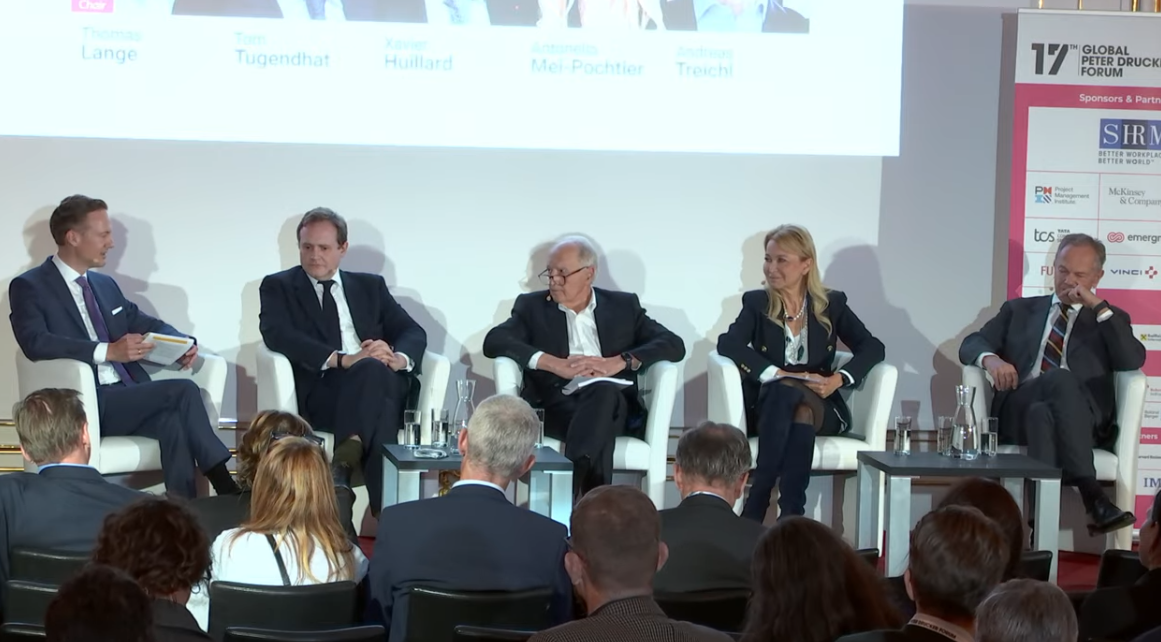
At the Peter Drucker Forum, I attended a powerful conversation titled Stick to Business or Take a Stand?
The panel, chaired by Thomas Lange, Managing Director, Achleitner Ventures, featured
- Tom Tugendhat, Member of Parliament of the United Kingdom; Former UK Minister
- Xavier Huillard, Chairman of the Board of Directors of VINCI
- Antonella Mei-Pochtler Executive Vice Chair, Pochtler Industrieholding
- Andreas Treichl, Chairman of the Supervisory Board, ERSTE Foundation
The discussion revolved around one essential tension that leaders face today. When should a leader simply focus on running the business, and when should they take a public position on broader social and political issues?
What struck me during this conversation is how deeply connected this question is with the polarity between the short term and the long term. It is not a problem with a single right answer. It is a polarity to manage carefully and continuously.
The world today pushes leaders toward the short term. Shareholder pressure. Quarterly expectations. Electoral cycles. Social media outrage. Geopolitical shocks.
Yet almost every speaker insisted that leadership requires something very different. It requires seeing beyond the urgency of the moment.
Tom Tugendhat said it clearly. Politics often operates on very short time horizons. Electoral cycles and media storms pull elected leaders into the daily fight. But business has the opportunity, and even the responsibility, to bring in long-term thinking. Decisions on energy, technology, rare earths, supply chains, and defense have consequences that unfold over decades. When business leaders focus only on the short term, society loses one of the few voices capable of thinking beyond the next three years.
Antonella Mei Pochtler added another dimension. Many global companies face situations where taking a stand is difficult, because they operate across countries that are in political conflict. What position should a company take when the United States and China oppose each other, and the company depends on both markets? Taking a stand might hurt the business. Not taking a stand may quietly support an authoritarian regime. This is a long-term dilemma: protect immediate business interests or defend values that ensure long-term legitimacy.
Andreas Treichl offered a complementary warning. In recent years, many companies, governments, and institutions pushed too fast on various ESG topics without bringing people along. The result was a backlash that played directly into the hands of populists. Progress that does not match the pace of public understanding eventually works against the long-term goals it tries to advance.
This brought the conversation back to a fundamental point. For a democratic society to function, people need to understand how their institutions work. And that includes their companies.
Several speakers argued that companies should be radically transparent with their employees. Explain how the company really makes money. Explain the pressures, the constraints, the trade-offs. Help people understand why they are paid what they are paid, and what decisions shape the future of the business.
When employees understand the inner workings of the company, they become less susceptible to manipulation from populists on the left or the right. They develop a deeper sense of agency and clarity. They can then participate more confidently in long-term decisions.
This is where the polarity of short term versus long term becomes visible inside organizations too. Short-term secrecy may simplify life for leaders who prefer not to explain everything. Long-term transparency is harder, but it builds understanding, resilience, and trust.
To help visualize this polarity, here is the polarity map for Short Term and Long Term.

The panel reminded me that next-era leadership is not only the capacity to take a stand. It is the capacity to take a stand while thinking across decades. It is resisting the pressure to react to every wave of anger or confusion, and instead building organizations where people understand, participate, and grow.
It is also refusing to be neutral when neutrality reinforces oppression. Some speakers insisted that not taking a stand against an authoritarian regime means silently supporting it. Others insisted that taking a stance could put thousands of employees or billions in revenue at risk. There is no simple answer. But the conversation made one thing clear. Silence is a choice. And choices shape the long-term world in which we all live.
This brings me back to the core idea of Emerging Leadership. It is the practice of creating systems where people take responsibility for both the next step and the next generation. It is the discipline of balancing urgency with vision. It is the courage to create organizations that serve society, not just the quarter.
As we close, here are the questions I invite you to reflect on this week:
Where in your leadership are you being pulled too strongly into the short term? Where should you be taking a longer view to serve your team, your organization, or society? What would more transparency inside your organization make possible? What stand would you take if you were not afraid of the immediate consequences?
I would be glad to read your reflections.