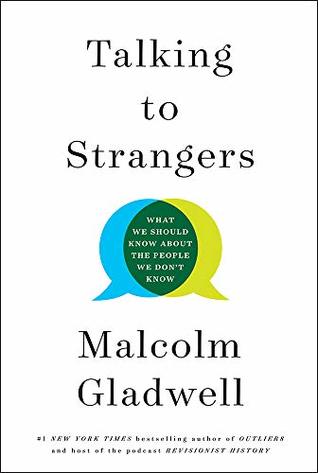
Based on a recent recommendation, I read Talking to Strangers by Malcolm Gladwell. The book was already on my reading list, as I really enjoyed his previous books.
In reality, I listened to the enhanced audiobook on audible. Enhanced means that you have real interviews, and others played dialogues along with the narration by the author.
The book is excellent. It is about our (in)ability to grasp what strangers are up to because of three aspects:
We default to the truth: we think people are telling the truth, and it serves us well because people usually are telling the truth. But, it is not always the case.
We believe in transparency: we think we are pretty good at reading people. We believe the behavior we observed is aligned with what people think and say. But, it is not always the case.
We don’t believe in coupling. In reality, location or context dictates the behavior of people. Their behavior is not defined by who they are.
The combination of the two first aspects makes us easy to be fooled. By adding the third aspect, we turn it into a society problem. The book is a must-read. And, by the way, the part on Alcohol is a must-read.
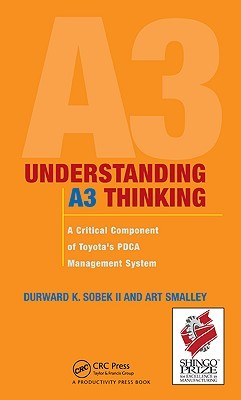
The A3 report is a key tool used by Toyota in support of problem resolution. The approach enable them to solve the root causes of the problem and not only to find paliative temporary fixes.
This is that time of the year when we think it is a good idea to take “good resolution.” Last year, I already discussed in the article How to keep up with your 2019 resolutions, how the willpower effect will come into play when we say we will do something, and we are not.
Blaming ourselves will not help. It is even the opposite, as guilt will damage our willpower even more.
It is as if we started with a certain amount of willpower, our initial capital, and that our actions would affect our capital. Using our willpower would increase the amount of willpower we have because now, we know we can do it, we are happy because we did it… and so on…
On the contrary, not using our willpower will damage our capital, as we tend to build a belief that we will NEVER be able to do ANYTHING…
Willpower is really like a “melting” currency. I know the term is used in French and not in English, so I need to tell you a little bit more about that so you can get the analogy. Silvio Gesell proposed demurrage fees as a way to foster economic activity. When you don’t use your money, you pay a fee that will decrease your capital. If the fee is high enough, you cannot earn money just by possession, you have to use your money.
Back to our willpower: if you want to increase your capital, you have to use it, even if it is just a little. Let’s say that the goal is to feel more energetic. Exercise is a good way to achieve that goal, but before committing to go to the gym, maybe you can start small and do a 30-day plank challenge. It does not require any specific equipment and will take you only 2 or 3 minutes a day.
Ready to grow your willpower capital?
Stick the 30-day calendar on the fridge and tick each day when you are done!
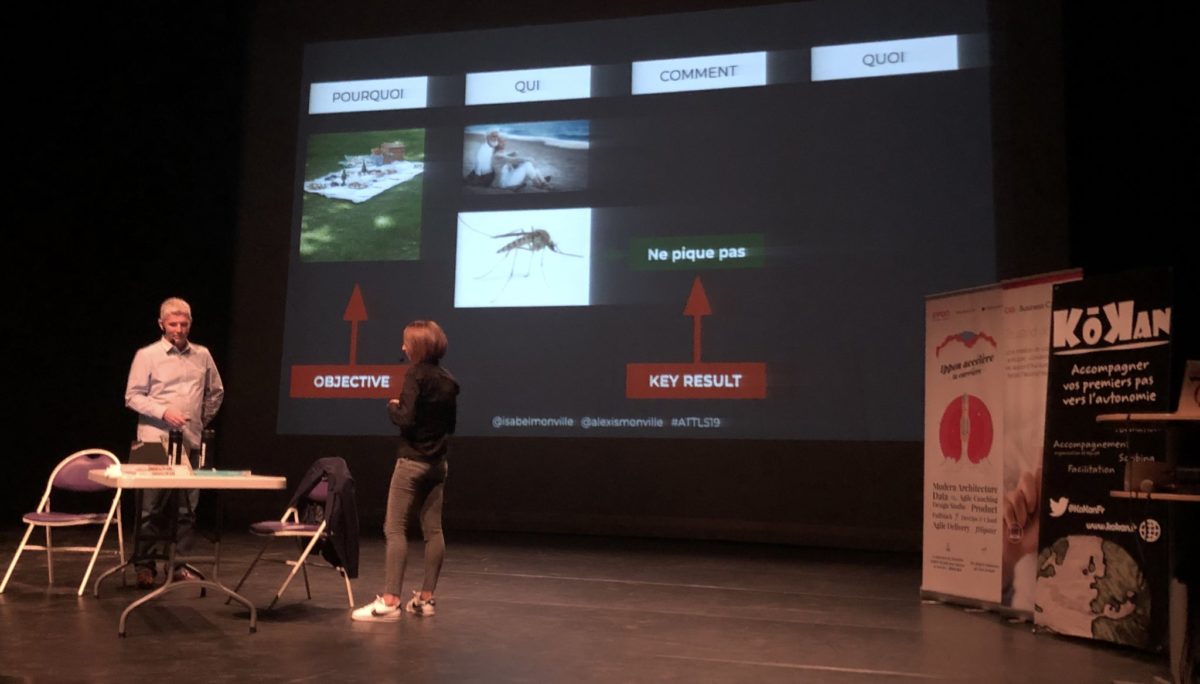
I had the great pleasure of giving four keynote speeches this fall. I already told you about the keynote I gave in Bordeaux for AgileTour in this post. The three others are really special to me. We did those addresses with my wife.
Last year, I was invited to speak about Changing Your Team From The Inside in Grenoble and Rennes. After the conferences, Isabel and I had a great dinner with Aurelien, Celine, Chris, Nelson, Benji, and Jerome. All of them happen to be conference organizers. And they asked us if we were giving talks together. Even if we worked together for quite some time when we had our management and organization consulting and coaching firm, but we never gave talks together.
One of them said that if we were to prepare something, it would be probably worth a keynote. And as all the others were enthusiastic about the idea, we decided to give it a try.
Of course, we went through our ups and downs in preparing the keynotes. But in the end, we were happy with the result! The feedback was way above what we were hoping for! Thank you!
The three keynotes were, of course, each a little bit different. This was influenced by a lot of factors like the location (being in a real theater in Toulouse was much better for us, for example) and, of course, by our own experience, you know the drill, the more you practice, the luckier you are.
The talk, about Individuals and their interactions, is structured in three acts and a conclusion. Each act is composed of a role-play of a situation, followed by a debrief to consolidate what we learn from the story.
Here is the recording of the last one we gave in Grenoble!
One of my colleagues noticed that I take all my notes graphically and asked me for resources on how to start. I am far from being an expert, and I am not doing as beautiful drawings as the experts will do, even if I am taking notes this way for more than ten years.
Having a beautiful result is, of course, something that I would like to have, but this is not the most important benefit I see with the practice. Among those benefits: the connection of ideas with each other, the ability to have a whole meeting on one page, see when people are tempted to go back to a previous agenda item (it could be a sign that the topic was not closed properly and there are still things to be discussed)…
How to start?
First, you have to be comfortable with your tools and be satisfied with an imperfect result.
I started by using just sheets of paper. I think I was not comfortable to waste a page in my notebook, speaking of being satisfied with an imperfect result… I then moved to a small notebook, and then a large-high-quality notebook. I loved the feeling of the pen gliding on the paper on those notebooks! Then I switched to a reMarkable tablet which gives me the ability to have topics dedicated notebooks. Really useful to have the ability to go back one page to have a look at the notes of the previous meeting on that topic.
Once you have tools, you are ready to start. To make sure I am clear, a pen and paper, and you are ready to start!
Have a look at how a mindmap works. The mindmap approach will give you one way to use the space until you invent your own way.
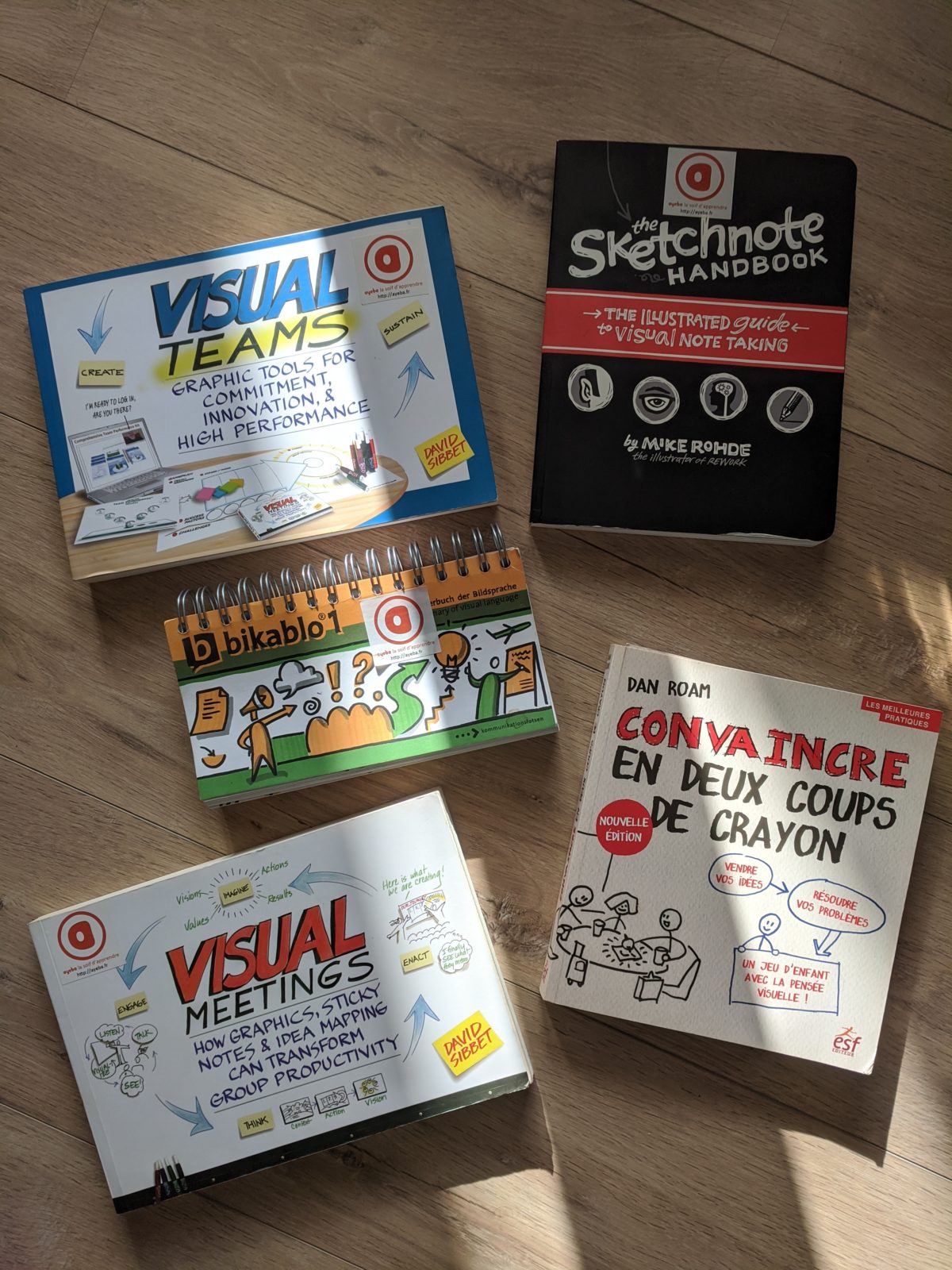
Then you have to increase your graphic vocabulary.
My preferred book for that is Bikablo. Those other books are also useful (ranked in order of preference):
In the end, there is no magic, and you have to practice! Every day!
One way to get started is to draw TED Talks. TED Talks are very well structured talks, so you will be able to get clues on how to use the space early in the speech. Furthermore, you can start with the shorter ones.
One year and a half ago, I noticed that my daughter was using an app to improve her Spanish and her English. Of course, there is an app for that! There are even several apps!
The one she was using is Duolingo. I decided to give it a try and started learning Spanish from scratch. Over the last year, I observed multiple evolutions of the application meant to motivate people to stick to their practice and continue using the app.
One evolution they introduced lately is “division”. You start in the “bronze” division. A division is a group of 50 people. Over the week, the first 10 of them will go to the higher division, the “silver” one. Once you reach the “silver” division, the first ten can go up, and the last five are relegated to the lower division. The number of XP (eXperience Points) you gain during the week defines your ranking. You can gain XP by attending a lesson, and how successful you are during lessons.
Of course, with 300 million learners, you can imagine that there are several “bronze,” “silver,” “gold” divisions running in parallel. But it seems it does not affect the behavior of the learners. I realized quickly my habit of doing three lessons per day got me immediately to the top of the first divisions, but after a few weeks, it was harder to get to the top 10, and I needed to increase my practice. So, it worked… And now, to stay in the current division, I need to do a little bit more than three lessons a day.
Of course, I am doing it every day to keep my “streak” 🙂 Another incentive to help you keep up with the habit!
I saw a lot of content management systems that are ranking the top contributors. The problem is that when you are a newcomer, the top is something inaccessible so it cannot motivate you to do anything. The weekly top could also be unreachable, so maybe divisions could solve that problem?
Why do you want people to contribute, and how useful will be their contributions remain questions you will have to answer.
How does it work with my learning of Spanish?
I keep up with the practice, and I was able to understand a lot of things during my last travel to Spain. But I am not yet comfortable enough to speak. Compare to my starting point, the progress is enormous for just a few minutes invested each day.
By Mapto – Own work, Public Domain, https://commons.wikimedia.org/w/index.php?curid=2690261
The project management triangle is a well-known model showing that the quality of the delivery is constrained by the budget, the deadlines, and the scope. The idea is that it is possible to trade between constraints: ask for an earlier delivery with a smaller scope, for example. And If you don’t trade, then the quality of the delivery will suffer.
During a discussion with a team, one of the team members brought that the way they were working was damaging the quality of the product and its long term maintainability. His point was that the fixed set of features (scope), associated with a 3-months deadline for the release, without changing the team, was blocking all the constraints, so the only thing that could vary was the quality.
I have to admit that I was totally in agreement, and while he was talking, I draw the well-known triangle on the whiteboard of the meeting room.
Another team member surprised us by stating calmly: “I always disagreed with that triangle. There is another variable that is not taken into account.”
He got all our attention, and finish his sentence: “The other variable is the effort that you are willing to put into the project.” Two other team members approved immediately in support of that claim. The other team members said nothing and did not move, probably waiting to see where that discussion would go.
After a quick glimpse at the only person in the room who seemed to disagree with that claim, I tried to explain that you could envision that the people could work longer hours, increasing the capacity of the team artificially without changing the cost, but that it will not be sustainable and there was an invisible cost to that burst. A debt that the team will have to pay later. Furthermore, after several days of working long hours, I was pretty sure that the quality would suffer anyway.
I tried to argue that pushing your “best” individuals to deliver could get short term results, but will also damage the ability of the people to collaborate, to support and help each other, to onboard new people in the team, and so on.
They continued to disagree explaining that some people were able to work for a longer time, with a strong focus on their work without damaging the quality of their delivery. This was the “effort” they wanted to celebrate and incentivized.
So do you think we should add “effort” as another dimension to the project management triangle?
In the documentary, I Am Not Your Guru, released in 2016, Performance coach Tony Robbins proposes an interesting exercise. Imagine your life in the near future. If everything goes well in three years, how much will you make a year?
Don’t read further until you have the figures.
When you get the amount, multiply it by three and imagine what you are doing to deserve such compensation?
Inspiring?
No, it’s not all about money. Money is a by-product of our actions, and if money is not what you want to visualize, pick something meaningful to you.
I would be happy to hear what you think of the exercise!



 One year and a half ago, I noticed that my daughter was using an app to improve her Spanish and her English. Of course, there is an app for that! There are even several apps!
 Of course, with 300 million learners, you can imagine that there are several “bronze,” “silver,” “gold” divisions running in parallel. But it seems it does not affect the behavior of the learners. I realized quickly my habit of doing three lessons per day got me immediately to the top of the first divisions, but after a few weeks, it was harder to get to the top 10, and I needed to increase my practice. So, it worked… And now, to stay in the current division, I need to do a little bit more than three lessons a day.