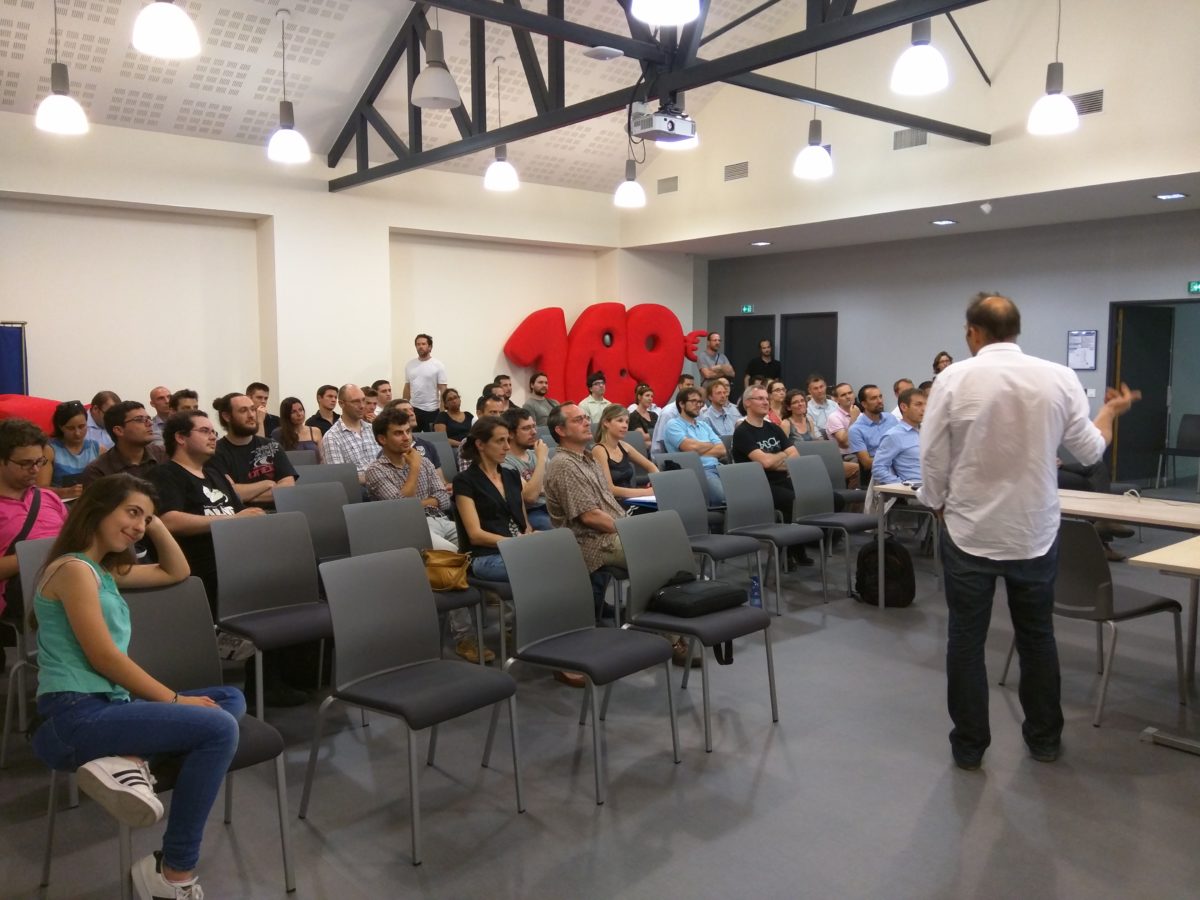
Une nouvelle édition du ScrumWine s’est déroulée le jeudi 4 juin 2015. Nous étions pour l’occasion accueilli par CDiscount. Je remercie au passage Isabel pour l’organisation et adresse toutes mes félicitations à Damien Tourette, papa depuis la veille ! Notre hôte, Lionel Richer, expliquait dans son introduction que malgré une découverte récente de l’agile, 60 personnes travaillaient à présent en agile et que le bénéfice du rapprochement des métiers et des équipes de développement était remarquable.
Les actualités ont permis ensuite de mettre en avant les prochains événements consacrés à l’agile. Agile France bien sur, programmé pour les 18 et 19 juin, et pour lequel j’aurais le plaisir de donner une version courte et en français de ma conférence sur le bonheur au travail (Happiness is Coming). ALE 2015 qui se déroulera cette année à Sofia, toujours au cours de la dernière semaine d’aout, évènement remarquable puisqu’il inclut époux et enfants, ce qui augmente le niveau d’énergie positive de l’événement. Je termine par une mention pour AgileTour Bordeaux qui a annoncé la date de la prochaine édition pour les 30 et 31 octobre 2015.
Olivier Patou a relevé avec succès le challenge de la présentation en 5 minutes avec une présentation sur les histoires utilisateur : Comment faire de bonnes User Stories ?
Le programme proposait ensuite 2 sujets en parallèle :
– de l’OODA loop à l’innovation collaborative par Emmanuel Henriot, session qui a reçu un très bon accueil, et j’ai donc essayé de convaincre Emmanuel de la proposer pour AgileTour Bordeaux, car je n’ai pu y assister… puisque je proposais aux participants de jouer à :
– Lego4Devops, un jeu simulatif utilisant les mêmes boites de Lego que le célèbre Lego4Scrum et dont j’avais participé à la mise au point lors de la dernière édition de Agile Games France. La version 1.0 est donc bien jouable sur un temps court, moins de 60 minutes, mais il semble préférable de pouvoir y consacrer plus de temps afin d’être moins pressé pour les explications initiales et avoir l’opportunité de réaliser plus d’itérations. Nous avons eu la possibilité d’avoir 2 équipes de 7 joueurs en parallèle, ce qui nous a également permis d’identifier de nombreuses possibilités d’amélioration. Nous sommes en train de compiler de façon collective ces idées d’amélioration afin de les proposer pour une prochaine version. Merci à Christophe Héral pour avoir contribué à la facilitation du jeu, et bien sur merci à tous les participants !
Rejoignez le groupe pour poursuivre la conversation et construire la prochaine édition :
https://groups.google.com/forum/#!forum/sug-bordeaux
Author: Alexis
-

ScrumWine #15.2
-

Happiness level during your last quarter
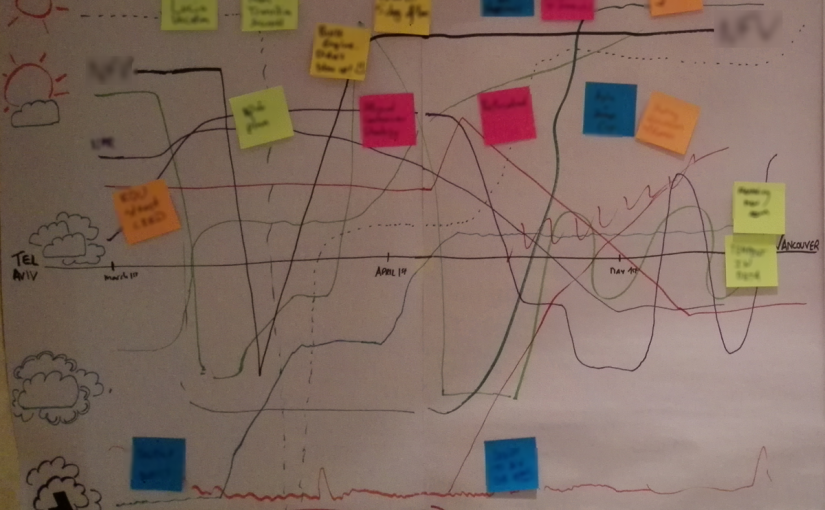
Two weeks ago, I facilitate a quarterly meeting of a distributed team. They met in person only once a quarter during this meeting.
I chose to start the meeting with an exercise to share their feeling about the last quarter. I asked:
Can you draw a line representing your happiness level during this period?
The levels are represented by weather symbols that make them more understandable for the people of this team who are coming from several countries in the world. They almost all chose to comment the drawing when they were drawing the line, and when they were not, I asked them to comment, and after that I thank each of them for sharing.
I was amazed by the amount of information shared during this simple exercise about their general feeling about their work, what make them tick from holidays to specific achievements, learnings, relation established with other people and so on…
I feel also that the state of mind of the whole group was best prepared to review the results achieved during the last quarter.
On the second day, in front of the drawing, I start by thanking them again to have shared their feelings about the last quarter and I asked them to use one or two post-it notes to answer this second question:
What are you proud of?Once again, a good question to understand what’s important for the individuals in the team, and a good way to set the stage for the day.
If you try this, I would appreciate your feedbacks.
-

Self-driving cars and basic income
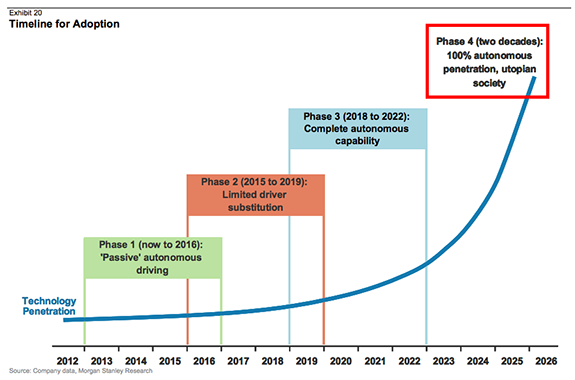
In 10 to 15 years, self-driving cars will be a reality in our world. It means that, people transportation and goods transportation will be done by those self-driving cars and trucks. The positive consequences are numerous and will be highlighted by manufacturers and service providers, like the possibility to order your vehicle from your phone and your computer. We will be able to remove traffic lights, and there will be no more (or less) traffic jam, less car accident…
We have seen with the emergence of Uber and other apps that can help you to order a car with chauffeur that the market was disrupt heavily. Imagine just one second that the car you will order with Uber will be self-driving ones in a few years from now.
In one article published on Medium, Tanay Jaipuria, questioned the decisions that will be made when it will come to the programmation on those robots. Isaac Asimov covered a lot of complex cases in his novels, now it’s reality…
One of the consequence of those self-driving cars will be unemployment of millions of people that are taxi or truck drivers. It’s not so easy to find the exact number of truck drivers in the world. More that 3.5 million in the US, so I suppose that there are more in Europe and Asia, as the number of truck registrations is 50% higher in those areas.
Millions of unemployed people that will not so easily find a new activity.
We can say (or think) that it’s not our fault or our responsibility. I believe that we should care about this problem and put in place an unconditional basic income for every people that will cover the basic needs, and give time to people to find an activity that can suit them.
A basic income is an income unconditionally granted to all on an individual basis, without means test or work requirement. More information can be found here.
-

Don’t change my mindset, I am not that open
Nick Barcet and I were schedule for the last talk session of the Openstack Summit in Vancouver (Of course, design sessions will continue on Friday).
When we submitted the proposal for this session we were looking for a way to help our co-contributors to the openstack project.
The way we think it can be the more helpful was to share our way of working together to foster change in the organizations of the customers we work with.The recording of our session has already been published by the Openstack Foundation, and is available here:
Our slides are available there:
Your feedbacks are welcome to continue the conversation!
-

Bridges and Hierarchy
Mark McLoughlin delivered the Red Hat Keynote, on the morning of the second day of the Openstack Summit in Vancouver.
During the afternoon, he delivered a more intimate talk about the governance of the Openstack project.
The main idea is that, the new Big Tent organization model will allow the emergence of new projects, and it can be the time to redefine the main values that will help the project contributors to take the good decisions.Mark started his talk refering to the Keynote Eben Moglen gave in Auckland at LCA 2015. In this keynote, Eben Moglen explained that the hierarchical organization model that we all know very well, is the model of the 20th century, and that the organization of the 21st century will be based on transparency, participation and non-hierarchical collaboration, like it is in free software.
Mark continued his introduction with a reference to Andy Hunt’s blog post, The Failure of Agile. Andy Hunt is one of the original writer of the agile manifesto, so when it came to discuss agile, we can at least consider him seriously. The main point of this article is that a lot of people lot’s the agile way by focusing on a set of practices, forgeting the agile values and principles. They are focused on doing agile, and they forgot that depending on your experience, if your are a beginer in a practice, you need clear directives to learn how things work, and more and more your skills are developing you will need coaching on the go, and then you will need some support, and then you will be fully autonomous and during this journey you will have adapted the initial set of practices living the agile values and principles.
That reminds me the stickers I had printed for an agile conference:

When I recieved the stikers at this point, I was thinking… humm I should have crossed also “be” and put “learn” instead… because this is really what we are doing here…So Mark proposed those 4 high level ideas that can become the high level principles we can refer to as an Openstack contributor :
diverse interests, but a shared vision, based on consensus
individuals and interactions over processes and tools
leadership through empowerment, empathy and trust
every advance must ultimately iterate from the bottom upAnd I encourage you to watch the talk to understand the details of his proposal.
-

Happiness is Coming
I had the great pleasure to deliver the opening keynote of April 17, 2015 of the Drupal Developer Days in Montpellier. The selected theme was Happiness…
Here are the slides:
And a selection of tweets:
In 5 minutes, @alexismonville already make an entire room smile and laugh at #drupaldevdays ! Happiness is at rendez-vous !
— GoZ (@GoZOo) April 17, 2015
Great keynote about #happiness by @alexismonville at #drupaldevdays
— Blootips (@blootips) April 17, 2015
And now @alexismonville is talking to us about happiness at work! #drupaldevdays pic.twitter.com/UshK5Y7HWW
— Morsok (@Morsok) April 17, 2015
Very inspiring keynote by @alexismonville on happiness! Thank you for that! #drupaldevdays
— Johannes Haseitl (@derhasi) April 17, 2015
Thank you for your great feedbacks and for the great conversations that followed!I feel ready for the next DrupalCon 😉
-

The DevOps Opportunity
In the beginning was the session of John Allspaw and Paul Hammond during the 2009 Velocity Conference, showing how cooperation between Dev and Ops at Flickr allows 10 deployments a day (Header image of this post is extract from this presentation, and it shows how Leonard Nimoy was important for us even if I started this post on February 6th and forget about it after…).Following that, there was the first DevOpsDays conference in Gent at the end of 2009.Behind the promise of reconciliation between evolution and stability objectives, reconciliation between devs and ops, some saw technological solutions enabling to shorten the lead time of go lives, and even to go live without human intervention.Others saw the opportunity to realize the promise of the last 20 years of the agile movement (yes I start to count at the beginning of the discussions about the lightweight project management method and the emergence of XP… already 20 years…).
Others questioned the skills that sys admin will need to acquire to be able to consider infrastructure as code.Others imagined that the devs will need to change and acquire a good understanding of the behavior of their code in production, that they must integrate exploitation constraints into their code, like the ability for their apps to react to failure, to scale in or scale out, the ability to update or upgrade without services interruption…Others thought that the change should be from the entire system, that we need to reconsider the way we envision software evolution, and information system evolution, looking at it feature by feature – using not only the idea of Minimal Viable Product (MVP) at the beginning of a project but the idea of Minimal Marketable Feature (MMF) during all the lifecycle of our information systems.Others thought that cloud technologies was an enabler to our way to envision information systems, and obviously others are working on those technologies to enable those transformations.Others argued that if they want to recruit new people in their team they need to transform their organization because new generations will not accept the constraints of silos that prevent collaboration.All those point of views demonstrate the complexity of the devops subject and the impact on different domains in the organization: tools, method, organisation and culture.It was really interesting to observe the diversity of all those views during the Devops CIO’s breakfast organized by Red Hat in Paris on February 6th, my role was to shed some light on the subject and to facilitate the discussion between participants.Now that eNovance is part of Red Hat, the challenge to transform organization’s culture (internally and externally) continue with the Red Hat Cloud Innovation Practice and the size effect and open source culture allows exiting discussions with my peers. -

Club de Lecture
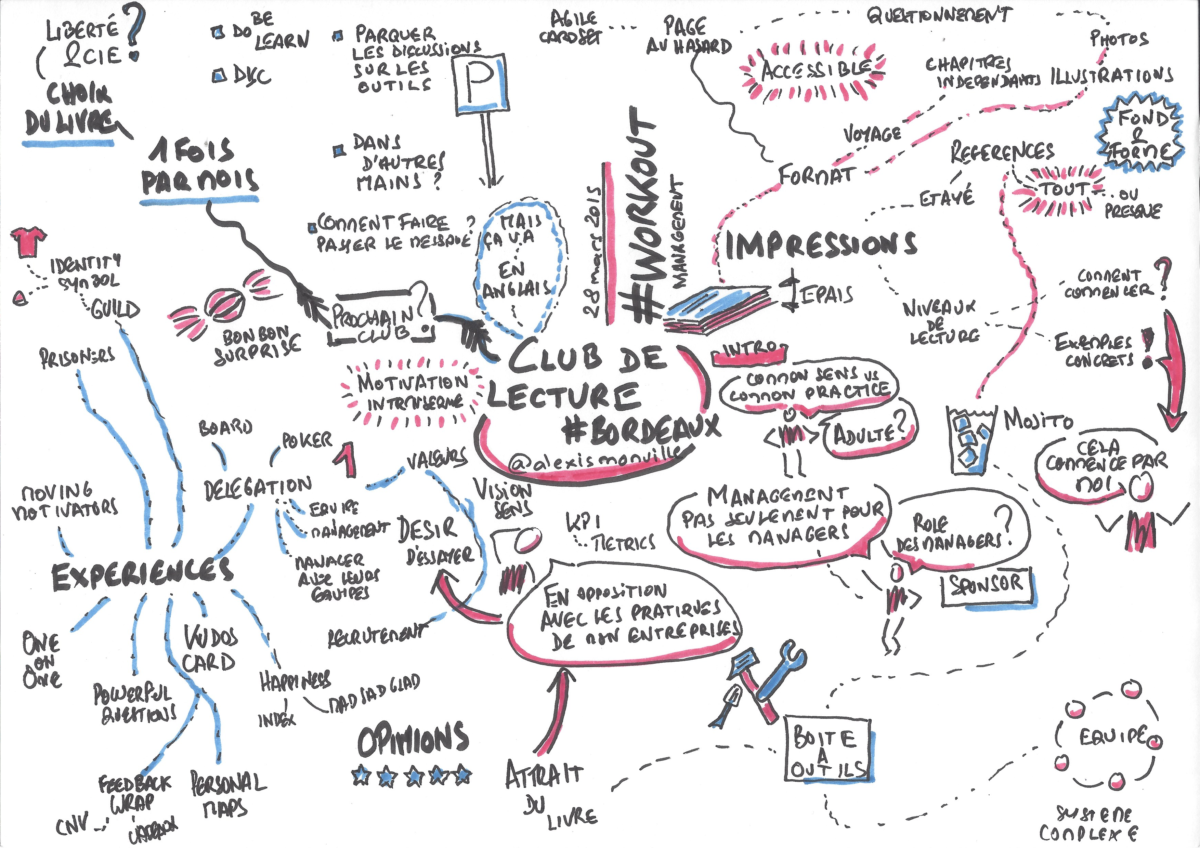
Une session du Club de Lecture de Bordeaux s’est déroulée ce samedi 28 mars 2015, de 10h30 à 12h00. L’idée de proposer cette session m’était venu suite à la participation au club de Toulouse que j’ai raconté ici.
1er RDV du Club de lecture #Bordeaux initié par @alexismonville avec le livre #management #workout de @jurgenappelo pic.twitter.com/vOX9yhUJpD
— Guillaume Commagnac (@GuillaumCo) March 28, 2015
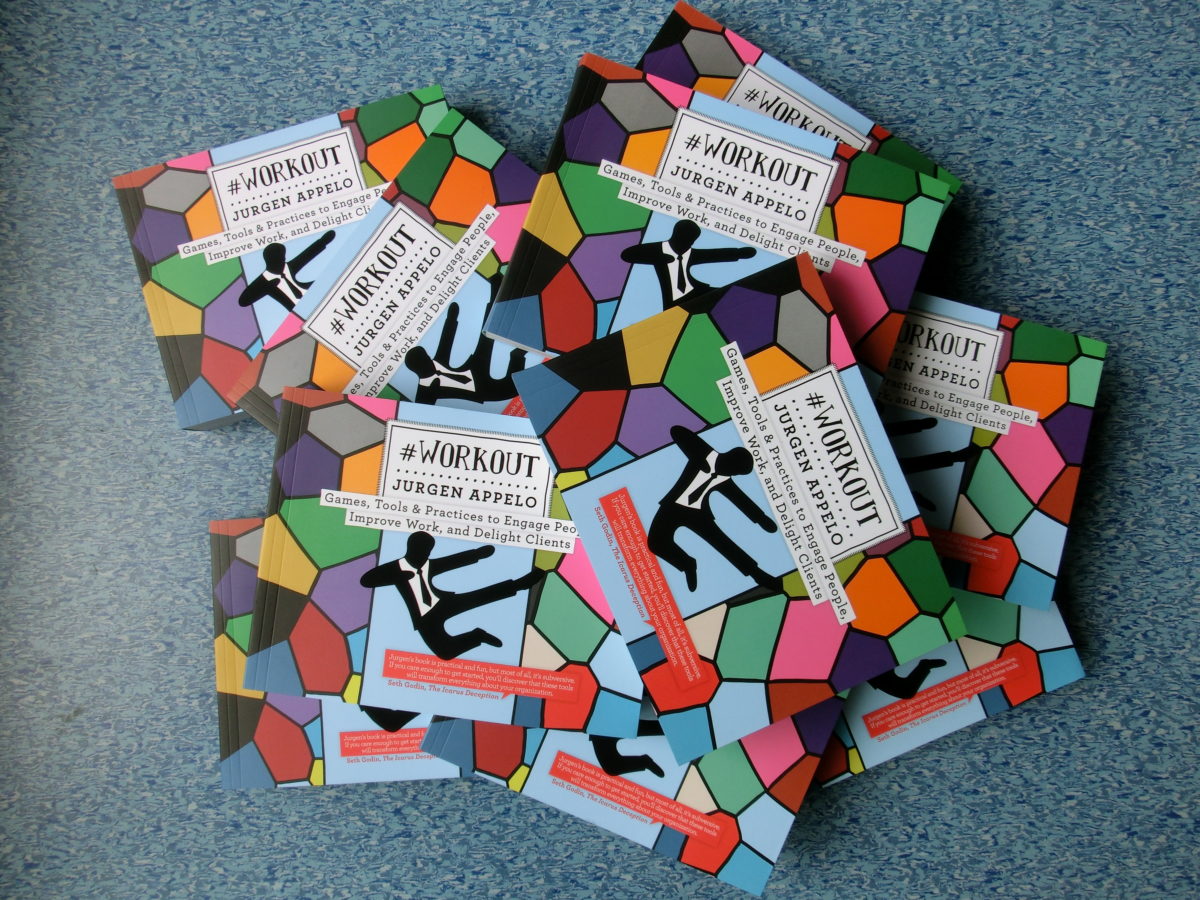
Isabel, Claire, Guillaume, Olivier, Patrick, Philippe se sont joints pour raconter leurs impressions, opinions, expériences en rapport avec #Workout, le dernier livre de Jurgen Appelo.
J’ai trouvé cette heure et demie très courte. Les échanges étaient très riches. Le format, la qualité d’impression, le choix des illustrations contribuant autant à la forme qu’à la réflexion sur le fond, sont des points communs remarqués par l’ensemble des participants.

Les notes de lecture de Claire Ils ont également notés que ce livre sur le management est accessible à tous… et même à mettre dans toutes les mains pour transmettre le désir d’essayer d’envisager les choses autrement.
Les idées proposées dans le livre sont étayées (ce qui permet de les transmettre plus facilement), illustrées d’exemples, associés à des références qui font dire aux participants qu’il y a tout (ou presque tout) dans ce livre (agile, coaching, management, communication…).
La possibilité d’adopter une lecture linéaire, en fonction du sujet recherché ou même en laissant faire le hasard fait de ce livre une référence à long terme.
Les participants avaient tous expérimentés au moins une des pratiques proposées dans la livre : guild, identity symbols, motivators, delegation poker ou board, powerful questions, feedback wrap, personal maps, happiness index, feedback door… Certaines pratiques restent “à essayer” : formule pour le salaire par exemple.
La suite du Club de lecture ?
Pour choisir la date : http://doodle.com/k7nfnwtchnzzz8zs
Un board Trello pour proposer et choisir les livres: https://trello.com/b/FIsc7Xf7/club-de-lecture-bordeaux
Le principe est :
- de proposer des livres dans la colonne idée,
- les livres recevant plus de 3 votes sont sélectionés
- le livre ayant le plus de vote au moment du choix est retenu comme prochain livre du club
-

World Happiness Day
March 20th, it is World Happiness Day.
I am writing this short post listening to Happiness Sounds Like playlist.
What recommandation for this day?
Maybe follow some of the suggestions of The Year of Happy and learn things about happiness that can surprise you? Or maybe follow on your pace the UC Berkeley course about Science of Happiness? Or one of those of the DayOfHappiness website summed up on the image on the right?Or even simpler, smile to those your will cross today?
I close with an announcement, I am happy to announce that I will deliver a keynote on happiness during the Drupal Developer Days at Montpellier on April 18th.
The header image came from here.
-

Le Bonheur au Travail
Au mois d’octobre 2013, je vous avais proposé de devenir producteur du film “Le Bonheur Au Travail” de Martin Meissonnier.
Le film a été diffusé hier, mardi 3 février 2015, dans les locaux d’eNovance (Red Hat) à Paris pour une avant-avant-première (c’était la contrepartie pour notre contribution au financement du film sur touscoprod.com).Le film est passionnant et regorge d’exemples excellents montrant ce qu’il est possible de faire lorsque l’on commence par la confiance. Certaines entreprises sont évoquées dans le livre d’Isaac Getz, Liberté et Compagnie, conseiller scientifique du film.
Les échanges avec le réalisateur qui ont suivi la projection était très intéressant. Un grand merci à lui de nous avoir offert ce moment !
Je ne vous en dirais pas plus pour l’instant, mais je vous encourage à participer aux journées du bonheur au travail les 12, 13 et 14 février.
Et bien sur, à noter dans votre agenda de regarder Arte le 24 février à 20h50 pour la première diffusion du film en France.
-

Management 3.0 #Workout
Lorsque Claude Aubry a publié cet article à propos du site du club de lecture de Toulouse, j’avais déjà en projet l’idée de lancer un club de discussion. Je m’étais donc dis que c’était une nouvelle bonne raison de le faire.
La réunion du Klub de Toulouse se déroulait lundi 2 février, le livre du jour était #Workout de Jurgen Appelo. Les participants ont accepté que je m’invite à cette réunion en me connectant à distance en video-conférence.
Un grand merci donc à Marie-Josée, Nathalie, Jean-François, Cyrille, Jean-Pascal et Claude pour leur accueil sympathique.
Comment cela se passe ?
La facilitation de Claude est discrète et efficace, il lance une question à laquelle les participants répondent le temps d’un tour de table. Les questions sont par exemple : « quel lien feriez vous avec l’agilité ? », « pensez-vous que le type de management proposé dans l’ouvrage devienne « mainstream » ? », « quels sont les pratiques que vous avez expérimentées dans vos organisations ? ». J’imagine que les participants sont habitués à l’exercice. Le temps de parole se réparti harmonieusement, les éléments issus du livre et de l’expérience se complètent avec équilibre.
Concernant le livre en lui-même, les participants ont apprécié #Workout. Ils ont apprécié les explications simples, les illustrations issues de l’expérience, les propositions d’exercice de mise en pratique avec une équipe ainsi que les nombreuses références.
Ils ont également apprécié les nombreux arguments permettant de diffuser le message vers différents publics.
Vous pouvez retrouver ce livre ici : http://www.management30.com/workout en version gratuite ou commander une version payante.
Le force du Klub est de pouvoir profiter du regard des autres, de voir ce qui les intéressent et qui parfois m’avait échappé. Un exemple : je n’avais pas remarqué qu’à la fin de chaque chapitre, il y avait une page de références… Bien sur, avec le livre sous les yeux, j’ai été étonné de constater cela lorsque quelqu’un a abordé ce sujet
Cette expérience très agréable me motive pour proposer un club de lecture à Bordeaux, je propose que ce soit un samedi et que le premier livre soit également #Workout de Jurgen Appelo.
Je vous propose donc de prendre le temps de la lecture du livre et de nous retrouver soit le samedi 14 soit le samedi 28 mars entre 10h30 et 12h00. Le Doodle suivant permettra de choisir la date : http://doodle.com/ttdm3t283m2k4kwz
-

Assess Me If You Can
A friend asked some help with an HR assessment spreadsheet he had to fill in. This spreadsheet was intended to prepare the budget for next year raises and bonuses.
In one of the columns, he must write if the person was underachieving (C), on average (B), or above average (A). He obtained the following result: 11 A, 15 B et 4 C. The next instruction was to split the people equally into those categories (10 for each in his case). So 1 person in A should go in B, and 6 from B should go in C.
The problem was that the budget will probably be reduced for the people in B and C categories, and he will have some troubles to give compensations according to his own evaluation.
Moreover, he wanted to have a transparent evaluation system to help the skills development of his team, and he anticipated that the transparent system would reveal the iniquity of the system.
The trick was there, calculate the global budget needed for the team, and twist the information in the spreadsheet to obtain the budget.
Toward another system?
The initial intent of “human resources” to anticipate compensation problems that could lead to people departure is good. The initial intent to encourage the managers to assess the skills of their teams is also good. But the instruction to divide the team by third leads to falsification. Combined with the idea of a fixed budget for the year it can leads to numerous other problems.
We can design another system where the budget and individual assessment are two different things.
Some companies decide to allocate a part of their results to raises. They compare the compensation and benefits of their employees to others in similar industries. And then, they will decide the evolutions according to those datas and people desiderata. (Poult goes further with a compensation committee… I will write something about it in the future).
Peer evaluation
I experiment with a team a system that combine a self-assessment and a peer-assessment. There were only three criteria: Technique, Method and Behavior.
Each team member evaluate himself and the other team members on a scale from 1 to 10 for each criteria. He indicates in comments the observables facts sustaining his evaluation.
Those comments were reviewed with the manager and the coach to improve observation and feedback skills, and to reinforce the team talent development ability.
Then, each team member reviewed all the evaluation collected with the manager and the coach, defined one or several improvement actions that were displayed on the team board. An improvement time was allocated during each sprint to each person.
One of the team member was known to react very negatively to some news affecting the product development. All the team was down in a negative spiral and experienced troubles to get out of it. This exercise helped this person to be aware of her behavior and the effect on the team, she asked for help to other team members that should told her if it was happening again. The first time I hear one of the team members, rather shy usually, ask her: “How could you view this differently?” I feel that we were really starting to change.
Header picture is from Wikipedia.
Picture “Measure Your Life In Love” is from Quinn Dombrowski (Creative Commons).