We’ve all been sold the same dream: “Be Agile.” We start with a small, scrappy team where everyone finishes each other’s sentences, and the magic just happens.
But then, success hits. You grow. Ten people become fifty. Fifty become five hundred. Suddenly, those “individuals and interactions” you valued so much have turned into an endless calendar of “sync meetings” that leave everyone exhausted and nothing actually… synced.
The hard truth? At scale, the very things that made you Agile start to break you.
In the latest episode of Le Podcast on Emerging Leadership, I sat down with Fabrice Bernhard, co-founder of Theodo and co-author of The Lean Tech Manifesto.

Fabrice has lived this. He helped scale an organization from 10 people to over 700. He realized that the four core values of the Agile Manifesto have a “scale issue.” It’s not that Agile is wrong; it’s that it wasn’t designed for the weight of a 100-million-dollar organization.
To survive growth, you don’t need more “Agile ceremonies.” You need Lean Tech.
In most corporate cultures, a “problem” is a bug—something to be hidden, fixed quietly, or blamed on someone else.
In a Lean Tech organization, a problem is a feature of growth. Fabrice argues that the goal of a leader isn’t to have all the answers, but to build a Learning Organization. This requires a radical psychological shift:
- Hiding a problem is the only true failure.
- Showing a problem is an act of service.
- Analyzing a problem is the core work of a leader.
When we reframe our technical hurdles (like a monolithic codebase) as communication hurdles, we stop fighting the technology and start re-architecting the human system.
One of the examples Fabrice shares is the “API Mandate.” When Amazon faced scaling gridlock, Jeff Bezos didn’t ask for more meetings. He asked for fewer.
By forcing teams to interact only through tech-enabled interfaces (APIs), they created a Tech-Enabled Network of Teams.

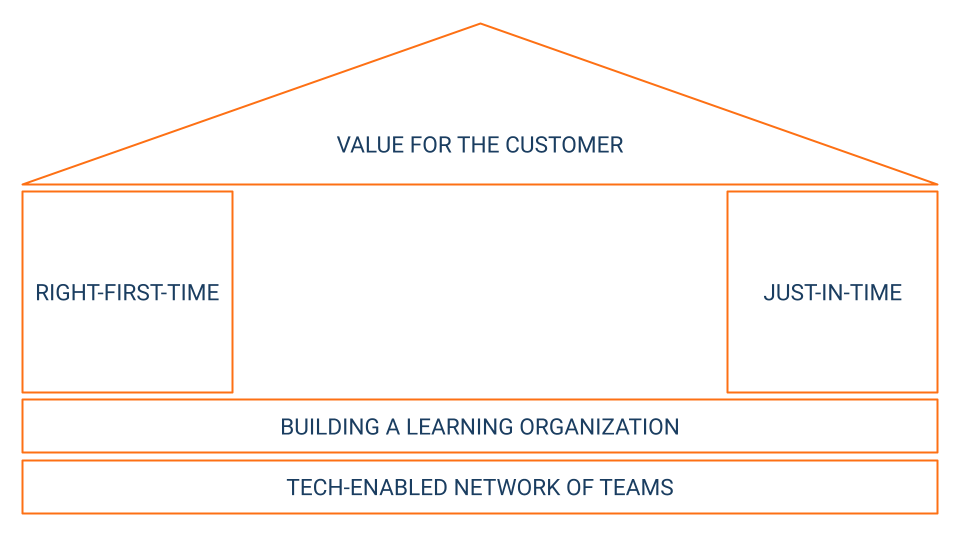
To scale successfully, you need to align your leadership with the five structural elements of the Lean Tech House:
- Value for the Customer (The Guiding Star): Move beyond simple “collaboration”. Leaders must work tirelessly to clarify what “value” actually looks like for the whole organization so that every team can align their autonomy with a shared goal.
- Right-First-Time (The Quality Pillar): This is the ideal of perfect quality. Instead of rushing to “move fast and break things,” aim to detect and analyze defects as early as possible—such as through unit testing or precise specifications—to build long-term intuition and speed.
- Just-In-Time (The Flow Pillar): Fight the urge to work on multiple features in parallel to “feel” productive. Focus on single-piece flow, delivering small increments of value quickly to get real feedback and reduce the waste of half-finished work.
- Building a Learning Organization (The Cultural Foundation): Create a culture where raising a problem is a positive act and hiding one is discouraged. This is grounded in a culture of problem-solving, where leaders teach skills rather than just providing solutions.
- Tech-Enabled Network of Teams (The Technical Foundation): You cannot achieve agility on top of a messy architecture. Use technology—like APIs or modular design—to enable teams to work autonomously without needing constant, bureaucratic synchronization meetings.
The Kanban Mantra:“Stop starting, start finishing.”
If your team is struggling with “Agile fatigue,” look at your Work In Progress (WIP). Parallel work is a lie we tell ourselves to avoid the difficult conversations that collaboration requires.
The Gold: Scaling isn’t about adding more layers of management; it’s about removing the “waste” that prevents value from flowing.
The Coaching Prompt
Ask yourself (or your team) these three questions this week:
- “What is the most uncomfortable problem we are currently pretending doesn’t exist?”
- “If we could only work on one thing this week to deliver value to the customer, what would it be—and why aren’t we doing that?”
- “When was the last time I ‘went to the Gemba’ (the actual code, the actual customer call, the actual workshop) instead of just reading a report about it?”

Want to hear the full deep dive? You can listen to the full conversation with Fabrice Bernhard on Le Podcast on Emerging Leadership right here.
You can also listen to new conversations on Le Podcast on Emerging Leadership wherever you already get your podcasts. Just pick your favorite platform and hit “subscribe” so you won’t miss any new episodes:
- Apple Podcasts
- Spotify
- Castbox
- Amazon Music
- RSS Feed
And if your favorite platform isn’t on the list, just let me know, I’ll be glad to add it.
I’d love for you to join me there! See you in your earbuds!